Kenaz Rune Meaning: The Torch, the Opening, the Controlled Flame
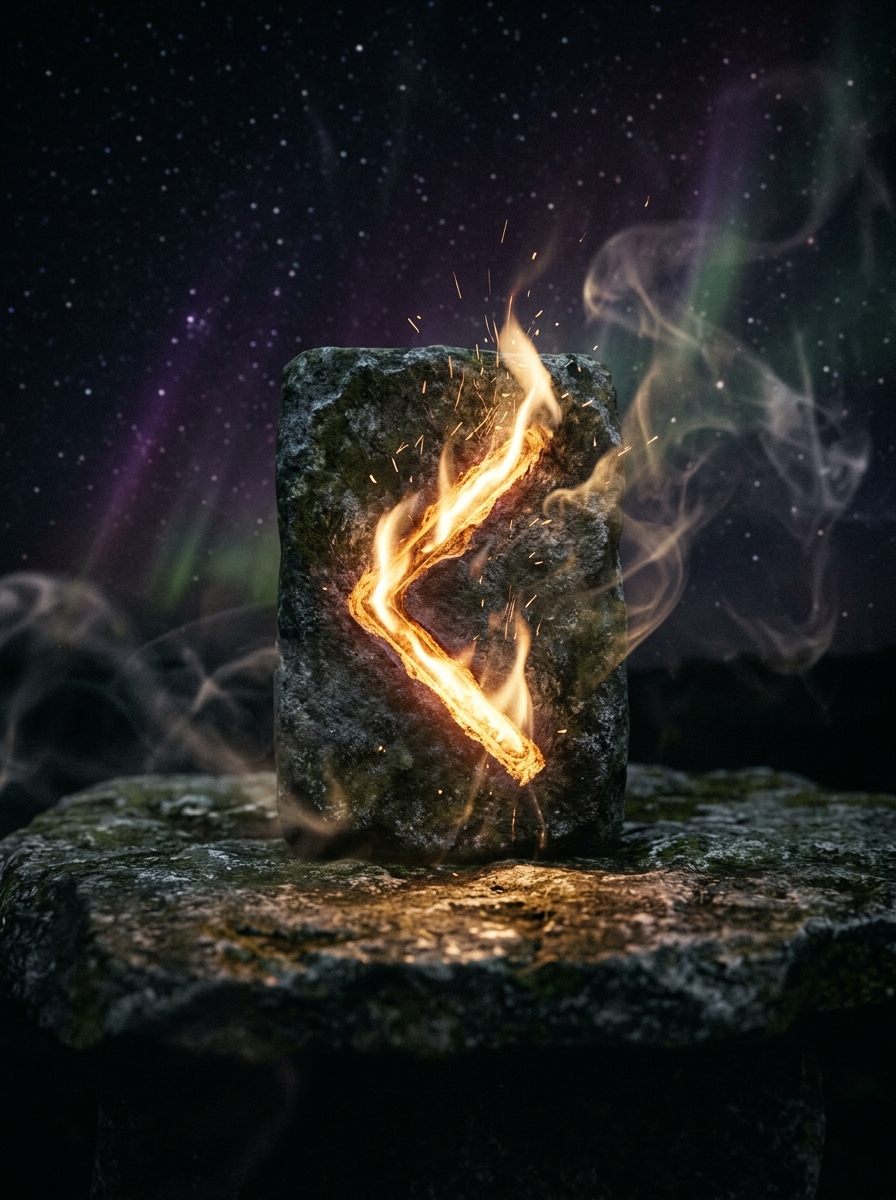
Kenaz is fire with a handle
Kenaz is the rune of directed fire: the torch, the lamp, the forge-flame you can hold without being consumed. Its name, often glossed as “torch,” matters because the image is not abstract brilliance but a deliberately carried light—illumination that can be aimed, tended, and passed from hand to hand. In divination, Kenaz does not announce “inspiration” and stop. It marks the moment inspiration becomes legible enough to shape into craft. The thought sharpens. The hidden thing shows its edge. The problem becomes nameable.
This distinction is the heart of the rune. Kenaz is not lightning from the sky nor the steady sun at noon. It is fire at human scale: intimate, vulnerable, useful. It lights the room selectively—exposes some things, leaves others in shadow. That partiality is not a weakness; it is the condition of discernment. A torch does not reveal the whole landscape; it reveals what needs to be seen now for action to become possible. Kenaz therefore carries a double truth: illumination is power, and illumination is partial. The rune has no interest in total revelation. It asks what, exactly, must be visible in this moment for you to proceed.
The psychological root: from projection to craft
Psychologically, Kenaz corresponds to the moment when unconscious content becomes available as usable image. In Jungian terms, it is the lamp held up to the unconscious—not a flood of raw material, but a focused beam that lets you recognize what belongs to you. What was projected onto another person can be reclaimed as your own fire, fear, or longing. This is not a gentle process, but a liberating one. Kenaz frees by making distinction possible.
This is why the rune is the natural ally of the apprentice, the teacher, the healer, and the artisan. Each works by turning raw insight into a repeatable method. A sculptor does not merely see the block of stone; she sees where to cut. A therapist does not merely understand the wound; she knows which question will open it. Kenaz respects both instinct and form, but it asks that instinct prove itself through form. A vision that cannot be built, spoken, or tested remains incomplete.
Upright and reversed: the two faces of the same flame
Kenaz does not change nature when it moves from upright to reversed. The fire remains fire. What shifts is the container.
Upright: the disciplined breakthrough
Upright Kenaz reads as a breakthrough, but a disciplined one. The relevant breakthrough may be intellectual, creative, erotic, or practical, yet it usually arrives as increased precision rather than dramatic spectacle. The problem becomes nameable. The method becomes obvious. The relationship reveals its real terms. What had been vague starts to cohere. This rune often appears when a person is moving from intuition into execution—the spark has already occurred; now the question is whether it can be housed, shaped, and repeated.
The upright current favors the maker’s mind: the part that can compare versions, notice defects, and revise without losing the original charge. In a reading, it tells you that the answer is already forming and that the task is to refine your attention until the pattern is unmistakable. The fire is under control. You can work with it.
Reversed: the flame gone wrong
Reversed or merkstave Kenaz is seldom “no light at all.” More often it is distorted light: glare instead of clarity, heat without illumination, enthusiasm that burns through its vessel, or an inner spark buried under fatigue, shame, or fear. The rune can indicate creative blockage, emotional confusion, or a situation where insight exists but cannot yet be trusted.
A common manifestation is false clarity. Someone feels certain while missing the structure of the problem. A relationship may look illuminated because conflicts are being discussed, yet the conversations produce more heat than understanding. A project may be active but not fertile—full of motion, empty of direction. The torch still burns, but it no longer reveals cleanly. Reversed Kenaz asks where the process has lost its shape. Too much heat without containment becomes damage; too little heat and nothing is transformed.
On an inner level, reversed Kenaz can reflect the psyche’s refusal to hand over the next image. That refusal is not always obstruction; sometimes it is protection. A person may be trying to force meaning before the emotional ground can support it. The result is frustration, dullness, or compulsive overthinking. The work is not to demand more blaze. It is to remove what smothers it—a situation especially relevant in periods of burnout. Kenaz describes the writer who can still produce words but no longer trusts them, the healer running on depleted reserves, the lover who wants intimacy but feels emotionally scorched. The lesson is to restore proper containment so the fire can return as light rather than exhaustion.
Kenaz in a life: how the torch shows up in love, work, and spirit
Because Kenaz is the rune of focused clarity, its appearances in specific life areas are best understood as applications of its core dynamic—not separate meanings.
In love, Kenaz asks what exactly needs to be seen now. It may be a confession that strips away fantasy, or the recognition of a bond’s real terms after a period of projection. The rune does not promise romance; it promises truth that can be held and used. If the reading feels foggy, Kenaz points to the remedy not as more information but as a better beam of attention: a direct conversation, a moment of honest presence.
At work, Kenaz favors the moment when a problem becomes nameable and method becomes obvious. It is the rune of the editor who sees the structural flaw, the researcher who isolates the variable, the artisan who measures the heat. In career readings, it often signals a productive period for design, teaching, troubleshooting, surgery, repair—any task that benefits from focused expertise. The rune has a vocational edge: it belongs to those who learn by watching the flame and know that heat must be measured.
Spiritually, Kenaz marks the opening of inner sight through disciplined attention rather than vague longing. It is the rune of meditation that yields a clear image, of prayer that becomes conversation, of practice that turns from aspiration to technique. Its message is that the divine does not burn you if you approach with respect for the flame’s size.
The rune in the Elder Futhark: a bridge between raw and crafted
Within the Elder Futhark, Kenaz occupies the sixth position and belongs to the second aett, traditionally associated with growth, tension, and existential testing. The runes before it—Fehu (survival), Uruz (raw strength), Thurisaz (threshold), Ansuz (divine breath), Raidho (journey)—establish need, movement, and the first forms of humanized value. Kenaz arrives as the first clearly crafted illumination. It is the point at which raw experience becomes comprehensible enough to shape and transmit.
That position makes Kenaz a bridge between instinct and culture. It is fire made useful, intelligence made embodied, knowledge made teachable. It has little patience for inert abstraction. The rune wants the idea to become method, the feeling to become truthful expression, the insight to become correction. In this way, Kenaz is not merely about learning—it is about the transformation that happens when learning becomes skill. A good teacher does not simply possess knowledge; they know how to cast it so another can receive it. Kenaz symbolizes that castability. The glow matters because it can be used.
Related
- Nauthiz Rune Meaning: Need, Friction, and the Fire It Makes
- Eihwaz Rune Meaning: The Axis of Endurance, Thresholds, and Hidden Change
- Dagaz Rune Meaning: Dawn, Threshold, and the Turning of Fate
- Algiz Rune Meaning: Protection, Thresholds, and the Sacred No
- Berkano Rune Meaning: The Birch Gate of Growth, Protection, and Renewal
Comments
Loading comments…