Hagalaz Rune Meaning: The Hail That Breaks the Pattern
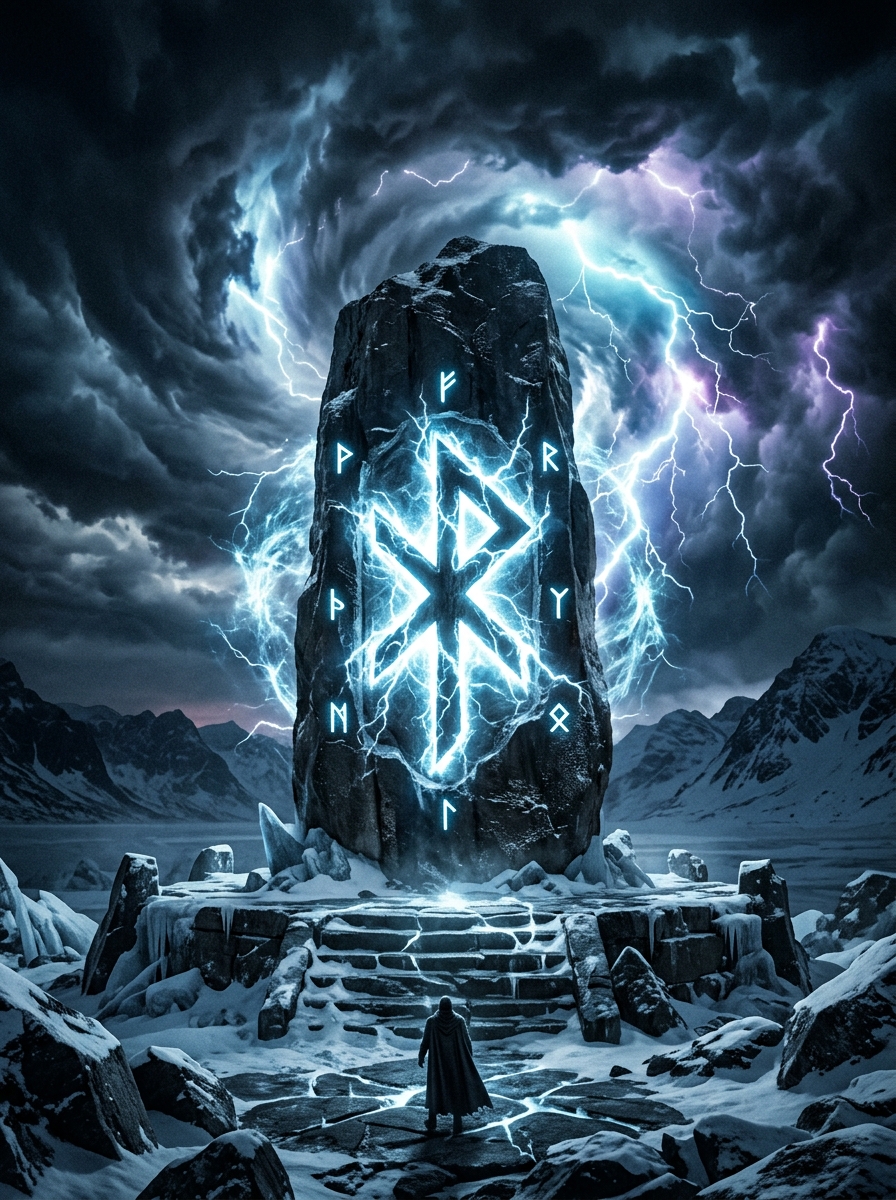
Hagalaz Is Not a Gentle Run in the Runes
The Hagalaz rune names hail — not a pastoral storm that passes, but ice falling from a sky that does not negotiate. In the Elder Futhark, that weather word is the entire thesis. Hagalaz does not symbolize change in the vague inspirational sense; it names an event that interrupts, damages, and reveals structure. Its divinatory force is not subtle. It says: something in the present arrangement cannot remain intact, and the breaking is not accidental to the message.
This rune is therefore routinely misunderstood by readers who want the runes to soothe. Hagalaz is not a comfort rune. It is a truth rune in the severe register, exposing where a structure was already brittle. Hail does not invent weakness; it makes weakness visible. In that sense, the rune is brutally clarifying. It speaks to the moment control fails, and with it the illusion that order was ever as solid as it looked.
Name, shape, and the logic of impact
The old name survives as a weather word because hail is the right image for the operation: sudden, external, impersonal, physically consequential. Unlike fire, which transforms by consuming, hail transforms by striking. It is force that does not negotiate. Its meaning is therefore not moral condemnation but pressure. The rune tells you the atmosphere has turned hostile to the old form.
Visually, Hagalaz belongs to the angular logic of runic carving. Its form is often read as a crossed or cracked pattern, a geometry of interruption. That matters symbolically. The rune does not present a smooth line of progress; it embodies collision. Even before divination is interpreted, the sign declares that an arrangement has reached its fracture point.
The Upright Current: Disruption as Disclosure
When Hagalaz appears upright in a reading, it points to upheaval, but not as theatrical catastrophe. Its message is diagnostic. It indicates a force already in motion that will expose whatever cannot withstand stress: a relationship built on denial, a plan with no redundancy, a belief system overconfident in its own coherence. The rune can describe literal disruption — delays, breakdowns, weather, equipment failures, abrupt reversals — but its deeper function is revelatory. It shows where the form has become false.
The upright rune often arrives when life is refusing to continue in a compromised arrangement. That is why it can feel punitive even when it is not. Hagalaz is not a punishment rune; it is a consequence rune. If the edifice was built on thin ice, the break is not random. The rune’s wisdom lies in making the hidden vulnerability undeniable.
What the rune asks you to see
When Hagalaz upright appears, the question is not “How do I stop this?” so much as “What exactly is being revealed by this collapse?” That shift matters. Hagalaz is less interested in rescue fantasy than in honest appraisal. It asks for the point of impact: where, precisely, are you overextended, underprepared, or pretending that a brittle arrangement is durable?
Psychologically, this can correspond to an encounter with the disowned material Jung called the shadow — not as mystical punishment, but as the return of whatever has been excluded from conscious order. Hagalaz may expose anger beneath politeness, fear beneath competence, or grief beneath productivity. In that way, the rune strips away secondary narratives. It does not merely break things; it breaks the story you used to keep the thing unexamined.
Threshold, not duration
Upright Hagalaz is often less about duration than threshold. It speaks to crossing from one state into another by way of pressure. You may be at the exact point where the old way can no longer support the next step. The rune can therefore mark a crisis that is also an initiation. What survives Hagalaz is not what was loudest or most defended; it is what is structurally real.
That is the rune’s severity and its mercy. Hail destroys the crop, but it also ends the delusion that the season could be managed by wishful thinking. The message is cleaner than it first appears: accept the rupture as information. The question is not whether something will crack, but whether you will learn what the crack is telling you before you rebuild.
The Merkstave Face: Resistance as the True Breakage
Reversed or merkstave Hagalaz does not mean “less bad.” It changes the emphasis from overt disruption to the inward failure to work with disruption intelligently. In practice, merkstave Hagalaz often points to panic, denial, or a stubborn attempt to preserve a structure after its supporting logic has already failed. The storm may be external, but the deeper problem is the refusal to read the weather.
This is where the rune becomes psychologically sharper. Upright Hagalaz says, “Something is breaking.” Reversed Hagalaz says, “Your relation to the breaking is making it worse.” That can show up as needless escalation, dramatic overcorrection, or paralysis. Instead of allowing the crisis to reveal truth, the querent may be feeding the crisis with fear, resistance, or fantasy.
The shadow expression of control
Merkstave Hagalaz frequently describes compulsive control under pressure. When life becomes unstable, the instinct is often to clamp down harder. But the rune warns that rigidity in a hailstorm is a losing strategy. This is not the moment for cosmetic fixes, performative calm, or aggressive reassurance. The structure needs rethinking, not defending.
In relationship readings, reversed Hagalaz can indicate that conflict has become self-sustaining because nobody wants to admit what the rupture actually is. In career or practical readings, it can point to a refusal to pause, cancel, or retool a flawed plan. In personal work, it may reveal a deeper attachment to crisis itself — the unconscious belief that chaos is familiar, therefore controllable. Hagalaz reversed exposes that attachment.
When the rune asks for surrender, not surrendering everything
There is a difference between yielding to reality and giving up your agency. Merkstave Hagalaz demands the former. It asks you to stop expending energy on what is already falling apart so that you can preserve what still has life in it. The rune does not require passivity; it requires discernment. If upright Hagalaz breaks the shell, reversed Hagalaz warns against pecking at it with panic instead of waiting for the right opening.
Reading Hagalaz Well: What It Does to a Question
When Hagalaz appears in a spread, the most useful response is to identify the brittle point rather than obsess over the drama of the break. Ask what structure was already too tight, too idealized, or too dependent on favorable conditions. Ask what would have had to remain untested for the situation to seem stable. The rune is not interested in aesthetics; it is interested in load-bearing truth.
It also helps to read Hagalaz as a rune of sequence. First comes the pressure, then the fracture, then the assessment. If you rush to repair without understanding the fault line, you repeat the conditions that made the break inevitable. If you panic and abandon everything, you may discard what was sound. The rune rewards neither denial nor drama. It rewards clear eyes.
The practical divinatory message
In practical terms, upright Hagalaz says: expect disruption, look for the vulnerable point, and do not confuse collapse with meaninglessness. Something may need to break because the next stage requires a different architecture. Merkstave Hagalaz says: your resistance, fear, or overcontrol is intensifying the damage; stop forcing a shape that the situation has already outgrown.
How does this land in the domains of life? In love, Hagalaz can mark the end of a relationship that was held together by avoidance — not a random ending but a necessary exposure of incompatibility. In work, it can signal a project that must be scrapped because the assumptions were false, or a career path that hits a wall. In personal growth, it can show up as a health crisis, a financial shock, or a confrontation with a long-denied habit. In each case, the rune asks the same thing: look at what the break reveals, not at the break itself.
That is the rune’s final lesson. Hagalaz does not promise ease. It promises contact with reality under pressure. If you can meet it without sentimentalizing the wreckage or panicking at the sound of cracking ice, you gain something rarer than comfort: a truer foundation than the one you lost.
Related
- Eihwaz Rune Meaning: The Axis of Endurance, Thresholds, and Hidden Change
- Dagaz Rune Meaning: Dawn, Threshold, and the Turning of Fate
- Nauthiz Rune Meaning: Need, Friction, and the Fire It Makes
- Raidho Rune Meaning: The Road, the Rhythm, and the Right Order
- Algiz Rune Meaning: Protection, Thresholds, and the Sacred No
Comments
Loading comments…