Nauthiz Rune Meaning: Need, Friction, and the Fire It Makes
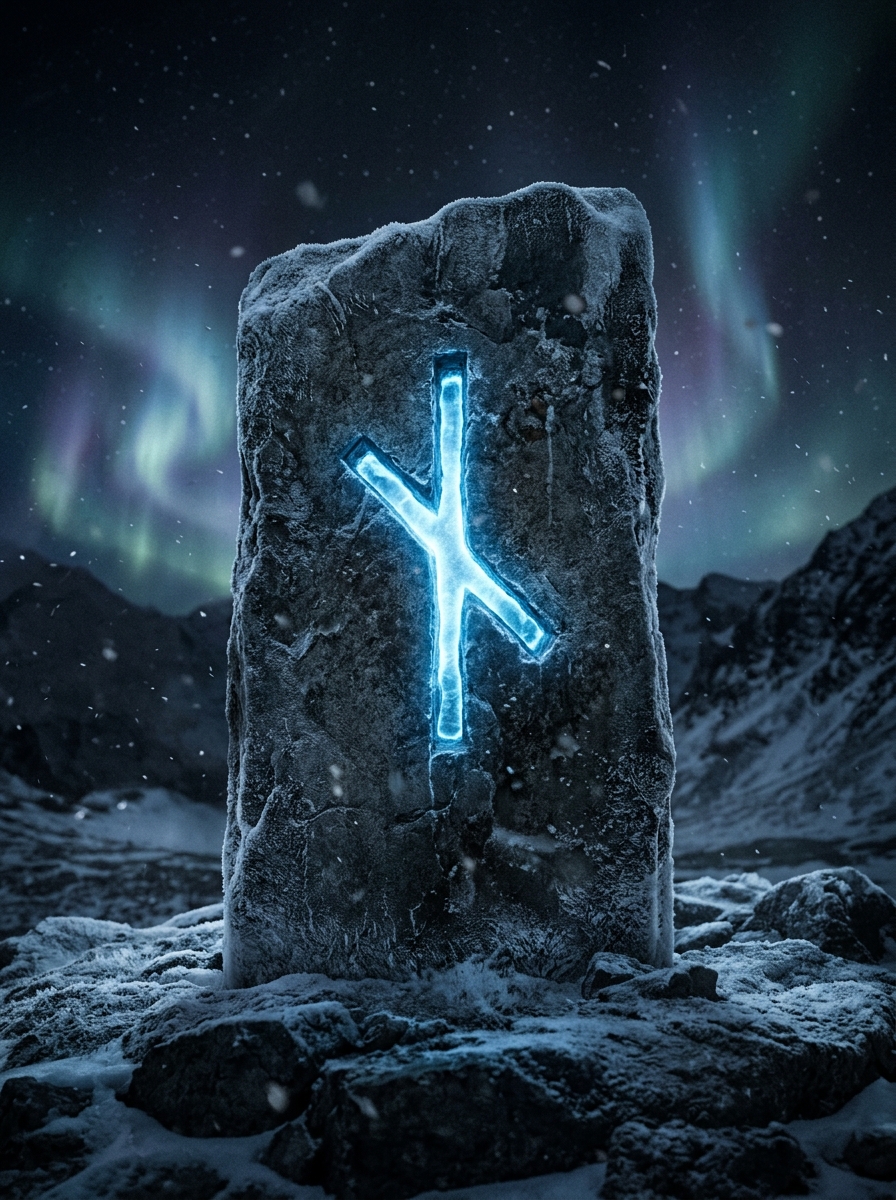
Nauthiz names the friction that clarifies
The Nauthiz rune does not gesture toward lack in the abstract. It names the specific pressure point where life contracts and the psyche must choose: meet the limit with honesty, or fight it and waste the heat. In the Elder Futhark, Nauthiz is the rune of necessity — not as a philosophical concept, but as the immediate fact of a narrowed passage, a shortage that won’t dissolve, a forced pause that strips comfort until only what is real remains.
That core dynamic is the whole rune. Upright, Nauthiz says the situation is smaller than your desire and tougher than your preference. The counsel is to get smaller, more exact, more honest — to stop amplifying the difficulty with fantasy or resistance. Reversed, or in its merkstave expression, the rune warns that the response to constraint has itself become the problem: panic, self-denial, or compulsive force turns need into a wound that deepens as you try to close it. Every insight on this page is a variation on that single point, so we will not rehearse it again.
What the rune is and what it is not
The Old Norse name Nauthiz gives the direct gloss: “need.” But the rune’s territory is more precise than general hardship. It is not the sudden ruin of Hagalaz or the slow freezing of Isa. It is the lived condition of not enough when the shortage is real and cannot be bypassed — of money, time, emotional availability, energy, or any resource the situation demands. In a reading, Nauthiz often appears when the question is not “What do I want?” but “What is actually required here?” It exposes the gap between appetite and obligation, between fantasy and what the ground will support.
Visually, the rune is a stark crossed slash — two lines locked in tension, no ornament, no opening. That austerity is part of the meaning. There is no bloom, no way around. Yet the deeper symbolism is not mere blockage. Traditional rune work treats friction as the condition under which latent fire appears: two stones rubbed together produce spark, pressure reveals energy, constraint concentrates force. Nauthiz does not promise comfort. It promises heat that can be used — if you do not waste it fighting the friction itself.
The psychological root: how need shapes character
Nauthiz operates on the psyche like a test of discernment. It forces the distinction between a true necessity and an impulse dressed up as one. When resources tighten, the mind’s first reflex is often to protest, to grab, to demand relief. The rune asks you to pause and ask: Is this hunger real, or is it restlessness? Is this a boundary that protects, or a wall that isolates? The answer is rarely comfortable, but it is precise.
This is where Nauthiz becomes a rune of maturation. It strips away the childish assumption that every discomfort is an emergency and every delay an injustice. It also refuses the opposite fantasy — that denial equals strength. The rune’s wisdom is severe but humane: you have limits, and those limits can teach you exactly where your power is real. In Jungian terms, the psyche discloses its true attachments under pressure. You discover what you cannot tolerate losing. You also discover which forms of control are only cosmetic — habits of worry, rituals of complaint, the posture of victimhood that masquerades as patience.
The psychological work Nauthiz demands is the work of self-regulation. When upright, the rune points to a season in which boundaries become medicine: fewer commitments, clearer terms, stricter habits, less leakage of attention. It favors endurance, resourcefulness, delayed gratification. This is not asceticism for its own sake. It is the discipline hidden inside difficulty, the recognition that sometimes the way through is to get smaller before you can expand.
How it matures — and how it goes shadow
Upright Nauthiz describes the condition of usable friction. The need is real, but it does not overwhelm. The person feels the pinch and responds with exactness: they stop overextending, begin conserving, tell the truth about what they require. They may still suffer, but they do not add to the suffering by denying it or fighting phantom battles. The rune’s message is to work with the grain of reality, not against it.
Merkstave Nauthiz, the shadow position, shows what happens when the psyche responds to constraint with panic, self-denial, or compulsive force. Here the pressure does not clarify; it distorts. The shortage may be external — the same lack that upright Nauthiz would meet soberly — but the response amplifies the bind. This can look like frantic spending to fill an emotional hole, controlling behavior in a relationship, chronic resentment toward anyone who seems to have more, or a refusal to acknowledge need at all. The most dangerous version is when the restriction is partly internal: inherited guilt about wanting, shame around asking for help, the conviction that needing anything is weakness.
In this state, Nauthiz becomes a rune of self-inflicted scarcity. The person may tighten their fist until nothing can be received, or they may rush into relief that worsens the original lack. The rune does not reward optimism or cheerfulness. It rewards honesty. The shadow reading says: your effort may be tangled with avoidance; your restraint may be fear wearing a mask; your urgency may be despair pretending to be ambition. Once named, the pattern can be interrupted — but only if the person is willing to see that not every obstacle is outside the self.
How the rune shows up in a life
Because Nauthiz is a condition, not a category, it does not map neatly onto “love,” “career,” and “health” as separate lexicons. The same dynamics apply across domains, and the reader who understands the core need will recognize it anywhere.
- In relationships, Nauthiz upright calls for difficult candor — the kind that names a true lack (time, attention, honesty) without blaming or pleading. Merkstave warns of codependency, where need for the other becomes compulsion, or of emotional withholding that masquerades as independence.
- In work, upright Nauthiz points to a period where discipline matters more than inspiration, and where the smart move is to simplify the workload, not add to it. The shadow form appears as burnout driven by the belief that rest is weakness, or as frantic striving to prove worth through output.
- In healing, Nauthiz asks the body or psyche what it actually requires — rest, nourishment, a limit on activity — and warns against the urge to push through signals. The wound may be that the person has learned to ignore their own needs, mistaking endurance for strength.
In every case, the rune’s power lies in its refusal to confuse comfort with truth. It does not offer relief. It offers clarity at the price of comfort. That is the deal.
Nauthiz in the Elder Futhark sequence
Nauthiz gains depth when read as part of the runes’ progressive logic. It belongs to the line of pressures that teach the cost of development: before competence comes limitation accurately perceived; before expansion comes contraction honestly accepted. The runes that follow — Isa, Jera, Eihwaz — all deal with the aftermath of constraint, with what grows from it or how it can be endured. But Nauthiz is the threshold. It is the moment when a person must stop arguing with conditions and start reading them.
Among the runes it is often confused with, Nauthiz is narrower than Hagalaz (disruption) and more personal than Isa (freeze). It is not a catastrophe that arrives from outside; it is the pinch that arises because something has been overextended or denied. In that sense, it is a profoundly moral rune — moral in the old sense of character under pressure. The question is not whether difficulty exists. It is whether you can meet it without self-betrayal.
Nauthiz does not promise a way out. It promises a way through, provided you let the friction do its work. The spark it produces can light a fire or burn the hand. That depends on the one holding the stone.
Comments
Loading comments…