Eihwaz Rune Meaning: The Axis of Endurance, Thresholds, and Hidden Change
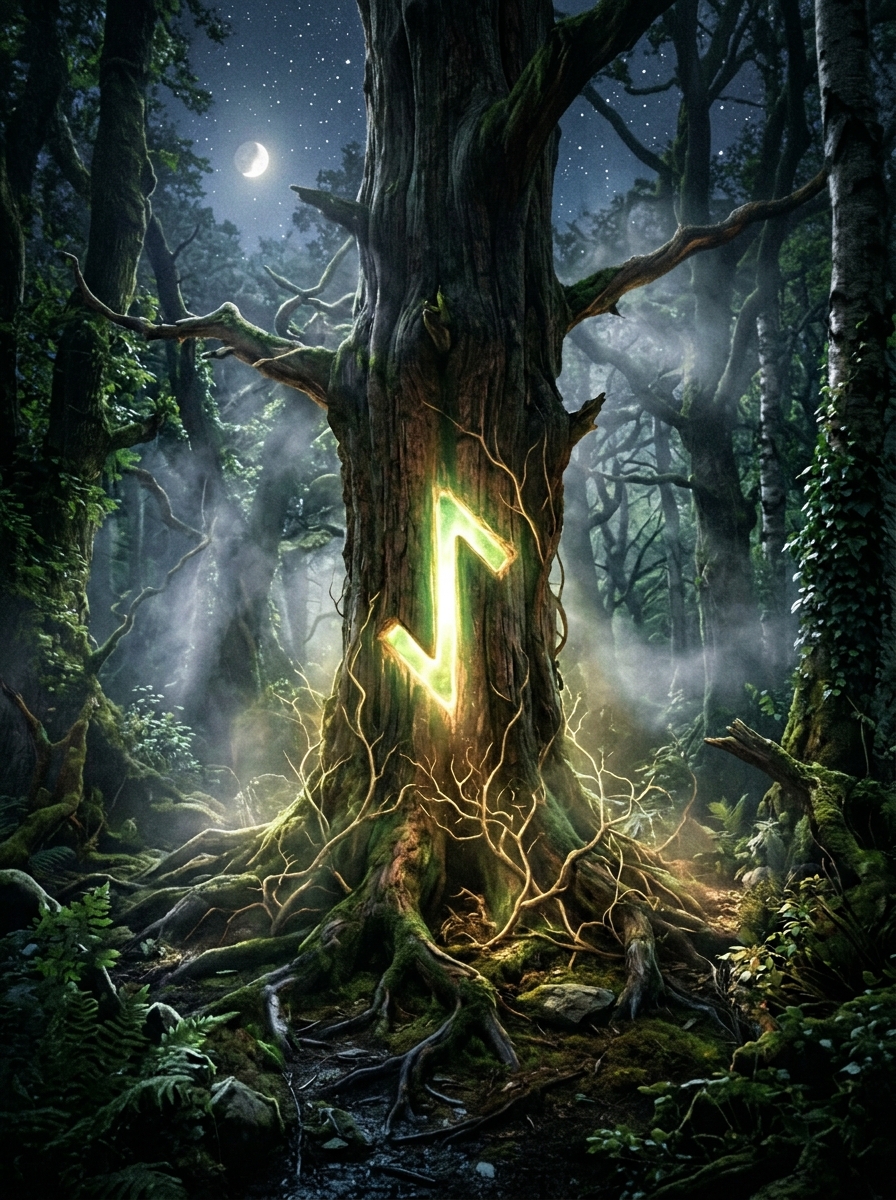
Eihwaz is the rune of upright strain: not collapse, not ease, but the strength that comes from holding shape while everything around you changes. It marks a threshold condition — the moment when an old form has died enough to be left behind, but the new one has not yet fully emerged. Its message is rarely simple comfort. More often it says: endure intelligently, do not force the crossing, and trust the hidden structure that remains when appearances fall away.
The Core Dynamic: Endurance, Threshold, Hidden Change
The rune’s name is usually connected to yew, the tree that long outlives human reckoning and was valued in northern Europe for timber, bows, and funerary associations. The yew is a fitting emblem because it is both poisonous and protective, evergreen and grave-bound — a living witness to continuity through endings. That doubleness is the key to Eihwaz: it belongs to survival, but not to bland survival. It speaks of a life force that has passed through deathlike conditions and learned how to persist with its integrity intact.
In the Elder Futhark, Eihwaz carries the phonetic value of the “ei” sound, and its angular form is often read as a vertical axis with opposing diagonals. That shape matters. The rune does not describe movement in a straight line; it describes the load-bearing center that allows movement to be endured at all. Its visual grammar is closer to a spine than a flourish. The core question Eihwaz poses to every querent is not “how do I escape this?” but “what can I hold without distorting?” — a question that cuts through the noise of lesser anxieties.
The Architecture: Shape, Name, and the Logic of Tension
The yew’s usefulness as bow-wood gives Eihwaz a practical edge that many runes lack. A bow is not strong because it is rigid; it is strong because it can bend without losing its purpose. That is the rune’s intelligence: it asks where pressure can be borne without fracture, where tension can be organized into aim. For a querent, this may show up as a period in which one must accept discipline, delay, or compression without mistaking those conditions for failure.
The yew’s funerary associations add another layer. In the symbolic landscape of Eihwaz, death is not simply an ending but a kind of thinning out — a stripping away of what cannot cross the threshold. That is why the rune so often appears when a person is grieving an identity, relationship, plan, or belief that has outlived its viable form. It does not deny pain. It frames pain as part of an initiation into sturdier being. The rune’s psychology rests on this paradox: the very structure that seems to confine you is also the structure that will carry you through.
Upright and Merkstave: The Two Currents of Alignment
Upright Eihwaz is not a cheerful rune, but it is an excellent one. It says that obstacles are not necessarily blocks; some are load-bearing tests. In a reading, it points to the necessity of waiting, maturing, or staying with discomfort long enough for the deeper pattern to become visible. The crucial distinction is between passivity and steadiness. Eihwaz favors steadiness: not forcing a resolution, but refusing to abandon the center.
Because Eihwaz belongs to thresholds, it often appears when the outer world looks stalled while the inner life is actively reordering itself. The visible situation may seem inert, but the real movement is subterranean. This is the rune’s chief psychological teaching: transformation does not always arrive as action. Sometimes it arrives as consolidation, as the gathering of resources that will later make action clean and decisive. It also carries a sharp ethical intelligence. Eihwaz does not reward self-betrayal in the name of peace. If a situation demands that you violate your own core in order to keep appearances smooth, the rune may be pointing you toward a harder loyalty.
Reversed Eihwaz — or merkstave — does not usually mean simple disaster. It more often indicates compromised tension: the structure is still in place, but the force moving through it is erratic, delayed, or misdirected. If upright Eihwaz is the axis, reversed Eihwaz is the axis under stress, or the refusal to become the thing the moment demands. Something wants to change, but fear, inertia, or overidentification with the old shape is resisting the transition.
The merkstave message can feel frustrating because it often describes a person who knows change is necessary but cannot yet cooperate with it. This is a state of psychic congestion. The issue may be emotional rigidity, defensive stoicism, or a clinging to endurance as identity. In such cases, Eihwaz reversed exposes a subtle trap: the belief that suffering itself is proof of strength. It is not. Sometimes the strongest act is surrendering a brittle strategy. Energy may be invested in controlling outcomes that cannot be controlled, or in preserving a form that has already ceased to serve. The rune can point to delay, but the delay may be meaningful — a pause forced by circumstances until the querent becomes honest about what is actually ending.
Eihwaz in the Lived Life: A Consolidated View
If one rune in the Elder Futhark can be called the keeper of the threshold, Eihwaz is among the strongest candidates. Its symbolism is broader than endurance alone. It is about vertical alignment, the bridge between worlds, and the ability to remain conscious where ordinary identity would rather dissolve. In mythic terms, it resembles the tree-trunk logic of the world axis: something rooted in darkness, rising through pressure, and reaching toward the unseen.
In a practical spread, Eihwaz shows up in every domain but never repeats itself. In relationship readings, it can point to a bond passing through a crucible — the partnership is being tested for structural truth rather than romantic image. The couple must determine whether the tension they feel is forging a truer vessel or merely exhausting one. In career matters, it often suggests an apprenticeship phase, a hidden preparation, or the need to endure a temporary lack of recognition while building something durable. In spiritual readings, it is one of the clearest signs of initiation through restraint — the kind of growth that happens when the ego is no longer allowed to be the loudest voice in the room. It also has a precise practical dimension: Eihwaz may describe a literal delay in travel, a period of recuperation after illness, or a decision that cannot be rushed without distorting the result.
Seasonally, the rune feels closest to winter’s interior logic, though not as mere coldness. It belongs to the dormant intelligence of deep time, when visible growth has ceased but form is being preserved for future emergence. Its energy is less about blossoming than about holding essence intact through the long night. That makes it especially apt for readings involving therapy, recovery, rites of passage, or any moment when a person is learning how to remain themselves inside pressure.
Reading Without Flattening: Common Errors and True Discernment
The most common mistake with Eihwaz is to romanticize hardship. The rune is not a medal for suffering. It is a diagnostic and initiatory sign: where is the structure true, where is it strained, and what must be surrendered so that the center can remain intact? Read well, Eihwaz identifies the difference between meaningful endurance and stubborn collapse delayed by pride.
The second mistake is to make it too mystical and ignore its practical precision. The power of the rune lies in its refusal to flatter. It tells the truth about what is strong enough to hold and what must be allowed to pass. That is why, alongside runes like Ansuz and Hagalaz, Eihwaz belongs to the mature company of the Elder Futhark — signs that demand the querent meet life as it is, not as they wish it were. Upright, it teaches the courage to stand at the threshold without panicking. Reversed, it reveals the cost of clinging to a form that no longer carries life. Between those two poles lies its full meaning: the art of remaining aligned while the old self gives way, and the next self is still assembling in the dark.
Related
- Ehwaz Rune Meaning: The Sacred Grammar of Movement, Trust, and Mutual Gain
- Tiwaz Rune Meaning: Victory, Sacrifice, and Right Action
- Nauthiz Rune Meaning: Need, Friction, and the Fire It Makes
- Ingwaz Rune Meaning: The Seed, the Closure, the Quiet Force of Gestation
- Fehu Rune Meaning: Wealth That Moves, Not Wealth That Sleeps
Comments
Loading comments…