Fehu Rune Meaning: Wealth That Moves, Not Wealth That Sleeps
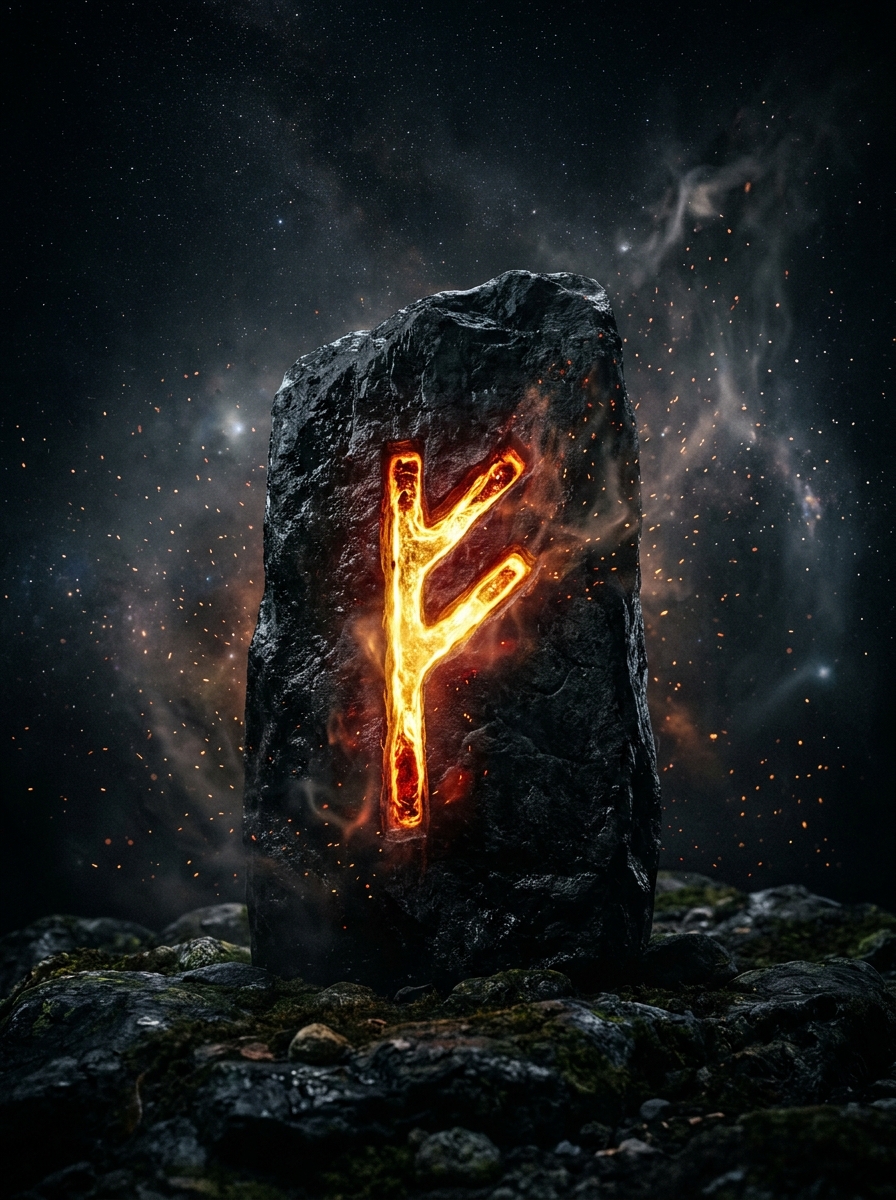
Cattle, Not Capital
Fehu means "cattle," and that etymology is not incidental — it is the entire argument. In the old Germanic world, cattle were the primary form of portable wealth: they moved, reproduced, gave milk, and could be traded, lost, or stolen. Unlike land or a cache of silver, a herd was alive. It demanded attention. It could increase on its own or collapse in a bad winter. Fehu therefore names a kind of value that is inherently dynamic — circulating force rather than stored reserve.
As the opening rune of the Elder Futhark, Fehu carries an initiatory charge. It does not simply say "resources exist." It announces the first uncomfortable truth that resources produce: now you are responsible for them. The name shares its root with Old English feoh and Latin pecunia (from pecus, cattle), and that etymological thread runs straight into modern English "fee" — value rendered, value owed. The rune is generous, but its generosity comes attached to obligation.
The Ethics of the First Rune
Because Fehu is first in sequence, it functions like a threshold. In divination, the matters it governs are primordial: money, yes, but also appetite, self-worth, and the fear of insufficiency that shadows all of them. The rune's phonetic energy — an opening breath, unornamented — matches its symbolic position: this is where life begins to have stakes.
What Fehu introduces that later runes build on is a distinction between abundance as possession and abundance as process. The herd that is simply accumulated without grazing, tending, or trading is not wealth; it is a liability. Every other reading of this rune flows from that premise.
Upright: Gain in Motion
Upright, Fehu is one of the clearest markers of material increase in the Elder Futhark, but its message is more precise than generic good fortune. It tends to indicate resources that are immediately usable — a raise, a sale, a fertile creative opening, a well-timed client, a workable arrangement. The accent falls on liquidity, on value that can actually be put to work.
That emphasis on motion matters practically. Upright Fehu favors people who participate in their own prosperity. A cow must be tended; a fire must be fed without being overfed. In a reading, the rune often suggests that wealth arrives when energy is directed rather than scattered. It rewards attentiveness and a realistic relationship to what you have.
What Fehu Does Not Promise
Fehu is frequently read as a guarantee of riches. It is not that. It does not endorse endless accumulation, and it does not bless greed. Upright Fehu can appear precisely because you are being tested — value has entered your hands, and the question is whether you will handle it wisely or let it leak away through inattention or magical thinking.
This is why the rune carries an ethical dimension that surprises people who encounter it for the first time. Prosperity is not only a reward; it is a test of circulation. What comes in must be used well, shared appropriately, and protected from neglect. If the question in a reading concerns self-worth, Fehu often points to a person learning that material competence and inner confidence are distinct things that nonetheless feed each other — the gain is external, but the readiness begins inside.
Merkstave: The Weight of Frozen Value
Reversed or in merkstave, Fehu does not simply negate wealth. It shows what happens when value is obstructed, hoarded, or psychologically overidentified with. The core experience is typically not "I have nothing" but "what I have will not move." Payment is delayed, effort is wasted, or resources slip through tightly closed hands precisely because they are held too tightly.
In shadow terms, merkstave Fehu can point to greed, possessiveness, and scarcity anxiety. The problem may be external — real loss, debt, a deal that collapses — but the rune's deeper diagnosis is almost always fear-driven control. A person clings to money, status, a relationship, or a role because they have confused possession with safety. Merkstave Fehu exposes that confusion: what, exactly, are you trying to keep from changing? The honest answer is often something that is already diminishing, or something living that cannot thrive under lock and key.
When the Loss Is Real
Not every reversal is psychological. Sometimes Fehu reversed is an accurate read of material strain: cash flow dries up, a resource proves unreliable, overextension catches up with someone. The surrounding runes clarify whether the issue is situational or characterological. But even when the loss is straightforwardly real, the rune's message is diagnostic rather than despairing. It locates where value is draining, which is the first step toward stopping the leak.
The deeper counsel of merkstave Fehu is this: what is hoarded without circulation decays. What is controlled too rigidly becomes brittle. The rune is a warning against building a life around what cannot breathe.
Symbol: Fire, Fertility, and the Economics of Aliveness
The strongest symbolic thread in Fehu is that cattle were not merely a store of value but a daily economy. They produced milk, labor, offspring, and compost. Their worth was inseparable from their vitality. That is why the rune feels simultaneously earthy and volatile — it is about usefulness, but also about the continuous work of keeping something alive.
Modern interpretation often links Fehu to fire, and the analogy earns its place. Fire, like wealth, can warm a household or burn it down depending on how it is managed. Both reward skill and punish neglect. This is why the rune resonates with questions of enterprise, creative output, and sexuality — all domains where energy wants expression and cannot be handled by suppression alone.
From a Jungian angle, Fehu frequently appears where a person's sense of self-worth has become entangled with visible proof of having: money in the bank, measurable success, evidence of desirability. The rune quietly challenges that accounting. Real abundance, in its symbolic logic, is not what you own but what you can move through the world without poisoning it. A psychologically mature relationship to Fehu means being able to hold value, use it, and release it — without panic in any of those three movements.
Reading Fehu in Context
No rune speaks alone, and Fehu is especially context-sensitive. Near runes of movement, it can indicate resources arriving through travel or changing circumstances. Near runes of partnership, it often points to material support or affection expressed in concrete, tangible ways — care demonstrated rather than declared. Near runes of exhaustion or blockage, it can name the specific place where energy is being spent faster than it is replenished: not a talent problem, but a leakage problem.
What a good reading reveals is not merely whether Fehu is present, but what kind of circulation it describes. Upright, it marks a phase in which value can be increased if you move with it correctly. Reversed, it marks a place where life force has been turned into a possession — locked, static, and slowly diminishing.
That is the rune's final severity and its grace in equal measure. It is a symbol of wealth, but wealth understood as motion, responsibility, and vitality. If it comes to you upright, something worth cultivating has arrived. If it comes to you in merkstave, look to the place where you have stopped letting things move.
Related
- Eihwaz Rune Meaning: The Axis of Endurance, Thresholds, and Hidden Change
- Uruz Rune Meaning: The Raw Power of Vital Force
- Ehwaz Rune Meaning: The Sacred Grammar of Movement, Trust, and Mutual Gain
- Nauthiz Rune Meaning: Need, Friction, and the Fire It Makes
- Raidho Rune Meaning: The Road, the Rhythm, and the Right Order
Comments
Loading comments…