Carnelian Meaning & Healing Properties: Fire for Will, Creativity, and Vitality
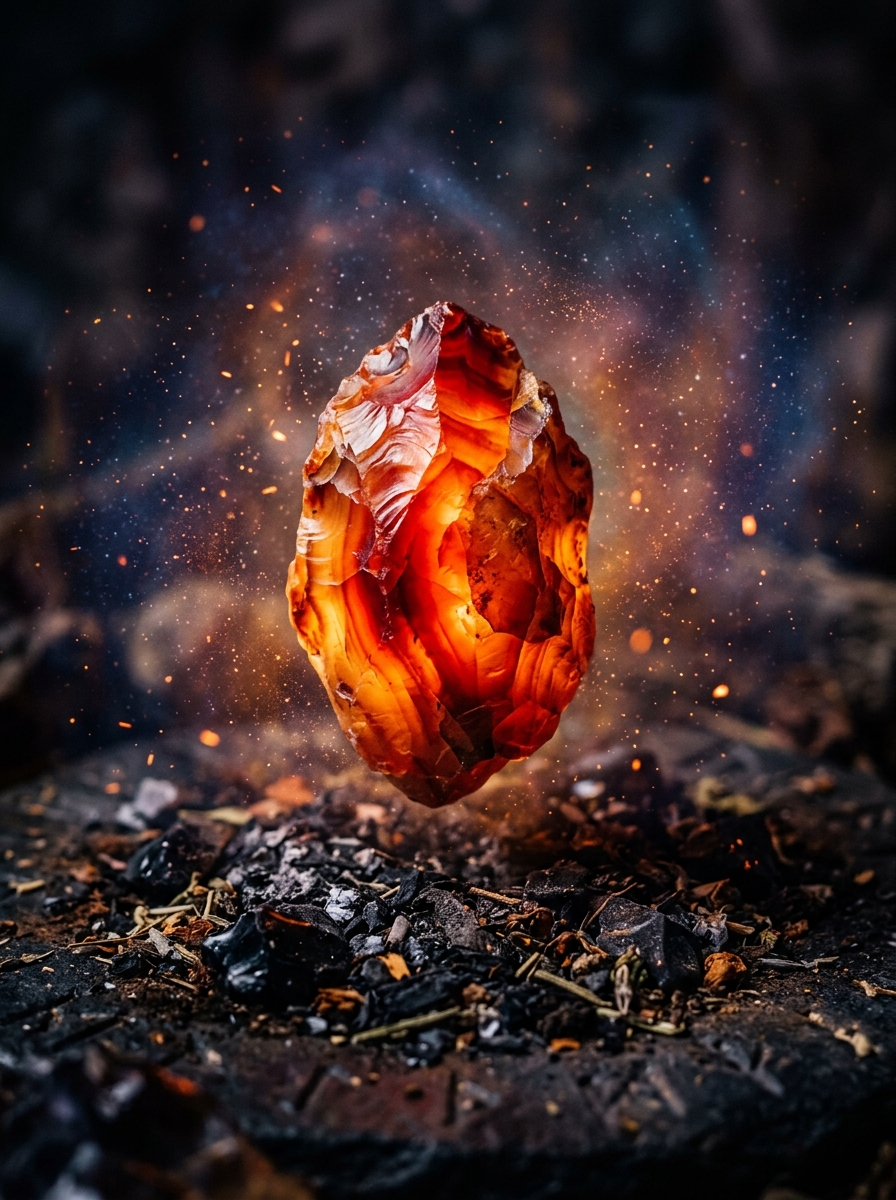
Carnelian is the stone of embodied momentum: a solar-plexus and sacral ally that turns raw life force into courage, appetite, creativity, and decisive action. Its metaphysical signature is not passive serenity but warm ignition. Where other stones soothe, carnelian mobilizes.
Carnelian’s core dynamic: the ethics of fire
Carnelian is a variety of chalcedony colored by iron, and that material fact matters metaphysically. It is a mineralized lesson in how heat, pressure, and time can produce confidence without hardening into cruelty. The stone’s meaning is not “power” in the abstract; it is the disciplined use of power in the body, in desire, and in the everyday act of beginning.
In esoteric language, carnelian is tied to vitality because it works as a threshold between intention and motion. If the Sun symbolizes identity and radiance, carnelian supplies the muscular willingness to stand in that radiance and act from it. That is why it often appears in discussions of ambition, sex drive, creative work, and speaking with conviction. It does not make you louder; it makes you less internally divided. This is the stone of “yes” as a verb.
That distinction matters. Many people reach for carnelian when they want “energy,” but the deeper current is coherence. In Jungian terms, it supports the ego’s capacity to carry instinct without being overwhelmed by it. The stone’s specificity—choose, move, make, risk, begin—is what makes it useful for artists facing blank pages, entrepreneurs facing inertia, or anyone who has outgrown passivity but has not yet trusted their own momentum. When destiny itself demands a behavioral shift, the same developmental pressure that astrology describes through the North Node becomes tangible; carnelian does not reveal the destination but supplies the grit to step toward it. For a fuller frame on that life-direction, see the North Node.
The psychological root: why we stall
The healing reputation of carnelian rests on its ability to remedy the gap between knowing and doing. Procrastination is rarely laziness; it is conflict. A person avoids not the task itself but the visibility, responsibility, or identity shift that comes with it. Carnelian strengthens the will to tolerate that friction.
One of its clearest psychological gifts is its relationship to shame—not the theatrical kind, but the quieter version that says, “Don’t be too much,” “Don’t want too much,” “Don’t risk looking foolish.” Carnelian counters that interior censorship. It invites a person back into appetite—creative appetite, erotic appetite, social appetite, the simple appetite for being here. This makes it unusually helpful for rebuilding after criticism or rejection. It does not ask you to transcend hurt; it asks you to metabolize it into movement. In that sense, the stone has more in common with healthy anger than with passive comfort. It can help a person reclaim boundary and voice, especially when they have been over-accommodating for too long.
Because carnelian works on both the sacral chakra (desire, creativity, relational flow) and the solar plexus chakra (will, self-definition, command), it bridges two layers of power. The sacral says “I feel”; the solar plexus says “I decide.” When those two are out of sync, a person may have abundant ideas but no follow-through, or strong opinions but no courage to speak them. Carnelian restores the link. If you want to understand which life arenas repeatedly require that kind of courage, the framework of astrological houses can help you see where your energy patterns are calling for initiation.
Mature use versus shadow expression
Used well, carnelian fosters disciplined courage. It helps a person claim space without needing external validation first. That is the energetic language of selfhood under pressure: choosing, speaking, acting, and tolerating the fact that not everyone will approve. In its mature form, carnelian does not equate to aggression. It is the internal authorization to begin, not the insistence on winning.
The shadow side of carnelian appears when its fire is raw and unguided. Then it can manifest as impulsiveness, irritation, or the kind of reckless drive that burns out relationships and projects. Because the stone amplifies will, it can also amplify stubbornness or a refusal to pause. This is why carnelian works best when paired with a clear intention and a willingness to revisit direction. It is not a perpetual-motion machine; it is a catalyst that requires conscious steering.
When the stone’s energy is balanced, it aligns naturally with the Sun as the organizing center of identity—the principle that says, “This is who I am, and I will live from that center.” That solar quality is why carnelian is so often chosen by people stepping into leadership or visibility. For a deeper exploration of that solar identity, the Sun sign page expands the symbolism of the core self, while The Emperor and The Sun Tarot card meaning shows how authority and vitality can become one coherent force.
How carnelian plays out in a life
Because carnelian is the stone of initiation, its applications are concrete rather than abstract. In creative work, it supports the transition from concept to draft. An artist who keeps a piece of carnelian on the desk may find that the block is less about inspiration and more about permission to make imperfect work. In professional life, it helps with meetings, presentations, and negotiations—situations where visibility can trigger self-doubt. Worn as a ring or pendant, it becomes a tactile reminder that your hands belong to your will.
In relationships, carnelian strengthens the capacity for honest desire. It does not soften conflict; it clarifies what you want and gives you the nerve to say it. This can be especially valuable for those who have learned to silence their own needs to keep peace. The stone supports not aggression but self-possession—the ability to be present in relationship without losing center.
For people with a natal chart where latent potential is waiting to be unlocked—often indicated by a sextile aspect—carnelian can feel like a key. It activates qualities that are already in the personality but not yet expressed. That sense of “I could, but I haven’t yet” is exactly where the stone works. To understand that dynamic more fully, the sextile aspect page explores how untapped aptitude becomes usable.
Choosing and working with carnelian
Quality in carnelian is visible: rich orange, red-orange, or russet tones with a warm, translucent glow. But the more important criterion is felt responsiveness. A stone that seems lively in the hand will usually be more useful than one that merely looks pristine. If you want it for confidence, choose a piece that feels grounding rather than frantic. If you want it for creativity, choose one that feels warm and generative.
Cleansing carnelian is straightforward: smoke, sound, moonlight, or a brief intention-setting ritual work well. The key is consistency and attention. Before using it, state what kind of momentum you are asking for—not “make me successful,” but “help me begin,” “help me speak,” “help me stay with the work.” Those are cleaner, more usable intentions.
Carnelian is right when your life needs ignition more than comfort. It is the stone for the artist who has drafts but no nerve, the worker who has skill but no spark, the initiator who needs steadiness rather than fantasy. It aligns especially well with people whose growth is calling them into visibility and action—the very developmental pressure that astrology often describes through the North Node and the solar core. When the rest of the chart has a concentration of energy—a stellium—carnelian can help channel that force into one coherent direction rather than letting it scatter. For a deeper look at how concentrated planetary energy works, the stellium in astrology page offers a framework.
Used well, carnelian does not fabricate a self. It animates one already waiting to be lived. That is its deepest gift: not invention, but embodiment. Not noise, but courage. Not fire for its own sake, but fire made useful.
Related
- Garnet Meaning & Healing Properties: The Stone of Blood, Will, and Return
- Sunstone Meaning and Healing Properties: Solar Courage, Joy, and Clean Power
- Citrine Meaning & Healing Properties: Solar Clarity, Confidence, and Clean Power
- Ruby Meaning & Healing Properties: Fire, Blood, and the Will to Live
- Peridot Meaning: The Green Fire of Renewal
Comments
Loading comments…