Capricorn Sun, Aquarius Moon: The Concrete Reformer
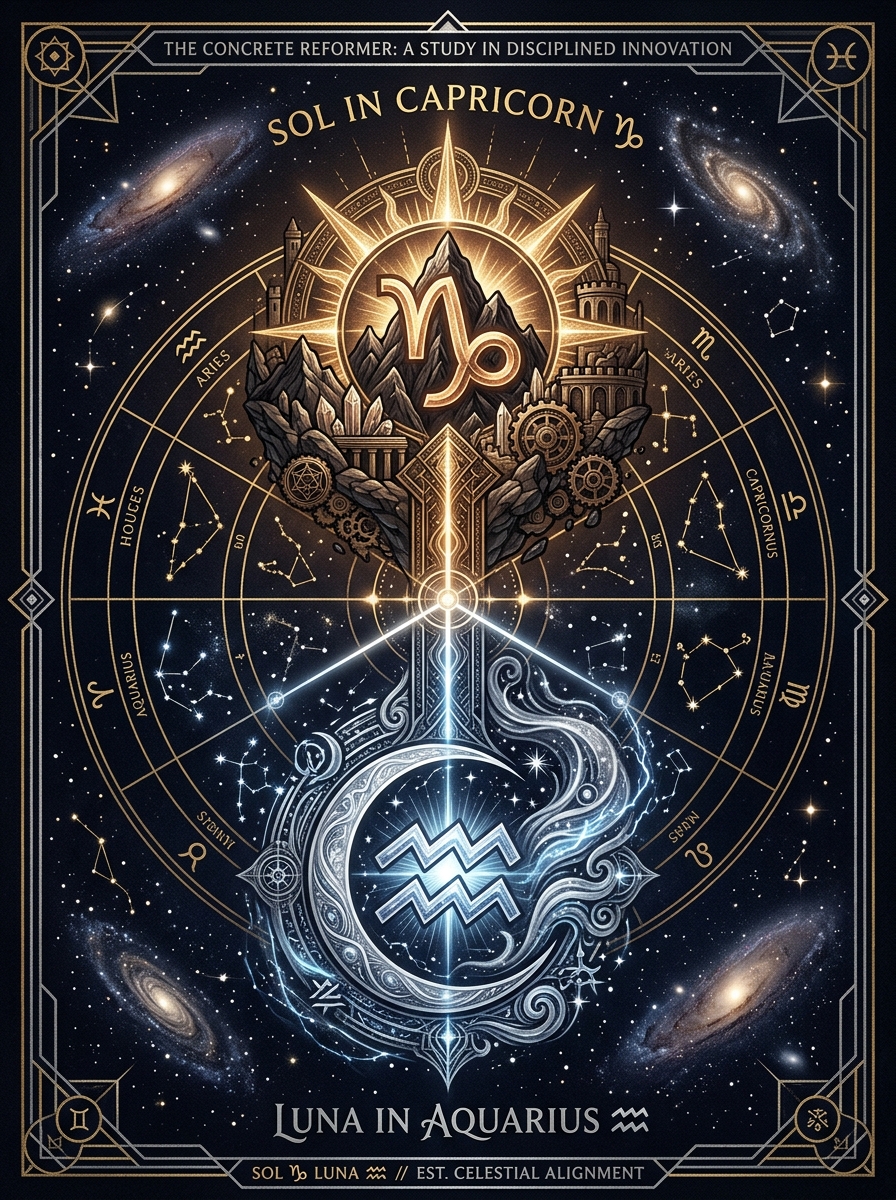
The Rarest Kind of Builder: Introducing the Capricorn Sun, Aquarius Moon
There is a type of person who attends the city council meeting, stays until the last agenda item, and then goes home and writes the proposal that actually gets built. They care deeply about the future — not in a dreamy, wishful sense, but in the way an engineer cares about load-bearing capacity. They see what is wrong with the system and they also see, with uncomfortable clarity, exactly how to fix it. This is the Capricorn Sun, Aquarius Moon person: part structural architect, part social visionary, all business.
This combination sits at the intersection of two of the most misunderstood signs in the zodiac. Capricorn is routinely flattened into a caricature of corporate ambition, while Aquarius is romanticized as the free-spirited rebel who never does their taxes. Neither portrait is accurate, and in the natal chart they are even less so. When the Sun occupies Capricorn and the Moon occupies Aquarius, what emerges is not a contradiction but a convergence — one of the most structurally coherent pairings available in Western astrology.
The keyword most astrologers reach for is concrete reformer, and it earns its place. Capricorn is the sign of long-range, material-world mastery, ruled by Saturn, the planet of limits, form, and earned authority. Aquarius, also co-ruled by Saturn in classical astrology before Uranus was discovered, governs collective systems, social ideals, and the kind of innovation that reshapes the architecture of civilization rather than merely decorating it. A person born with their conscious identity anchored in Capricorn and their emotional life anchored in Aquarius is someone who has internalized both Saturn's demand for durable structure and Uranus's drive to rebuild that structure when it stops serving the future.
They are not utopians. They do not post manifestos. They submit budget proposals. They sit on boards. They write the code that runs the infrastructure. And behind those actions is a genuine, though often quietly held, conviction that the world can be made more rational, more equitable, and more efficiently organized — and that it is their personal responsibility to help make it so.
The Double Saturnian Synthesis: Earth, Air, and the Architecture of Change
Saturn as the Hidden Thread
To understand the Capricorn Sun, Aquarius Moon combination at a foundational level, it is necessary to spend some time with Saturn. In the traditional seven-planet system — the one Liz Greene explores with characteristic depth in Saturn: A New Look at an Old Devil — Saturn rules both Capricorn and Aquarius. The outer planet Uranus, discovered in 1781, was later assigned to Aquarius as its modern ruler, but Saturn's co-rulership was never dissolved; it simply became layered.
This double Saturnian quality gives this combination its particular flavor of controlled, purposeful intensity. Where a purely Uranian Aquarius might be chaotic, eccentric, and allergic to planning, the Aquarius Moon here is kept company by Saturn's insistence on form and consequence. The emotional life of this person is not anarchic — it is visionary, but with a strong preference for visions that can be implemented. They are moved, emotionally, by systems that work. They feel a quiet thrill when a bureaucratic structure achieves exactly what it was designed to do, and they feel a restless dissatisfaction — an itch that becomes a compulsion — when they see a system falling short of what it could be.
Earth Meets Air: Elemental Complementarity
The Sun in Capricorn is an Earth placement: dense, patient, material, practical. The Moon in Aquarius is an Air placement: conceptual, communicative, relational in the abstract, oriented toward ideas rather than sensations. In a natal chart, Sun-Moon combinations that bridge Earth and Air are not unusual, but this particular pairing achieves something distinctive. Earth grounds Air's tendency toward pure abstraction. Air lifts Earth's tendency toward inertia and conservatism.
The result is someone who can hold a large concept — sustainable urban infrastructure, institutional reform, decentralized financial systems — and simultaneously develop the step-by-step, year-by-year plan required to bring it into existence. They are equally at home in a seminar on systems theory and in a project management spreadsheet. This is not an ordinary skill set. Most visionaries cannot project-manage. Most project managers are not visionaries. This person is often, quietly and without fanfare, both.
Uranus in the Basement
The influence of Uranus — as modern ruler of the Aquarius Moon — should not be dismissed. Saturn provides the load-bearing walls; Uranus provides the architectural vision that says those walls should face a different direction. In psychological terms, the Uranian dimension of this person's emotional life means that they will periodically experience a deep, inner pressure to disrupt whatever structure they have so carefully built. They reorganize their careers. They exit institutions that have grown too comfortable. They maintain a private loyalty to originality that can look, from the outside, like restlessness. It is not restlessness. It is the built-in self-correction mechanism of a person whose emotional intelligence is tuned to collective progress rather than personal continuity.
The Concrete Reformer in Action: How This Combination Operates in the World
Cardinal Fire, Fixed Vision
Capricorn is a cardinal sign: it initiates, it mobilizes, it sets things in motion. Aquarius is a fixed sign: it sustains, it holds a course, it refuses to abandon a vision once committed. The interplay between cardinal initiative and fixed follow-through is what gives this person their extraordinary long-game capability. They do not simply have ideas and drop them — a common failing of the more mercurial placements. Nor do they simply maintain what exists — a common failing of less visionary Earth configurations. They identify a future worth building and they pursue it with the methodical, compounding persistence of someone who has made peace with the fact that important things take time.
Steven Forrest, in his evolutionary astrology framework, identifies Capricorn as the sign most associated with the development of integrity under pressure — the mastery of the self within the constraints of material reality. The Capricorn Sun person is someone whose conscious identity is organized around this theme: the long climb, the earned achievement, the credibility that accumulates through demonstrated competence over time. Add the Aquarius Moon's emotional identification with collective improvement, and you get someone whose private inner motivation is not primarily personal advancement but systemic advancement — with their own mastery as the necessary instrument.
The Work They Are Drawn Toward
In practical terms, this combination has exceptional affinity with careers and vocations that sit at the intersection of systems design and social function. The brief identifies several specific domains: sustainable urban planning, technology management, clean energy grid design, NGO administration, and broader systems-level engineering. What these vocations share is the requirement to think in scales of time and complexity that most people find uncomfortable. A clean energy grid is not built in a quarter; it is built across policy cycles, supply chain negotiations, regulatory frameworks, and evolving technology landscapes. The Capricorn Sun, Aquarius Moon person does not find this discouraging — they find it interesting.
They are also frequently found in institutional roles that most people would find both dry and demanding: regulatory bodies, standards organizations, urban development agencies, academic administrative leadership, think tanks with implementation mandates. These are not the glamorous faces of social change; they are its engine room, and this person is constitutionally well-suited to engine rooms. They understand that power tends to concentrate in unglamorous places and that the person who masters unglamorous processes acquires real leverage.
Intellectual Authority Over Emotional Appeal
One of the defining characteristics of how this person operates in the world is their preference for intellectual authority over emotional appeal. They build cases. They present data. They rely on demonstrated expertise rather than charisma. This can be a source of genuine professional power — people trust them with complex, high-stakes projects because they know this person will not make decisions based on what feels good in the room. It can also create friction in environments that reward emotional attunement and social warmth, which will be addressed more fully in the shadow section below.
Vocational Strengths and Leadership: Mastering the Long Game
The Strategist's Mindset
The Capricorn Sun, Aquarius Moon person approaches leadership the way a chess grandmaster approaches the middle game: with multiple timeframes active simultaneously, aware of immediate tactical positions but always in service of a long-range strategic objective. They are remarkably difficult to rattle. Because their identity and their emotional security are both grounded in their own competence and their connection to a larger systemic purpose, they do not need external validation to maintain their sense of direction. They can absorb setbacks with equanimity that reads, to observers, as either extraordinary confidence or unsettling coldness. Often it is both.
This equanimity makes them effective in environments characterized by institutional complexity, political constraint, and long timelines — environments where many talented people burn out because they cannot sustain motivation in the absence of quick wins. The Capricorn Sun, Aquarius Moon person is internally resourced for the long haul in a way that is genuinely distinctive.
Building Teams Around a Mission
As leaders, they are most effective when they frame work in terms of mission rather than relationship. They attract collaborators who are intellectually motivated and value autonomy — people who want to contribute to something meaningful without being managed in a hands-on way. This works exceptionally well with self-directed, highly competent teams. It works less well in environments where people need emotional availability, frequent encouragement, or relational warmth from their leadership. The Capricorn Sun, Aquarius Moon leader will provide clarity of purpose, intellectual honesty, structural support, and genuine respect for competence. They will not provide a shoulder to cry on, and they are unlikely to pretend otherwise.
The Ethics of Systemic Thinking
There is a quietly profound ethical dimension to this combination. The Aquarius Moon's emotional orientation toward the collective means that this person genuinely considers the second- and third-order effects of their decisions — not just on their immediate stakeholders but on the broader systems those decisions will touch. They are natural practitioners of what systems theorists call "thinking in stocks and flows": understanding how decisions ripple through interconnected systems over time. Combine this with Capricorn's practical orientation and you get someone with both the motivation and the competence to make genuinely responsible long-term choices — a rarer combination than it should be.
Independence and Autonomy in Relationships
What Intimacy Means for This Combination
A Capricorn Sun, Aquarius Moon person does not relate to the concept of merging. The kind of intimacy celebrated in popular culture — the dissolution of self into another, the complete opening of one's inner world, the hunger for constant contact and reassurance — registers, in their nervous system, as something between claustrophobic and incomprehensible. This is not because they are incapable of deep feeling. It is because their deep feeling is structured differently: more like a long-term investment than a flood, more like a research partnership than a romance novel.
What they want from a partner is, above all, intellectual companionship. They want someone who can hold a rigorous conversation, who has their own point of view and defends it, who is interested in ideas and committed to their own work. They want to be impressed, and they want to respect. The emotional connection they form is real and durable, but it is built on esteem and shared values rather than on need.
The Requirement for Mutual Freedom
The Aquarius Moon is one of the placements most resistant to possessiveness in any form. This person needs to feel that their freedom is not merely tolerated by their partner but genuinely honored — and they extend the same respect in return. They are not prone to jealousy. They are not interested in monitoring another person's movements or emotional world. They find a relationship most sustaining when both people are pursuing their own meaningful work and coming together at the end of the day with something genuinely interesting to say.
This need for mutual freedom can be difficult to navigate with partners who have strong relational needs or attachment patterns oriented toward closeness and frequent contact. It is not that the Capricorn Sun, Aquarius Moon person is emotionally unavailable in the absolute sense — they are available, but on terms that require the other person to be substantially self-sufficient and comfortable with intermittent connection.
Friendship as a Parallel Structure
Worth noting is that this person often invests heavily in their friendships — networks of intellectually kindred people — in ways that can seem to outsiders to rival or even exceed their investment in their primary romantic relationship. The Aquarius Moon's natural social domain is the collective: groups with a shared purpose, networks organized around ideas or causes. These connections feed something in them that a single romantic relationship cannot fully provide. A partner who understands this, and who perhaps participates in some of these same networks, will find the relationship far more satisfying than one who experiences it as competition.
The Shadow of Impersonal Detachment: Where the Concrete Reformer Goes Cold
The Retreat Into Abstraction
Every astrological configuration has what Jungian analysts might call a shadow — the dimension of the archetype that, when unconscious or unintegrated, creates suffering rather than mastery. For the Capricorn Sun, Aquarius Moon person, the shadow lives in the space between ideas and people.
The weakness of this combination, as a psychological pattern, is the tendency to prioritize the abstract over the immediate: to care more about the structural improvement of a system than about the emotional reality of the individual in front of them. They can be brilliant advocates for social welfare in the aggregate and genuinely tone-deaf to the suffering of someone sitting across the kitchen table. They can spend years designing better institutional frameworks for the vulnerable and never ask their closest friend how they are really doing. The distance is not malicious. It is architectural: they have built their identity and their emotional life in the upper registers of systemic concern, and the close-up, particular, immediate human moment can feel inaccessible from that altitude.
Saturn's Other Face: The Risk of Emotional Withholding
Saturn, in its more defended expressions, tends toward withholding. In the professional domain, this often looks like appropriate boundaries. In intimate life, it can look like unavailability, emotional rationing, or a kind of controlled warmth that never quite becomes vulnerability. The Capricorn Sun carries a habitual self-discipline that, under stress, can harden into self-protectiveness. Add the Aquarius Moon's preference for emotional equanimity — its instinctive distrust of need and dependence — and you get a person who can go very long stretches without expressing or even recognizing their own emotional needs.
This can create a specific kind of relational erosion. The people in their lives gradually learn not to bring their soft edges to this person — not because they were ever explicitly told not to, but because the feedback loop was always slightly chilly, slightly analytical, slightly too focused on solving the problem rather than sitting with the feeling. Over time, this creates an isolation that the Capricorn Sun, Aquarius Moon person experiences as proof that they are fundamentally self-sufficient, when it is actually a consequence of patterns they have the power to change.
The Impersonal Ideal Versus the Actual Person
There is also a subtler shadow dimension: the tendency to love an idea of a person more than the actual person. The Aquarius Moon can form a strong, intellectual attachment to the concept of a partner — their values, their work, their role in the shared mission — while remaining curiously incurious about the emotional and relational texture of who that person actually is from day to day. The concrete reformer can be deeply loyal to someone they have slightly abstracted. This is one of the more painful dynamics this combination produces, and it requires a sustained, deliberate practice of presence to address.
Evolutionary Path and Integration: Learning to Be Vulnerable
The Senex and the Puer
In the Jungian-influenced archetypal astrology that Liz Greene and her colleagues developed, the tension within any Saturn-Uranus dynamic can be understood through the polarity of the Senex and the Puer. The Senex — the old wise one — represents order, form, tradition, patience, mastery within limits. The Puer — the eternal youth — represents spontaneity, originality, the creative leap, the refusal to be bound. In the Capricorn Sun, Aquarius Moon person, both archetypes are active: the Capricorn Sun inhabits the Senex mode by default, while the Aquarius Moon carries the Puer's impulse toward freedom and reinvention.
The psychological task is not to choose between these two forces but to achieve a genuine dialogue between them. When the Senex dominates without the Puer, the result is rigidity: a person who keeps building the same structure more efficiently without ever questioning whether it is the right structure. When the Puer dominates without the Senex, the result is chaos: brilliant ideas that never get implemented, freedom that generates nothing durable. The integrated Capricorn Sun, Aquarius Moon person holds both: the discipline to build and the willingness to tear down and rebuild when the vision demands it.
The Heart Opening
The evolutionary frontier for this combination is emotional vulnerability — not as therapy-speak performance, but as a genuine practice of letting other people matter in the particular, specific, irreducible way that individuals matter when you are truly present with them. This does not require abandoning the systemic perspective. It requires adding a dimension to it: recognizing that every system is made of irreplaceable individuals, and that competence in the aggregate cannot substitute for presence in the particular.
In practice, this often means developing a capacity to ask and genuinely receive the answer to the question how are you — not as a social ritual but as an act of attention. It means noticing when a conversation is asking for warmth rather than analysis, and choosing warmth. It means allowing a partner or close friend to see the places where the confident, architecturally sound exterior has gaps — the doubts, the grief, the places where the long game feels very long indeed.
Spiritual Orientation and Meaning
The Capricorn Sun, Aquarius Moon person often has a dry, almost agnostic relationship to explicitly spiritual language, yet they tend to find deep meaning in work that serves a purpose larger than themselves. The sense of being part of a long arc of human progress — of contributing something durable to the collective inheritance — is their version of the sacred. Honoring this is not a detour from integration; it is an important part of what makes integration possible. When they can connect their inner work, their emotional development, their vulnerability practice, to the larger project of becoming a more effective servant of something real, they are on their most sustainable path.
Frequently Asked Questions
What makes the Capricorn Sun and Aquarius Moon combination psychologically unique?
The distinctiveness of this combination lies in what both signs share before they differ. Both Capricorn and Aquarius are co-ruled by Saturn in the traditional system, which means both the identity (Sun) and the emotional instincts (Moon) are organized around themes of structure, form, and long-range purpose. This creates an unusual internal consistency: unlike Sun-Moon pairings where the two placements are pulling in genuinely opposite directions, here the friction is productive rather than disorganizing. The Capricorn Sun provides the material framework and the patience for the slow climb; the Aquarius Moon provides the collective orientation and the progressive drive that keeps that climb pointed toward something meaningful. The result is an individual who is simultaneously more conservative than most Aquarian types and more visionary than most Capricorn types — occupying a genuinely distinctive middle ground.
How does this combination handle emotional conflict in relationships?
Not well, initially — and with increasing sophistication over time, if the work is done. The default response to emotional conflict for a Capricorn Sun, Aquarius Moon person is to reframe it as a problem to be solved rather than an experience to be moved through. They will identify what went wrong, propose a structural remedy, and wonder why their partner does not feel better. The missing piece is the willingness to simply be in the discomfort alongside another person without moving immediately to resolution. This is a learnable skill, but it requires the person to first accept that their instinct to problem-solve in emotional contexts is often a form of distance rather than support. Partners who can name this dynamic clearly, without shame, tend to get further with a Capricorn Sun, Aquarius Moon person than those who withdraw or escalate.
What careers are best suited to the Capricorn Sun, Aquarius Moon person?
The careers that tend to fit this combination best are those requiring sustained engagement with complex, multi-stakeholder systems — particularly systems with a clear social or collective function. Urban planning and infrastructure development reward both the practical and the visionary dimensions. Technology management, especially in sectors with significant public interest implications (clean energy, public health technology, civic infrastructure), activates both the systemic intelligence and the reforming drive. NGO and nonprofit leadership, especially in organizations large enough to have real institutional complexity, suits the combination of strategic patience and collective motivation. Academic administration, think tank leadership, regulatory and standards work, and policy development at the institutional level are also strong fits. What these domains share is the expectation that you will hold a systemic perspective over a long timeframe while managing real-world constraints — which is, essentially, what this combination was built to do.
How does the Aquarius Moon affect emotional expression compared to other Moon signs?
The Aquarius Moon occupies what astrologers sometimes call the most detached of the Air Moons. Where Gemini Moon tends toward emotional expression through talking and information processing, and Libra Moon tends toward emotional processing through relationship and comparison, Aquarius Moon tends toward emotional processing through conceptual framework — the feeling is real, but the person instinctively reaches for an idea or a systemic context to hold it. This can make the Aquarius Moon appear cold or unfeeling to more emotionally expressive types, but the emotional life underneath is often complex and genuinely committed to its values. The difference is register: what reads as warmth in one person reads as intellectual engagement in this one. Understanding this distinction is crucial for both the person with this placement and the people in their lives.
What is the evolutionary lesson for this combination, and how does it unfold over a lifetime?
The evolutionary lesson for the Capricorn Sun, Aquarius Moon person is the development of intimate, particular, embodied human connection alongside — not instead of — their systemic and professional mastery. In the early decades of life, the work tends to be heavily weighted toward the outer: building credentials, mastering a domain, finding and contributing to the right institutions and causes. The interior life is often deferred. The middle of life tends to bring — through relationships, losses, and accumulating experience — a growing awareness that the people close to them have been somewhat starved, and that they themselves have been living at a certain altitude that, while comfortable, is also lonely. This recognition is not a failure; it is the beginning of a second, deeper phase of development. The people who navigate this well are those who bring the same rigor and long-game patience to inner development that they brought to professional mastery — treating vulnerability not as weakness but as the next competence to develop.
How does this combination relate to social justice and collective causes?
The Aquarius Moon gives this person a genuine, enduring emotional investment in collective improvement — not as a political pose but as a felt sense that the organization of human society matters and that better designs are possible. The Capricorn Sun adds the practical dimension: the awareness that systemic change happens through institutional mechanisms, policy levers, and the slow, unglamorous work of building durable structures. This is a person who is deeply skeptical of activism that produces feeling without effect, and equally skeptical of institutional conservatism that produces stability without progress. Their natural position is the reform project: working from inside institutions to redesign them toward better outcomes, or building new institutions that can eventually replace what is dysfunctional. They are not romantics about this process — they know it is slow and imperfect — but they find it genuinely meaningful.
Comments
Loading comments…