Moon Trine Uranus: The Calm Current of a Restless Soul
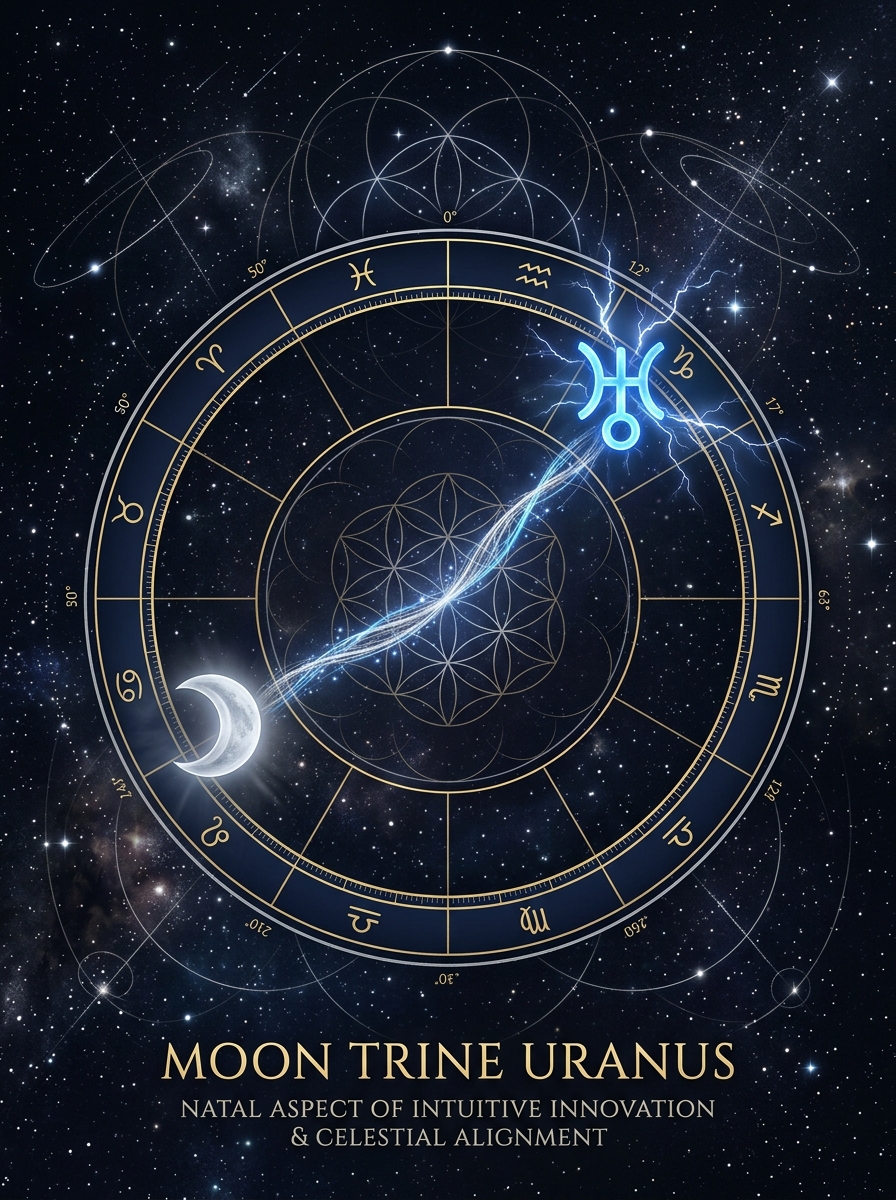
The core dynamic: when feeling meets freedom
Moon trine Uranus is not a tug-of-war between safety and rebellion. It is an instinctive handshake. The Moon craves belonging, habit, emotional nourishment; Uranus wants wakefulness, autonomy, the thrill of the new. In a trine, these two archetypes cooperate rather than clash. The result is a psyche that can feel deeply without getting stuck in emotional routine, and can innovate without cutting off its own heart. This aspect describes people whose emotional lives are less clingy and more adaptable—less sentimental and more responsive. They tend to process change faster than those around them, often saying “We can do this differently” with a calm that surprises others.
The geometry of the trine itself favors flow: planets in a 120-degree angle share the same element, and here the element is usually air or fire for Uranus and water or earth for the Moon depending on signs, but the harmony is between feeling and freedom. The native’s nervous system has been wired to tolerate change rather than resist it. Instead of equating security with repetition, they sense safety in flexibility. That is a profound mutation. It can become emotional intelligence or, if unconscious, a clever way to avoid being held.
Psychological roots: the nervous system that likes fresh air
People with this placement often discover that novelty regulates them—not as a thrill, but as a reset. A walk in an unfamiliar neighborhood, a sudden plan change, a new method for organizing the kitchen: these restore equilibrium. The psyche does not always calm down by going inward; sometimes it calms down by being interrupted. That distinctly Uranian instinct makes them comfortable with emotional improvisation. They may not know what they feel until they start speaking or moving, and their responses are quick but rarely shallow. Moods feel like events, not sentences.
This capacity often originates in childhood. The native may have grown up around emotional inconsistency, frequent moves, eccentric caretakers, or a household where predictability was scarce. They learned early to adapt without drama. The Moon absorbed the lesson that safety is not a fixed place but a responsive capacity. In some cases, the aspect marks a family member who eventually breaks a stale or coercive pattern—echoing the generational liberation described in the Uranus in the Fourth House dynamic.
What emerges is a form of intuition that lands sideways. The person can sense a room’s atmosphere before anyone speaks, feel when a relationship is about to shift, or know a solution that seems oddly modern or offbeat. This is not theatrical psychic ability; it is a fast, pattern-seeing intelligence embedded in the feeling body. The trine aspect amplifies this ease, making the insight feel natural rather than forced. But because it comes easily, the native may not realize how unusual their perceptual speed is—or how much others rely on slower, more steady emotional rhythms.
Shadow and maturation: from reactive novelty to humane originality
The shadow of a trine is never loud. Here, the risk is emotional underdevelopment through ease. Because handling change feels effortless, the native may use adaptation as a substitute for intimacy. They might always keep an exit strategy emotionally, a door ajar, never letting a relationship fully close around them. In love, they can love without suffocating—an attractive gift—but they may also underestimate how much ordinary continuity matters to partners. They might believe they are being kind by not demanding much, when in reality they are keeping themselves slightly unheld.
A second shadow: the body needs rhythm even when the mind likes freedom. People with this aspect can over-prioritize spontaneity and underrate the stabilizing value of sleep, meals, domestic order, or relational follow-through. During Uranus transits, this restlessness can become compulsive if the native has built a life around avoidance rather than genuine agency. A useful contrast is Uranus retrograde, where the revolutionary impulse turns inward; with a trine, the voltage is easier to live with, but the native still benefits from asking whether their freedom is creative or evasive.
Maturation refines these patterns. The highest expression of Moon trine Uranus is not mere eccentricity but emotional originality in service of life. The person learns that freedom is not only the right to move on; it is also the capacity to remain emotionally honest inside change. They stop using aliveness as an excuse to avoid attachment and begin using it to renew attachment without deadening it. That is a subtler art than rebellion, and it requires conscious effort. The psyche that can stay tender without staying static becomes a gift to others navigating transition—a model of belonging that does not require self-erasure.
How it plays out in a life
In practice, this aspect shows up most clearly where a person must respond to change under pressure. At work, they thrive in roles that reward emotional quickness, social agility, and improvisation—tech, freelancing, crisis response, creative fields where routine is not a cage. If Uranus lands in a house tied to daily labor, the specific expression deepens: for example, Uranus in the 6th House can make work itself a laboratory of freedom, while Uranus in the 11th House channels the energy into collective movements and unconventional friendships.
In love, they prefer companionship with room to breathe. They are drawn to unusual people, nontraditional arrangements, or partnerships that evolve through friendship. They detest emotional management and can be surprisingly resilient when a relationship changes shape. Yet their ideal bond must still be felt—if it becomes too abstract, the Moon can quietly go hungry. In family life, they often become the one who helps others navigate transition with minimal hysteria, saying the sane, unexpected thing.
Creatively, the imagination does not need a straight line. They excel at forms that reward insight, spontaneity, and the remixing of emotional material: music, editing, design, facilitation, experimental writing. They are rarely satisfied by repetition unless it is a tool, not a prison. For a deeper understanding of the planet that drives this aspect, the archetype of Uranus in astrology clarifies why its gift is less about rebellion than about awakening life that has gone numb. In a natal chart, Moon trine Uranus is a signature that the soul can stay tender without staying static—provided the native does not mistake ease for depth.
Related
- Sun Trine Uranus: The Free Spirit With a Center
- Moon Square Uranus: The Disrupted Heart and the Need to Break Free
- Moon Sextile Uranus: The Calm Spark of Emotional Freedom
- Moon Conjunct Uranus: The Nervous Moon and the Myth of Freedom
- Moon Opposition Uranus: The Restless Heart and the Lightning Nervous System
Comments
Loading comments…