Moon Square Uranus: The Disrupted Heart and the Need to Break Free
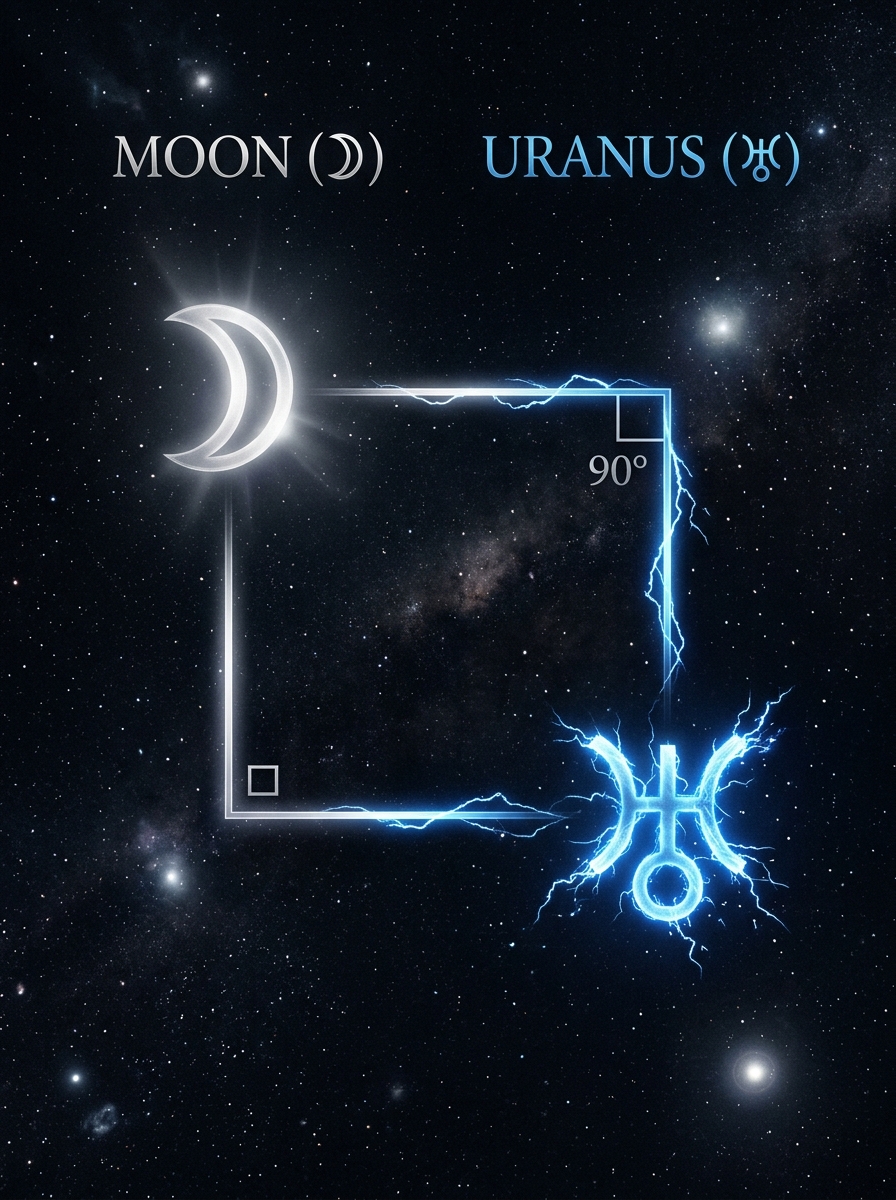
Moon square Uranus is not a personality quirk. It is a fundamental wiring conflict between two survival strategies: the Moon’s pull toward attachment, rhythm, and emotional continuity, and Uranus’s demand for autonomy, truth, and the right to be ungovernable. In a square, these drives do not alternate gracefully — they collide. The result is a psyche that experiences closeness as a potential trap and freedom as a potential abandonment. The person wants both, fully, and has not been given a design that allows both to coexist peacefully. That friction is the source of the aspect’s brilliance and its pain.
The Core Dynamic: When Safety and Freedom Are at War
The cleanest description of this aspect is a nervous system that cannot relax into predictability. The Moon organizes life around belonging, memory, and the body’s need for a trusted container. Uranus organizes life around awakening, rupture, and the refusal to be domesticated by expectation. When they meet in a square aspect, the person develops an inner reflex: I need you, and I need out. Both statements are true, and the tension between them is the aspect’s engine.
This often shows up as emotional intermittency. The native may be deeply tender, then suddenly detach — change plans, disappear into work, or deliver a startlingly honest remark at the worst possible moment. The interruption is not a lack of feeling; it is a defense against being absorbed, managed, or made predictable. The psyche treats closeness as a potential loss of self, and it will break the rhythm before the rhythm breaks it. For the native, this feels less like rebellion and more like survival.
A Somatic Signature of Voltage
Uranus carries electricity, speed, and surprise. In a hard aspect to the Moon, that voltage enters the emotional body directly. The person may startle easily, sleep lightly, dislike domestic routine, or feel internally “online” in a way that makes rest difficult. Even affection can activate vigilance: How much is too much? How quickly will this shift? The body resists being anchored, and the result is often a life that includes movement, variation, and occasional chaos to stay regulated.
This is why the aspect frequently appears in charts of people who need to keep options open — not out of indecision, but because commitment feels physically constrictive. The challenge is that the more one tries to control change, the more trapped the nervous system can feel. When the pattern becomes extreme, it can echo the pressure-cooker quality of a T-square: the life becomes a crucible, not a shelter. The native must learn to distinguish stimulation from depletion, or the voltage becomes a liability.
Psychological Roots: The Childhood of Unpredictable Mirrors
The domestic story is often where Moon square Uranus becomes most legible. Early life may have included inconsistency — emotional unpredictability, sudden changes, unusual household conditions, or caregivers who were themselves hard to pin down. Even a materially secure home can feel emotionally irregular if love arrived in fits and starts or if autonomy was granted and then withdrawn without warning. The adult then develops a nervous expectation of interruption.
This background can produce two postures. One is a lifelong drive to create a home that never cages anyone — a domestic space where freedom and affection coexist. The other is a suspicion of home itself, a tendency to treat domesticity as a trap and to keep moving before any place can claim too much of the self. For more on how this plays out when Uranus is actually in the fourth house, see Uranus in the Fourth House. Either way, belonging becomes a question of design rather than accident. The native must learn how to build a container that does not become a prison.
The Somatic Memory
Because the Moon rules bodily rhythm, this aspect often has a bodily dimension. The person may experience stress as restlessness, insomnia, digestive irregularity, or a sense that the body itself resists routine. They may need a life that includes movement, variation, and surprise in order to stay emotionally regulated. That does not mean chaos is healthy; it means that rigidity is metabolically expensive. The mature path is to find a chosen rhythm — enough predictability to soothe the Moon, enough openness to honor Uranus.
The Mature Expression: Emotional Innovation and the Courage to Be Real
The gift of Moon square Uranus is not mere independence; it is emotional innovation. These people often sense, before others do, when a family pattern is dead, a relationship contract is stale, or an inherited idea of “how things should feel” no longer fits real life. They may be the first in their lineage to name what was previously unspoken. In Jungian terms, Uranus functions like a disruptive messenger from beyond the approved personality, forcing contact with disowned truth. The psyche does this not to be difficult, but to avoid psychic deadness.
This is often the signature of someone who cannot fake emotional consensus for long. They may be highly sensitive to hypocrisy in the home, in partnership, or in social expectations around care. Their instincts can be startlingly progressive: a desire for unconventional family structures, unusual living arrangements, nonstandard rhythms of affection, or a private emotional life that refuses public inspection. For a deeper dive into the archetype behind this, see Uranus in astrology. When the square is lived well, the person does not abandon feeling in the name of liberation, nor abandon liberation in the name of comfort. They become someone who can love without anesthetizing themselves, and who can change without betraying what is human in them.
The Bright Side of Unpredictability
At its best, this aspect produces emotional quickness, improvisational intelligence, and a remarkable capacity to recover from shocks that flatten other people. The person may become the one who stays lucid in a crisis because part of them is already accustomed to discontinuity. They may be inventive caregivers, astute observers of family systems, or artists whose work carries an unmistakable pulse of the unscripted. There is also a fierce moral dimension: Uranus seeks not only novelty but truth. A Moon square Uranus native often feels ethically repelled by emotional manipulation, guilt as control, and the demand to perform sameness for the sake of appearances.
The Shadow Terrain: Volatility as Armor and the Fear of Being Known
The shadow side is not unpredictability itself, but the way unpredictability can become identity armor. If the person has learned that emotional closeness equals loss of freedom, they may unconsciously make themselves difficult to read so no one can possess them. They may cultivate a contrarian style, not because they genuinely disagree, but because being hard to pin down feels safer than being emotionally legible.
This can show up as a subtle contempt for neediness — including their own. The native may pride themselves on self-sufficiency while secretly suffering from loneliness, or they may destabilize a promising bond the moment it starts to feel meaningful. In some lives the drama is dramatic; in others it is quieter but more corrosive: chronic over-stimulation, chronic under-attachment, a habit of treating restlessness as wisdom. When the rebel impulse becomes a reflex, it narrows life rather than expands it. For a related lens on how the same archetype can internalize the revolution, see Uranus retrograde, where the change begins in secret before it ever appears externally.
When Freedom Fuses with Fear
The square is not trying to make the person unlovable. It is exposing the places where freedom has become fused with fear. The task is to differentiate the genuine need for autonomy from the defensive flight that prevents intimacy. This requires learning that dependence is not the same as captivity, and that freedom without attachment can become exile. The mature expression of this aspect learns to hold both: a self that can surrender without disappearing, and a self that can stand apart without hardening.
Living the Aspect: Navigating Love, Work, and Self
In relationships, Moon square Uranus often brings attraction to unusual, brilliant, unavailable, or hard-to-classify people. Conventional emotional predictability may feel dull, while intensity without spaciousness feels suffocating. These natives usually do best when love includes room for difference, separate interests, and an honest tolerance for mood shifts. If forced into emotional surveillance or expected to be continuously available, their system will rebel. Their freedom impulse is not a lack of love; it is often what protects love from becoming numb.
In work and vocation, the same dynamic applies. Routine-heavy roles drain them unless there is variation, intellectual surprise, or a mission that aligns with their need for authenticity. They may excel in fields that require crisis response, innovation, or unconventional problem-solving. The house placement of Uranus shapes the specifics. For example, Uranus in the First House expresses the square as visible eccentricity and defensive independence; Uranus in the Eleventh House routes the need for belonging through communities that value difference; Uranus in the Fifth House turns the emotional voltage into creative risk. When the square is part of a larger pattern like a T-square in your birth chart, the pressure becomes even more directive: the life asks for a craft, not just a coping strategy.
The practical work is twofold: build enough structure to soothe the Moon, and leave enough margin to honor Uranus. That might mean a home with flexible routines, a career with project-based intensity, or relationships with clear boundaries that allow for solitude. The goal is not to eliminate the tension — that is impossible — but to give it a container that transforms voltage into vitality. The Moon square Uranus native is not here to be comfortable. They are here to prove that emotional freedom and emotional intimacy can coexist, even if the proof takes a lifetime.
Related
- Moon Opposition Uranus: The Restless Heart and the Lightning Nervous System
- Sun Square Uranus: The Self That Refuses to Sit Still
- Moon Conjunct Uranus: The Nervous Moon and the Myth of Freedom
- Moon Sextile Uranus: The Calm Spark of Emotional Freedom
- Moon Trine Uranus: The Calm Current of a Restless Soul
Comments
Loading comments…