Moon Opposition Uranus: The Restless Heart and the Lightning Nervous System
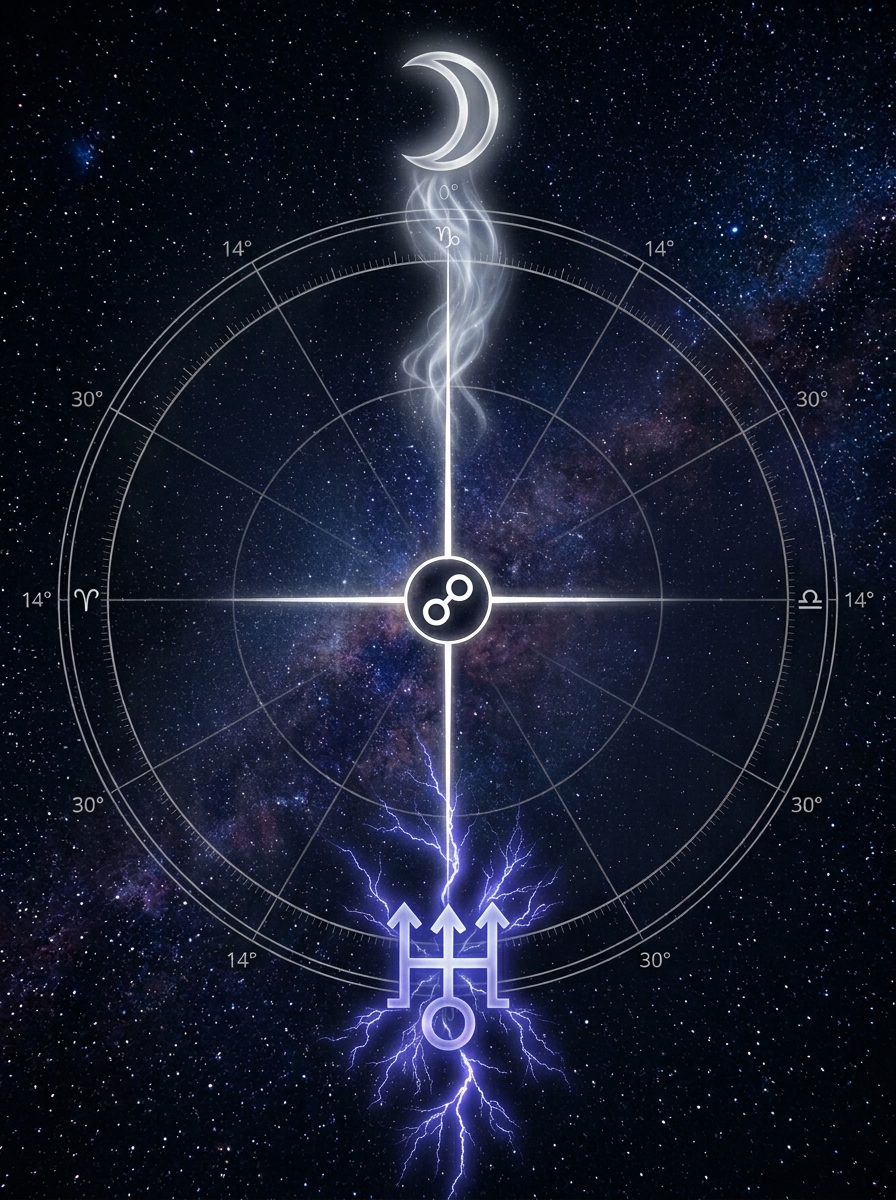
The Fault Line Between Attachment and Autonomy
Moon opposition Uranus describes a psyche organized around an irreducible tension: the part of you that wants to be held, anchored, and predictable is in direct conflict with the part that will do anything to remain uncontained. The Moon seeks rhythm, familiarity, and emotional osmosis; Uranus seeks rupture, novelty, and the shock of the new. In a 180-degree opposition, neither side can be pacified by ignoring the other—they are locked in a perpetual mirroring that forces consciousness into the narrow space between them.
The result is a person whose inner weather changes without warning. A mood can shift from intimate to irritable in a breath, not because anything external provoked it, but because the psyche registered a loss of freedom before the mind did. The native may sincerely want closeness and, in the same instant, feel endangered by the very terms of closeness. This is not indecision; it is a split in the emotional operating system. The Moon cannot trust safety if it feels like a cage. Uranus cannot trust freedom if it feels like abandonment.
What looks like inconsistency to others is actually a nervous system that has learned to equate predictability with suffocation and surprise with survival. The opposition is not a problem to be solved but a polarity to be mediated—and that mediation begins by understanding where the wiring came from.
The Wound Behind the Wiring
This aspect almost always has a biography. The early environment likely failed to provide both secure attachment and breathing room. Perhaps a caretaker was physically present but emotionally erratic—loving one moment, aloof the next; attentive then suddenly invasive. Or the family was stable in structure but psychically charged: high-strung, intellectually cool, or unspokenly volatile. In such conditions, the child learns that closeness is not reliably restful. The nervous system develops a double reflex: reach for connection, then brace for the moment it turns into obligation.
The Moon in opposition to Uranus often originates in a home where emotional safety came with strings attached—where love meant surveillance, or loyalty required self-suppression. The child who grows up with this imprint either becomes the family shock absorber (smoothing over disruptions) or the family dissident (refusing the emotional script entirely). Both are Uranian solutions to a lunar wound. The first over-functions out of hypervigilance; the second exits preemptively. Neither inhabits the world from a place of trusting vulnerability.
This history lives in the body. The Moon rules sleep, appetite, digestion, rhythm; Uranus rules sudden discharges of tension. Together they produce a somatic signature that is exquisitely responsive and hard to regulate. Sleep is light or interrupted. Appetite swings with mood. The native may feel “fine” until one extra demand tips the system into shutdown, irritation, or a desire to vanish. This volatility is not immaturity—it is a survival strategy that has outlived its context. The task is not to become less sensitive but to give sensitivity a structure that does not strangle it. For those whose early home life was the crucible, the Uranus in the Fourth House placement often mirrors this same struggle to belong without being consumed.
Where the Split Becomes Self-Sabotage
In adult life, the unmediated opposition tends to reproduce the original wound. Relationships follow a familiar pattern: a surge of attraction and warmth, followed by a slow or sudden retreat. The native may choose partners who are stimulating, unconventional, and mentally quick—only to recoil when the bond asks for predictability. Or they may become the “cool” partner, prized for independence while privately starving for tenderness. Either way, the core problem is the same: intimacy is experienced as a pressure system, and the impulse to break the seal can feel like a matter of survival.
This dynamic is especially pronounced in romantic partnerships, where the Moon’s need for closeness and Uranus’s need for space collide daily. The native may accuse themselves of being broken—but the pattern is structural, not personal. The Uranus in the Seventh House configuration externalizes this exact polarity into the relationship itself; here, the opposition makes the inner split the relationship’s central drama.
At work, the aspect resists monotonous systems and rigid authority. The native thrives in roles that allow improvisation, crisis response, or creative disruption—but may undermine their own consistency. They start with brilliance, then rebel against the very structure that would let that brilliance endure. The Uranus in the Sixth House placement intensifies this friction in daily labor, turning routine into a battleground. The lesson is not to become obedient; it is to learn the difference between a dead pattern and a sustaining one. Uranus is allergic to deadness, but the Moon still needs a rhythm to digest life.
The Mature Form: Emotional Originality Without Panic
The gift of Moon opposition Uranus is that this tension, when held consciously, produces something rare: emotional intelligence that is not sentimental, intuition that is not vague, and a radical honesty that refuses canned scripts. These people perceive social atmosphere, hidden tension, and the stale air of convention with unnerving speed. They can feel the fracture line in a family system or a workplace long before it breaks. That is Uranian insight filtered through lunar sensitivity—not detached analysis but emotionally accurate perception.
In creative work, this translates into art that feels alive because it does not flatter the expected emotional pose. In relationships, it can produce bonds that allow solitude, eccentricity, and direct communication without the usual pretense. The native may build families of choice, unconventional homes, or work schedules that reduce psychic suffocation. They reinvent emotional forms because they know, from deep experience, that security must evolve to remain real. This inventive impulse aligns with the broader rebellious spirit of Uranus in Aquarius, where the personal becomes the template for collective liberation.
Integration does not mean becoming calm all the time. It means becoming less possessed by the swing. The native learns to pause before detonating a bond, to ask whether the urge to flee is genuine intuition or an old reflex. They learn that a desire for space does not necessarily mean the relationship is wrong, and a desire for closeness does not mean freedom must be sacrificed. Maturity here is not the triumph of one side over the other—it is a life in which emotional truth can move without panic and independence can be honored without abandonment. That lifelong negotiation is the developmental task, and it is often awakened or clarified during Uranus transits, which force the old arrangement to catch up with what the soul already knows.
The person with this aspect does not need to become normal. They need to become fluent in both tongues: the one that says “I need safety” and the one that says “I need to remain myself.” The life that honors both is rarely conventional, but it is usually alive—and for this configuration, aliveness is the deepest form of home.
Comments
Loading comments…