Moon Sextile Uranus: The Calm Spark of Emotional Freedom
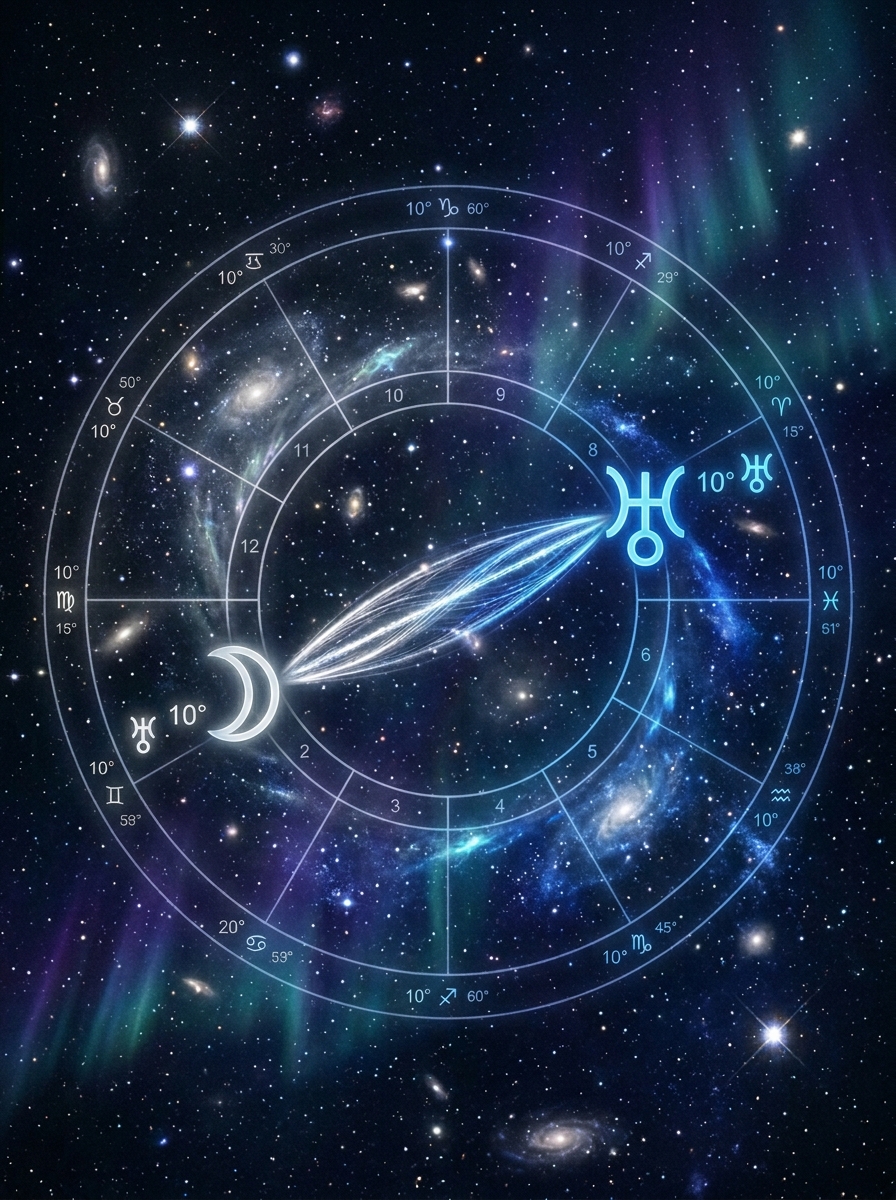
Moon sextile Uranus describes a psyche that can feel deeply without becoming inert, and change without becoming chaotic. The Moon wants continuity, instinct, and belonging; Uranus wants waking up, loosening the grip, and making room for the unforeseen. In sextile, they cooperate. The result is emotional intelligence with a live wire in it: responsive, inventive, hard to sentimentalize, often quicker than the people around it to sense when a feeling, relationship, or environment has gone stale.
The Core Dynamic: Feeling That Does Not Fossilize
A sextile is an aspect of opportunity, not compulsion—a 60-degree angle that invites conscious participation. When the Moon and Uranus form this connection, the native inherits a temperament where emotional originality is not an occasional disruption but a regular resource. The Moon registers safety, memory, habit, and the private motions that shape a life before language catches up. Uranus is the shock of the new, the refusal to be trapped by inherited scripts, the impulse to individuate. In sextile, these principles cross-pollinate rather than cancel each other. Emotional life becomes adaptable rather than merely reactive, and originality becomes livable rather than merely rebellious.
This is not the drama of a square or opposition. It tends to work through opportunity, not crisis. The person usually has a natural opening to novelty: a knack for trying something different, recovering quickly from an emotional reset, or intuitively sensing that a change will be liberating before it is obvious to everyone else. The broader logic of the astrological sextile clarifies how this aspect activates latent potential without forcing it. In this chart contact, the Moon does not fear Uranian weather; it has a window that opens toward it.
What that often looks like in real life is a temperament that keeps one foot in intimacy and one foot in air. These people may value home, family, and emotional reliability, yet they also need space, experimentation, and the right to revise their feelings as they go. They are often the family member who introduces a new idea without making a doctrine of it, or the friend who can discuss something painful without drowning in it. Their emotional body wants to breathe.
Emotional Reflex, Not Emotional Rigidity
A hard lunar configuration can make a person defend a pattern long after it has stopped serving them. Moon sextile Uranus is more elastic. Feelings can shift, and the chart holder is often willing to admit it. That sounds simple, but it is psychologically rare. Many people confuse consistency with health. This aspect suggests another standard: the capacity to stay honest with changing needs.
That honesty can appear almost suspicious to others. The person may be surprisingly detached in moments that would produce theater in another chart. But detachment is not the same as emptiness here. More often, it is a nervous system that knows how to step back far enough to see the shape of the emotional problem. In that sense, the sextile can resemble a refined form of Uranus in astrology applied to feeling itself: not rebellion for its own sake, but liberation from emotional automatism.
Psychological Roots: The Nervous System Learns to Trust Surprise
The Moon governs the internal climate—the preverbal register of safety, threat, and attachment. Uranus governs the impulse to break free from inherited scripts. In a sextile, these two drives do not fight; they inform each other. The native’s early environment likely contained enough stability to allow for novelty without panic. Perhaps a parent who encouraged curiosity, a childhood home that tolerated eccentricity, or a significant disruption that arrived early enough to be integrated rather than traumatized. The result is a nervous system that does not interpret surprise as danger.
This is not to romanticize instability. The sextile works because it operates within a supportive baseline. The Moon must feel fundamentally secure before it can welcome Uranian interruptions. When that baseline is present, the person develops an intuitive intelligence about emotional atmosphere. They pick up on shifts in tone, subtext, and collective mood before they can explain what they know. They excel in environments where feeling and cognition need to move together: caregiving with autonomy, creative work under pressure, social organizing, counseling with unconventional methods.
The Moon here is not simply sentimental; it is perceptive. Uranus sharpens that perception, giving it speed and pattern recognition. The person may notice when a room is lying, when a family story is outdated, or when a private habit has become an emotional prison. They often make good improvisers because they can read the field and adjust without losing themselves. There is a clear kinship here with the more open, innovation-friendly side of the sextile as a whole, the logic explored in the astrology of the sextile aspect. This is a chart signature for latent potential that awakens through contact with new experiences, new people, and new ways of naming what is felt.
The Subconscious Wiring: Emotional Autonomy as a Birthright
Where other lunar configurations may fuse attachment with dependency, Moon sextile Uranus keeps a subtle boundary intact. The person can love without dissolving, care without caretaking. This is often traced to an early experience of being allowed to have feelings that did not match the family script. They may have been the child who said the uncomfortable thing, or who needed solitude after a family gathering. That space was granted, or at least not punished. As a result, they grew up with a nonnegotiable sense of emotional autonomy. They do not automatically conflate closeness with surrender.
This wiring is not cold. It is simply more porous than most. The challenge is that it can be misinterpreted by others as aloofness or unreliability, especially in cultures that equate emotional availability with constant accessibility. The native may find themselves explaining their need for alone time, their tendency to change plans, their refusal to perform consistency. The work is to learn when that explanation is necessary and when it is a defense.
Maturation vs. Shadow: The Gift of Elasticity and the Risk of Evasion
The best expression of Moon sextile Uranus depends on timing. Uranus works in flashes; the Moon works in cycles. Together, they produce someone who can benefit from interruption, movement, and periodic reinvention, but not from constant upheaval. Too much change, and the lunar side becomes frayed. Too little, and Uranian energy starts to leak out as restlessness, bizarre emotional exits, or an itch for disruption that seems to come from nowhere. The art is to build a life where freshness is scheduled into the structure before boredom turns it into sabotage.
As the aspect matures, the native learns to distinguish between a genuine need for novelty and a reflexive escape from emotional depth. The shadow emerges when Uranian freedom becomes an avoidance strategy. The person may prefer relationships that are stimulating, intellectually open, and slightly unconventional because those forms allow movement. But when the bond needs emotional patience, they may feel the urge to disappear into principle, independence, or cleverness. This is where the Moon becomes protective to a fault. It wants to preserve a livable inner world, and Uranus can convince it that escape is the same as preservation.
The lesson is not to become less original. It is to differentiate between a healthy need for space and a conditioned exit triggered by the first sign of emotional compression. This is especially important if the Moon is otherwise heavily emphasized in the chart or if Uranus is angular, in a fire or air sign, or strongly tied to the chart ruler. Pages on Uranus in the First House and Uranus in the Seventh House can clarify how the same planetary voltage behaves when rooted in self-expression or partnership rather than just operating as an aspect.
The Grace of Intelligent Distance
When well-developed, this aspect grants a kind of emotional sovereignty that is rare. The person does not panic when a relationship changes shape, a feeling evaporates, or a life chapter ends. They have built-in resilience because they have always known that feelings are not permanent fixtures. This does not make them heartless; it makes them honest. They can stay present through grief or conflict without losing their center, because they trust that the emotion will move through and that they will remain intact.
This is also the source of their social magnetism. Their authenticity is not a pose. They do not merely talk about being themselves; they can actually metabolize change without losing their core. The Moon gives the Uranian impulse a human scale. Uranus gives the lunar nature courage to revise itself. Together, they produce someone who is not afraid of being different, but also not interested in difference as a costume.
Expression in a Life: Love, Work, and the Architecture of Freedom
The dynamic already described—elastic emotional intelligence paired with a need for autonomy—shapes every domain of life, but it does so through the same lens. No separate analysis is required. In love, the native often gravitates toward partners who are self-contained, inventive, or comfortable with a nonstandard rhythm. Emotional monotony is more repellent than emotional intensity. The relationship must have oxygen. They may prefer unconventional arrangements: living apart, long-distance intervals, partnerships built around shared projects rather than shared rooms. The key is that closeness does not require self-betrayal.
In work, Moon sextile Uranus favors roles that reward quick adaptation and humane originality. These people often thrive in settings where they can improve process, introduce novel methods, or respond to changing conditions without being micromanaged. They tend to dislike being trapped in dead routines. The chart can resemble the more inventive strain of Uranus in the Third House or Uranus in the Eleventh House when the aspect is emphasized by house placement: ideas, networks, and systems become channels for emotional intelligence.
In family life, the aspect can indicate a person who either came from an unusual domestic atmosphere or became the family member who unconsciously breaks old patterns. Sometimes both. They may be the one who modernizes the emotional culture of the household: speaking openly, refusing inherited taboos, or making room for difference without dramatizing it. If the family system is rigid, they can become the circuit breaker. If it is already unconventional, they may become its most emotionally literate member. For more on how Uranus behaves when rooted in the home, see Uranus in the Fourth House.
The Inner Story: A Myth of Revision
Psychologically, this aspect often belongs to someone whose life narrative includes a turning point where change was not merely disruption but rescue. They may have discovered, early or later, that what felt destabilizing also freed them from a stale allegiance: a family role, a mood pattern, a self-image built for survival rather than truth. That is the Uranian blessing. It does not always arrive gently, but in a sextile it can arrive with enough grace that the person learns to welcome revision before collapse forces it.
This is one reason Moon sextile Uranus can mature beautifully. The older the native gets, the less interested they are in proving consistency for its own sake and the more interested they are in maintaining aliveness. That shift is profound. It turns the emotional life from a museum into a living instrument. They become experts at redesigning the container without spilling the contents.
Synthesis: Freedom That Can Be Felt, Not Just Claimed
Moon sextile Uranus is the aspect of emotional originality with a social face. It makes a person potentially magnetic because they do not merely talk about authenticity; they can usually metabolize change without losing their center. The Moon gives the Uranian impulse a human scale. Uranus gives the lunar nature courage to revise itself. Together, they can produce someone who is not afraid of being different, but also not interested in difference as a costume.
The most elegant expression of this aspect is a life in which closeness does not require self-betrayal. That may mean unconventional friendships, flexible partnerships, unusual work rhythms, or a home life that honors both privacy and spontaneity. The point is not eccentricity. The point is fit. When the chart is well lived, the native discovers that emotional safety is not the absence of change; it is the capacity to remain oneself through change.
For readers mapping this aspect against the rest of the chart, it can be useful to compare it with other subtle reintegration signatures, such as the semi-sextile in astrology and its quieter evolutionary tensions. But Moon sextile Uranus does not ask for martyrdom or discipline as much as it asks for alertness. Keep the channels open. Let feeling move. Let the pattern update. The psyche stays alive that way.
Related
- Moon Square Uranus: The Disrupted Heart and the Need to Break Free
- Sun Sextile Uranus: The Genius of Awake Selfhood
- Moon Conjunct Uranus: The Nervous Moon and the Myth of Freedom
- Moon Opposition Uranus: The Restless Heart and the Lightning Nervous System
- Moon Trine Uranus: The Calm Current of a Restless Soul
Comments
Loading comments…