Moon Sextile Pluto: The Quiet Alchemy of Emotional Power
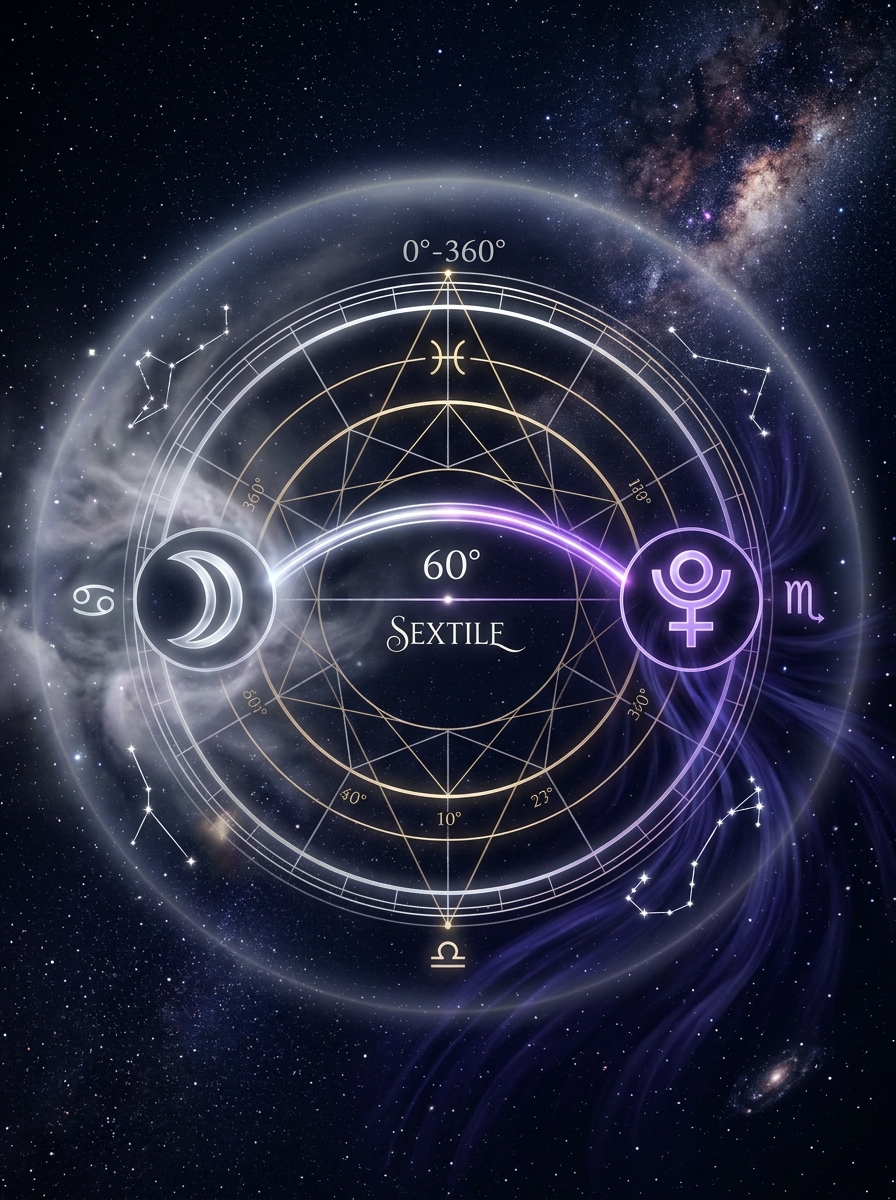
The Moon sextile Pluto chart signature is not a collision of sensitivity and power. It is a collaboration. The Moon governs instinct, memory, need, and the private weather of the psyche; Pluto governs intensity, x-ray perception, and the intelligence of death and rebirth. In a sextile—a sixty-degree geometry of opportunity rather than guarantee—these two forces do not fight or fuse. They offer each other a skill. The Moon learns to look beneath itself. Pluto learns to feel its way into the human room without crushing it. The result is emotional depth that stays usable: a person who can enter psychological darkness without mistaking it for doom.
The Core Exchange: Instinct Meets X-Ray Sight
A sextile does not force action the way a conjunction or square does. It opens a channel that must be worked. Here, the channel runs from raw feeling into diagnostic insight. The Moon does not merely react; it registers pattern in tone, silence, body language, and timing. The person often knows something is wrong before they can name it. Pluto sharpens that vague unease into something surgical—a quiet instinct to ask: What is really happening? What fear, attachment, hunger, or grief is hiding under the surface?
This produces what could be called emotional x-ray vision. The native understands other people’s protective mechanisms almost before those people do. They read shame, coercion, submerged longing, and the way loyalty can be used as a cage. They are not necessarily psychic in the theatrical sense; their Moon has been tutored by Pluto to distrust the obvious. For a fuller understanding of the aspect’s triggerless nature, the logic of the sextile aspect meaning lays out why this geometry rewards deliberate use rather than automatic expression.
The deeper thesis here is that the psyche can survive more truth than it first believes. Pluto wants reality without anesthesia. The Moon wants safety, continuity, belonging. In a sextile, the two drives negotiate. Emotional security is not built by avoiding intensity but by metabolizing it. The person learns that feeling everything is not the same as being overwhelmed by everything. That gives this aspect a particular poise: under pressure, the native becomes more private, more focused, more quietly formidable. They do not perform distress. They process it.
Where the Skill Comes From: Early Training in Subtext
This aspect rarely appears in a vacuum. Most people with Moon sextile Pluto grew up sensing more than they were told. Their families often had secrets, unspoken grief, power struggles, or an atmosphere in which everyone knew what not to mention. Even in outwardly stable homes, there was emotional complexity beneath the surface. The native learned early that feelings have consequences—that a withheld look or a too-quick change of subject could hide a wound that still bled.
That training produces two outcomes, sometimes simultaneously. One is genuine emotional maturity: the child becomes the family interpreter, the one who can translate subtext, mediate tension, or absorb the climate of the home. The other is hypervigilance: a persistent scanning for hidden threat, a habit of testing loyalty in silence, a private ledger of who can be trusted and who cannot. This early patterning shapes how the Moon uses its Pluto-given depth. If the family system was particularly controlling or secretive, the native’s gift for reading below the surface may harden into suspicion. If the family allowed emotional truth to be named—even painfully—the gift becomes a form of healing intelligence.
The specific house placement of Pluto often roots this training. A Pluto in the 4th house tends to excavate family memory and ancestral patterns; the native may spend years unwrapping inherited emotional contracts. A Pluto in the 8th house pushes the training into intimacy, sexuality, and the territories of shared power—the native learns to read what others hide in the closest bonds. But regardless of house, the skill is the same: the ability to sense what is real beneath what is said.
The Grown Version vs. the Guarded Version
When integrated, Moon sextile Pluto produces a rare capacity: containment without repression. Repression seals feeling until it mutates into symptom or explosion. Containment is the ability to hold strong material—another person’s grief, a family secret, a crisis, a complicated truth—without spilling it all over the floor. The native does not panic the room. They become the person others call when things fall apart, because their presence invites whatever is raw to land safely.
This containment has a regenerative edge. The aspect often gives a practical relationship to emotional death and rebirth. The person goes through phases that feel like psychic shedding: an old attachment outgrows itself, a family role expires, an identity loses its charge, a relationship ends, and something more honest emerges. Pluto is never concerned with preserving the shell. The Moon insists that what is reborn must still be livable. That tension makes the native surprisingly good at long-term healing work, because they do not romanticize pain and do not fear it either.
But the sextile has a shadow, and it is not emotional chaos—it is emotional control. The person may be tempted to manage feeling too tightly, to test loyalty, to withhold until safety is proven, to keep score in silence. This is not always manipulative in the crude sense; it is often a learned survival strategy. If feelings can wound, they must be measured. If love can betray, it must be vetted. That instinct makes sense, but it can narrow the life.
The power dynamic is always present. Because Pluto is a planet of power, the native may become adept at knowing what matters most to others and may use that knowledge gracefully or defensively. Under stress, insight becomes surveillance. They may read too much into pauses and omissions, or feel compelled to probe when directness would be cleaner. The shadow question is not “What are they hiding?” but “What am I hiding from myself?” That inward turn is essential, especially if Pluto sits in a house tied to public image or partnership, such as the 10th house or the 7th house.
A Life Lived Below the Surface
This aspect is easiest to recognize in the places where trust, loyalty, and emotional truth matter—not as abstract ideals but as daily practices. It shapes how the native loves, works, and moves through crisis, all from the same well of depth.
In love, the native is rarely casual for long. They want emotional honesty and the sense that intimacy can survive reality. When attached, they are profoundly devoted. When threatened, they can retreat behind silence or test their partner’s commitment. But the sextile’s constructive nature means they are capable of extraordinary trust-building because they tolerate the revealing process. The relationship does not have to be perfect; it has to be true. This makes the aspect highly compatible with partners who value depth and do not require constant performance.
In work, Moon sextile Pluto favors roles that require calm under pressure and sensitivity to hidden dynamics. The native excels where others unravel: psychology, crisis response, research, strategy, trauma-informed care, or any field in which the real issue is not the obvious one. If Pluto is strongly placed in the 3rd house or the 6th house, this depth applies to diagnostics, analysis, and the repair of systems. The highest expression is discernment used in service of healing, not control for its own sake.
In crisis, the native does not unravel. They go quiet, focused, almost unnervingly steady. They have an instinct for the one question that cuts through the noise. This is not emotional hardness; it is emotional truthfulness with a backbone. They can enter the dark because they have been there before and know the way out.
The Evolutionary Edge: Depth Without Worship
Moon sextile Pluto asks for emotional courage with discipline. The native already has access to depth; the lesson is how to use it cleanly. If the aspect remains unconscious, it turns into suspicion, withholding, emotional tests, or a private addiction to intensity—a habit of seeking the raw and the hidden for their own sake. If it is integrated, it becomes one of the chart’s most useful signatures for resilience.
The mature form is not emotional hardness. It is the ability to feel deeply without dramatizing depth, to perceive what is hidden without becoming captive to suspicion, to transform pain without turning pain into identity. The native learns that Pluto does not require them to live in the underworld; it only asks that they be willing to go there when the work demands it. Pluto transits often reveal precisely where the psyche has avoided surrender—grief, power, dependency, buried truth—and the sextile’s channel makes these transits less destabilizing and more instructional. If natal Pluto is retrograde, the inwardness of this aspect becomes even more pronounced; the Pluto retrograde lens can clarify why the native’s depth sometimes feels more private and harder to articulate.
The quiet miracle of Moon sextile Pluto is that it makes survival psychologically intelligent. It does not promise a painless life. It promises that you will be able to use what happens to you—not as a badge of suffering, but as raw material for a more truthful self.
Related
- Moon Trine Pluto: Emotional Depth, Psychic Instinct, and Quiet Power
- Moon Conjunct Pluto: The Emotional Underworld and the Power to Rebirth
- Saturn Sextile Pluto: The Art of Enduring Power
- Sun Sextile Pluto: Quiet Force, Clean Will, and the Gift of Reinvention
- Moon Opposition Pluto: The Emotional Cataclysm and the Promise of Rebirth
Comments
Loading comments…