Moon Conjunct Pluto: The Emotional Underworld and the Power to Rebirth
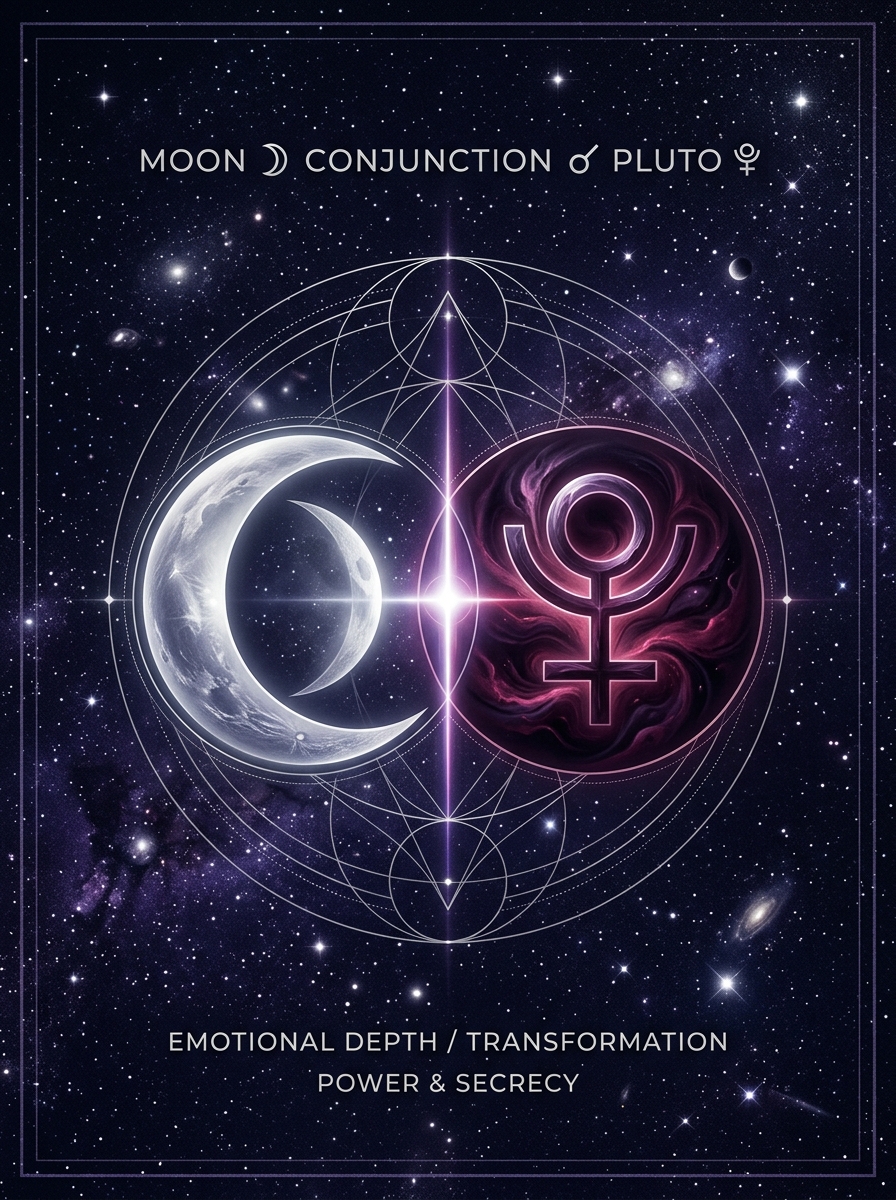
Moon conjunct Pluto does not merely intensify emotion — it rewires the nervous system for depth. The Moon governs instinct, memory, attachment, and the body’s sense of home. Pluto governs the underworld: what is hidden, taboo, compulsive, and regenerative. When they merge in a conjunction, feeling becomes a form of survival intelligence. The native does not take emotional data at face value; they register subtext, silence, the weight of a glance. This is x-ray sensitivity, not ordinary empathy. Vulnerability feels dangerous, which is why the same person can be profoundly nurturing and fiercely armored. The core dynamic is simple: emotional truth and emotional safety are fused so tightly that the psyche treats every relationship as a potential minefield and every loss as a death that must be metabolized.
The crucible of early attachment
The Moon is the imprint of early caregiving — the atmosphere of the nursery, the mother’s mood, the rhythms of belonging. With Pluto fused to it, the childhood environment is rarely neutral. It may be saturated with unspoken stress, a parent’s hidden grief, addiction, power struggles, or a love that came with conditions that had to be read like omens. The child becomes an expert in the emotional weather: they learn to detect shifts in tone before a word is spoken, to sense when a silence is a weapon or when a smile is a mask. This is not pathology; it is adaptation.
The maternal bond — or its absence — often carries an intensity that echoes through adulthood. The mother figure may have been magnetic and invasive, wounded and controlling, or present in body but absent in soul. Even in loving households, the child may feel that love is contingent on performance or loyalty. The result is a deep, often unconscious equation: to be seen is to be vulnerable; to be vulnerable is to risk annihilation. This early training colors every later attachment, which is why this conjunction resonates with Pluto in the Fourth House themes even when the planet is not literally there: the home becomes a crucible where the psyche learns that intimacy and power are inseparable.
Gifts and shadow of the deep feeling self
The supreme gift of Moon conjunct Pluto is the capacity to hold the unbearable. These natives can sit with grief, rage, shame, family trauma, or complicated desire without flinching. They are natural crisis holders — the friend you call when the secret has to be told, the therapist who does not look away from the wound. They understand that healing is not cosmetic; it is descending, encountering, and transforming. This depth makes them compelling artists, investigators, midwives, strategists, and caregivers. They sense what others avoid. That quality has kinship with Pluto in the Eighth House, though the conjunction is more personal: the underworld is not an abstract subject but a lived atmosphere.
The shadow is that the same perception can turn toward control. Pluto does not merely observe; it seeks leverage. When the native feels unsafe — and they often do — they may withhold, test, probe, or quietly dominate to restore a sense of order. Sometimes this is conscious; more often it is a reflex. The deeper danger is a pattern of psychic siege: expecting betrayal, then behaving in ways that invite it, or demanding total honesty while concealing their own core vulnerability. Love becomes a field of surveillance. The cure is not naivety; it is learning that intimacy can survive imperfection, delay, and incomplete certainty. This inner work is often forced to the surface during Pluto transits, which hit Moon-Pluto natives with unusual weight, demanding that the old survival strategies be surrendered.
How it lives in relationships, work, and creative expression
In intimate partnership, Moon conjunct Pluto wants emotional nakedness, not polite companionship. The native cannot tolerate superficiality; they sense it like a rotten floorboard. They may provoke conflict to force honesty or withdraw into protective silence when the bond feels fake. A partner who is evasive or weak-willed triggers the deepest defenses. A partner who can tolerate intensity without escalating it offers a rare gift: the experience of intimacy as transformation rather than threat. This aperture to the power dynamics of love aligns with Pluto in the Seventh House, where relationship becomes the arena where control and surrender are negotiated.
In work, the conjunction often expresses as a calling to handle crisis, manage confidential information, or work with emotionally charged material. Psychology, medicine, criminal investigation, crisis response, finance, research — any role that requires discretion and penetration suits the native. They need stakes; superficial duties atrophy them. At its worst, the work life becomes a stage for compulsive involvement — enmeshing in office politics, carrying intensity into every task. At its best, it is a sanctuary where depth is an asset. If the chart also emphasizes daily routines and physical health, the pressure can channel through work and the body, echoing Pluto in the Sixth House: the job becomes the field where power, anxiety, and healing meet.
Creatively, Moon-Pluto people do not merely imagine emotion; they excavate it. Their art — whether painting, music, writing, or the craft of a meal — feels raw, atmospheric, psychologically exact. They have a gift for making containers that hold intensity: a room, a ritual, a conversation that changes the temperature of a life. The shadow here is emotional perfectionism: fear of exposure can lock the deepest material away, or the native may only feel creative when life is on fire. The challenge is to make depth available without requiring disaster as fuel.
The evolutionary arc: from siege to sovereignty
The mature expression of Moon conjunct Pluto is not intensity for its own sake, but emotional sovereignty. That means feeling deeply without being owned by fear, memory, or compulsion. It means learning that a powerful inner life does not require psychic warfare. The native’s task is to metabolize what others repress — to sit with the hard stuff — without becoming addicted to the drama of excavation.
This often involves grief work, boundary work, and a long, honest reckoning with attachment. The person may need repeated experiences of safe intimacy before the nervous system believes it. When that happens, the same chart that once felt like a bunker becomes a source of extraordinary depth, loyalty, and healing presence. They become guardians of the threshold — protectors of the vulnerable, witnesses to what is hidden, alchemists of the emotional underworld. That gift is demanding because it is never casual, but when integrated, it turns emotional extremity into depth of care, and depth of care into a force that can transform lives. For those whose charts also emphasize public authority or duty, the pressure of early family dynamics can become the hidden engine of ambition, as explored in Pluto in the Tenth House: the career becomes a stage where the private crucible is remade as a public offering.
Related
- Moon Opposition Pluto: The Emotional Cataclysm and the Promise of Rebirth
- Moon Sextile Pluto: The Quiet Alchemy of Emotional Power
- Moon Trine Pluto: Emotional Depth, Psychic Instinct, and Quiet Power
- Moon Square Pluto: The Hidden Weather of Intensity
- Sun Conjunct Pluto: The Furnace Where Identity Becomes Power
Comments
Loading comments…