Moon Opposition Pluto: The Emotional Cataclysm and the Promise of Rebirth
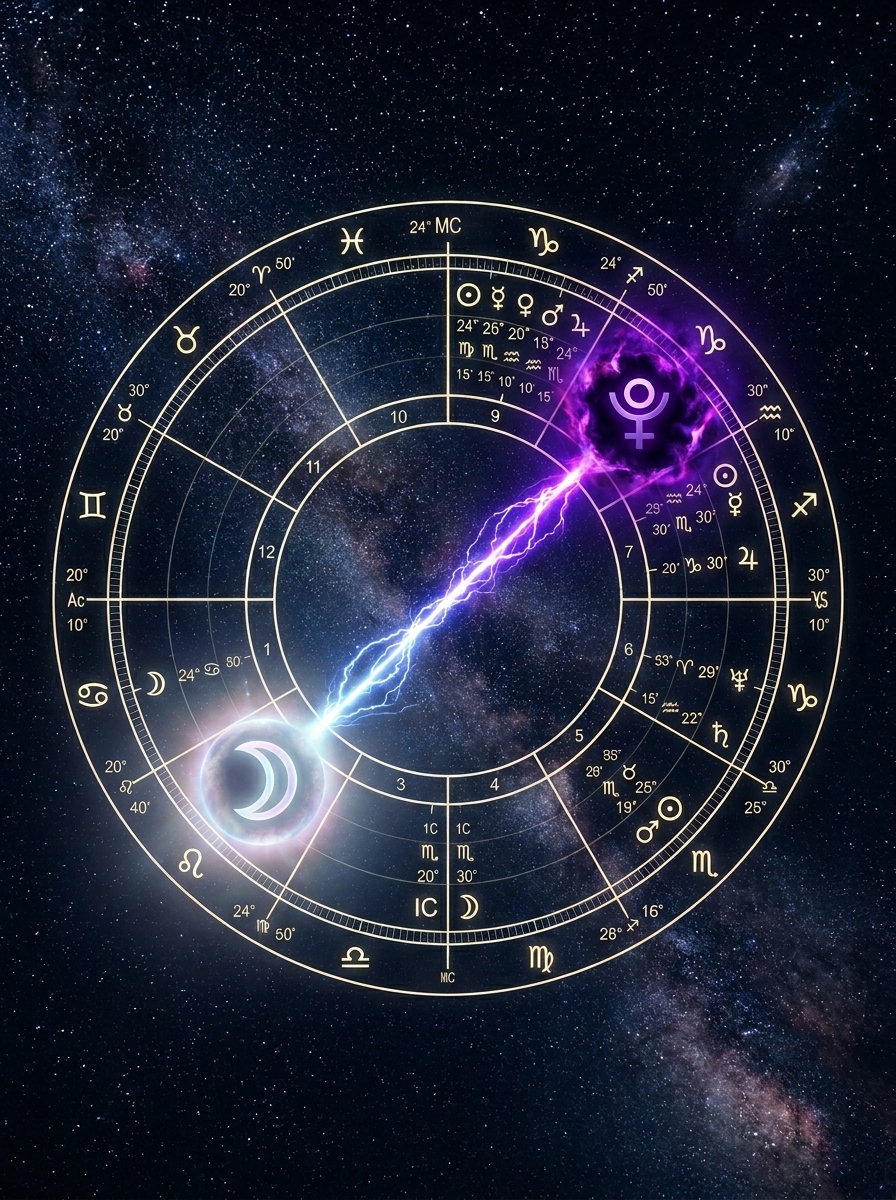
The Emotional Landscape of Initiation
Moon opposition Pluto does not describe a personality trait; it describes a survival system. The Moon governs the infant’s first need: safety, rhythm, unguarded attachment. Pluto governs the true cost of closeness: power, exposure, the risk of being consumed or abandoned. In the 180° face-off of the opposition, these two drives do not blend – they mirror each other through a glass wall. Every bid for comfort is shadowed by suspicion; every gesture of trust feels like handing over a weapon.
This is not intensity for its own sake. It is the psyche’s permanent alert to the fact that love and control often wear the same face. The native’s emotional x-ray vision – the ability to catch a micro-shift in tone, to smell a lie before it is spoken – is not a parlor trick. It is a scar that became a skill. The central truth of this aspect is that the native must learn to feel deeply without surrendering sovereignty. That learning is not optional; it is the price of entry into adult emotional life. For the structural grammar of how oppositions educate rather than split, the opposition aspect provides the larger map.
The Formation: Childhood as Emotional Training Ground
The first classroom of Moon opposition Pluto is not romance – it is early bonding. The emotional environment that shapes this aspect is rarely neutral. It may be saturated with a parent who was consuming, volatile, secretive, or wielding authority through silence and guilt. Sometimes the atmosphere is not explosive but chemically charged: affection tied to compliance, the child made into confidant or emotional witness. What matters is the lesson the child internalizes: need has consequences. To need may invite intrusion. To cry may provoke control. To lean may trigger collapse in the other.
The psyche adapts with remarkable intelligence. The child may become prematurely self-contained, fiercely private, psychically vigilant. Or it may become the family’s secret keeper, because holding the truth feels safer than speaking it. Either way, the Moon’s capacity to receive and self-soothe gets contaminated by power. Comfort becomes something earned, watched, and debt-ridden. The native often carries a lifelong oscillation: craving fusion, then recoiling; wanting to trust, then testing; needing surrender, then tightening control. This is not indecision. It is the nervous system trying to reconcile two incompatible truths: “I need closeness to live” and “closeness can destroy me.”
This early formation often has an ancestral current. The emotional life may carry residues older than the individual – family secrets, inherited trauma, patterns of domination or powerlessness. When Pluto is tied to the fourth house, the Pluto in the fourth house page explores that subterranean terrain directly. Even without a house placement, the native is often called to separate their own emotional truth from an inherited script.
The Shadow: Control as a Substitute for Safety
The most common defense pattern here is control – not always the overt kind. Sometimes it is emotional self-containment so rigid it masquerades as calm. Sometimes it is testing, baiting, provoking others into revealing themselves before the native dares to be vulnerable. Sometimes it is the compulsion to know everything before feeling anything. The shadow is not only about dominating others; it is also about being dominated by one’s own psychic alarm system. The native may overread signs of betrayal, create crises where none exist, or stay loyal to a wound because the wound feels more familiar than peace.
This aspect is hard on trust. It does not merely ask, “Can I trust you?” It asks, “Can I survive if I don’t control the terms of intimacy?” That question can keep a person locked in a cycle of emotional testing that destroys what it wants to protect. For the underworld literacy that informs this dynamic – intimacy as a transaction with the soul’s hidden economy – the Pluto in the eighth house page offers a parallel framework.
Yet the same sensitivity that creates the shadow also houses the gift. When the defensive layer softens, these natives possess an almost forensic emotional intelligence. They can accompany others through breakdown without flinching. They know that grief has a pulse, that attachment can become addiction, that tenderness can be weaponized. In the right setting, they become healers, investigators, artists, or guardians of hidden pain. The gift is not to be “the intense one.” It is to be someone who can tolerate intensity without converting it into possession or siege. Steven Forrest often describes Pluto as insisting on authenticity; here, authenticity must include the most difficult truth: you do not heal control with more control.
How It Plays Out in a Life: Love, Work, and the Body
Because both the Moon and Pluto are deeply relational symbols – one seeking bonding, the other seeking merger and transformation – this aspect tends to express where attachment is tested by power.
In love, the native attracts intense partners or becomes the intense partner, often both. There is no appetite for lukewarm connection. Casual feels meaningless; deep feels dangerous. This can produce a pattern of all-or-nothing bonding, jealousy, emotional bargaining, or periodic purges when the pressure becomes too high. At its best, this aspect yields extraordinary loyalty and presence. But the native must learn the difference between intimacy and enmeshment. If the relationship becomes a psychic surveillance state, Pluto has won by turning love into a proving ground. For how this dynamic resonates when Pluto lands in the seventh house, the Pluto in the seventh house page expands on transformation through the mirror of partnership.
In work and vocation, the native is drawn to roles that require composure under pressure, discretion, and emotional stamina – crisis management, psychology, research, trauma-informed care, investigative work. They detect manipulation and resent pretense; ordinary office politics can feel like low-grade warfare. They do best where depth is valued. When Pluto is prominent in public life, the Pluto in the tenth house page examines how power and visibility intensify each other.
In the body, the Moon lives in the nervous system. The hypervigilance of this aspect can manifest as chronic tension, digestive issues, or sleep disruption. The body is often the first place the emotional pressure lands. Learning to downshift – through somatic practice, breath, or movement – is not optional; it is the most direct way to signal safety to the psyche.
Integration: From Siege to Sovereignty
The goal of Moon opposition Pluto is not to become less feeling. It is to become less possessed by feeling. Suppression only drives the underworld deeper. The work is to create enough inner containment that the psyche no longer has to use control as a surrogate for safety.
Integration begins when the native stops mistaking every emotional surge for a verdict. A strong feeling is not always a true prophecy. A fear of abandonment is not always evidence of abandonment. The pause between trigger and reaction is where Pluto’s raw power can be reclaimed from compulsion. Therapy, trauma processing, journaling, and especially somatic work are not luxuries – they are the crucible in which the opposition’s tension becomes education rather than permanent crisis. For the larger symbolic frame of how Pluto forces dead structures to give way, the Pluto transits page provides the broader view.
The lifelong lesson is that vulnerability and power are not opposites. The false choice is “Either I am open and unsafe, or guarded and powerful.” The mature answer is: “I can stay open enough to love, and strong enough not to be owned by fear.” That is the alchemy of Moon opposition Pluto. It begins in emotional siege, passes through the education of boundaries, and can end in a rare kind of depth – one that does not need to dominate in order to feel real. When integrated, the person becomes a witness to emotional truth without becoming its victim. They know the dark. They do not worship it.
Comments
Loading comments…