Moon Trine Pluto: Emotional Depth, Psychic Instinct, and Quiet Power
The core dynamic
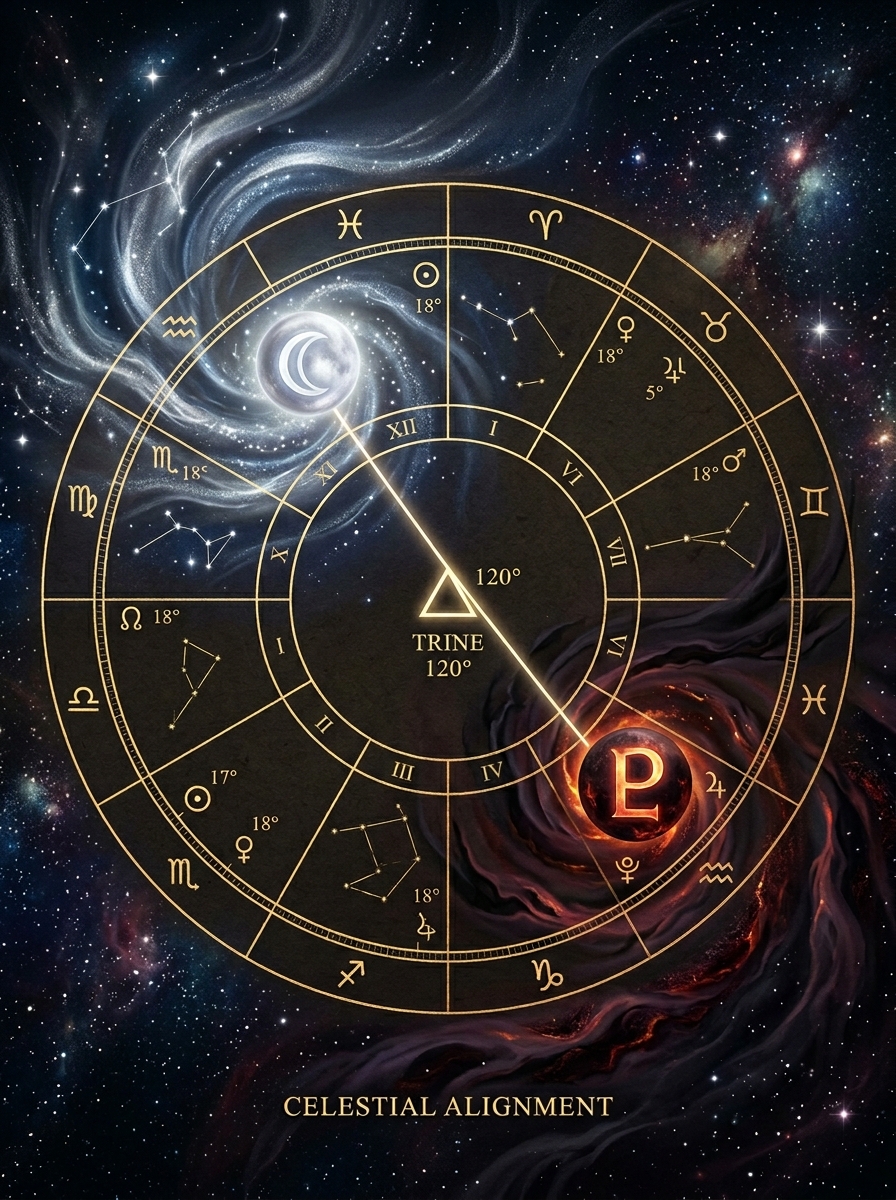
Moon trine Pluto describes a psyche that does not flinch from the underworld of feeling. The Moon governs instinct, memory, and the body’s reflex for safety; Pluto governs depth, taboo, death-rebirth, and the drive to excavate what is hidden. In a trine — a 120-degree relationship of elemental fluency — these two archetypes cooperate without the friction that would make their intensity obvious. The native senses emotional undercurrents before they surface, can sit inside grief without panicking, and often knows what others are suppressing before a word is spoken.
This is not a “light” placement. It is an ease with darkness. The classic description — emotional x-ray vision plus the stamina to stay present with what that vision reveals — captures it, but only if we add that the ease can make the native underestimate how deep their own emotional weather runs. The trine delivers skill without struggle, which means the person may not consciously interrogate their own intensity. They simply are the one who notices, who remembers, who carries the emotional history of a room.
For the geometry of this cooperation, see the broader discussion of the trine aspect. What matters here is that the fluency between Moon and Pluto is not static talent; it is a living relationship that can either deepen the soul or entrench a hidden script of control.
Psychological roots: the child who watched
The formation of this aspect often traces back to a childhood where emotional truth was present but not spoken aloud. The child learns to read the parent’s mood by the way the air changes, by the angle of a jaw, by the silence that follows a door closing. Pluto registers the concealed; Moon translates that registration into a bodily signal — a knot in the stomach, a sudden sleepiness, an attraction to a certain corner of the house. The child does not think, “This relationship is unsafe.” They simply stop eating at that table.
This early attentiveness can produce a mature, responsible young person. It can also produce hypervigilance disguised as sensitivity. The native may carry an assumption that love and power are always braided, that safety must be earned through perception. That assumption becomes the lens through which all later relationships are seen. When Moon trine Pluto is anchored in the 4th house, the family inheritance is especially charged; the Pluto in the Fourth House profile details how the roots of this intensity can become either a gift of ancestral healing or a buried loyalty to pain.
The body remembers before the mind does. That is the Moon’s domain. The mind may later rationalize, but the body already knows who withdrew, who lied, who protected, who shamed. The native’s emotional radar is not magical — it is pattern recognition at the level of the nervous system. And because the trine makes this recognition feel effortless, the native can mistake accuracy for truth. A mood may be a signal, but it may also be an echo of the past. The work of this aspect is to distinguish between the two.
Maturation and shadow: the quiet power that can turn covert
The gift of emotional presence
The most reliable gift of Moon trine Pluto is the capacity to remain emotionally available under pressure. The native does not need to flee from rage, shame, grief, or ambivalence — they understand that these states are not emergencies. This makes them excellent therapists, crisis workers, investigators, and intimate partners. They can ask the question everyone else is avoiding and tolerate whatever answer comes back. Emotional courage is not the absence of fear; it is the refusal to abandon someone — including oneself — when the truth gets heavy.
That capacity often attracts others who sense a subtle magnetism: the sense that there is more beneath the surface than the native is saying. This attraction can lead to deep bonds, but it can also attract projection — people who want the native to hold their own darkness because they cannot. For those with Pluto in the partnership axis, this dynamic sharpens into a mirror; Pluto in the Seventh House explores how the other becomes a vessel for the native’s own shadow material.
The shadow: intensity as identity
Because the trine is smooth, the native can unconsciously build a self-image around being strong, deep, unshakeable — the one who handles the worst. That sounds admirable, but it can harden into a script: I do not need much. I understand what others cannot. Underneath that script is often a taboo against ordinary vulnerability — the kind that is messy, dependent, or unproductive.
The same radar that reads others can also be used to manage them. The native knows how to soothe, how to provoke, how to keep a bond alive through emotional gravity. Most of the time this is protective, even tender. But in shadow, it becomes quiet control — a form of power that hides inside care. Pluto always asks: What are you doing with your perception? The answer is rarely neutral. The difference between integrity and manipulation is consciousness.
This is not a flaw to be fixed; it is a power to be refined. The native who learns to hold their own depth without needing to manage everyone else’s has access to a rare form of emotional initiation — the ability to catalyze transformation without theatrics. The Grand Trine configuration, when it includes Moon and Pluto, can amplify this ease but also the risk of inertia; see the Grand Trine for how harmonic flow can become a trap if unexamined.
How it plays out in a life
Relationships
People with Moon trine Pluto do not invest casually. They love with concentration, loyalty, and a need for truth that can survive weather. Superficial contact feels wasteful; they want the bond that becomes a place where hidden griefs are named and old loyalties revised. Betrayal is not forgiven lightly — it is processed into something else, often a deeper understanding or a clean break. The test is whether the partner can meet the same depth without collapsing. For those with Pluto in the 8th house, intimacy becomes the primary arena of transformation; Pluto in the Eighth House describes how merging and power dynamics become the crucible.
Work and vocation
The native gravitates toward roles that require emotional honesty under pressure: therapist, investigator, crisis manager, artist of the shadow, advocate for the voiceless. They are often drawn to fields that involve death, money, or hidden knowledge — Pluto’s domains. They can sit with a dying person without needing to fix it; they can read a contract and sense where the power imbalance hides; they can hold a group through conflict without panicking. The work becomes a vessel for the same gift: staying present with the uncomfortable.
Later life: inheritance and legacy
As the native ages, this aspect often expresses as a kind of soul housekeeping. They become the one who breaks a family pattern simply by refusing denial. They may be called to clear an estate, do genealogical excavation, support an elder’s end-of-life transition, or confront a truth the family has buried for generations. This is Pluto’s great competence: making peace with what cannot be made pretty. The sign of Pluto in the chart colors this — Pluto in Scorpio adds a relentless urge to go deeper into personal shadow, while Pluto in Capricorn may focus the work on authority structures and institutional legacy. For those with Pluto retrograde, the internal excavation is even more private and psychologically layered; see Pluto Retrograde for how the work turns inward before it can be expressed outward.
The mature expression
When Moon trine Pluto is living at its highest register, the native no longer needs to prove their depth. They become a quiet catalyst — someone whose presence tells the truth before words do. They can hold contradiction without collapsing: they love deeply without naivete, protect fiercely without rigidity, go under the surface without drowning. The gift is not constant intensity; it is the ability to initiate emotional transformation in themselves and others without drama. They understand that renewal is sometimes a private decision to stop lying to oneself, and that this decision, made silently, can change a lineage.
This is the underworld guide who knows the way back. Not a savior, not a martyr. A witness who has learned that deep feeling and accurate interpretation are not the same thing — and who has the integrity to continue the work of distinguishing them, year after year.
Related
- Moon Sextile Pluto: The Quiet Alchemy of Emotional Power
- Sun Trine Pluto: Quiet Sovereignty, Deep Will, and the Power to Transform
- Moon Conjunct Pluto: The Emotional Underworld and the Power to Rebirth
- Saturn Trine Pluto: The Quiet Architecture of Power
- Uranus Trine Pluto: The Electric Engine of Deep Change
Comments
Loading comments…