Uranus in Aquarius: The Promethean Fire and the Digital Generation
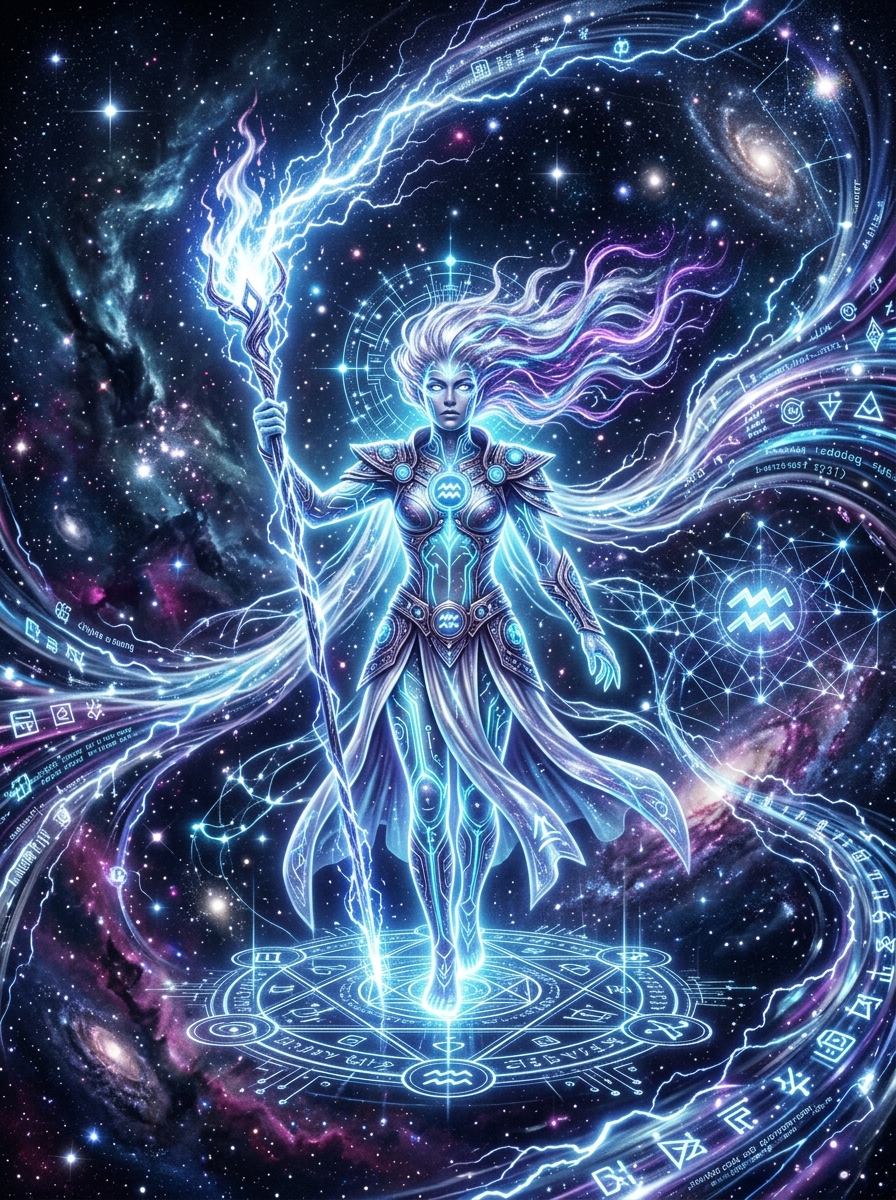
The Cosmic Disruptor: Uranus in its Modern Domicile
Astrological tradition assigns Saturn as the ancient ruler of Aquarius, the sign of the water-bearer, governing its structures, boundaries, and the cool, intellectual distance of fixed air. However, the discovery of Uranus in 1781—a historical moment bracketed by the American and French Revolutions and the dawn of the Industrial Age—led modern astrologers to recognize a new, dynamic affinity. Uranus became the modern ruler, or domicile lord, of Aquarius. This relationship represents a potent alignment where the planet of sudden awakening, radical liberation, and revolutionary breakthrough finds its natural home in the sign of collective networks, humanitarian progress, and systemic innovation. When Uranus occupies Aquarius, its electricity flows with targeted precision, bypassing intermediate channels to directly rewrite the social contract and reformat human consciousness. This placement generates a unique psychic tension. On one hand, Aquarius seeks the welfare of the collective, advocating for horizontal structures and the democratization of power. On the other hand, Uranus demands absolute individuality, refusing to bow to any consensus. The synthesis of these forces results in the Promethean archetype: the thief of fire who defies the gods to empower humanity. Under this influence, individuals feel an urgent responsibility to contribute to the evolutionary progression of society while remaining fiercely independent of its mainstream dictates. It is an alignment that champions the genius, the reformer, the eccentric, and the revolutionary, merging the cool objectivity of the intellect with the electric passion of radical change.
In psychological terms, Carl Jung’s work on the collective unconscious and archetypal shifts provides a valuable framework for understanding this placement. Jung observed that humanity goes through major psychic epochs, driven by subterranean currents that erupt into the conscious world as new cultural movements and technological advancements. Uranus in Aquarius acts as a conscious lightning rod for these collective transformations. Rather than presenting as chaotic disruption, the planetary energy here is structured by the fixed modality of Aquarius. It channels what evolutionary astrologer Steven Forrest describes as the urge to break free from cultural conditioning. In Aquarius, this liberation is not merely personal; it is systemic. The individual seeks freedom from the stale, inherited dogmas of the past, not to isolate themselves, but to construct a more rational, egalitarian, and interconnected future. This fixed air environment allows the Uranian lightning bolt to be sustained, organized, and manifested as tangible societal progress rather than disappearing as a brief flash of lightning in the night. The archetype here represents the bridge between divine inspiration and human realization, demanding that the ideals of liberty, equality, and fraternity be built into the very architecture of our shared social systems.
The Promethean Fire: Uranus in its Modern Domicile of Aquarius
To understand the full depth of Uranus in Aquarius, one must examine the planetary dynamics of rulership and essential dignities. In classical astrology, Saturn ruled both Capricorn and Aquarius, representing the boundaries of time, structure, law, and physical limitation. When Uranus was discovered, it shattered the classical boundaries of the visible solar system, acting as a higher octave of Saturn. While Saturn builds the walls and establishes the laws, Uranus breaches those walls in search of universal truth. In Aquarius, a sign characterized by its fixed air quality, Uranus finds an ideal medium. Fixed air represents concentrated mental energy, intellectual systems, and the structural networks of society. Unlike the watery depths or the fiery outbursts of other signs, Aquarius offers a cool, objective space where Uranus can operate without being clouded by personal emotion or dogmatic bias. It is here that the planet of revolution becomes the architect of the future.
Liz Greene, in her seminal work on the mythic and psychological dimensions of the outer planets, notes that Uranus represents the archetypal need to participate in a larger evolutionary design. The myth of Ouranos, the sky god who fathered the Titans and rejected them for their physical imperfections, points to the psychological trap of this placement: the quest for a perfect, sterile utopia that rejects the messy reality of human nature. When Uranus is in Aquarius, this quest is amplified. The individual and the collective are driven by a vision of a rational, perfectly ordered society where all parts function in harmony. Yet, as Greene warns, this intellectual ideal must be tempered with human compassion. Aleister Crowley, in his symbolic analysis of the Tarot’s Star card—associated with Aquarius—depicts the pouring of double streams of water: one onto the earth and one into the sea, representing the flow of divine wisdom fertilizing both the rational mind and the collective emotional depths. This duality reminds us that the Promethean fire is not merely an intellectual concept, but an active force meant to serve and elevate the human condition in all its complexity.
The evolutionary imperative of this placement is therefore one of conscious reconstruction. It demands that we look at the legacy of Saturn—our traditions, hierarchies, and rules—and ask which of them serve the collective future and which must be discarded. This is not rebellion for the sake of destruction, which is a low-vibrational expression of Uranus. Rather, it is the systematic dismantling of obsolete paradigms to make room for progressive, inclusive, and liberating structures. It requires an intellectual courage to stand apart from the crowd, to question consensus reality, and to hold a vision of what could be, even when the rest of the world remains bound by what is. In the modern domicile of Aquarius, Uranus provides the clarity, the stamina, and the electric drive to carry out this evolutionary work, transforming the lightning of inspiration into the steady current of progress.
The Birth of the Digital Native: The Generational Cohort (1995–2003)
The transit of Uranus through Aquarius from 1995 to 2003 marked the arrival of a generation destined to fundamentally reshape how humanity communicates, organizes, and shares information. Born into the cradle of the early internet, this cohort represents the first true generation of "Digital Natives." For these individuals, the boundary between the physical and virtual worlds was never a hard line to cross; rather, it was a fluid continuum. While older generations viewed the internet as a tool or a novelty, the Uranus in Aquarius cohort integrated it as an extension of their cognitive architecture. They grew up in a world where geographic boundaries began to dissolve, replaced by virtual nodes, chat rooms, and peer-to-peer sharing networks. This has resulted in a unique generational psychology that is highly collaborative, skeptical of traditional hierarchies, and comfortable with rapid, non-linear changes.
This generational imprint is directly tied to key global technological milestones that occurred during their formative years. The emergence of search engines like Google democratized information, transforming the acquisition of knowledge from a gatekept privilege into a decentralized utility. The launch of Wikipedia replaced centralized encyclopedias with collaborative, crowdsourced knowledge, embodying the Aquarian ideal of collective intelligence. Meanwhile, platforms like Napster disrupted traditional economic models of intellectual property, proving that the flow of information and art could not be easily corralled by corporate monopolies. These historical developments shaped a generational psyche that inherently values open access, collaboration, and systemic transparency. They do not view knowledge as a commodity to be hoarded, but as a shared resource that belongs to the collective.
From an evolutionary astrology perspective, this cohort carries a collective mission to dismantle hierarchical, top-down institutions. They instinctively trust peer-to-peer networks over centralized authorities, whether in politics, media, or finance. This manifests as a natural affinity for decentralized autonomous organizations, digital activism, and collaborative problem-solving. However, this electric connectivity comes with a distinct set of psychological challenges. Growing up in a hyper-networked environment exposes these individuals to an unprecedented volume of collective anxiety, psychic noise, and digital overload. Their evolutionary task is to harness the immense potential of the digital web without losing their anchor in the natural world, transforming virtual connection into genuine human community. They must learn to navigate the tension between the global virtual network and the local physical reality, ensuring that their pursuit of collective ideals does not alienate them from the simple, everyday experience of being human.
Furthermore, this cohort's relationship with identity is profoundly shaped by the Aquarian archetype. Aquarius is the sign of the group, yet Uranus demands absolute individuality. For the 1995–2003 generation, identity is often constructed, explored, and expressed through subcultures, online communities, and global networks. They have pioneered new ways of understanding gender, sexuality, and career, rejecting the rigid classifications of past generations. They find strength in numbers, forming vast online networks to advocate for environmental sustainability, social justice, and political reform. Yet, this reliance on the group can create a secondary conformity, where the individual feels pressured to align with the ideological purity of their chosen subculture. The ultimate evolutionary lesson for this generation is to maintain their unique individual voice within the collective, avoiding the trap of groupthink while contributing to the collective good.
Uranus in Aquarius in the Natal Chart: House Placements
While Uranus in Aquarius acts as a broad generational signature, its specific house placement in the natal chart determines the area of life where the individual must confront the urge for radical liberation, unconventional thinking, and Promethean innovation. In these specific domains, the individual is called to break free from societal expectations and pioneer new ways of being.
The Houses of Self and Identity (Houses 1, 2, and 3)
When Uranus in Aquarius resides in the First House, the individual’s very identity and physical presentation become a canvas for revolutionary expression. They are natural eccentrics, project an aura of electric independence, and refuse to conform to traditional style or social norms. They require immense personal freedom and will resist any attempt by others to box them in or define their path. In the Second House, the rebellion turns toward personal resources, values, and finances. These individuals often reject conventional career paths, finding financial freedom through freelance work, technology, or unorthodox investments, defining their self-worth by their independence rather than material accumulation. They may experience sudden fluctuations in wealth, which serves the evolutionary purpose of teaching them that true security lies in their intellectual resourcefulness rather than external assets. In the Third House, Uranus electrifies the mind and communication. The intellect is rapid, prone to sudden flashes of genius, and drawn to unconventional topics. Their speech patterns are unique, and they often champion marginalized or radical ideas in their local communities, acting as catalysts for intellectual awakening among their peers.
The Houses of Foundation and Creative Expression (Houses 4, 5, and 6)
In the Fourth House, Uranus in Aquarius disrupts the traditional concept of home and family. The domestic environment may have been highly unconventional, intellectually stimulating, or geographically unstable during childhood. As adults, they seek non-traditional living arrangements and must actively liberate themselves from ancestral conditioning to find true emotional security, understanding that home is a state of consciousness rather than a physical structure. Placed in the Fifth House, this energy fuels a highly original creative genius. Artistic expression is boundary-pushing, often incorporating technology or avant-garde concepts. In romance, they require immense freedom, rejecting traditional relationship structures in favor of unique, intellectually stimulating connections that allow both partners to maintain their individuality. In the Sixth House, Uranus revolutionizes the daily routine, work environment, and physical health. These individuals thrive in flexible, self-directed work environments and are often drawn to alternative healing modalities, viewing the body as an energetic system rather than a mechanical instrument, and resisting any form of monotonous labor.
The Houses of Relationship and Shared Resource (Houses 7, 8, and 9)
With Uranus in Aquarius in the Seventh House, the evolutionary demand for freedom enters the realm of committed partnerships. Standard marital expectations are discarded; they require partners who respect their independence and intellectual autonomy. Relationships are built on friendship and shared ideals rather than co-dependency. In the Eighth House, the electric current penetrates the deep psychological realms of intimacy, shared resources, and esoteric knowledge. They approach psychological shadow work with rational objectivity and may experience sudden, cataclysmic shifts in their shared finances or inheritances. They are drawn to hidden truths, occult subjects, and deep psychological investigation, using their objective intellect to illuminate the dark corners of the human psyche. In the Ninth House, Uranus liberates the individual’s worldview, philosophy, and approach to higher education. They reject dogma in favor of an eclectically constructed belief system, pursuing wisdom through unconventional travel, independent study, or esoteric practices, acting as spiritual free-agents who refuse to subscribe to any single school of thought.
The Houses of Collective Integration (Houses 10, 11, and 12)
In the Tenth House, Uranus in Aquarius manifests as an unconventional public reputation and career path. These individuals are social reformers, tech pioneers, or public eccentrics who cannot tolerate corporate hierarchy, pursuing careers that align with their humanitarian values. They are often recognized for their visionary contributions to society, though their public image may be polarizing. The Eleventh House is the natural astrological home for Uranus in Aquarius, amplifying its power. Here, the individual is a natural networker, community organizer, and visionary. They lead collectives, coordinate digital campaigns, and find their purpose in collaborative social movements. They have an innate ability to bring diverse groups of people together around a common cause, facilitating horizontal networks of cooperation. Finally, in the Twelfth House, the Promethean fire burns within the unconscious mind. This placement yields profound mystical insights, sudden spiritual awakenings, and an innate capacity to tap into the collective dream, though it requires conscious integration to prevent feelings of cosmic isolation, paranoia, or psychological disassociation.
Planetary Aspects: Uranus in Aquarius in Dynamic Relationship
The aspects that Uranus in Aquarius makes to personal planets in the natal chart reveal how the individual integrates this generational, electric impulse into their day-to-day psychology. Hard aspects (squares, oppositions, and conjunctions) present challenges that force growth, while soft aspects (trines and sextiles) offer natural, fluid expressions of this energy.
Sun and Moon Aspects: Core Identity and Emotional Nature
Aspects between the Sun and Uranus in Aquarius determine how the individual expresses their core vitality and willpower. A Sun-Uranus aspect creates an intense need to be recognized as unique, independent, and intellectually autonomous. These individuals are natural rebels against paternal authority and societal expectations, channeling their energy into social change, technological innovation, or progressive movements. However, they must guard against a defensive need to shock others for its own sake or a chronic restlessness that prevents them from completing what they start. When Uranus aspects the Moon, the emotional nature is electrified. There is an inherent need for emotional space and autonomy within relationships. Emotional processing is rapid and highly intellectualized, which can lead to sudden shifts in mood, sudden breakups, or an inability to sit with uncomfortable feelings. The challenge here is learning to ground the nervous system and value vulnerability alongside intellectual independence, realizing that emotional intimacy does not mean a loss of freedom.
Mercury and Venus Aspects: Intellect and Relationship Dynamics
Mercury in aspect to Uranus in Aquarius creates a highly charged intellect, often referred to by astrologers as the signature of the inventor or the genius. The mind operates in leaps of intuition rather than linear logic, receiving sudden downloads of information from the collective unconscious. Communication is direct, logical, and often focused on systemic issues, though the individual may struggle with impatience toward slower thinkers or a tendency to speak before considering the impact of their words. Venus in aspect to Uranus brings the Aquarian need for freedom into the realms of aesthetics, art, and love. These individuals are drawn to unconventional relationships, valuing intellectual kinship above traditional romance. They appreciate avant-garde art, non-binary expressions of beauty, and financial systems that prioritize autonomy, though they may have to work hard to build emotional intimacy and consistency in partnerships. They must learn to reconcile their fear of engulfment with their human need for closeness, building relationships that are both stable and liberating.
Mars Aspects: Action, Drive, and Rebellion
When Mars forms an aspect with Uranus in Aquarius, the individual's drive, physical energy, and capacity for anger are infused with electric intensity. They act as catalysts for change, working tirelessly to dismantle restrictive structures and implement progressive plans. This aspect makes them formidable advocates for social justice, but it can also manifest as erratic energy, impatience, and a tendency to act impulsively without considering the long-term consequences. Physically, they need constructive outlets for this high-frequency energy to prevent physical burnout or chronic nervous tension. They must learn to discipline their drive, ensuring that their actions are guided by a sustained commitment to their ideals rather than a reactive desire to destroy whatever stands in their way. In this way, they transform a volatile temper into a powerful tool for systemic evolution.
Historical Milestones and the Evolution of the Collective
To fully appreciate the scope of Uranus in Aquarius, one must look at its historical cycles. Uranus takes approximately 84 years to orbit the Sun, spending roughly seven years in each sign. By examining the historical periods when Uranus transited Aquarius, we can observe how the collective consciousness of humanity undergoes systemic reform, scientific awakening, and technological acceleration. Each transit represents a major leap forward in our shared capacity for cooperation, networking, and collective self-determination.
A critical historical transit occurred during the late 18th century (1797–1804). This period marked the consolidation of the Age of Enlightenment, a time when rational thought, scientific inquiry, and democratic ideals challenged the divine right of monarchs and the authority of religious institutions. The collective mind was electrified by the promise of human rights, self-governance, and technological advancement, setting the stage for modern Western democracy. The intellectual blueprints drawn during this time reflected the Aquarian dream of a society organized around rational principles rather than inherited privileges. It was during this period that the early stages of industrial automation began to take root, illustrating the Aquarian connection between technology and the liberation of human labor.
The subsequent transit from 1995 to 2003 mirrored these themes on a global, digital scale. Just as the 18th-century transit decentralized political and intellectual authority, the late 20th-century transit decentralized information. The expansion of the World Wide Web dismantled traditional media monopolies, allowing individuals to publish, communicate, and organize globally without intermediaries. This era laid the technological infrastructure for the contemporary world, demonstrating that whenever Uranus enters Aquarius, the old Saturnian boundaries must yield to the inevitable tide of decentralized, interconnected networks. The introduction of open-source software, the creation of the first virtual communities, and the rise of digital commerce all serve as monuments to this transit, showing how the Promethean fire continues to reshape the landscape of human civilization.
Psychological Shadow and Spiritual Integration
Every astrological archetype contains a shadow, and Uranus in Aquarius is no exception. Because Aquarius is a fixed air sign, its primary focus is on the intellect, systems, and ideals. When combined with the erratic, revolutionary energy of Uranus, this can lead to a psychological trap that Liz Greene describes as the tyranny of the ideal. Individuals with a strong Uranus in Aquarius signature can become so enamored with their vision of how humanity should function that they lose touch with the reality of how human beings actually function. This creates a state of cold emotional detachment, where the individual loves humanity in the abstract but struggles to show empathy to the real, flawed people in their immediate lives. They may advocate for global peace while treating their family members with cold indifference, falling into a hypocritical division between their high-minded principles and their personal behavior.
The shadow also manifests as digital anxiety, hyper-intellectualization, and alienation. When the nervous system is constantly exposed to the high-frequency current of Uranus, it can lead to chronic anxiety, insomnia, and a feeling of being disembodied. The individual may retreat into the sterile, predictable realms of digital spaces or intellectual theories to avoid the messy, unpredictable emotions of real-world relationships. This intellectual isolation can lead to a profound sense of alienation, leaving the individual feeling like an outsider looking in on a world they cannot fully join. They may experience a deep existential loneliness, believing that no one can truly understand their unique perspective, which in turn reinforces their defensive detachment.
Spiritual integration requires bringing the Promethean fire down to earth. Drawing from Steven Forrest's evolutionary astrology, the path to healing lies in balancing digital connectivity with somatic presence. Individuals must learn to quiet the mind and listen to the wisdom of the body, utilizing practices like grounding, meditation, yoga, and time in nature to soothe their sensitive nervous systems. They must also cultivate personal empathy, recognizing that true Aquarian community is not built on cold intellectual agreements, but on a shared capacity for vulnerability, warmth, and mutual support. By grounding their electric ideals in daily presence, they can truly manifest the evolutionary promise of Uranus, transforming their brilliant visions into compassionate, real-world service.
Frequently Asked Questions
What does it mean to have Uranus in Aquarius natally?
Having Uranus in Aquarius in your natal chart indicates that you carry a strong generational urge for intellectual independence, systemic innovation, and social reform. Because Uranus is in its modern domicile in Aquarius, this placement operates with high efficiency and clarity. It encourages you to think outside conventional boundaries, seek decentralized approaches to life, and work collaboratively to improve the collective. In your personal life, this placement manifests as a need for intellectual freedom, an attraction to progressive ideas, and an resistance to conforming to traditional social expectations. You are here to question the status quo and help build a more egalitarian future.
How does the 1995–2003 generation experience this placement differently from other generations?
The cohort born between 1995 and 2003 experiences Uranus in Aquarius as a defining generational signature. They are the first true digital natives, having grown up alongside the rapid development of the internet, search engines, and collaborative platforms like Wikipedia. This has shaped a collective psychology that values open access, horizontal networks, and social transparency. They instinctively challenge hierarchical authority and are natural pioneers of decentralized systems, digital activism, and collaborative problem-solving, though they also face unique challenges related to digital overload, information fatigue, and emotional alienation.
How can I manage the emotional detachment associated with this placement?
Managing the emotional detachment of Uranus in Aquarius requires a conscious effort to balance your intellectual ideals with somatic presence and emotional vulnerability. When you feel yourself retreating into dry logic or digital spaces to escape messy feelings, practice grounding exercises, mindfulness, or body-oriented therapies to reconnect with your physical self. Cultivate active empathy by listening to others without immediately trying to analyze or solve their problems, and allow yourself to share your own vulnerabilities, recognizing that true connection requires warmth as well as intellectual alignment.
What are the key lessons of Uranus in Aquarius aspects to personal planets?
Aspects to personal planets teach the lesson of integration—bringing your radical, independent, and systemic Uranian insights into your core identity, emotions, mind, and relationships. If Uranus aspects your Sun or Moon, your challenge is to express your unique individuality and emotional needs without defensive rebellion or detachment. If it aspects Mercury or Venus, the lesson is to utilize your intuitive genius and love for freedom to build open, honest communication and unconventional, supportive relationships. Aspects to Mars call on you to direct your electric drive toward progressive action without falling into impatience, anger, or burnout.
What is the evolutionary purpose of Uranus in Aquarius in the natal houses?
The house placement of Uranus in Aquarius reveals the specific area of life where your soul is called to experience evolutionary liberation and break free from consensus reality. Whether it is in the house of career (Tenth House), relationships (Seventh House), or home (Fourth House), this placement indicates where you must act as a pioneer, introduce unorthodox methods, and challenge traditional standards. By embracing the unique, progressive, and innovative qualities of Aquarius in that specific house, you fulfill your individual role in the broader evolution of the collective consciousness, serving as a beacon of change in that specific domain.
Comments
Loading comments…