Moon Square Pluto: The Hidden Weather of Intensity
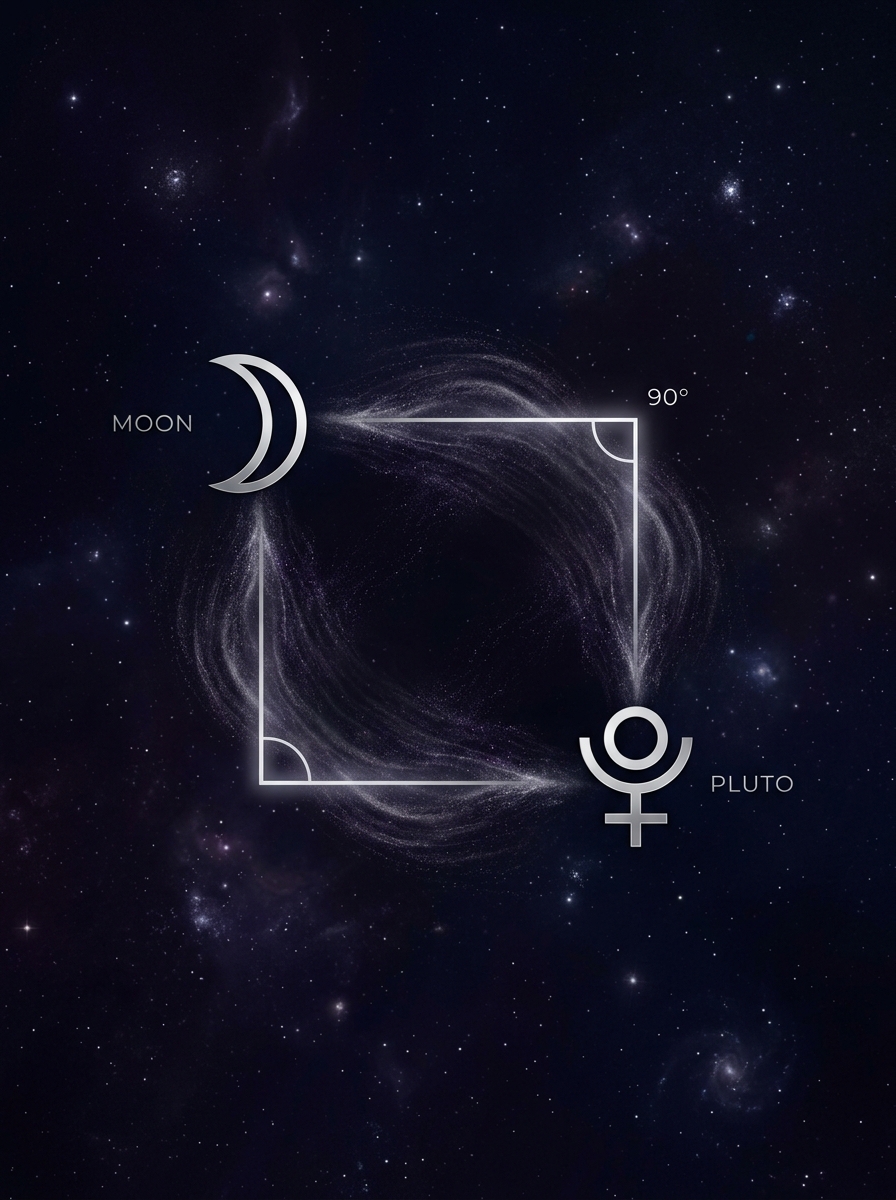
The core conflict: safety meets survival
Moon square Pluto is the natal aspect that rigs emotional need and psychic power into a perpetual friction. The Moon, principle of nurture, rhythm, and belonging, wants a safe place to rest. Pluto, lord of the underworld, does not trust safety — it tears a situation apart to see if anything real survives the wreck. When these two forces meet in a square aspect — the 90° geometry of tension — they do not compromise. They press until the native learns that vulnerability is not surrender and power is not domination.
The result is an emotional life that is rarely temperate. Feelings arrive with tectonic force. A small slight can trigger an ancient suspicion; a loving gesture can feel like a test. This is not drama for its own sake. The emotional organism learned early to read subtext for signs of betrayal, coercion, or loss. The astrological square itself mirrors this dynamic: a disciplined but generative strain that forces growth through resistance. To understand the geometry behind it, see the foundational treatment of the astrology of the square aspect. Here the focus is narrower: how the Moon-Pluto square imprints the psyche with a permanent alertness.
Why it feels fated
The square behaves as though an invisible hand keeps turning the emotional volume knob. The person is not consciously performing intensity; their inner weather is simply rarely mild. Early life often taught that need had consequences — that attachment could be used as leverage, or that love was contingent on absorbed silence. Even when the external story looks ordinary, the internal response pattern is extreme: closeness equals exposure; vulnerability invites invasion. This is the signature of Pluto operating on the Moon: the psyche treats every attachment as a survival calculus.
The early imprint: how need and power become tangled
The child who learned to monitor the room
The natal Moon describes what makes a person feel safe enough to exist; Pluto describes where the psyche encountered irreversible loss, secrecy, or emotional coercion. In square, the early environment often taught that expressing need could be punished, ignored, or turned into a loyalty test. The child may have lived in a home where unspoken rage hung in the air, where grief was denied, or where a caregiver’s intensity forced the child to manage the adult's emotions. The result is a nervous system wired for hypervigilance: scanning for hidden danger in tone, silence, or sudden shifts.
This pattern can produce a person who is magnetically intense but hard to read — revealing depths only in crisis. The emotional roots run so deep that the native often feels like the keeper of family secrets, even when no overt trauma occurred. The Pluto domain of the fourth house is a natural home for such buried inheritance; for more on that excavation, see Pluto in the 4th House. But the square is not a house placement — it is an active tension between two planets that makes the psyche a permanent archaeological site.
The fear beneath the possessiveness
At its ugliest, Moon square Pluto produces emotional brinkmanship: testing, withholding, and the urge to control before being controlled. Yet the underlying fear is rarely about control itself. It is about annihilation — the terror of being abandoned, replaced, or psychologically invaded. The native may unconsciously provoke conflict to force hidden truth into daylight, because the silence feels more dangerous than the fight. This is the shadow of the eighth-house territory of intimacy and merging; the page on Pluto in the Eighth House illuminates that terrain well. But the square adds a twist: the Moon's need for connection cannot be separated from Pluto's need to test it. Love is never just love. It is a survival question.
How the dynamic shapes life: relationships, work, and belonging
Love as a crucible
In intimate relationships, Moon square Pluto often seeks total honesty and total fusion — and distrusts both. The native may be drawn to partners who are equally intense, creating magnetic attraction, rapid emotional fusion, then power struggles over dependency and privacy. What looks like jealousy is really grief in disguise: a fear that the bond cannot hold if truth is spoken. Yet the same person is repelled by superficial reassurance. They need contact that can survive the truth — conflict, honesty, mutual exposure.
This is not a recipe for easy partnering. But when conscious, the native becomes formidable in any relationship that requires emotional courage: therapy, crisis work, deep friendship. The square forces the question: can you stay present when the emotional temperature rises? The pattern belongs to the family of hard aspects that turn relationship into curriculum — similar in structure to the T-square aspect pattern, though the Moon-Pluto square is more subterranean than dramatic.
Career and creative expression
Professionally, this aspect often gravitates toward roles that require psychological x-ray vision: investigator, healer, artist of the difficult. The native can sit with pain without flinching — a rare capacity that makes them indispensable in fields where others burn out. They are often drawn to work that involves hidden knowledge, secrets, or transformation: research, psychology, crisis management, writing that touches taboo.
When the Moon's receptive depth meets Pluto's refusal of falseness, the creative voice that emerges can be stark, erotic, or uncanny. Many with this square produce their best work when wrestling with material others avoid: grief, betrayal, family rupture, psychic survival. The page on Pluto in the 10th House explores how such intensity seeks public form; here the point is simpler: the square wants an outlet. Without one, the pressure turns inward and becomes emotional pathology.
The gift hidden inside the pressure
Depth perception beyond normal range
The best version of Moon square Pluto produces extraordinary emotional intelligence. These people know when something is off before they have evidence. They detect unspoken grief, the moment a dynamic turns coercive, the exact weight of a silence. In a culture that rewards surface calm, this can feel inconvenient; in reality, it is often lifesaving. The gift is not just intuition — it is tolerance for depth. They can accompany pain without being shocked by it.
This capacity is especially potent when Pluto is emphasized elsewhere in the chart, such as in Scorpio or an angular house. For related evolutionary strengths, see the page on Pluto in Scorpio. The square, when integrated, becomes alchemy: the conversion of emotional lead into insight, art, and boundaries.
Creativity under pressure
Many people with this aspect create best when they are working with material that would overwhelm others. The pressure of the square becomes a forge. Grief becomes poetry; suspicion becomes psychological acuity; the need to control becomes the discipline of clean boundaries. This is not sentimental healing. It is the transmutation that Pluto governs: what once felt poisonous can be rendered meaningful. The psyche learns that intensity is not the same as catastrophe — it is raw material.
The 12th house is a natural terrain for such underground work; for a deeper look at how Pluto operates in the hidden realms, see Pluto in the 12th House. But the square does not require the house placement to activate — it is an aspect that turns the emotional life into a laboratory wherever it falls.
Maturation: from emotional defense to inner authority
Separating intensity from catastrophe
The developmental task of Moon square Pluto is to stop equating deep feeling with danger. Early on, the psyche treats every spike of emotion as a sign that something is about to break. Over time, the native learns a subtler truth: feelings are data, not commands. Intimacy is not merger. Privacy is not secrecy. Power can be shared without being seized.
This maturation usually arrives through repeated experiences of surviving the very feelings that once seemed unmanageable: jealousy admitted instead of acted out, grief allowed to move, anger used to set a boundary rather than punish. The square becomes less volatile when the person stops using intensity as evidence of truth. Truth is often quieter than the fear around it.
The body as anchor
Because the Moon governs the physical body and instinct, integration also requires somatic safety. The native must learn that rest is permitted, that the nervous system can downshift without being ambushed. Concrete practices — sleep hygiene, rhythm, touch, nature — are not optional; they are the ground of the work. When the body knows it is safe, the Pluto intensity becomes usable rather than overwhelming. The native becomes someone who can hold depth without drowning — which is the real promise of this square. Not peace in the shallow sense, but earned authority over the hidden weather of the soul.
For those with a reinforced pattern of chronic tension, the T-square configuration compounds the demand; see the T-square in your birth chart for how such dynamics can be turned into lifelong mastery. But even alone, the Moon-Pluto square asks for one thing: that you learn to feel everything without being ruled by it.
Related
- Saturn Square Pluto: The Pressure of the Immovable Force
- Mars Square Pluto: The Pressure of a Psyche That Refuses to Back Down
- Sun Square Pluto: The Will Under Pressure
- Neptune Square Pluto: The Ocean and the Underworld in Conflict
- Moon Conjunct Pluto: The Emotional Underworld and the Power to Rebirth
Comments
Loading comments…