Mercury Conjunct Neptune: The Mind That Listens to the Unseen
The Core Dynamic
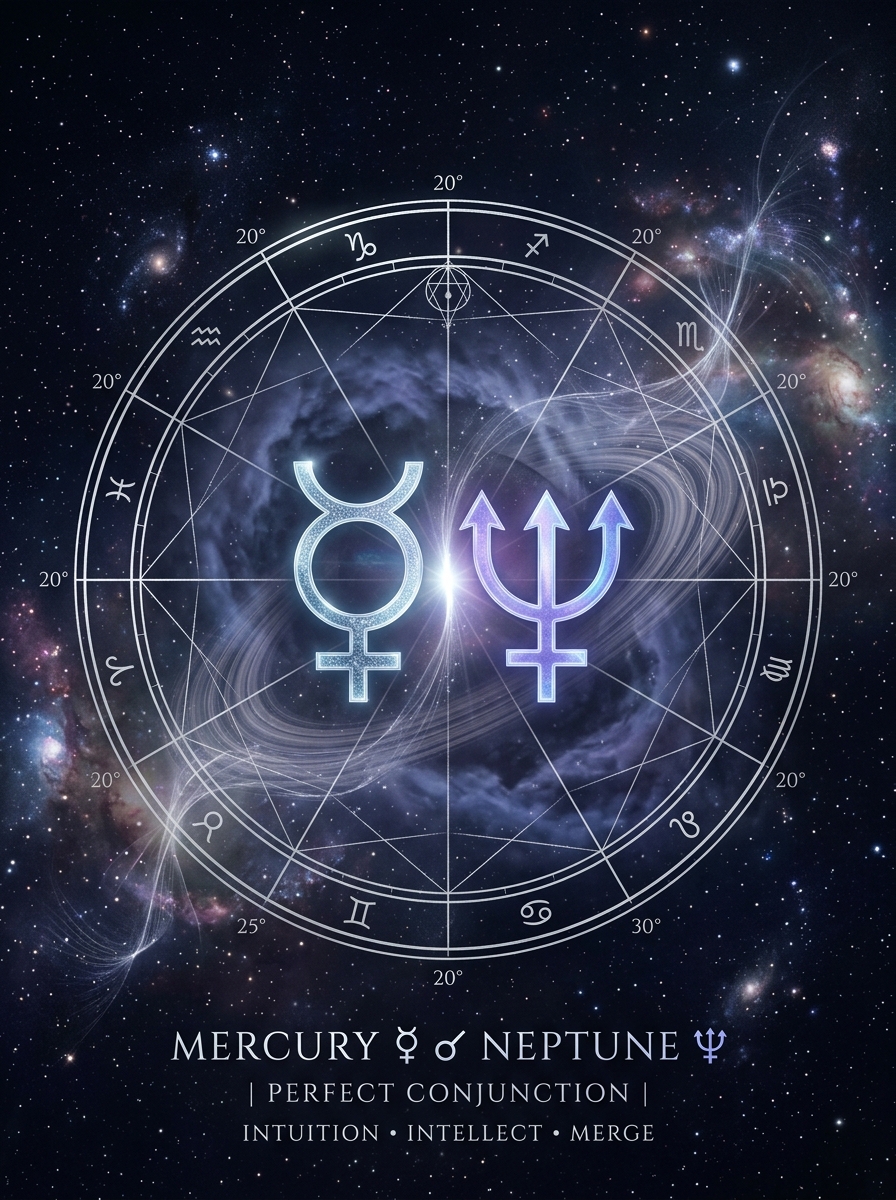
Mercury conjunct Neptune fuses perception with dissolution. The mind no longer processes the world as a sequence of discrete facts; it registers atmosphere, subtext, image, and mood before it ever reaches a label. Thought here is less a straight line and more a tidal current — it rises, recedes, and carries the debris of dream, projection, and intuition all at once. Where Mercury normally discriminates and names, Neptune blurs edges and receives what cannot be proven. The result is a cognitive style that hears poetry before prose and meaning before argument, but that also risks mistaking wish for evidence. This is not simply “having intuition.” This is intuition that can eclipse verification unless something else in the chart provides ballast. For the broader architecture of how Mercury shapes the act of knowing, see Mercury in Astrology: The Archetype of Communication, Mind, and Connection.
How the Mind Becomes a Receiver
The Permeable Boundary
Every conjunction is a fusion, but Neptune does not blend like a partner — it dissolves like water. The native’s mental boundary is porous from the start. They do not so much think about a room as absorb it. A charged silence enters them before they have a word for it. This permeability is the psychological root of the aspect: the child who learned to survive by reading what was unspoken, the adolescent who could feel a lie before it left the mouth, the adult who finds that language itself feels like a secondhand translation of something truer.
This is why the aspect often appears in charts of artists, mystics, counselors, and anyone whose work depends on atmosphere rather than literalism. The mind is tuned to the unconscious channel. Dreams and slips of the tongue are not side notes; they are primary data. Compare the more diffuse identity pattern of Neptune in the First House, where the self becomes a mirror for others’ projections — here the mirror is the intellect itself.
Learning to Read the Unsaid
Early conditioning matters. A home where information was indirect, emotionally charged, or spiritually saturated trains this Mercury to become fluent in ambiguity. The child may have learned that direct speech was dangerous, so they developed a radar for tone, silence, and the space between sentences. That survival strategy becomes a talent: they can later walk into a room and sense the unspoken contract of a group. But the same fluency can become a trap when the person attributes meaning where none exists. Without a grounded counterweight — perhaps Mercury in Taurus or a supported earth element in the chart — they may romanticize silence or mistake projection for empathy.
Between Vision and Vapor
The Gift: Imaginal Precision
The highest expression of Mercury conjunct Neptune is not vagueness — it is a different kind of exactness. These people can name what no one else has words for: the precise texture of grief, the shape of a collective mood, the undercurrent of a conversation. Their language often carries a luminous afterglow because it emerges from a place where image and meaning are not separate. This is the signature of the translator of the invisible: the poet who makes the reader feel a truth they could not articulate, the therapist who hears what the client cannot say, the strategist who senses public sentiment before polls catch up.
In writing, film, music, or spiritual work, the mind becomes a vessel for something larger than personal opinion. When supported by a placement like Mercury in the Fifth House, where the mind takes on a creative, performative edge, the imagination finds an audience. When anchored by Mercury in Virgo, the vision becomes craft — the dreamer learns to edit.
The Friction: Self-Deception and Leakage
The shadow is not mere confusion; it is compromised discernment. Neptune can dissolve the line between what is true and what is desired. The native may remember what they wanted to hear rather than what was said. They may agree to things they have not fully understood. They can rewrite the past with the kindness of fantasy — or the cruelty of it. This is where the aspect earns its reputation for misinformation, misplaced trust, and a subtle habit of erasing one’s own judgment in order to preserve harmony or maintain a beautiful story.
There is also psychic exhaustion. When the mind cannot tell its own signal from the collective noise, the person may become drained by crowds, overwhelmed by others’ moods, or prone to absorbing the emotional weather of a partner. This is especially acute if the conjunction falls in a house that governs relationship, such as the seventh. Compare the relational ambiguity of Neptune in the 7th House, where the partner becomes a projection screen — here the confusion lives inside the act of thinking itself.
The Anchor: Discernment as Craft
The cure is not cynicism. Hard edges would kill the gift. Instead, the native must develop discernment as an art form: the ability to hold a perception lightly enough to keep it alive, and firmly enough to test it. This means externalizing thought — writing things down, repeating agreements back, checking impressions against facts. It is not distrust of the intuition; it is protection of a sensitive instrument. When the chart also contains a strong Mercury in Capricorn placement or a supported sixth house, the dreaminess can become remarkably productive because it is tethered to method.
Living with a Tidal Mind
In Relationships
People with Mercury conjunct Neptune often speak in ways that soften or enchant. They know how to say the thing that makes a partner feel seen. But they can also romanticize ambiguity: a half-sentence becomes a promise, a vibe becomes a contract. They need partners who are precise without being harsh, imaginative without being evasive. The soul craves enchantment; the nervous system needs clarity. In friendship, they are the ones who pick up on the joke no one else hears, or the sorrow no one admits. But they can also idealize a friend’s character and feel betrayed when the human underneath appears.
In Work and Vocation
Professionally, this aspect thrives where language meets atmosphere: writing, film, music, therapy, branding, the healing arts. Any field that requires translating diffuse experience into something others can feel is natural territory. The person may struggle in jobs that demand relentless literalism or procedural adherence — unless another factor supplies that skill. The voice itself can be a vessel; they may speak with a tone that changes the room before the content lands. When grounded — say, through Mercury in the Sixth House — the dreaminess becomes disciplined output.
Early Patterns and the Need for Direct Speech
A natal Mercury conjunct Neptune often echoes a childhood where words were unreliable. Maybe the family used silence, denial, or fantasy as coping. Maybe the environment was artistically rich but emotionally indirect. Later in life, the person may need to learn what direct speech feels like when it is not dangerous. That learning is part of maturation: to say what one means, without the fog of suggestion, is a skill that must be consciously cultivated. The Mercury in the Fourth House placement can intensify this, as the home itself becomes the place where memory and dream are fused.
Working With the Aspect
The task is not to become less receptive, but to give the receptivity a container. The mind is a radio that picks up many stations; the art is learning which signal to amplify. This means treating the unconscious not as an infallible oracle but as a source of imagery that requires interpretation. The question is never “Is this magical?” but “What is this image trying to tell me, and how do I test it in the world?” For those willing to do that work, Mercury conjunct Neptune becomes a rare gift: the ability to hear what has not yet been said, to translate the invisible into form, and to speak with an authority that sounds, at times, like revelation.
Comments
Loading comments…