Mercury Trine Neptune: The Mind That Hears Through the Veil
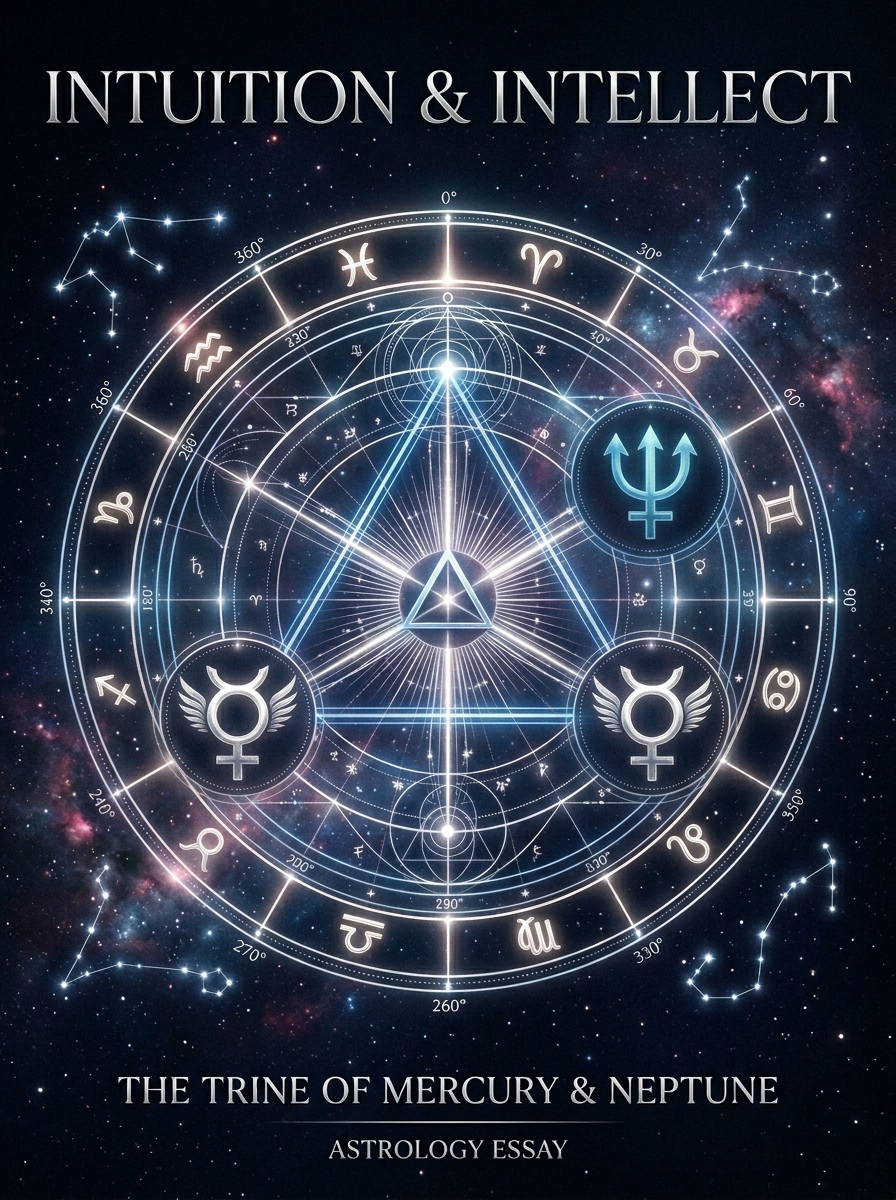
The Mind That Hears Through the Veil
Mercury trine Neptune does not simply make a person creative—it restructures how meaning arrives. Where a hard aspect between these planets pits logic against intuition, the trine lets them cooperate without friction. The result is a mind that receives information not as isolated data but as atmospheric fields: tone, silence, gesture, emotional residue. The native apprehends a room by feeling its temperature before naming its furniture.
This is the core dynamic: Mercury provides structure, naming, and pattern; Neptune supplies depth, resonance, and symbolic weight. In a trine, the two drives interpenetrate rather than cancel. The mind learns that reality has layers, and that the layer beneath speech is often the truer one. People with this aspect may not realize how unusual this is—they assume everyone hears the weather of a conversation before the words land.
The risk is that ease can masquerade as certainty. A trine aspect is fluent, but fluency is not accuracy. The gift is immediate receptivity; the shadow is the temptation to trust the impression before the evidence.
How the Mind Learns to Translate
Cognition with this aspect often begins before language. A person senses, then interprets—not through linear deduction but through a field of impressions that later condenses into explanation. This is not psychic power; it is heightened permeability. Neptune dissolves the crust around experience so meaning can move, and Mercury gives that movement a grammar.
This orientation toward the symbolic rather than the literal is classically Jungian. The native lives in a world where every object, phrase, or gesture carries a charge. They may excel at metaphor, poetry, spiritual counseling, or any craft that requires translating the unsaid. When Mercury is placed in a sign or house that already favors interiority—such as Mercury in the 12th House or Mercury in Pisces—the effect deepens: the mind becomes a finely tuned instrument for the subconscious currents of others.
In early life, this can feel like a burden. The child knows when a parent is lying before the lie is spoken, but lacks the vocabulary to prove it. They may be called “too sensitive” or “spacey.” The challenge is not the perception itself but the inability to distinguish between what is real and what is felt. The trine’s ease works against the development of that boundary.
The Shadow of Ease: Blur, Idealization, and the Fog of Longing
The danger of Mercury trine Neptune is not conflict but soft distortion. Mercury wants accuracy; Neptune dissolves edges. When the trine operates unconsciously, the native may remember intentions instead of actions, vibes instead of evidence, possibilities instead of commitments. This is not dishonesty—it is a permeability that fails to differentiate.
In relationships, the aspect can produce a powerful vulnerability to idealization. Neptune wraps ambiguous behavior in a glow of hope, and Mercury supplies the rationalizations. The person may explain away obvious boundary violations because the intuition beneath the explanation is enamored. This is especially pronounced when Neptune or Mercury falls in the 7th house, as described in Neptune in the 7th House. The native reads others beautifully but struggles to know where one person ends and another begins.
When hurt, the aspect can turn evasive. Instead of saying “I don’t want this,” the person drifts, delays, softens, or disappears. Neptune prefers mist to blunt edges, and Mercury can construct exquisite verbal fog when it senses confrontation. The antidote is not to become harsh but to anchor sensitivity in evidence: write promises down, repeat commitments back, name feelings without dressing them in poetry.
Maturation and Vocation: Disciplined Permeability
At its best, Mercury trine Neptune matures into what might be called disciplined permeability. The native learns that receptivity is a skill, not a trance. They can enter symbolic states and return with usable language. They can dream, then edit. They can sense, then verify.
This is where house and sign placements refine the expression. With Mercury in Virgo, the trine can produce an unusually lucid diagnostic imagination—a therapist who intuits the wound and names it precisely. With Mercury in Scorpio, the intuition becomes forensic, able to read the hidden emotional motive beneath the words. In Mercury in the 5th House, the same pattern turns theatrical, using imagination as performance. When Neptune is tied to the midheaven, as in Neptune in the 10th House, the public expression of this sensitivity can become a vocation: artist, spiritual guide, translator of collective feeling.
Maturity often depends on contact with grounded systems. Routines, calendars, direct feedback—these are not the enemy of intuition but its vessel. The paradox of the trine is that the more ethereal the gift, the more practical the container must be. Without structure, the native floats. With it, they become a channel.
Pouring the Gift into a Life
How does this play out in the ordinary? The same dynamic—atmospheric perception seeking form—shows up across domains without requiring the dynamic to be re-explained.
In love, the native may unconsciously shape a relationship around what is unspoken. They give the benefit of the doubt, assume depth where there may only be absence, and struggle to articulate boundaries until hurt forces clarity. The gift is profound empathy; the risk is losing the self in the other.
In work, the aspect often finds its finest expression in translation—whether of languages, emotions, or states of consciousness. Counselors, poets, songwriters, film editors, and interpreters of all kinds draw on this capacity to read between the lines and render the invisible visible. But they also need editors, deadlines, and collaborators who demand specificity.
In everyday conversation, the native may be sought out for their ability to hear what is not said. Friends call them when they need to be understood without having to explain. The aspect gives a natural attunement to subtext, but it also requires the native to learn when to trust that attunement and when to ask for the literal.
The difference between a life shaped by Mercury trine Neptune and one adrift in it is whether the native trusts the vision enough to test it—and trusts reality enough to let that vision be refined. When honored, the aspect gives speech the shimmer of dream and dream the discipline of speech. When ignored, it becomes beautiful fog.
Comments
Loading comments…