Mercury Opposition Neptune: The Pen and the Fog
The Core Dynamic: A Mind Divided Between Signal and Sea
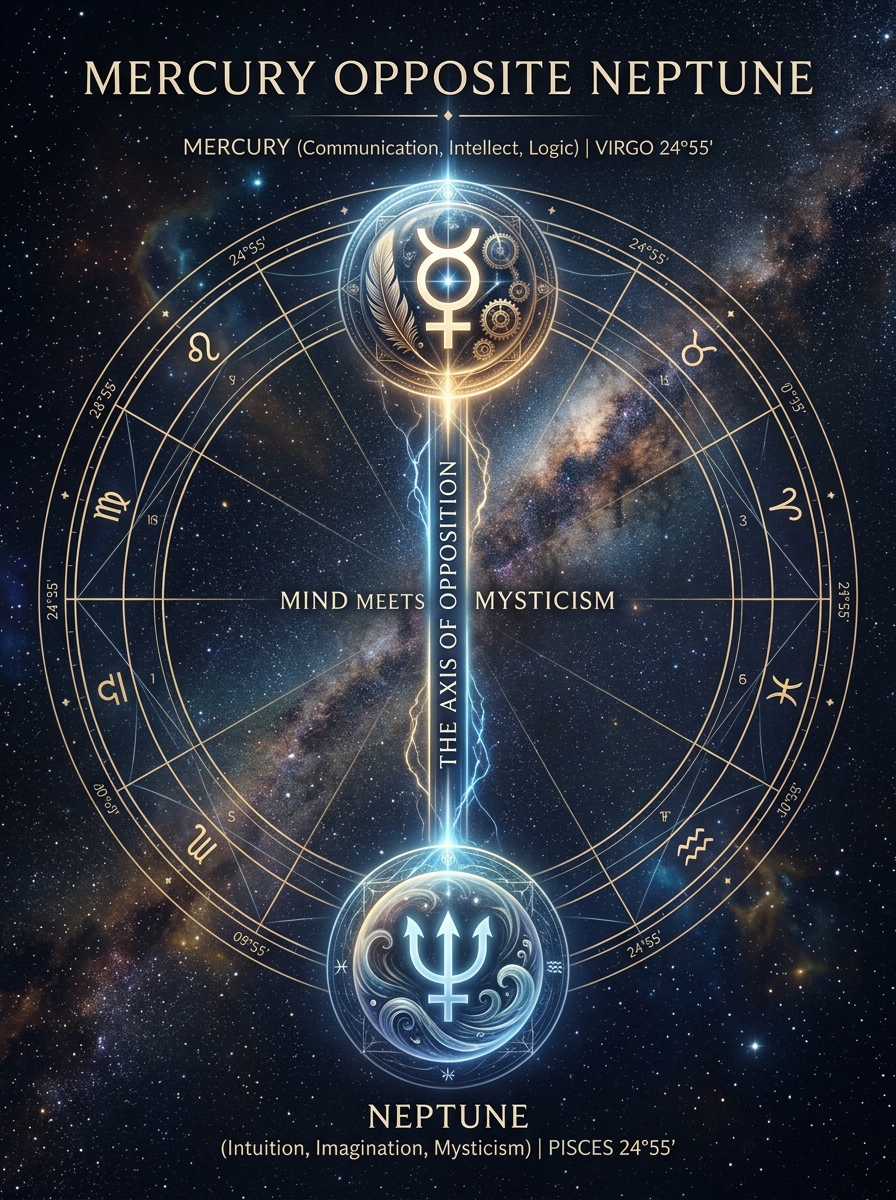
Mercury opposition Neptune describes a psyche that never receives information in a clean line. Thought arrives through atmosphere, image, hunch, symbol, dream, and emotional contagion as much as through logic. The core tension is simple to state and difficult to live: the mind wants fact, while Neptune dissolves fact into meaning, longing, fantasy, or fog. In the opposition, neither principle can dominate without consequence. The result is not merely confusion. It is a highly permeable intelligence that can become clairvoyant, evasive, inspired, deceptive, or all four in the same afternoon.
This is why the aspect often feels like a lifelong education in discernment. The native is asked to tell the difference between intuition and projection, compassion and martyrdom, imagination and self-deception. The opposition aspect itself is a mirror current; the opposition is not a wall but a charged line of awareness, and with Mercury on one end and Neptune on the other, the line is lit with both revelation and distortion. The mind sees what it wants to believe, then spends years learning how vision becomes responsible.
How It Forms: The Psychological Roots of Permeability
The permeability of this opposition does not appear from nowhere. Neptune weakens the ego’s boundary with the collective unconscious; Mercury normally patrols that border with language and logic. When they oppose each other, the border becomes a sieve. Early in life, the native may have learned that fantasy was safer than fact—that a beautiful lie soothed more than an ugly truth. Or they may have absorbed the emotional weather of a home so intensely that they never learned to distinguish their own thoughts from the feelings of others. The mind learned to escape into imagination when reality became harsh.
This is why Mercury in Pisces shares a similar nervous system: thought moves in currents rather than lines. But the opposition adds a reflective tension. The person is not merely dreamy; they are aware of the gap between the dream and the fact, even if they cannot always close it. The psychological signature is a kind of chronic double-vision: the literal meaning and the felt meaning both claim authority, and choosing between them feels like betrayal.
In some charts, this dynamic is anchored by Neptune in the 12th House, where the subconscious is the ground of all experience. Then the opposition becomes a lifelong dialogue between what is said and what is left unsaid, between memory and myth, between the story the world tells and the story the soul knows.
The Mature Expression vs. the Shadow
The gift of this opposition is not “good intuition” in a vague sense. It is a specific kind of synthetic intelligence: the ability to hold two contradictory truths at once and feel the third thing that emerges from their friction. When Mercury and Neptune cooperate, language becomes more than information transfer—it becomes atmosphere, medicine, spell, or revelation. The mature native can write a line that lands like diagnosis, compose a melody that tells the truth before the lyric does, or offer a sentence that helps someone see through their own fog.
But the opposition has a shadow, and it is not deception of others—it is self-deception. The mind can become a projector: the native unconsciously gives their own longing, fear, or idealism to other people, then relates to the projection as if it were external fact. This produces idealized friendships, confusing romances, and recurring disappointments with people who seemed luminous and turned out to be ordinary. Another shadow expression is avoidance. If the truth feels harsh, the person slides sideways, softening reports into unreliable ambiguity. This is not always conscious manipulation. Often it is self-protection. The psyche prefers a beautiful haze to an ugly fact.
The mature version learns to use Mercury retrograde cycles as a built-in discipline: review, reinterpret, correct. The native who can write, speak, or decide twice—once to let the fog out, again to find the usable shape hidden inside it—has begun to integrate the aspect. The solution is never rigidity. It is building a bridge between perception and proof, between revelation and revision.
Where It Shows Up in a Life: Love, Work, and the Everyday
Mercury opposition Neptune does not stay abstract. In love, the aspect is famously vulnerable to enchantment. The native may be drawn to elusive, wounded, or unavailable partners because the relationship becomes a screen for longing and transcendence. If Neptune in the 7th House also appears, the erotic and emotional mystique can intensify into a near-sacramental hunger for union. The desire can be beautiful—but it can also be expensive. The work is to recognize that a partner is not a portal to the divine; they are a human being with their own boundaries and contradictions.
In work, the same permeability produces gifts for publicity, art, counseling, editing, music, film, design, or any field where symbolic intelligence matters. But it can create trouble with contracts, schedules, and vague expectations. If the role depends on exactness, the native must build external structure around internal fluidity—otherwise promises dissolve. Mercury in the 7th House would intensify the relational dimension of this struggle, while Neptune in the 5th House would flood creative expression with a longing for transcendence that must be channeled, not indulged.
In everyday life, the aspect shows up as a tendency to hear what one hopes was said, to remember what protected the ego, and to explain away contradictions with poetic rationalization. The discipline that serves best is mundane: write things down, verify details, tolerate the disappointment of plain language. These are not anti-spiritual habits; they are the scaffolding that lets a Neptunian mind stay in the room with reality long enough to serve it.
The Art of Truthful Imagination: Integration Practices
Integration is not about suppressing Neptune or overcorrecting with Mercury. It is about learning to serve both without being mastered by either. The native must respect impressions without granting them automatic authority. This begins with language discipline: say the thing plainly, then let the metaphor arrive afterward. Distinguish what was observed from what was inferred. Delay public declarations when emotional weather is high.
When the opposition is integrated, the person stops choosing between fact and feeling and begins to work at the far more difficult art of truthful imagination. This is the mind that can translate the invisible without lying about it. It is the kind of intelligence that knows Mercury keeps the words honest and Neptune keeps them alive. For the native, the journey is from confusion to discernment—not to certainty, but to trustworthiness amid uncertainty. Practical tools like those of Mercury in Virgo can help anchor the process: precision as a sacred discipline, not a cold one.
The higher promise of Mercury opposition Neptune is not prophecy that never errs, but a human being who understands that meaning is layered, and that truth requires both intuition and verification. That is the bridge between the pen and the fog—a bridge the native must build themselves, one honest sentence at a time.
Related
- Mercury Trine Neptune: The Mind That Hears Through the Veil
- Mercury Square Neptune: The Mind at the Mirage’s Edge
- Mercury Conjunct Neptune: The Mind That Listens to the Unseen
- Mercury Sextile Neptune: The Mind That Can Hear the Invisible
- Sun Opposition Neptune: The Bright Self and the Vanishing Horizon
Comments
Loading comments…