Neptune in the First House: Ego Porosity, Ethereal Identity, and the Sacred Persona
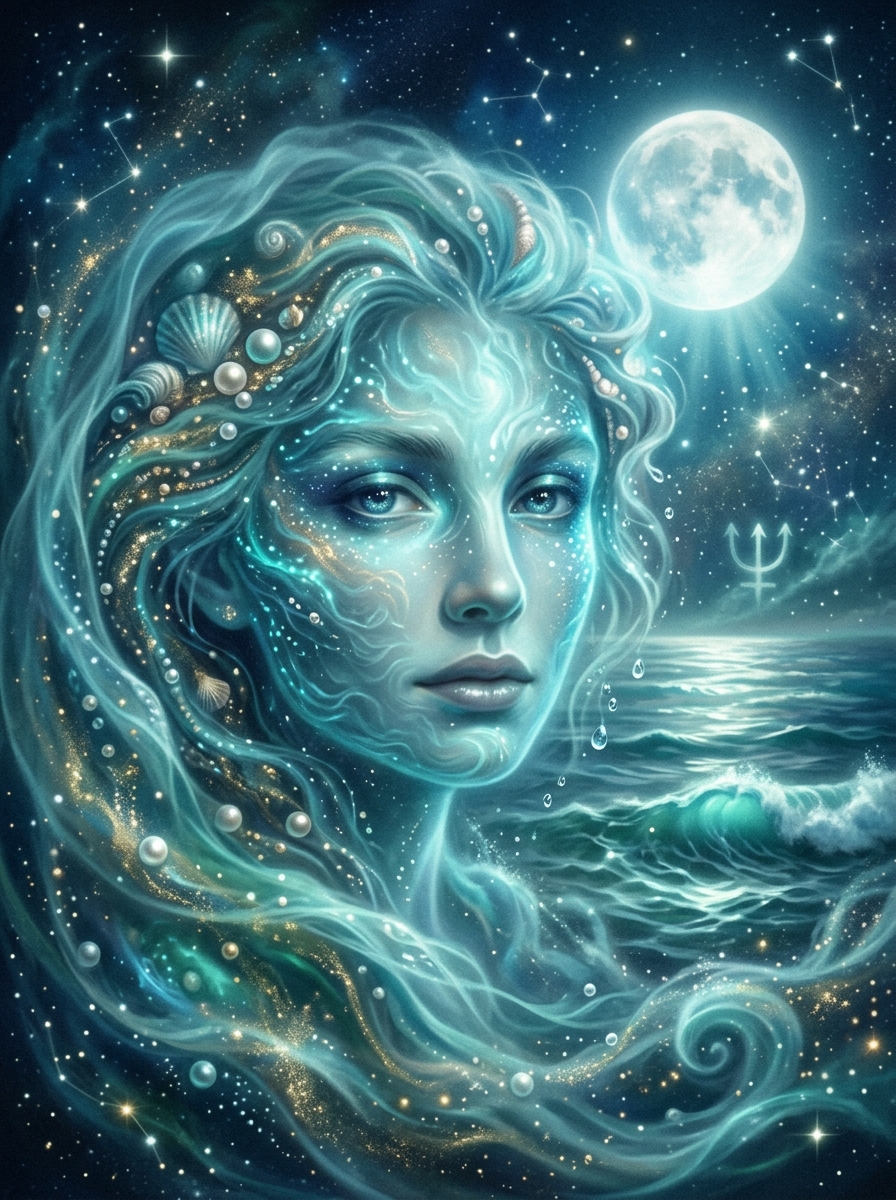
Neptune in the First House: The Ethereal Persona and Fluid Identity
When Neptune, the planet of oceanic unity, boundless imagination, and spiritual dissolution, resides in the first house of the birth chart, the very boundary of the self undergoes a profound transformation. The first house, traditionally associated with the Ascendant, represents the threshold between the internal psyche and the external world. It is the lens through which we view reality and the filter through which the world perceives us. With Neptune positioned here, this lens is not a clear, rigid pane of glass, but rather a shifting surface of water, refracting light in unexpected patterns and absorbing the colors of whatever surrounds it.
The individual with Neptune in the first house does not possess a fixed, solid ego-identity in the traditional sense. Instead, their sense of self is fluid, chameleonic, and inherently porous. They do not merely walk through the world; they flow through it, constantly adapting their shape to fit the psychic vessels they encounter. This creates a personality that is deeply mysterious, compelling, and often difficult to pin down. Others may project their own desires, fears, and ideals onto the Neptunian individual, seeing in them a saint, a savior, a victim, or a phantom. The physical presence itself often carries an ethereal quality—a softness in the eyes, a gentle voice, or an elusive grace that seems to defy the physical constraints of the material plane.
Esoterically, Neptune’s presence here indicates that the incarnating soul has chosen to experience the dissolution of the rigid boundaries of the personality. The ego is not allowed to crystallize into a self-centered monolith; instead, it must remain open to the collective unconscious, serving as a conduit for energies that transcend the personal sphere. This creates a lifelong quest to answer the fundamental question: "Who am I when I am not absorbing the world around me?" The answer is rarely a simple, singular identity, but rather a recognition of the self as a vast, interconnected ecosystem of consciousness. This planet, named after the Roman god of the deep seas, demands that the individual learn to swim in the vast currents of the collective psyche without losing their core essence to the deep waters.
The Lens of the Ascendant: Personality as a Prism
The Ascendant is our primary tool for navigating the material world—it is our psychological armor, our physical interface, and our style of action. When Neptune merges with this point, the armor becomes semi-permeable. The personality functions not as a shield, but as a prism. Incoming light is split into a spectrum of colors, making the individual highly sensitive to the subtlest shifts in their environment. They possess an instinctual understanding of the unspoken undercurrents in any room, reading the emotional atmospheres as clearly as others read written words.
This prismatic quality means that the Neptunian persona is rarely consistent. In the presence of anger, they may unconsciously mirror that tension; in the presence of grief, they may become a vessel for tears that are not entirely their own. This fluidity is not a conscious strategy of deception, but an involuntary response to the ocean of collective energy. The challenge lies in learning to witness these shifting states without identifying with them completely, recognizing that the prism remains itself even as different colors pass through it. The individual must understand that their ability to mirror others is a gift of empathy, not a lack of character. It requires a deep maturity to allow the light to pass through without clinging to any single color of the spectrum.
Ethereal Aesthetics and Somatic Projection
The physical manifestation of Neptune in the first house is often striking, though not always in a conventional sense. There is frequently a dreamlike, photogenic, or hypnotic quality to the appearance. The eyes may appear watery, luminous, or seemingly focused on a distant, invisible horizon. The body itself can feel like a canvas for the imagination of others, making these individuals natural actors, models, and artists who can easily step into different roles and archetypes. They project an aura of mystery, an intangible quality that makes people feel they are looking at a mirage rather than a solid human being.
However, this somatic fluidity can also manifest as physical vulnerability. Because the energetic boundaries are so thin, the physical body is highly sensitive to substances, environments, and emotional stress. The Neptunian physical form acts as a barometer for the psychic health of their environment. Allergies, autoimmune issues, or mysterious, hard-to-diagnose ailments can occur when the individual is overwhelmed by toxic dynamics or sensory overload. The body is telling the psyche that the boundaries have been breached and that retreat into a quiet, sacred space is necessary for restoration. They must learn to treat their physical form as a delicate instrument that requires careful calibration and purification.
Extreme Sensitivity: Ego Porosity and Ambient Absorption
To live with Neptune in the first house is to exist in a state of perpetual openness. Most individuals develop a psychological skin during childhood—a set of defense mechanisms and definitions that separate the "me" from the "not-me." For the Neptunian, this skin is incredibly thin, sometimes feeling almost non-existent. They absorb the moods, thoughts, anxieties, and physical sensations of those around them. This is not merely intellectual empathy; it is a somatic, cellular absorption that can leave the individual feeling utterly exhausted and disoriented without knowing why. When they enter a crowded room, they do not just see people; they feel the collective weight of everyone's unexpressed dramas, hopes, and sorrows.
This extreme sensitivity often begins in early childhood. The young Neptunian may have been the emotional sponge of the family, absorbing the unspoken tension between parents or carrying the unexpressed grief of the ancestral line. Because their ego was not yet strong enough to differentiate, they may have grown up believing that the emotional chaos around them was their own fault or their own internal state. As adults, this manifests as a constant need to retreat from the world to discharge the accumulated psychic debris of daily life. They must learn the art of energetic hygiene, deliberately cleansing their aura of the emotions and energies that do not belong to them.
The Jungian Lens: Ego Boundaries and Participation Mystique
From a Jungian perspective, Neptune in the first house represents a state of prolonged participation mystique—a term Carl Jung borrowed from anthropology to describe a psychological connection where the subject cannot clearly distinguish themselves from the object. The Neptunian individual experiences a state of oneness with their environment that mimics the mystical state of non-duality, but when experienced through an unintegrated ego, it can lead to psychological fragmentation and confusion. They feel merged with their partners, their friends, and even the collective social climate, making it difficult to locate their own desires.
Without a functioning ego boundary, the unconscious mind floods the conscious sphere. The archetypal images, collective anxieties, and psychic currents of the era wash over the individual. As Liz Greene has noted in her work on Neptune, the longing for the primeval womb—the desire to return to a state of absolute safety and undifferentiated bliss—is the driving force behind this placement. The challenge is that to function in the three-dimensional world, the ego must exist. The goal of Neptunian development is not to destroy the ego, but to construct a flexible, semi-permeable membrane that can open to the divine while still protecting the individual's sanity and safety in the mundane world.
The Sensory Load: High Sensitivity and Somatic Empathy
The sensitivity of a first-house Neptune is not limited to emotions; it extends to the physical senses. Loud noises, bright lights, synthetic chemicals, and chaotic environments can feel like physical assaults on their nervous system. They are often highly reactive to medications, caffeine, and alcohol, requiring much smaller doses than the average person. This high sensitivity is a form of somatic empathy—the body itself feels the environment. If someone nearby is suffering from a headache, the Neptunian may develop a similar pain in the exact same location.
This level of somatic absorption requires a conscious effort to ground and discharge. If the individual does not learn to identify which sensations are theirs and which are ambient, they may live in a state of chronic illness or somatic overwhelm. They must develop an acute awareness of their bodily boundaries, using physical feedback to identify when they have taken on too much external energy. By recognizing the body as an energetic sanctuary, they can transform this vulnerability into a powerful tool for diagnostic and healing work.
Creative and Spiritual Vocations: Channelling the Neptunian Stream
While the sensitivity of Neptune in the first house can be a heavy burden, it is also the source of extraordinary creative and spiritual gifts. These individuals are natural channels. Because their ego does not stand in the way with rigid preconceptions, they can receive inspiration directly from the collective unconscious. They are the artists, mystics, musicians, healers, and visionaries who bring the formless realms of spirit into tangible reality. They possess an innate understanding of symbols, metaphors, and dreams, communicating in a language that bypasses the rational mind and speaks directly to the soul.
In the realm of career, traditional, highly structured corporate environments are often deeply toxic for the first-house Neptunian. They require autonomy, creative freedom, and a sense of higher purpose in their work. They thrive in fields where their empathy is an asset rather than a liability, such as counseling, depth psychology, energy healing, creative writing, music, film, and the visual arts. When they align with a creative or spiritual practice, they find a constructive outlet for the ocean of energy they carry, transforming their ambient absorption into beautiful, healing forms. They must view their work not merely as a job, but as a sacred service to the collective.
Artistry as a Vessel of the Unconscious
For the Neptunian artist, the creative process is not about intellectual construction, but about surrender. They do not "create" the art so much as they allow it to flow through them. When sitting at the piano, writing a poem, or painting a canvas, they enter a trance-like state where the boundaries of time and space seem to dissolve. The art becomes a map of the invisible realms, offering comfort and healing to others who struggle to express their own inner depths. Their creations carry a haunting, atmospheric quality that resonates with the universal human experience of longing and transcendence.
This capacity for channelling makes them highly effective storytellers and mythmakers. They understand the universal symbols that resonate with the human soul, speaking the language of dreams and symbols. By giving form to the formless, they heal not only themselves but also the collective, acting as cultural shamans who translate the whispers of the unconscious into the light of awareness. Their work often has a timeless quality, as it is drawn from the deep well of the collective unconscious rather than the passing trends of the material world.
The Mystical Calling: Astrologers, Healers, and Spiritual Guides
The spiritual realm is the natural home of the first-house Neptunian. They possess an innate connection to the divine that does not require dogmatic belief systems. They feel the presence of the sacred in nature, in art, and in the quiet spaces of their own minds. This makes them natural spiritual guides, astrologers, tarot readers, and energy healers. Their ability to step aside and allow higher frequencies to flow through them makes their healing work deeply transformative.
In counseling and healing roles, they do not just listen to the client's words; they feel the client's energetic field. This allows them to identify the root causes of suffering that are often hidden from the client's own conscious mind. However, to be effective in these roles, they must maintain strict energetic boundaries. Without proper training and self-discipline, they risk absorbing the client's pathology, leading to burnout and exhaustion. They must learn to act as a clear hollow reed, allowing the healing energy to pass through them without clinging to it or taking on the burdens of those they seek to help.
The Neptunian Shadow: Identity Dissolution, Codependency, and Escapism
Every astrological placement has its shadow, and for Neptune in the first house, the shadow is as vast as the ocean itself. The primary danger of this placement is the total dissolution of identity. When the boundaries are too weak, the individual may lose all sense of personal agency, becoming a passive leaf blown by the winds of other people's desires. This can lead to a profound state of victimization, where the individual feels helpless to change their circumstances and retreats into a state of passivity or self-pity. They may feel that life is something that happens to them, rather than something they actively participate in creating.
Escapism is another significant shadow expression. When the harsh realities of the material world become too loud, too chaotic, or too painful, the Neptunian may seek escape through various means. This can manifest as addiction to drugs, alcohol, media, fantasy, or even spiritual bypass—using spiritual concepts to avoid dealing with practical, emotional, or financial realities. The desire to return to the ocean of unity can manifest destructively as a slow dismantling of the physical life, avoiding the necessary challenges of growth and self-assertion. They must guard against the temptation to fade into the background, using invisibility as a shield against the demands of the world.
The Savior-Victim Dynamic and the Chameleonic Trap
In relationships, the porous boundaries of Neptune in the first house often lead to codependency. These individuals easily slip into the roles of the Savior or the Victim, forming relationships based on mutual rescue rather than mutual respect. They may attract partners who are wounded, addicted, or emotionally unavailable, believing that their unconditional love can save them. They sacrifice their own needs and boundaries in the service of the partner, only to end up feeling resentful, depleted, and betrayed. Conversely, they may play the victim, seeking a strong partner to rescue them from the demands of the physical world.
The chameleonic nature of the placement can also lead to a loss of truthfulness. Because they want so desperately to please, to blend in, and to avoid conflict, they may tell people what they want to hear, presenting a face that matches the expectations of the observer. Over time, this creates a profound sense of isolation and deceit, as the individual realizes that no one actually knows who they are—because they have never risked showing a defined, limited, and potentially disappointing self. They must learn that true connection requires the vulnerability of being seen as a separate, distinct, and sometimes flawed individual.
Escapist Mechanisms: Fantasies, Addictions, and Spiritual Bypass
The pain of the material world can feel intolerable to the highly sensitive Neptunian nervous system. To cope, they often develop sophisticated escapist mechanisms. Some retreat into elaborate fantasy worlds, spending hours daydreaming or living through fictional characters. While this can fuel creative work, it becomes destructive when it replaces real-world action and relationships. The individual may prefer the perfect, untouchable realm of fantasy to the messy, imperfect reality of human connection.
Addiction is a constant risk for this placement. Whether it is substances like alcohol and narcotics, or behavioral addictions like social media, gaming, and romance, these tools are used to numb the overwhelming sensory and emotional input of daily life. Spiritual bypass is another common defense, where the individual uses high-vibrational concepts, meditation, and ascension theories to avoid the grounded, uncomfortable work of healing psychological trauma and managing their physical life. They must learn that true spirituality is not an escape from the body, but a complete descent of the divine into the physical form.
The Developmental Stages: From Confusion to Conscious Channelling
The journey of integrating Neptune in the first house is a lifelong evolutionary process. It typically unfolds in distinct developmental stages, moving from unconscious overwhelm to conscious mastery of this delicate energy. Understanding these stages can help the individual navigate the challenges and honor the natural timeline of their growth.
The Childhood Sponge: Unconscious Absorption
In the first stage, which usually spans childhood and early youth, the individual is entirely at the mercy of their sensitivity. They have no vocabulary for what they are experiencing and no tools to protect themselves. They absorb the psychic atmosphere of their family, school, and community, often manifesting this emotional load as physical illness, shyness, or behavioral issues. They may feel like outsiders, unable to cope with the harshness of peer groups. During this time, they often develop a rich inner life as a sanctuary from the outer world, though this sanctuary can sometimes border on isolation and dissociation.
The Crisis of Dissolution: Dark Night of the Ego
As they enter adulthood, the pressure of maintaining a functional persona in the material world often triggers a crisis. The lack of defined boundaries leads to relationship failures, career confusion, or psychological collapse. This is the "dark night of the ego," where the illusions they have built about themselves and others are stripped away. They may experience periods of deep depression, anxiety, or addiction as they confront the emptiness of having no solid sense of self. This stage is painful but necessary; it is the process of breaking down the false, rigid structures of the personality so that a more authentic, spiritually aligned identity can emerge.
The Awakened Channel: Stepping into Spiritual Authority
In the final, mature stage, the individual has learned to navigate the Neptunian waters. They have established healthy boundaries, grounded their energy, and developed a strong, flexible ego that can interact with the world without dissolving. They no longer see their sensitivity as a curse, but as a sacred gift. They step into their role as conscious channels, using their creative, healing, or spiritual abilities to serve the collective. They possess a quiet authority born of having faced the depths of the ocean and returned with its treasures, acting as pillars of compassion and wisdom in a chaotic world.
Mature Integration: Building Boundaries and Honoring the Ascendant-Descendant Axis
The path to maturity for Neptune in the first house involves the conscious construction of energetic and psychological boundaries. This is not about building brick walls to shut the world out; rather, it is about developing an internal anchor that allows the individual to remain open without being swept away. It requires learning to say "no" to demands that drain their energy, recognizing that self-care is not selfish but a prerequisite for their survival. They must learn to tolerate the discomfort of other people's disappointment, understanding that their primary responsibility is to maintain their own energetic alignment and integrity.
An essential component of this integration is working with the Descendant, which in this case will be in the sign opposite the Ascendant (typically Virgo if the Ascendant is Pisces, or a highly practical, grounding sign depending on the chart). The Descendant represents the qualities we seek in others to balance ourselves. For the first-house Neptunian, integrating the Descendant means developing discrimination, practical routines, attention to detail, and a grounded approach to daily life. By bringing the practicality of the seventh house into the self-expression of the first, the individual creates a container that can safely hold the vastness of their Neptunian vision. They must learn to appreciate the beauty of order, detail, and physical service as the natural grounding agents for their mystical aspirations.
Grounding the Mystic: Practical Rituals for Containment
To manage their extreme sensitivity, Neptunians must develop daily rituals of grounding and purification. This can include physical practices like yoga, walking in nature, or swimming, which help to anchor the awareness in the body. Spending time near water is particularly healing, as it allows them to release the energetic debris they have absorbed. Salt baths, clean eating, and minimizing exposure to screens and chaotic environments also play a critical role in maintaining nervous system health.
Psychological boundaries can be strengthened through depth therapy, journaling, and creative work. By naming their emotions and separating their feelings from those of others, they learn to navigate the psychic currents with clarity. They must also learn to embrace the beauty of limitation, recognizing that to manifest anything of value in this world, we must choose one path, one form, and one expression, letting go of the infinite possibilities to honor the sacred reality of the present moment. These practical steps are not a restriction of their freedom, but the very key to unlocking their true potential.
The Virgo Descendant: Embracing Order, Discernment, and Routine
The relationship axis is where the Neptunian individual often learns their hardest and most valuable lessons. With Neptune in the first house, the Descendant is typically in Virgo, representing a deep, unconscious need for order, clarity, and discernment in relationships. Initially, the individual may project these qualities onto partners, attracting critical, analytical, or hyper-practical people who try to organize or control their chaotic lives. While this can lead to conflict, it points to the qualities the Neptunian must integrate within themselves.
To balance the nebulous, boundaryless nature of the first house, the individual must develop their own internal Virgo. This means embracing analytical thinking, paying attention to details, and creating healthy, daily routines. It involves developing discernment in who they allow into their inner circle, learning to analyze people's actions rather than just feeling their potential. By integrating the Virgo shadow, the Neptunian stops looking for a partner to save them or criticize them, and instead uses their own analytical skills to build a stable, functional life that supports their spiritual and creative work.
Frequently Asked Questions
What does it mean to have Neptune in the first house?
Having Neptune in the first house means that the planet of spirituality, imagination, and boundary dissolution is located in the house of self-expression, physical appearance, and ego-identity. This placement creates a highly sensitive, intuitive, and fluid personality. Individuals with this placement often have porous emotional boundaries, absorbing the energy of their surroundings, and may possess a dreamlike or ethereal physical presence that others project their own ideals and expectations onto. They are natural empaths who must learn to differentiate their own feelings from the ambient emotions of the collective.
How does Neptune in the first house affect physical appearance?
Neptune in the first house often manifests as a soft, dreamlike, or magnetic physical appearance. The eyes are frequently described as luminous, watery, or deep, carrying an expression that seems to look beyond the immediate physical reality. These individuals may have a chameleonic style, easily changing their look to suit different moods or environments. Because of their physical sensitivity, they can also be highly reactive to environmental toxins, stress, and substances. Their physical presence is less about solid form and more about the atmospheric quality and emotional resonance they project.
What are the main challenges of this placement?
The primary challenges include a lack of clear identity, difficulty setting boundaries, codependency, and a tendency toward escapism or addiction. Because they absorb the emotions of others so easily, they can suffer from psychic exhaustion and feel lost or disoriented. They may also struggle with the Savior-Victim dynamic in relationships, either trying to rescue others or seeking to be rescued from the harsh realities of physical life. Learning to say no and accepting the limitations of the physical world are lifelong struggles for these individuals.
How can someone with Neptune in the first house protect their energy?
Protective strategies include establishing daily grounding rituals (such as spending time in nature, swimming, or practicing yoga), setting clear verbal boundaries, and scheduling regular periods of solitude to discharge absorbed energies. Creative expression (art, music, writing) serves as an excellent outlet to process and transform ambient emotions. Developing practical habits and routines, associated with the opposing seventh-house axis (Virgo), is also crucial for staying anchored. Utilizing energetic clearing techniques, like salt baths or visualization, can also help keep their field clear.
Is Neptune in the first house a good placement for careers in art or healing?
Yes, this is one of the most classic placements for artists, healers, mystics, and counselors. The porosity of the ego allows these individuals to channel inspiration directly from the collective unconscious, making them gifted musicians, actors, writers, and visual arts professionals. Their natural empathy and somatic sensitivity also make them deeply compassionate therapists, energy workers, and spiritual guides, provided they have learned to manage their energetic boundaries. They excel in any vocation where they can act as a bridge between the unseen worlds and practical reality.
How does Neptune in the first house affect relationships?
In relationships, this placement often leads to a high degree of romanticism, projection, and codependency. Neptunians are prone to idealizing their partners, seeing them through rose-colored glasses, and ignoring red flags. They may unconsciously take on their partner's emotional state, losing their own identity in the process. To find harmony, they must integrate their Descendant energy (typically Virgo), which demands discernment, practical communication, and the acceptance of partners as flawed, real human beings rather than idealized fantasy figures.
Comments
Loading comments…