Mercury Sextile Neptune: The Mind That Can Hear the Invisible
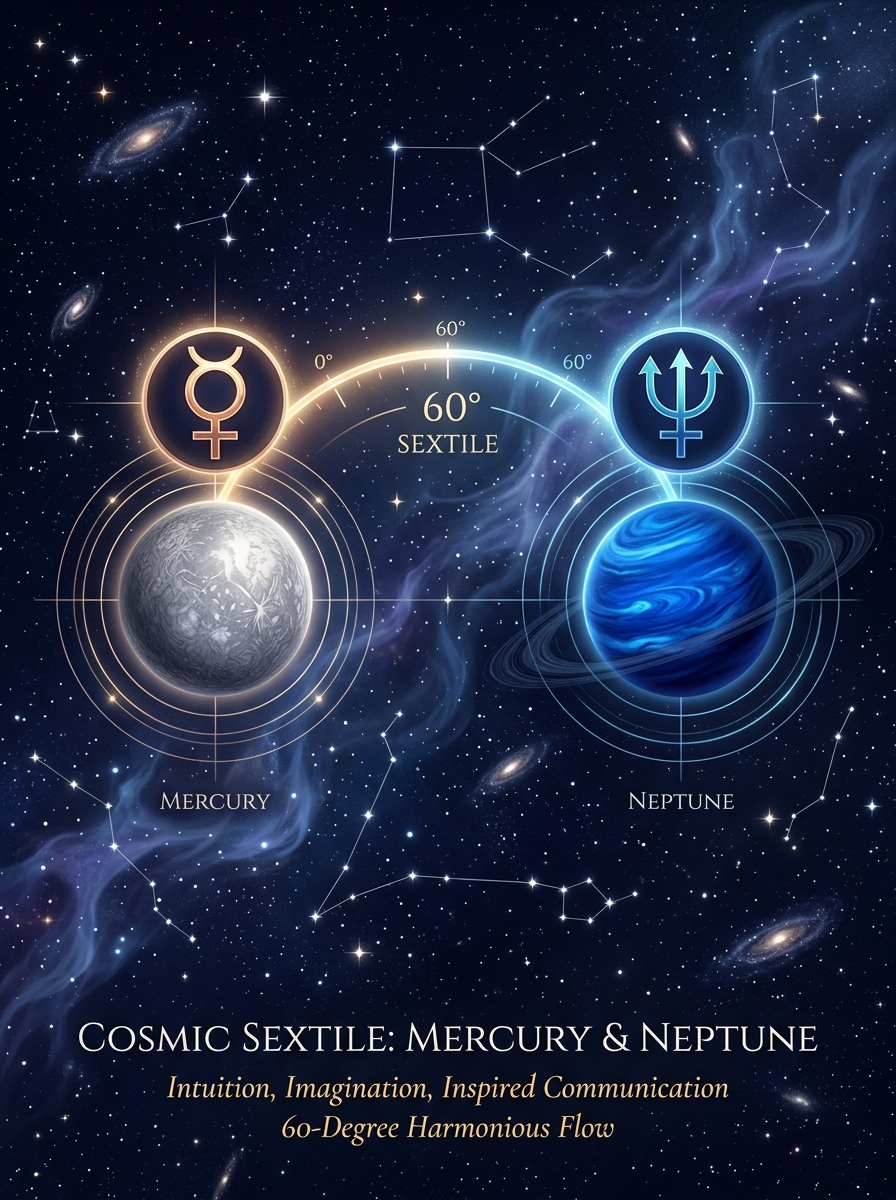
Mercury sextile Neptune describes a mind that does not merely process data; it absorbs the weather of a room, the subtext of a silence, the shape of an unspoken longing. The core thesis is simple: this aspect gives thought a permeable edge and imagination a usable structure, so intuition can become language without losing its poetry. In a natal chart, that often produces someone who listens between the lines, translates feeling into images, and instinctively searches for the meaning behind events rather than their surface mechanics.
The Core Dynamic: Collaboration Between Data and Dream
A sextile is not a collision but an opportunity—an angle of cooperation between planets in compatible elements. For a fuller look at the aspect's DNA, see the meaning of the sextile. Mercury and Neptune in sextile indicate that thought can move toward vision without forcing the issue. Mercury is the messenger, the classifier, the interpreter of data. Neptune dissolves categories, opens the psychic weather system, and speaks in dreams, symbols, music, longings, and invisible connections. In hard aspect, these two fog each other: Mercury gets confused, Neptune gets mistranslated. In sextile, they become collaborators. The mind becomes receptive enough to catch faint signals, but not so flooded that it loses its bearings.
People with this aspect often think in images before they think in propositions. They may know something is true before they can defend it. Their first response to a person, a room, a poem, or a silence is an impression rather than a conclusion. That does not make them irrational. It means their cognition includes a wider sensory field than logic alone. This is why Mercury sextile Neptune frequently appears in charts of writers, healers, musicians, editors, therapists, and translators of all kinds. The gift is not just creativity—it is interpretive finesse: the ability to convert a private inner atmosphere into something others can receive.
How This Wiring Develops: The Receptive Mind's Formation
The sextile does not create this sensitivity from nothing. It offers a channel—a pathway that the native can learn to use deliberately. Often, the person grew up in an environment that rewarded intuitive listening: a household where what was left unsaid mattered more than what was said, or where imagination was a refuge. The mind learned to pick up emotional undertones because doing so felt necessary. But the sextile itself does not cause that history; it simply provides a doorway. Unlike a hard Neptune aspect, which may blur boundaries by force, the sextile lets the native choose when to open and when to close that doorway.
This is particularly evident when Mercury is placed in the 12th house, where the mind already lives beneath the surface, or when Neptune is in a similarly inward position. The wiring says: you can participate in mystery without being swallowed by it. The psychological root is not trauma but permeability with a filter. Over time, the native learns to distinguish between their own imagination and the atmosphere they are receiving. That discernment is the central developmental task of this aspect.
The Mature Expression vs. the Shadow
When developed well, Mercury sextile Neptune becomes symbolic intelligence—the ability to sense what a situation means before you can prove it, then use language, art, or counseling to give that sense form. The best version is not dreamy vagueness; it is craft. The native can feel the precise adjective that unlocks a feeling, or know how to shape a sentence so it carries emotional subtext. This is one reason the aspect can be quietly excellent in work that depends on nuance: diagnosis, literary editing, storytelling, brand voice, psychotherapy, or any field where literal-mindedness would flatten the truth. The gift is the ability to trust the image, then test the image. That testing may happen through journaling, dialogue, or simply letting the initial impression sit until the emotional charge drops. This aspect produces a gifted editor precisely because it knows how seductive a phrase can be—it understands the difference between atmosphere and accuracy.
You can hear the same archetypal chord in Mercury in Pisces, where the mind thinks in waves, but the sextile is less about sign flavor and more about the elegant bridge between cognition and vision.
The shadow side is a vulnerability to soft manipulation, vague promises, or emotionally coated misinformation. Because Neptune dissolves edges, it can make Mercury's distinctions temporarily softer than they should be. The tip toward confusion is subtle: the native may hear what they want to hear, especially when a dream or hoped-for meaning is already present. In the wrong context, intuition becomes rationalization with incense on it. Another friction point is psychic leakage—struggling to tell where one's own thoughts end and another person's atmosphere begins. With Neptune in the 12th house, the whole chart may already be predisposed to permeability; the sextile gives the mind a door into that terrain. The mature response is not to shut the door but to learn its lock.
Living the Aspect: Work, Relationships, Inner Life
The same dynamic that makes this aspect an asset in certain professions also shapes how the native moves through love, conversation, and solitude. Because the core mechanism is already established—receptive mind, usable channel—we can now see its concrete expressions without re-explaining it.
In work, this is excellent for roles requiring tact, interpretation, and emotional intelligence. The native may excel at explaining abstract or intangible material in a way others can feel. They are strong in the arts, nonprofit work, healing professions, spiritual teaching, communications, or research that needs intuition alongside data. A chart with Mercury in the 5th house amplifies the creative performance aspect; here the sextile gives the mind a stage for symbolic play.
In relationships, the aspect often produces a gifted listener. Others may feel mysteriously understood in their presence. That is a real gift, but it comes with a social caution: because the native can sense so much, they may overestimate mutual understanding. Clarity must be stated; it cannot be assumed. Bonds may form through shared aesthetics or spiritual vocabulary—a glance, a poem, a song, an unspoken recognition. This is beautiful when grounded in reality. It becomes costly when the bond is maintained by fantasy alone. The aspect is a lesson in loving the person, not the projection. When Neptune is in the 7th house, the idealization of partners is amplified; Mercury sextile Neptune can at least name the idealization before it becomes a spell.
In inner life, the aspect feels like a room with a skylight. Thoughts are not sealed off from mood, dream, memory, or symbol. The native may receive insight during walks, showers, music, or the borderlands of sleep. Dream material can be unusually vivid and verbally suggestive. A phrase may arrive fully formed, carrying more truth than a page of analysis. For readers exploring why Mercury is the part of the psyche that names, sorts, and connects, Mercury in astrology provides the cleanest frame.
The Balance: Opening and Grounding
The healthiest Mercury sextile Neptune does not worship inspiration. It disciplines it gently. The native thrives when imagination has habits: notes, drafts, prayer, meditation, music practice, research routines, regular walks—any ritual that gives the receptive mind a container. Without container, Neptune diffuses. With container, Neptune becomes art, insight, compassion, and symbolic literacy.
This aspect benefits from a life that alternates between openness and verification. The person should be allowed to dream, but also asked to check facts. They should be encouraged to trust nuance, but not to confuse nuance with obscurity. They need enough quiet to hear the inner signal and enough external reality to keep it clean. That balance is the real achievement. In the end, Mercury sextile Neptune is the natal signature of a mind that can cross the bridge between the seen and the sensed. It is not the loudest intellect in the room, but often the one that notices what the room is feeling. When developed well, it can speak with grace, write with atmosphere, counsel with compassion, and turn intuition into something sharable. The mind does not lose itself in the mist; it learns how to navigate by it.
Comments
Loading comments…