I Ching Hexagram 50: The Cauldron and the Alchemy of What a Life Can Hold
The Cauldron is not a container — it is a crucible
Hexagram 50, The Cauldron does not ask what you hold. It asks what you can refine. In the I Ching’s ancient world, the cauldron was the bronze vessel that turned raw grain into ritual food, raw metal into dynastic authority. Its meaning is not about storage or possession; it is about transmutation under fire. The hexagram’s question for any life, project, or relationship is this: have you become a vessel that can withstand heat, hold complexity, and yield something that nourishes others? If not, no amount of raw material will produce good fortune.
This makes The Cauldron a hexagram of moral chemistry. It concerns the integrity of the container before the quality of the ingredient. A cracked vessel spills even the finest offering. A well-formed vessel ennobles the simplest meal. The divination points not to what you have but to what you have become able to transform. That distinction separates this hexagram from every other in the I Ching: it is not about acquisition, not about action, but about the architecture of the self that receives and metabolizes experience.
The image: three legs, two handles, one bronze body
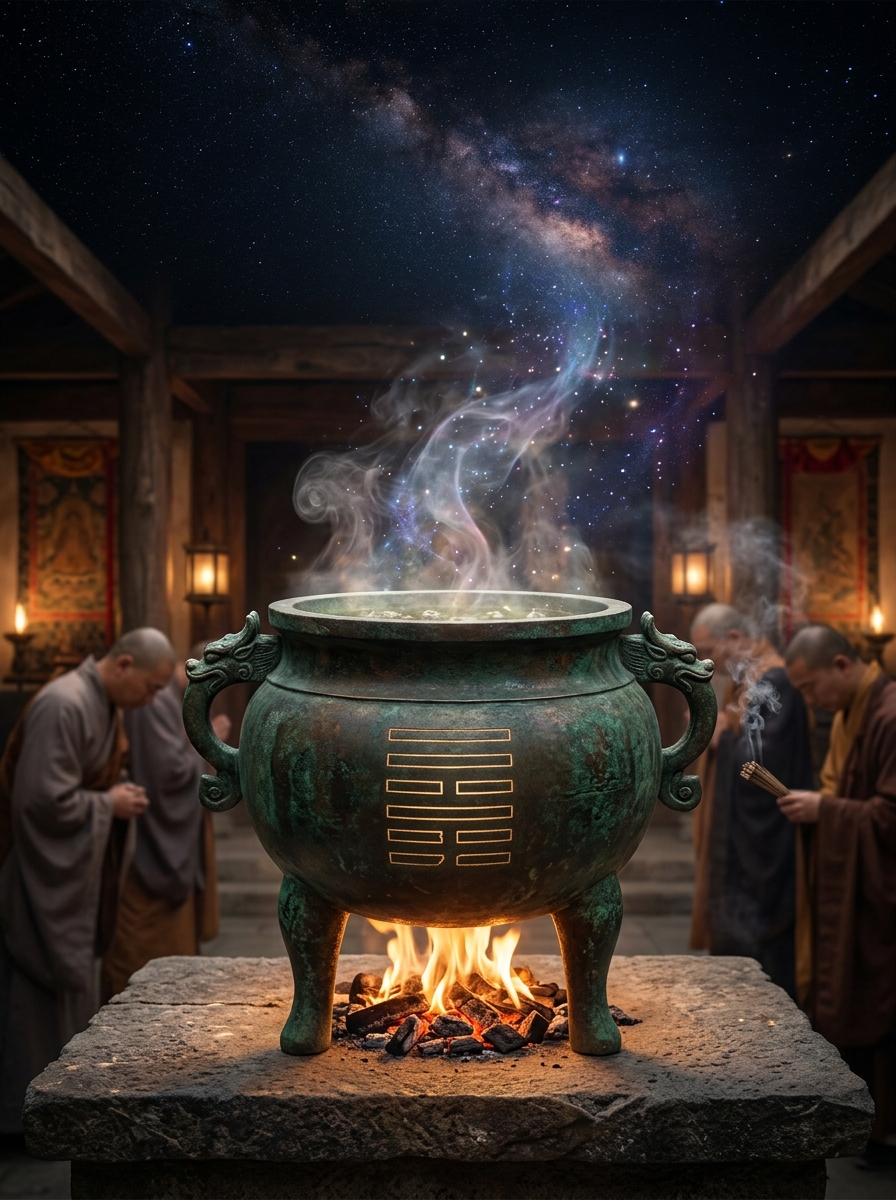
The traditional image of The Cauldron is precise: a bronze tripod with two handles. Every detail carries weight.
The three legs represent stability through tension. A cauldron does not rest on flat certainty. It stands because its weight distributes across three points, each bearing a share of the load. In a reading, this signals that the querent’s equilibrium depends on balancing multiple factors — ambition, discipline, purpose; instinct, ethics, timing; inheritance, revision, public use. Hexagram 50 rarely appears when one pillar alone supports a life. It favors those who have learned to hold opposites in dynamic balance: the spiritual and the practical, the private and the communal, the old and the new.
The two handles matter because a cauldron is meant to be carried. It is not a sealed vessel for private contemplation; its contents are transferable. The handles signify that refinement must become communicable. When The Cauldron appears in a reading, it often asks whether your knowledge, suffering, or talent has been shaped into a form others can receive. If it cannot be carried outward, it has not yet fully taken shape. This is the social dimension of the hexagram: the cauldron feeds people, not just the self.
The bronze body itself is a symbol of endurance. Bronze is not soft; it is an alloy fired and cooled, made to survive centuries. The Cauldron therefore points to authority that has been tested by repetition — not the flash of inspiration but the wisdom of what has been ritually preserved. The querent may be called to steward a tradition, a craft, a household pattern, or a moral charge that others depend on but do not fully see. The cauldron’s value is not ornamental; it is functional. Its beauty is the beauty of something that works under heat.
The three legs as a diagnostic of imbalance
When a moving line weakens one leg, the entire vessel tilts. In divination, Hexagram 50 often warns of a single over-investment — too much ambition without ethics, too much discipline without purpose, too much inheritance without revision. The solution is not to abandon the strongest leg but to strengthen the others. The cauldron stands because no leg bears the whole burden.
The handles as a test of transmission
A broken handle means the cauldron cannot be lifted. This appears when the querent has refined something valuable but cannot present it — a manuscript, a skill, a healed wound. The Cauldron asks: what is blocking the movement from inner formation to outer use? The answer is usually a failure of form, not a failure of substance.
The judgment: supreme success through right ordering
The Judgment of Hexagram 50 reads: Supreme success through the cauldron. The well-fitted vessel receives the offering. The blessing is conditional. The outcome depends on preparation. A misaligned cauldron ruins even excellent contents. A well-ordered cauldron turns the simplest grain into a feast.
That logic reverses the usual divinatory advice. Most hexagrams urge action: advance, retreat, wait, strike. The Cauldron urges alignment. It says: before you pour anything in, check the vessel. Before you teach, heal, lead, or create, ask whether your inner structure can contain the heat. The hexagram is a mirror for the querent’s capacity to hold tension, contradiction, and intensity without cracking. It is not a hexagram of effort but of readiness.
The Judgment also links the sacred and the practical. The cauldron is both a kitchen tool and a ritual vessel. In a reading, this means the querent’s daily work — cooking, teaching, parenting, managing — carries a ceremonial weight. Hexagram 50 sanctifies ordinary labor when it is done with integrity. The offering is not separate from the process; the process is the offering.
The warning inside the blessing
A damaged cauldron cannot hold the feast. If the querent’s character, institution, or relationship is compromised by vanity, haste, or fragmentation, nourishment leaks away. The Cauldron does not comfort. It diagnoses. The problem may not be lack of material but an unworthy container. The cure is repair, not addition.
The principle of right order
The hexagram’s sequence places it after Hexagram 49, Revolution. The old skin has shed; now the vessel must be formed to receive the new life. The Cauldron is the structural phase of transformation — the time when emerging energies become reliable form. Without it, revolution collapses into chaos. The querent stands at that threshold: how do you shape what has been born into something that can last?
The moving lines: where the fire does its real work
The six lines of Hexagram 50 describe stages of refinement. They do not chart external events but internal capacities. When a line changes, the issue is technical truth, not dramatic collapse.
A broken leg, a missing handle, an overloaded vessel — each failure is precise and correctable. The first line warns of a cauldron overturned, its contents spilled. This is the state of raw potential that cannot yet contain anything. The second line speaks of a cauldron with illness in the food — envy or resentment contaminating what feeds others. The third line describes a handle that has come loose; the cauldron cannot be carried. The fourth line shows a leg broken, spilling the offering. The fifth line is the golden handle and bronze rings — the vessel is sound and yields supreme fortune. The top line features jade rings — the highest refinement, where the vessel itself becomes a work of art, fit for ritual use.
These stages form a ladder of integrity. The querent can locate themselves: still raw, slightly contaminated, structurally weak, or fully formed. The advice follows the diagnosis. If the handle is loose, fix the connection before carrying the vessel. If the food is poisoned, purify the contents. If the legs are uneven, redistribute the weight.
In practice, The Cauldron’s moving lines rarely ask for heroic effort. They ask for craftsmanship. The work is in the details — the fit of a joint, the clarity of a method, the honesty of a relationship. The hexagram honors the slow, invisible labor of making form worthy of content. That labor is the cauldron’s real fire.
How the cauldron plays out in a life
The Cauldron consolidates into three applications, each drawn from the same dynamic already established.
In work and vocation, the hexagram points to roles that depend on cultural stewardship: editor, teacher, healer, chef, curator, manager, guide, or any position where the quality of the container shapes the outcome. The question is not whether you have talent but whether your process can hold and transform it for others. A writer whose craft is meticulous but whose vessel of presentation is sloppy will see the offering lost. A therapist whose own wounds are uncontained will spill more than she heals. Hexagram 50 calls for the discipline of the pot before the meal.
In relationships, the hexagram asks whether the bond is a shared cauldron — a structure that can hold grief, ambition, memory, and growth without cracking. It does not favor intensity alone. It favors form: daily rituals, mutual accountability, the kind of trust that survives repeated fire. The relationship that feeds others — children, community, the future — is one that has been shaped with intention. The Cauldron does not reward spontaneity; it rewards design.
In inner development, the cauldron is the psyche itself. Jung recognized the image: the vessel that contains the alchemical work. Hexagram 50 describes a self that has become big enough to hold contradictions, patient enough to let experience cook into wisdom. The danger is inflation — mistaking the vessel for the contents — or contamination — letting raw emotion poison the whole. The promise is integration: what once felt chaotic becomes nourishment. The person who has been through the fire and come out with a usable life is the person others seek out, not because they are perfect but because they are fit to hold what life brings.
A reading of Hexagram 50 always returns to the same center: refine the vessel, and the offering follows. The cauldron does not glorify the labor; it sanctifies it. The blessing is not in being admired but in becoming fit to nourish.
Related
- I Ching Hexagram 51: When Thunder Breaks the Silence
- Hexagram 48, The Well: Depth, Nourishment, and the Work of Drawing What Lasts
- I Ching Hexagram 63: The Knife-Edge of After Completion
- Hexagram 45: The Sacred Pressure of Gathering
- I Ching Hexagram 29, The Abysmal: How to Enter the Water Without Losing Yourself
- I Ching Hexagram 27: Nourishment and the Art of What Feeds Us
Comments
Loading comments…