Hexagram 45: The Sacred Pressure of Gathering
The Core Dynamic: Convergence That Costs
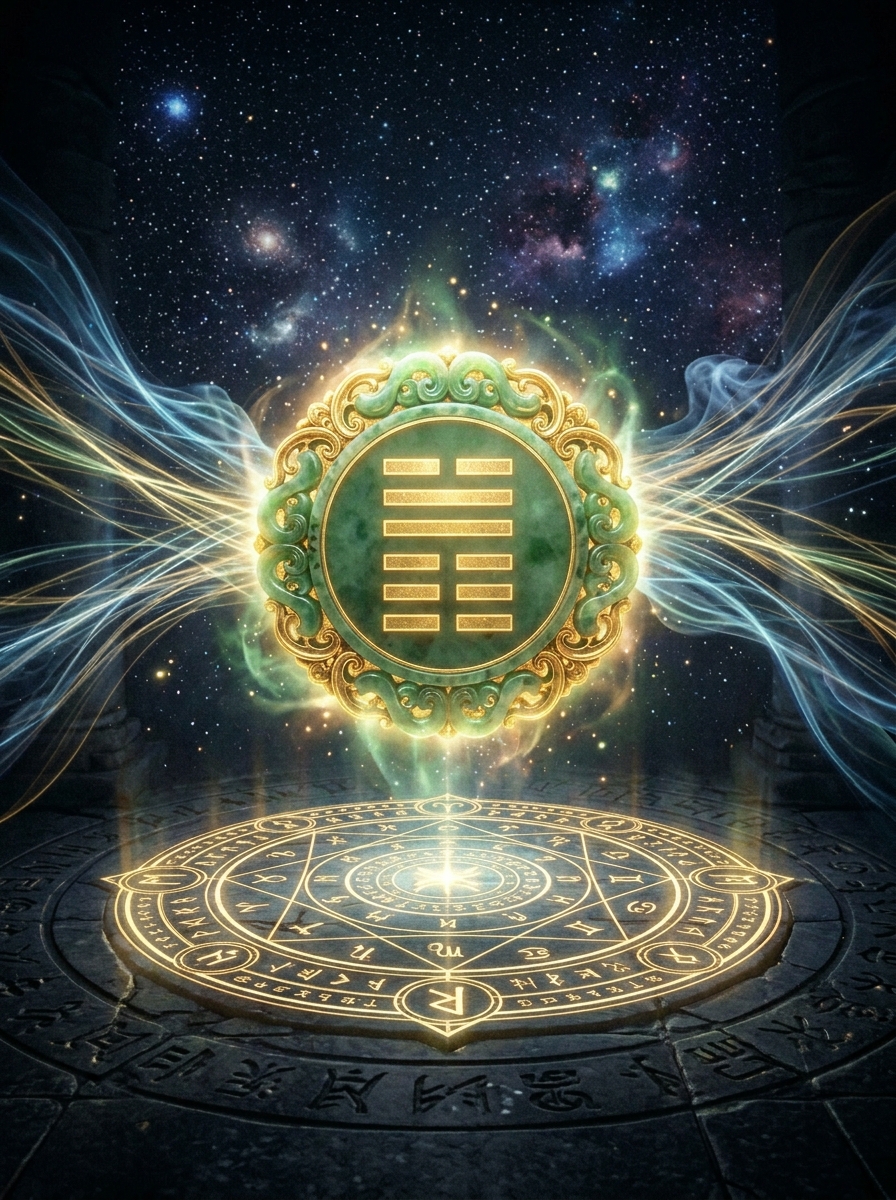
Hexagram 45, Gathering Together is not about social warmth or spontaneous community. It describes a field of convergence formed under pressure—the lake held by the earth, water contained by a receptive basin. The image is spatial and ceremonial: something has drawn disparate lives into a single point, and that drawing demands a price. The Judgment states this bluntly: the king approaches the temple, great offerings are brought, and the gathering succeeds only when the center is worthy and the participants are willing to sacrifice.
The thesis of Hexagram 45 is that union is never accidental and never free. Every gathering—a family, a team, a partnership, a movement, a psyche re-integrating after fragmentation—is a containment of forces that would otherwise scatter. The binding agent is a magnetic center: an elder, a shared vow, a crisis, a sacred task, or sometimes a loss that clarifies who belongs. That center must be legitimate. Charisma without substance produces a crowd, not a communion. The oracle’s “great person” is not merely a charismatic leader; it is the principle of right authority, whether external or internal, that can hold the space without exploiting it.
The trigrams compress the entire meaning. The upper trigram is Dui, the Lake: openness, speech, delight, the social surface where emotion becomes visible. The lower trigram is Kun, the Earth: receptivity, mass, support, the fertile ground that withstands weight. Joy rests on surrender. Without Kun, the lake spills into sentimentality or manipulation; without Dui, the earth remains inert, a mute gathering of potential. The assembly works because the container (earth) and the expression (lake) are equally real.
The Psychological Architecture of Gathering
Earth below, lake above – this is not just an external image. It maps directly onto how the psyche gathers its scattered parts. Kun represents the passive, receptive capacity to hold what arises: griefs, memories, ambitions, fears. Dui represents the active, expressive capacity to name, connect, and delight in coherence. Integration happens when the ego (the lake) learns to rest on the Self (the earth) – a deeper ordering principle that requires reverence rather than control.
In Jungian terms, Hexagram 45 describes the process of individuation as a gathering of fragments around the Self. Thoughts, roles, and desires that have been running wild begin to cohere. This can feel like relief, but it also creates pressure: once the pieces assemble, they can no longer be ignored. The great person here is the inner authority that knows what deserves allegiance. The great offerings are the ego’s willingness to surrender its dominance over certain parts of life – to sacrifice pride, comfort, or a favored narrative for the sake of wholeness.
This psychological reading is not metaphorical in a soft sense. The hexagram emerges in readings when someone is being asked to face a truth they have kept scattered: an unfinished grief, a broken commitment, a role they can no longer play. The gathering of the psyche requires the same sincerity, timing, and willingness to expend something that a tribal assembly would require. There is no integration without cost.
The Spectrum of Gathering: Maturity and Shadow
Hexagram 45 contains both promise and warning. Its mature expression is a legitimate center that attracts without forcing, holds without crushing, and directs the gathering toward a purpose that serves all members. The changing lines illustrate key inflection points.
Line 2 is the position of genuine faithfulness. Here the gathering is real because its loyalty is real – the right people find one another, or the individual’s heart knows where it belongs. This is the stage where trust consolidates. Line 5 shows the ruler’s place: the center has earned authority not through spectacle but through demonstrated capacity to hold the group’s trust and direct it toward meaningful action. When the hexagram is stable at these lines, the assembly is an instrument of transformation.
The shadow side appears in Line 3, where self-importance distorts the center. Someone wants to be seen as the focal point rather than to serve the cause. In a relationship, this is the partner who performs devotion while secretly demanding control. In a team, it is the leader who mistakes position for purpose. Hexagram 45 is intolerant of vanity dressed as leadership. The center must gather others; it cannot use them as an audience.
Line 6 describes the tragic edge: a gathering formed by loss, blood, or tears. A community may come together after a rupture; an individual may be forced into coherence by illness or consequence. This is not a failure of the hexagram. Some congregations are consecrated by grief. The oracle does not sentimentalize sorrow – it acknowledges that the most durable assemblies are often those that have survived the fire together. The shadow, by contrast, would be a gathering that refuses to acknowledge its own wounds, maintaining a false cheer that cannot weather real pressure.
Gathering in a Life: Relationships, Work, and Inner Work
The dynamic of Hexagram 45 plays out in every domain of life, but always as a variation of the same principle: convergence requires a worthy center, sincere offerings, and the tolerance of tension. No section needs to re-explain the core – only to show its shape.
In relationships, this hexagram often describes a bond that is moving from casual to consequential. Two people are drawn together, but the oracle asks what they are gathering around. If the center is shared purpose or mutual growth, the bond deepens into an instrument of transformation. If the center is need or charisma alone, the relationship will scatter the moment the emotional weather shifts. Hexagram 45 does not bless attraction; it tests allegiance.
In work and collective projects, the hexagram favors coalition over solitary effort. It is an excellent sign for fundraising, organizing, convening stakeholders, or any endeavor that requires people to move as one. Yet the success depends on clarity of the center. If the leader cannot define the cause, or if the participants are unwilling to bring something real (time, resources, ego-surrender), the assembly will remain a meeting that goes nowhere. The great offerings are not symbolic; they are the actual expenditure that makes the container real.
In inner work, Gathering Together describes a psyche recovering its focus. This can feel like a calling back of scattered attention – a recentering around a core value or vocational truth. The process may require the “sacrifice” of old identities, comfortable distractions, or compulsive thoughts. The reward is not comfort but coherence. The scattered life becomes livable when it is organized around what is most real.
The Price and the Threshold
Hexagram 45 belongs wherever people, values, or inner forces must cohere around something larger than preference. Its ancient image – the king approaching the temple – captures the threshold nature of this work. The temple is a place of consecration, where the ordinary is pressed into service by the sacred. The offerings are not optional; they are what transform a random assembly into a true congregation.
The highest use of Gathering Together is not social success or organizational efficiency. It is truthful alignment. When the center is genuine, the gathering becomes an instrument for something that outlasts the individuals involved. When the center is false, the same assembly becomes a mask for appetite, anxiety, or power. That is why the hexagram is both encouraging and exacting. It promises success, but only where devotion, sacrifice, and right relation are non-negotiable.
In a reading, 45 asks one hard question: what are you gathering around, and is it worthy of the life being offered to it? The answer determines whether the lake will remain contained by the earth or spill into chaos – whether the assembly will become a kingdom or only a crowd.
Comments
Loading comments…