I Ching Hexagram 27: Nourishment and the Art of What Feeds Us
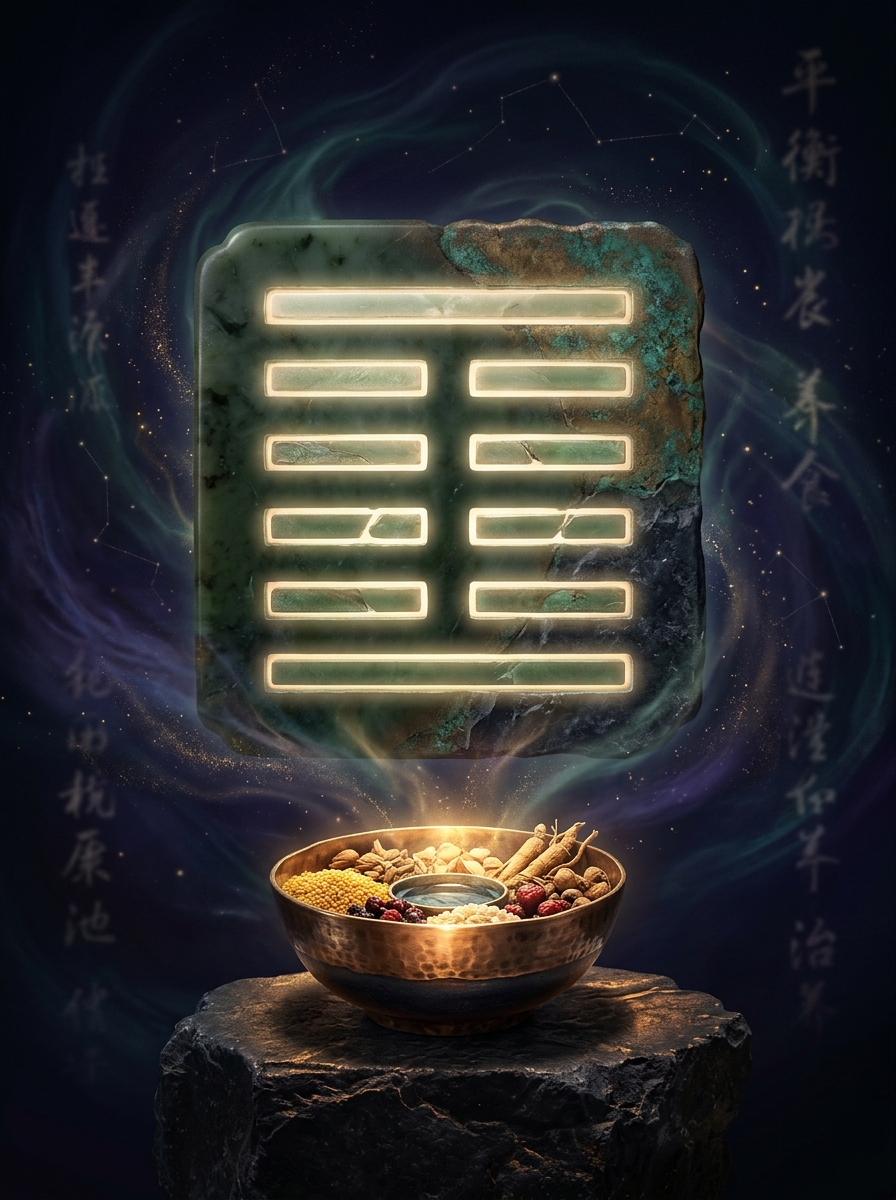
The Mouth as Threshold
Hexagram 27, Nourishment opens with the image of a mouth: the upper trigram Mountain rests on Thunder, forming the shape of jaws, a container that both receives and releases. The old Chinese name Yi literally means jaws or cheeks, and the hexagram’s argument is compressed into that one anatomical fact. It is not about food in the caloric sense, though food belongs here; it is about the architecture of intake itself. Everything that enters a life—words, images, relationships, habits, beliefs, emotions—must pass through a threshold. The threshold is the mouth, and the mouth can bless, devour, or lie.
This is not a hexagram of appetite as desire. Appetite is the raw opening; discrimination is the gatekeeper. Nourishment succeeds when the gatekeeper governs the opening, not when the opening runs unchecked. The hexagram’s central thesis is that what keeps a life alive is not abundance but the capacity to distinguish what feeds from what merely fills. A mouth that accepts everything becomes a hopper, not a digestive system. The person who consumes without discernment—news cycles, career obligations, emotional dramas, spiritual fads—may be stuffed but starved.
In divinatory practice, Hexagram 27 surfaces when the outer circumstances are less important than the channels of intake. The oracle asks not what is happening to you but what you are letting in. It often appears for someone who is trying to solve a subtle depletion by adding more—more information, more affection, more productivity, more discipline—when the real problem is the quality of the intake itself. The mouth is never neutral. It is the frontier where destiny begins, one ingestion at a time.
The Judgment and the Discipline of Intake
The Judgment of Hexagram 27 is famously spare: “Nourishment. Perseverance brings good fortune. Observe the jaws and the nourishment.” Perseverance here does not mean grim endurance. It names the patient maintenance of right measure—the ability to keep the mouth responsive but not greedy, open but not slack. Without that discipline, even good substance turns into distortion. The hexagram is unsentimental: it does not care if you are hungry; it cares whether your hunger has a form.
The word perseverance points to the ethical structure of intake. A person who chases stimulation but cannot digest experience is not nourished. A person who consumes information without reflection—scrolling, reading, hearing advice—is not nourished. A person who gives constantly but never receives is also not nourished; the mouth becomes one-directional, and the life narrows. Nourishment requires a rhythm between taking in and metabolizing, between openness and closure. The oracle’s warning is against the prestige of appetite. Hunger can wear the mask of ambition, curiosity, compassion, or spiritual seeking. All of these can masquerade as nourishment while actually draining vitality.
This is the hexagram’s sharpest insight: not all fullness is health. A life can be overfed and undernourished at once. The Judgment directs attention to the mechanism—the jaws—rather than to the content of the meal. Before examining what enters, one must examine the structure that admits it. That is why the hexagram often feels diagnostic rather than prescriptive. It does not tell you what to eat; it tells you to look at the mouth.
The Lines: From Instinct to Authority
The six lines of Hexagram 27 trace nourishment from raw dependence to the ethics of influence. Each line is a different posture of the mouth, but they cluster into two movements: the lower lines deal with personal formation, the upper lines with social responsibility.
The first three lines show a soul learning to regulate itself. The first line is the mouth at its most vulnerable: open to whatever is nearest, without any interior filter. In practice, this means absorbing habits, opinions, and emotional climates before the self has a stable center. The counsel is not to shut the mouth but to pause—to refuse passive intake long enough to feel what is actually needed. The second line shifts to a more conscious confusion: the appetite knows what is wrong but chooses what is convenient. Here the danger is not scarcity but substitution—taking available pleasures in place of appropriate ones. The third line introduces self-mastery as a form of restraint. Restraint here is not deprivation; it is the beginning of integrity. The mouth does not need to accept everything the moment it appears. Something in the psyche must be strong enough to wait.
The upper lines move into the social field. The fourth line asks what happens when one person’s mouth becomes another person’s source. Influence—whether as parent, teacher, manager, or public figure—can nourish or create dependence. The line warns against feeding that makes others weaker, against giving that seeks attachment rather than autonomy. True nourishment gives others capacity; it does not manufacture need. The fifth line is the hexagram’s ideal: a source of sustenance so aligned with the whole that it calms appetite rather than inflaming it. This is the image of clean authority—steady, not forceful; reliable, not seductive. The top line warns of the opposite extreme: nourishment that has lost contact with reality. The mouth becomes abstract, offering principles without substance, or consuming symbols instead of actual life. The final line insists that wisdom must remain edible—that it must be digestible by ordinary human beings in ordinary circumstances.
Where Nourishment Plays Out in Life
Because the hexagram is about intake as a general function, its applications are concrete without being limited to a single domain. In health and routine, Nourishment points to the body’s need for rhythm and specificity. The body often suffers not from one catastrophic flaw but from a chronic mismatch between intake and the pace of life. Sleep, hydration, movement, and regularity all belong here. So does the way we treat hunger itself: whether we answer it with what is actually needed or with a substitute that leaves the deeper appetite unaddressed. Overconsumption of any kind is frequently compensation for a starvation that the person cannot name.
In speech and leadership, the hexagram’s mouth image becomes literal. Words nourish or poison. Advice sustains; criticism wounds; silence can be either starvation or dignity depending on context. For anyone in a teaching, mentoring, caregiving, or public role, the question is not “What do I want to say?” but “What does this person need to take in?” The highest form of nourishment enables appetite for one’s own truth. A good guide does not create followers who cannot stand without the guide.
In the realm of values and spiritual metabolism, Hexagram 27 is about the process by which what we take in becomes character. We become what we repeatedly consent to. Not all dangerous influences arrive wearing the face of threat. Some arrive as entertainment, ideology, romance, ambition, or even spiritual practice. The hexagram asks whether the form matches the substance. It favors steadiness over spectacle and reverence for the ordinary sources that keep a life coherent: truthful speech, clean routines, appropriate boundaries, and a form of giving that does not empty the giver.
What the Hexagram Wants You to Notice Now
The deepest meaning of Nourishment is that life is not sustained by desire alone. Desire opens the mouth, but wisdom chooses the meal. The hexagram does not shame appetite; it civilizes it. It does not romanticize scarcity; it teaches that a life can fail from the wrong kind of plenty.
If this hexagram appears in a reading, look first at your inputs. What are you reading, repeating, eating, watching, believing, and allowing to shape your mood? Then look at your outputs. Are your words feeding clarity or confusion? Are your habits strengthening the self or merely keeping it occupied? The answer will usually be more ordinary than dramatic and more consequential than it first appears. Nourishment is one of the I Ching’s most practical and unsparing images because it recognizes that a human being is always being formed by intake. The mouth is the frontier where destiny enters, one choice at a time.
Related
- I Ching Hexagram 50: The Cauldron and the Alchemy of What a Life Can Hold
- I Ching Hexagram 20: Contemplation and the Art of Being Seen
- Hexagram 26, Great Taming: Power Held in Reserve
- I Ching Hexagram 2: The Receptive and the Art of Yielding
- Hexagram 48, The Well: Depth, Nourishment, and the Work of Drawing What Lasts
Comments
Loading comments…