Hexagram 13: The Fire of Fellowship
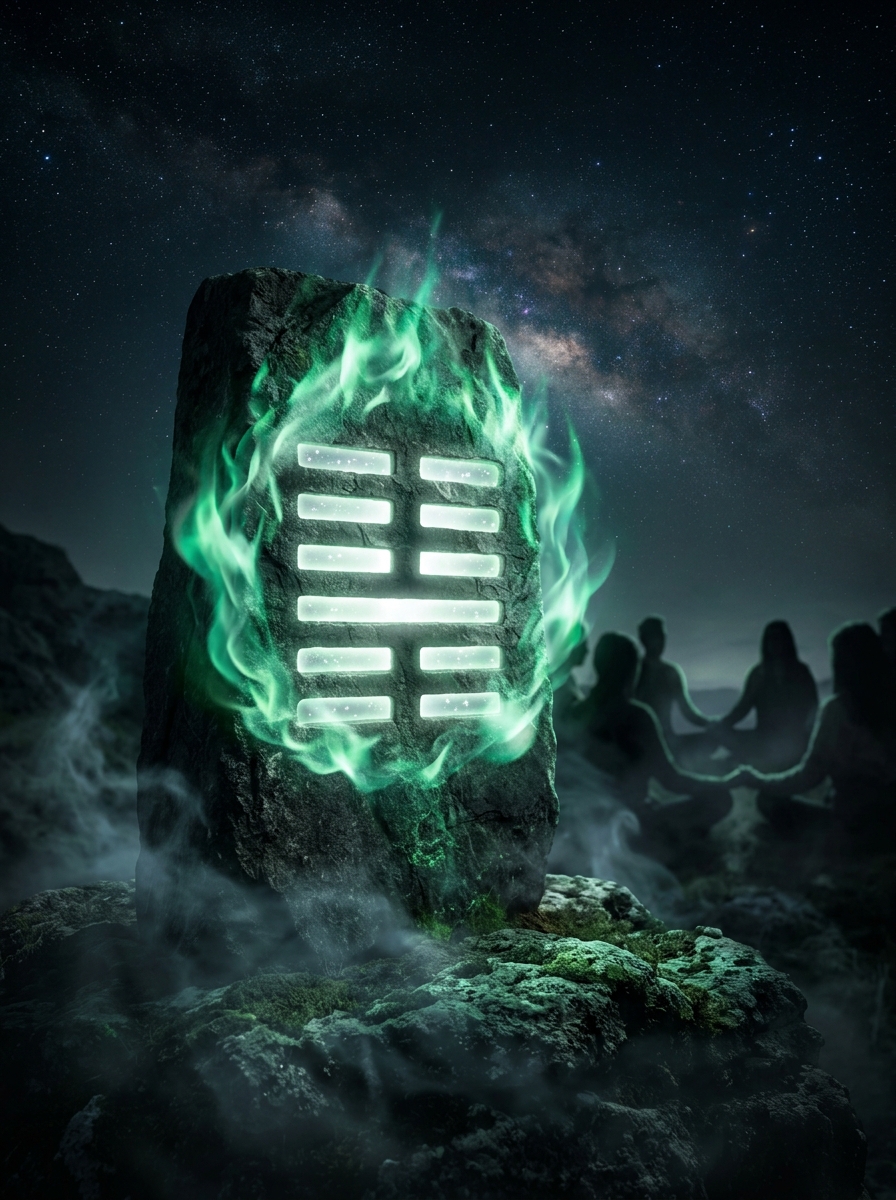
The Center That Holds
Hexagram 13, Fellowship with Men, names a specific kind of gathering: not a crowd, not a clique, but a circle bound by a single visible flame. Its upper trigram is Li, Fire; its lower trigram is Qian, Heaven. That pairing is the entire secret. Heaven below gives spaciousness, principle, and integrity; Fire above gives warmth and moral illumination. The image is not of people dissolving into each other but of each person remaining distinct while orienting toward a common light. The bond is legible: anyone can see what unites them.
The oracle’s judgment is famously concise. Fellowship “in the open” furthers the undertaking. Crossing the great water can bring success. The superior person sorts people by affinity. There is no sentimentality here. The hexagram does not celebrate togetherness as an end; it asks whether the group can survive being fully visible. Fellowship is favorable when it can be named, witnessed, and tested. If it requires concealment, it is not this hexagram.
Why the Trigrams Demand Discernment
Qian, the Creative, is pure yang: strength, initiative, expansion. It is sky-like in its amplitude, unforced in authority. Li, the Clinging, is fire that illuminates by attaching to fuel. Together they produce a beacon that can be seen from a great distance. People orient themselves toward it. That is why the hexagram is associated with gathering across difference — not cozy intimacy among those who already agree, but alliance built on a recognized center.
The structure carries a warning. Fire can consume; heaven can become abstract. Fellowship insists that the center must be principle, not personality or convenience. A group assembled for status, habit, or emotional dependency does not satisfy this hexagram. The trigrams demand discernment: the fire clarifies who is actually standing in the light. If there is confusion, that confusion is part of the answer.
This is also why the hexagram feels ethical rather than warm. Fellowship requires that the shared purpose be worthy of the sky-room. The bond is tested by its ability to withstand public daylight. Private loyalties must serve the common flame; if they eclipse it, the group fractures.
The Light and Its Shadow
Fellowship matures when it can support a passage through difficulty. The judgment’s crossing the great water signals a transformative crossing — a project, a life transition, a moral threshold — that succeeds because the right company steadies the boat. The bond is not the reward; it is the vessel. Without a shared center, the crossing becomes chaotic. With it, even a diverse group acts with coherence.
The shadow of the hexagram is false fellowship: performative unity, alliances of convenience, a circle that insists on belonging while rewarding conformity. This is not a separate “bad” meaning but the same dynamic seen from below. The hexagram’s light exposes what cannot survive honesty. A group that depends on unspoken agreements or polite illusion will crack under scrutiny.
When the reading points to tension, Fellowship often advises direct, open encounter rather than side-channel maneuvering. If the relationship can be saved, it will be by truth spoken in daylight. If it cannot, the hexagram helps you see that the bond was never built on a center that could hold.
Where the Fire Burns in Life
The hexagram’s dynamic plays out in three domains without requiring separate explanations.
In love, fellowship does not mean merging. It means two people recognizing a shared fire — values, vision, or a way of being together that can be witnessed. Relationships that depend on secrecy or mutual neediness do not satisfy this hexagram. The question: can this bond stand in the open and still feel true?
In work, the hexagram points to teams, causes, or movements that form around a legible mission. Fellowship thrives when motives are transparent and the group can be named without embarrassment. Leaders should ask whether their coalition holds because of shared principle or because of convenience. The latter will not survive the crossing.
In inner life, Fellowship can describe a reconciliation between conflicting parts of the psyche — the dreamer, the organizer, the skeptic — coordinating around a luminous intention. This is not self-erasure but internal alignment. The many selves remain distinct but face the same direction.
The hexagram also speaks to leadership and coalition-building. A fire on a height attracts not only travelers but the village. That dual function is the whole oracle: fellowship is a signal. It tells others where meaning is gathering. The work is to become the kind of presence around which worthy company can gather — and to recognize that not every bright spark is a true beacon.
The Art of Being Seen
Hexagram 13 does not ask you to be friends with everyone. It asks you to stand in the open, to choose companions by resonance of purpose, to build a circle whose warmth does not depend on concealment. The image is a beacon on a height. If your fellowship can be seen from afar and still remain true, it has passed the only test that matters.
Comments
Loading comments…