I Ching Hexagram 8: The Gravity of Belonging
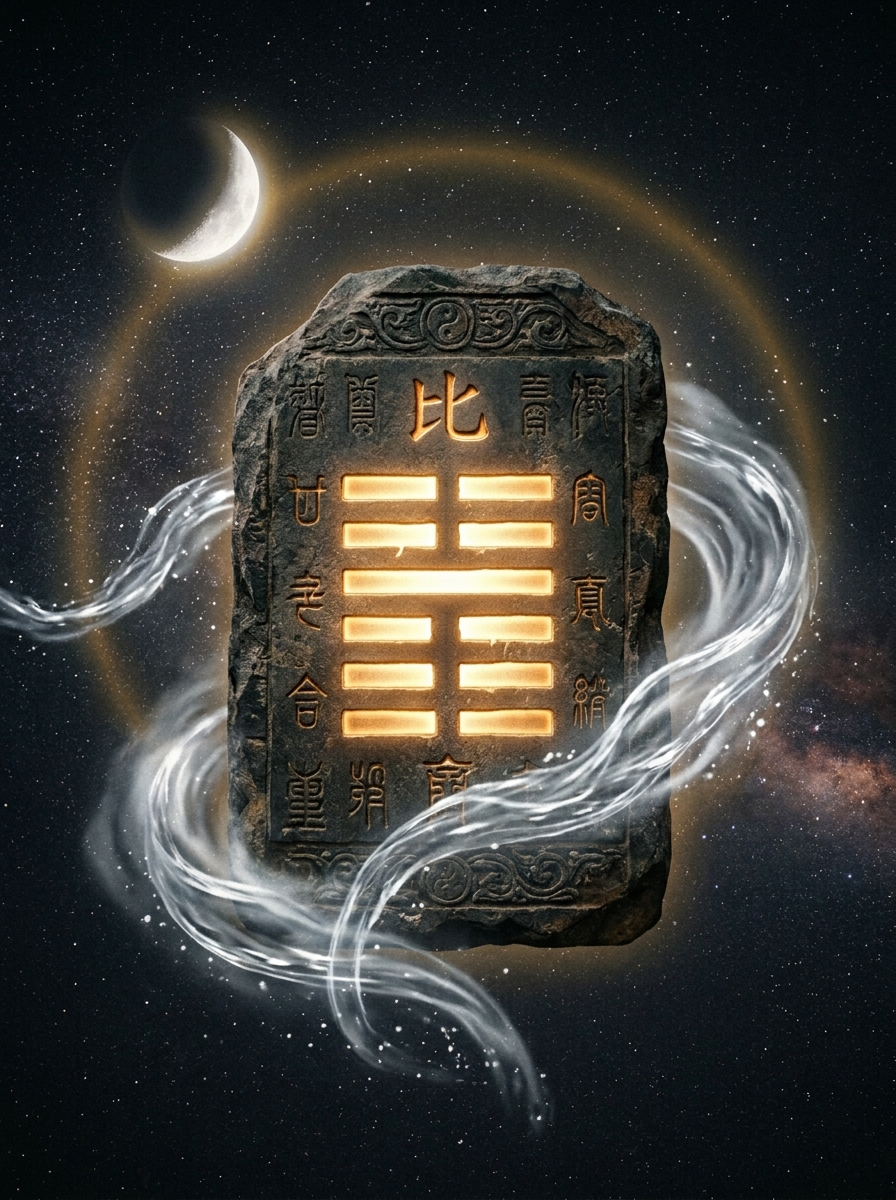
I Ching Hexagram 8: The Gravity of Belonging
The Image That Holds the Whole
Hexagram 8 – Holding Together – is built from Water above Earth. Water seeks the low places, seeps into whatever shape contains it; Earth receives, supports, and holds. This is not a metaphor for homogeneous unity. Water does not become earth, and earth does not dissolve into water. The enduring bond is one of mutual function: one flows, one receives, and together they create a social physics that is stable precisely because it respects difference.
The trigram of Water belongs to the domain of depth, danger, the hidden current. Earth is the yielding, nourishing, reliable ground. When water rests on earth, the relationship holds only if the container is genuine. A cracked vessel cannot hold the current; a rigid one repels it. This is the central insight: real belonging is not forced – it is adhesion born of resonance. The center must be worthy of allegiance, and the members must align themselves with something beyond private preference. The image warns against sentimental readings of community. It asks, instead, for a clear-eyed assessment of whether the bond fits naturally, or whether it is being propped up by will alone.
The Inner Audit — What the Judgment Demands
The Judgment of Hexagram 8 reads: “Holding Together brings good fortune. Inquire of the oracle once again whether you possess sublimity, constancy, and perseverance; then there is no blame.” This is not a blanket blessing. It is a self-audit before entering the circle. The phrase “inquire of the oracle” means: verify your motive. Do you seek the group because it is true, or because you want shelter from your own dispersion? Do you want to serve the common center, or to absorb its energy for personal gain? The hexagram asks the querent to distinguish authentic allegiance from dependency disguised as devotion.
The three qualities named are the internal architecture of durable belonging. Sublimity is the capacity to stand for something larger than appetite – a moral altitude. Constancy is the refusal to treat commitment as mood. Perseverance is endurance under strain, especially when the group stops being rewarding and becomes merely necessary. Together, these define the difference between adhesion (sticky but shallow) and attachment (possessive) versus the cleaner bind of Holding Together: people gathered around a center they recognize as legitimate. The phrase “then there is no blame” is not moral absolution; it means that if your alignment is sincere, your participation does not carry hidden rot. Wrong motives corrupt the bond long before outside events do.
The Line of Testing — When Belonging Bends
The moving lines of Hexagram 8 reveal how belonging behaves under pressure. They are not separate teachings; they are an arc of testing that every genuine collective must pass through.
Early Lines: The Hesitation Before Commitment
The opening lines address the problem of first allegiance. Here, the bond is still forming, and the question is whether to enter at all. The text warns against rushing in: impulse produces a counterfeit solidarity, one based on convenience or fear of loneliness. Early instability in Holding Together is not failure; it is the necessary clearing before genuine connection can appear. The querent is advised to wait, discern, and identify the authentic source of cohesion – is this alliance built on mutual respect or on a shared need for validation? Only when the answer is clear does commitment become wise.
Middle Lines: The Legitimacy of the Center
The central lines are the psychological heart of the hexagram. The focus shifts from whether to join to what makes a center worthy. The I Ching repeatedly emphasizes that groups cohere around something that stands above individual whim – a person, a principle, a mission that earns devotion. This is not authoritarianism; it is the recognition that a leader or guiding value must be legitimate for the bond to hold. In a reading, these lines often describe a situation where the querent must decide whether to trust the central figure or institution. If the center is sound, the bond deepens; if not, the collective decays from within. Water over Earth is a beautiful image only when the container is true; otherwise the water leaks, stagnates, or becomes a flood.
Upper Lines: The Limit of the Bond
The later lines indicate maturity or overextension. A bond that was alive may begin to harden into obligation. The self may be asked to serve the whole so completely that individuality becomes endangered. The wisdom here is delicate: true belonging does not require self-erasure, but neither does it permit isolation masquerading as freedom. If the center is worthy, the querent may experience the deep peace of being correctly placed. If not, the line can signal disenchantment, disconnection, or the need to withdraw allegiance. Holding Together eventually reveals what it was holding to.
The Conscience of the Collective
What remains is the human meaning: belonging is not the opposite of freedom – it is one of freedom’s tests. To belong well is to choose connection without surrendering discernment, and to accept structure without becoming owned by it. In psychological terms, the Self (in Jung’s sense) is not the ego’s favorite image of itself; it is the ordering principle that gathers fragments into meaningful relation. Hexagram 8 mirrors that inner work. It asks what in you can serve as center, and what in you is willing to align around it. When the answer is honest, the result is integration, not conformity.
In practical life, this hexagram applies to love, work, and every form of alliance without needing separate sections. A partnership that holds together is one where two people stop negotiating for dominance and begin organizing life around a shared center – but only if that center is real. A career collaboration succeeds when you fit into a functioning whole without surrendering your core; your presence strengthens the structure rather than using it. The same principle governs families, communities, and even internal dialogues between conflicting parts of the psyche. The question is never “how do I get what I want?” but “what am I being drawn into, and is the center worthy?”
The hexagram does not glamorize belonging. It dignifies it by insisting on accountability. Many people want connection without obligation, community without a shared principle, intimacy without exposure to truth. Holding Together strips away that fantasy. Real union asks something of you – not everything, but enough to prove you are not merely shopping for an atmosphere. It tells you whether the bond before you is real enough to enter, whether your own heart is steady enough to join it, and whether the center can bear the weight of loyalty. If the answer is yes, the union can carry life. If the answer is no, the wisest act may be to withhold yourself until a truer gravity appears.
Related
- Hexagram 45: The Sacred Pressure of Gathering
- I Ching Hexagram 61: Inner Truth and the Pressure of What Cannot Be Faked
- Hexagram 13: The Fire of Fellowship
- Hexagram 37, The Family: Order, Loyalty, and the Hidden Architecture of Belonging
- I Ching Hexagram 17, Following: The Art of Right Allegiance
- I Ching Hexagram 7, The Army: Command, Discipline, and the Cost of Cohesion
Comments
Loading comments…