Hexagram 26, Great Taming: Power Held in Reserve
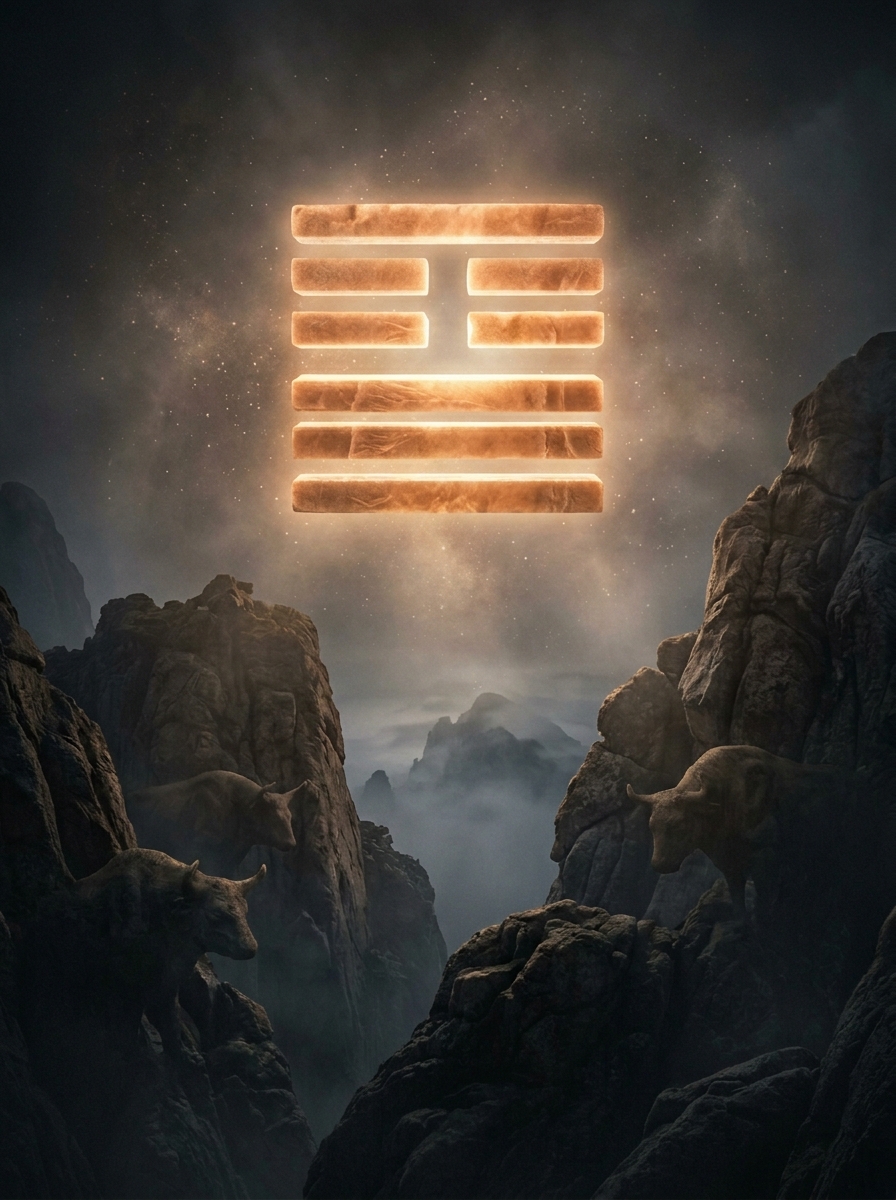
The Core Paradox: Force That Knows Its Container
Hexagram 26, Great Taming is not a recipe for suppression. It is the art of containing power without degrading it, of storing lightning so that it can be released at the exact moment it becomes trustworthy. The judgment delivers three instructions in sequence: perseverance furthers; it is favorable not to eat at home; crossing the great water is favorable. Each step depends on the one before. Perseverance means long-range discipline that looks unimpressive day‑to‑day but builds undeniable cumulative strength. Not eating at home is the counterintuitive pivot — a refusal to consume one’s resources on comfort, familiarity, or habitual gratification. Then, and only then, crossing the great water becomes favorable: major risk, transition, or passage into the unknown is safe because the reserve is real, not imagined.
This three‑part arc defines the hexagram’s core dynamic: force held in reserve, educated by time, and then spent on something worthy. The oracle does not ask for passivity. It asks for storage, refinement, and command. In Jungian terms, raw libido has entered a vessel — a schedule, a vow, a practice, a boundary. That vessel is what makes power accountable rather than destructive.
The Image as Inner Architecture
The figure of Great Taming pairs Heaven above with Mountain below. Heaven is expansive, creative, uncontainable; Mountain is stillness, inwardness, a place of stopping. The image is often rendered as a mountain range holding great clouds in reserve — power present but not yet descended into action. This pairing gives the hexagram its strange tension: the force is real, but it has consented to be shaped.
The mountain as the spine of the reading
The lower trigram Mountain is the psychological foundation. It stops movement, but it also gives shape to the path around it. In a reading, this points to an internal consolidation: appetite, ambition, or creative urgency are not acted on impulsively but organized into lasting strength. Because Mountain is in the lower position, the restraint begins in the self before it appears in circumstances. You are not merely waiting on the world; you are becoming someone who can hold tension without leaking energy. The hexagram’s discipline is not punitive — it is the prerequisite for authority that does not collapse under its own appetite.
Heaven’s pressure as latent destiny
The upper trigram Heaven supplies the grandeur. It represents pure creative force, the urge to move outward. Here that force presses against the mountain’s boundary and is refined by it. The result is not frustration alone but excellence. The hexagram carries an almost aristocratic ethic: power is honored by restraint. The one who can delay gratification, gather resources, and resist the noise of the moment becomes fit for larger work. The image warns against both rash action and cowardly inhibition. What is being educated here is not weakness, but power itself.
The Shadow of Leakage and the Danger of Premature Release
Great Taming has a shadow, and it is not excess — it is leakage. Energy dribbles away through distraction, status hunger, overexplanation, and habits that feel soothing but weaken resolve. The warning against “eating at home” can be read broadly as a caution against consuming what should instead be conserved. Pleasure is not banned. Dissipation is.
The warning of “eating at home”
To eat at home is to keep repeating the known, to take in what is familiar, to remain enclosed in the domestic and automatic. The hexagram counsels against this inward consumption because it drains the force needed for larger endeavors. The energy stored in Great Taming is meant for purpose, not comfort. In practice, this might mean refusing the small reward that would blunt a larger drive, or resisting the temptation to explain yourself when silence would do more work.
There is also the subtler danger of mistaking stored force for readiness. A person may feel charged — full of ideas, momentum, or emotion — and conclude they are prepared to act, when in fact they are only full. Great Taming distinguishes accumulation from maturity. The mountain may be packed with reserves, but until the inner structure is sound, release will be premature. This is why the hexagram rewards timing over enthusiasm, structure over impulse.
Great Taming in a Life: Work, Love, and the Inner Life
Because the core dynamic is containment leading to worthy release, Hexagram 26 applies across domains without needing separate explanations. Each application is simply a different arena for the same psychological process.
In work or vocation, the hexagram favors consolidation over expansion. It points to a phase of apprenticeship, research, or infrastructure‑building — the kind of progress that looks unimpressive day to day but becomes undeniable in retrospect. A company may be better served by strengthening its core than by chasing market share. A creative project may need a period of silence and revision before it can be shown. The “crossing the great water” here is the moment of debut, investment, or scaling.
In love and relationships, it counsels maturity over emotional flooding. Strong feelings are not denied, but they are given the silence and pacing necessary to become trustworthy. The ability to wait, to refrain from turning every feeling into an event, is what allows intimacy to deepen rather than combust. Great Taming in a relational reading often signals a relationship that is not yet ready for full expression — it asks for patience, boundaries, and the refusal to let comfort substitute for depth.
In spiritual practice, the hexagram emphasizes silence, study, and repeated forms over ecstatic display. The monastery, the long retreat, the daily discipline that seems small but accumulates into transformation — these are the expressions of stored force meeting a worthy purpose. The “great water” may be a major rite of passage, a surrender, or a public teaching.
What It Means to Live This Hexagram
The most refined reading of Great Taming is about authority — not legal authority, but the kind that comes from having mastered one’s own momentum. This is the power people trust because it does not need to advertise itself. It has weight. It can wait. It knows the difference between urgency and importance.
If this hexagram appears repeatedly, the message is likely structural rather than situational. Your life may be asking for a stronger container: a schedule, a vow, a budget, a boundary, a refusal to chase immediate reward. The point is not to become rigid. The point is to become capable of holding more without losing center. The mountain does not move, yet it gathers the sky. The sky does not vanish, yet it becomes usable. Great taming is what happens when power consents to be educated.
Comments
Loading comments…