I Ching Hexagram 30: The Fire That Reveals
I Ching Hexagram 30: The Fire That Reveals
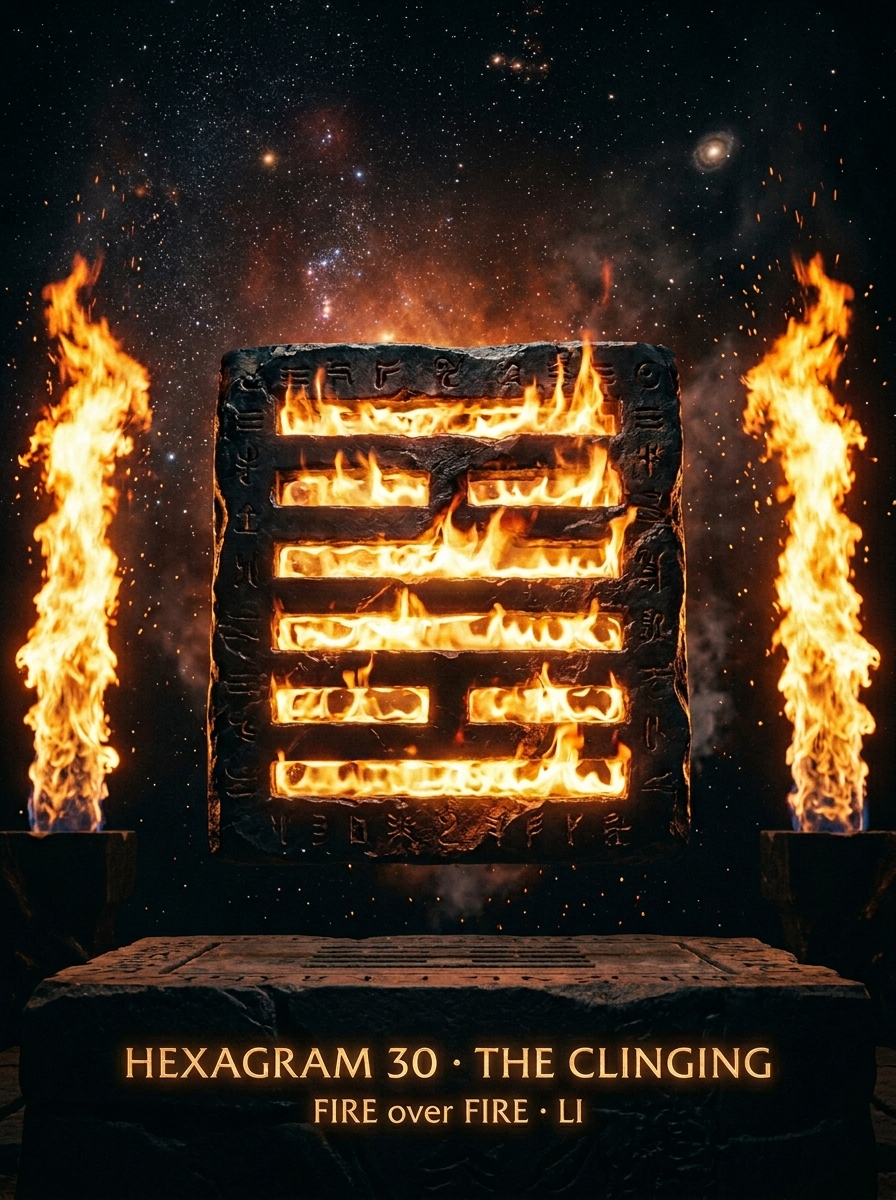
Hexagram 30, The Clinging, is the figure of illumination: what survives only by attaching itself to a source, and what becomes visible only because something burns. Its core message is not “find your truth” in the vague modern sense; it is more exacting. The Clinging asks you to recognize the conditions that make vision possible, to attach yourself to what is worthy of devotion, and to understand that brightness without structure quickly becomes ruinous. In this hexagram, fire is both revelation and dependence. It cannot stand alone, and yet nothing else shows the world so sharply.
The Paradox of Illumination
Fire does not generate itself. A flame borrows its existence from fuel, oxygen, and a spark; it has no substance of its own. Li, the trigram of fire, repeats above itself in Hexagram 30, creating an image of doubled brightness. One flame warms a room; two flames produce a field of light in which edges sharpen and shadows lengthen. The repetition is not decorative—it intensifies the core paradox: the thing that makes the world visible is itself dependent.
The traditional name, The Clinging, points directly to this dependence. Fire clings to a wick, a log, a hearth. Consciousness clings to the objects it reflects. Any brilliance you admire—art, charisma, insight, love—requires a support it can live on. The hexagram is not a celebration of raw intensity; it is a study of the structure that houses that intensity. The danger is mistaking the flame for self-sufficiency. The lesson is to honor both the fire and the thing that carries it.
In the I Ching’s domestic imagery, fire lives in a lamp or on a sacrifice altar. It is civilized force: it refines, cooks, and clarifies. It also consumes, and so it must be contained. That containment is the hidden ethic of Hexagram 30. To be illuminated is not to generate light from nowhere but to hold close enough to a worthy source to receive its radiance, without getting so close that you are burned blind.
What the Fire Clings To
The Judgment of Hexagram 30 is famously compact: “The clinging fire is successful when what it adheres to is correct.” The word correct here is not moralistic in the narrow sense; it means aligned with what can sustain the flame. A person seeking guidance should ask not only “What draws me?” but “What, exactly, am I giving my fire to?”
That question reveals the psychological depth of the hexagram. Modern culture often hears “cling” and thinks pathology, as if dependence were inherently shameful. The I Ching is subtler. Human life is constituted by dependencies—on language, on bodies, on seasons, on relationships, on inherited forms. The issue is not whether to cling, but whether the object of clinging is worthy, durable, and true.
Li has a moral dimension because light exposes. To be “bright” in the I Ching sense is to make distinctions accurately—to see what is there rather than what you wish were there. That is why Hexagram 30 often speaks to situations of visibility: reputation, leadership, artistic presentation, public roles, and moments when your inner state becomes legible to others. The hexagram favors right attachment over diffuse independence. It can advise loyalty, study, receptivity, or a return to the form that makes your talent coherent.
In practice, this means checking your attachments against reality. A relationship that feels electric but leaves you confused may be feeding on projection, not clarity. A career that rewards performance more than substance may be a blaze with no fuel left. The Judgment asks for a sober test: is the light connected to something nourishing, or is it feeding on combustibles that will soon be ash?
When the Light Turns Destructive
Fire can reveal projection as easily as truth. Because Li projects light outward, it casts dramatic shadows and can make the eye overvalue surfaces. The shadow side of Hexagram 30 is the confusion of radiance with substance. You may be seeing the glow of your own longing rather than the thing itself. A clear-looking situation may still be a theater of unconscious motives.
This is where Jungian language earns its place: fire corresponds to consciousness that makes distinctions, yet consciousness easily confuses what it illuminates with what it desires. A bright person may still be blind to their own attachments. The hexagram invites discrimination, not enchantment. When you feel dazzled, pause. Ask whether the brilliance comes from a true source or from your own need for intensity.
Another shadow is burnout. Fire consumes its fuel. If you identify wholly with your brightest mode—your productivity, charisma, creativity, or spiritual fervor—you will eventually meet depletion. The hexagram does not condemn intensity, but it insists that intensity must be housed, paced, and renewed. Running on adrenaline or applause is living as though the flame were enough by itself. The reading may be telling you to restore the structure that keeps the fire from eating the house: rest, boundaries, craft, solitude, or a return to ordinary rhythm. Meaning needs a form, just as fire needs a hearth.
The Clinging in Daily Life
When Hexagram 30 appears in a reading, it often turns on one question: what is the true source of your illumination? The answer may be a person, a practice, a place, a vow, a discipline, or a principle. The hexagram favors concentration over diffusion. If you feel scattered, it asks you to become more precisely lit. If your emotions are hot but ungoverned, it suggests containment, not repression—the lamp, the hearth, the vessel.
In relationships, The Clinging describes a bond built on mutual recognition. One person serves as the other’s mirror, and each becomes more themselves through the encounter. The deeper criterion is whether the connection increases lucidity. Does this bond help you see, or does it merely intensify your need? Illuminating fire is not intoxicating fire. If a relationship keeps revealing reality more cleanly, it belongs to the hexagram’s healthy side. If it demands sacrifice without insight, the fire has become greedy.
In career and vocation, Hexagram 30 favors roles involving presentation, analysis, teaching, communication, artistry, or leadership under public scrutiny. Fire belongs to the visible. It likes the stage, the page, the screen, the ritual, the polished result. But the hexagram is not a mandate for performance. Work must attach to something real: an ethic, a craft, a lineage, a reliable method. The person who wants only applause will burn out. The person who serves a form bigger than ego can become genuinely luminous.
The Hexagram in Context
Within the I Ching, Hexagram 30 follows the difficulty of obstruction—what the Changes call “the abyss.” Fire emerges after the water of Hexagram 29; it is the clarifying force that makes the contours of the situation visible. That sequence is not accidental. The Clinging belongs to the stage of life when vague feeling becomes discernible pattern. It is the moment of diagnosis, of seeing clearly enough to act.
There is also an aesthetic dimension. Li is beautiful. Fire is beautiful. The hexagram recognizes the seduction of beauty and does not reduce it to mere ornament. What is rightly beautiful draws the eye toward coherence. It helps the soul orient itself. That is why Hexagram 30 can appear in moments of spiritual or artistic refinement. The issue is not whether something glows, but what kind of glow it is. Superficial glamour or the radiance of something properly joined to its source? The Judgment confirms it: attach to what is correct, and light can serve life. Attach to what is false, and light becomes an accelerant for destruction.
Hexagram 30, The Clinging, is a study in responsible radiance. It tells you that illumination is never merely personal, that vision depends on support, and that the right kind of dependence is not weakness but form. Fire does not apologize for needing a hearth. Neither should insight.
Comments
Loading comments…