Hexagram 36: When the Light Must Hide
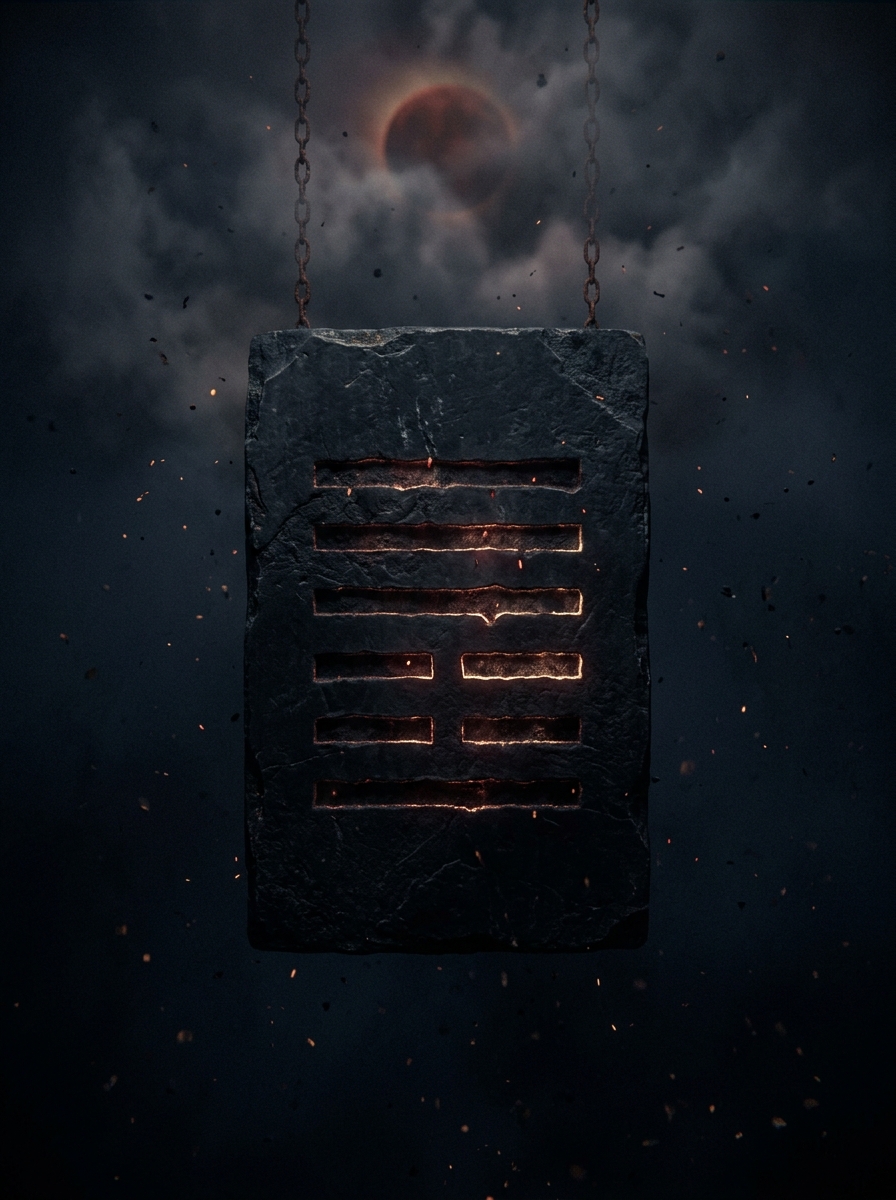
The Core Dynamic: Fire Under Earth
Hexagram 36, Darkening of the Light, appears when the flame of clarity, truth, or creative power lives on but cannot burn in the open. The trigrams tell the whole story: fire below, earth above. The light is real, but it is buried. This is not a hexagram of extinction—the inner virtue remains intact. What changes is the relation between the bearer of that virtue and the surrounding world.
The judgment advises perseverance and an orientation toward the “south”—a symbolic direction meaning warmth, civilization, and humane values. It does not recommend passive endurance; it recommends strategic concealment. The wise response is not to shine harder, blind to the cost, but to protect the flame until the environment can receive it without quenching it.
This makes Darkening of the Light one of the most subtle hexagrams in the I Ching. It forces a distinction between false defeat and true survival. The situation described is not one of personal weakness; it is a condition of the field. When the field is hostile or immature, visibility becomes liability. The hexagram’s wisdom lies in knowing when to become invisible without becoming false.
The Psychology of Concealment
How does a person come to live under darkened light? The image of fire pressed beneath earth mirrors a psyche that has adapted to an environment that punishes directness, rewards performance over substance, or cannot hold the weight of a difficult truth. This adaptation is often not conscious at first—it forms through repeated small betrayals, until the person learns that safety lies in opacity.
In Jungian terms, the shadow is not always the villain in this hexagram. Sometimes the shadow is the part of the self that had to go underground to survive. A child who spoke plainly and was shamed becomes an adult who trusts no one with their real thoughts. A brilliant worker who once revealed an insight and was punished learns to downplay gifts. These are not pathologies; they are intelligent responses to a wrong context.
The danger arises when concealment hardens into denial. The person begins to believe the light itself was imaginary. The hexagram’s clarity is a guardrail: it insists the light is still there. The task is not to force it into the open before the situation is ready, nor to pretend it never existed. The task is to keep faith with what is hidden, to tend the fire without letting the smoke give away its location.
This psychology applies equally to creative blocks, spiritual crises, and political silences. In every case, the underlying structure is the same: a valuable inner resource is present but suppressed by external pressure. The only honest path is to acknowledge both the pressure and the resource—and to manage their relationship with patience and discernment.
The Two Faces of Hidden Light: Maturation and Shadow
Hexagram 36 is not a single moral directive; it is a tension. The same concealment that can preserve the inner center can also corrode it. The difference lies in whether the person remains internally oriented toward warmth and truth while externally adapting, or whether adaptation erases the inner compass.
When concealment matures, it produces a person of tempered resilience. They have not surrendered their values; they have simply learned that not every battle is fought in daylight. They can wait, observe, and choose the moment of reveal with surgical precision. This is the “south” orientation: even in obscurity, one remains aligned with life-giving principles—courtesy, kindness, patience, truth. The hidden fire does not turn cold.
When concealment goes shadow, it curdles into bitterness, dishonesty, or self-deception. The person begins to enjoy hiding, or they start to believe the darkness is normal. They may adopt the language of the environment they despise, or they may withdraw so completely that they lose connection to the light altogether. This is the true danger of the hexagram: not that the world suppresses you, but that you forget you are suppressing yourself.
The practice that distinguishes the two is ongoing inner witness. The person under Darkening of the Light must regularly check: Am I hiding to protect the flame, or am I hiding because I no longer believe in the flame? Am I waiting for conditions to shift, or am I pretending conditions will never shift so I can remain comfortable in concealment? The hexagram rewards honesty at this level.
Where the Hexagram Breathes: Love, Work, and the Inner Life
Because Darkening of the Light describes a condition of the field rather than a fixed personality trait, it appears across life domains, always asking the same question: Where is the light being hidden, and why?
In love, this hexagram often shows up when one partner holds a tender truth—a need, a wound, a vision for the relationship—that the other is not ready to hear. The temptation is to force the conversation, to demand that the other see the light. The hexagram counsels patience. Speak softly, if at all. Protect the truth not by suppressing it, but by not throwing it against a closed door. There is a difference between cowardice and stewardship.
In work, the hexagram speaks to institutional climates where honesty is punished and loyalty to performance trumps loyalty to integrity. The person may know that a project is flawed, a policy is unjust, or a leader is deceptive, but speaking out would cost them their position. Here, Darkening of the Light does not demand heroic whistleblowing; it asks for careful documentation, quiet coalition-building, and a long view. The light may need to travel underground for a season before it can emerge in a safer system.
In the inner life, this hexagram describes periods of grief, exhaustion, or spiritual dryness. The spark of meaning is present but buried under depression, anxiety, or trauma. The temptation is to accuse the self of failure—to think the light has died. The hexagram’s reassurance is that the fire is still burning, though covered. The task is not to demand a blaze but to tend the coals: small acts of alignment, tiny gestures of truth, a sentence in a journal, a walk in the quiet dark.
Across all domains, the pattern is the same: concealment is temporary, not terminal. The hexagram’s power is that it refuses to romanticize either visibility or invisibility. It simply says: Right now, the flame must hide. That does not mean it is not burning.
The Long Return: What Concealment Prepares
Hexagram 36 does not end with concealment. Its changing lines describe movement—sometimes a deeper descent, sometimes a gradual return. The most hopeful thread in the hexagram is that fire under earth eventually either breaks through or transforms the earth above it.
The person who has lived through Darkening of the Light emerges with a different quality of brightness. The light has been tempered by difficulty. It no longer burns to impress; it burns because it survived. This is why the hexagram is sometimes read as a necessary passage for those who will later lead, teach, or illuminate from a place of true authority. They have learned what Hexagram 35, Progress, does not teach: that progress is sometimes invisible, that the most profound growth occurs in the dark.
The return is never guaranteed—the hexagram respects free will and circumstance. But the promise is real: a light that has learned to hide is a light that has learned its own limits. It will not waste itself on unworthy stages. It will wait for the right audience, the right moment, the right soil. And when it finally appears, it will be unmistakably itself—no longer a naive flame, but a fire that knows how to burn without being consumed.
Comments
Loading comments…