The Hanged Man and Death: When Surrender Becomes the Doorway
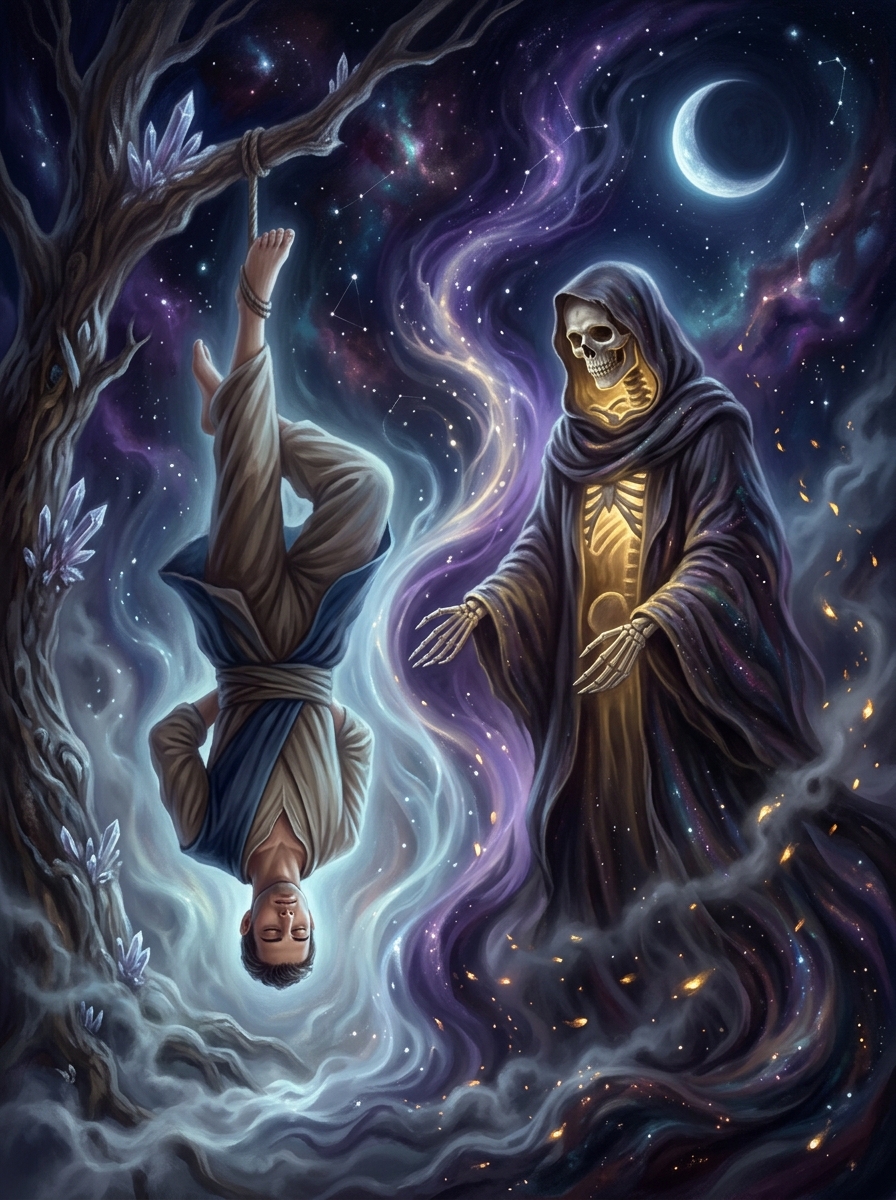
The Core Dynamic: Surrender as Surgical Precision
This is not a gentle combination. The Hanged Man and Death arrive together only when the psyche has exhausted its evasions. The message is clinical: an ending is already in progress, and the only remaining choice is whether you will meet it with awareness or continue to bruise yourself against the inevitable. What makes the pairing distinctive is the precise quality of the surrender it demands — not passive collapse, but a disciplined, almost surgical relinquishment of a form that has outlived its soul.
The Hanged Man first inverts your viewpoint. You stop struggling against the binds that hold you; you begin to see from the suspended position. Then Death acts on that new sightline. Once you can perceive the old arrangement for what it is — finished, no longer life-supporting — the severance that follows is not a catastrophe but a release. The trap is mistaking this suspension for living. The body waits, the mind reasons, but the cards say the waiting is not a pause; it is the final breath before the cut.
This pairing often surfaces when someone has been sacrificing meaning for security, or enduring a relationship, job, or identity out of a sense of duty that has curdled into numbness. The Hanged Man shows the cost of that endurance: a life hung upside down, vision inverted, blood rushing to the head. Death shows the cost of refusing to end it: the slow decay of vitality that makes the eventual ending more painful than necessary. To understand the broader archetypal stage these two cards set, see The Hanged Man and Death: From Sacred Suspension to Necessary Transformation.
The Psychological Sequence: Why Perception Must Precede Severance
Tarot pairs are rarely symmetrical. Here the sequence is everything: The Hanged Man arrives first in the psychological order because consciousness must be reprioritized before the ending can be metabolized. The card does not ask for action; it asks for altered seeing. When you are suspended, you are forced to notice what you had been ignoring — the way a relationship has become a hollow performance, the way a career identity has become a costume you no longer inhabit, the way an inner narrative about who you are has stopped matching evidence.
Only after that inverted gaze has done its work does Death step in. It removes what the new perspective has revealed as obsolete. In Jungian terms, the ego relinquishes an outgrown stance, and the psyche makes room for a more truthful organization. This is not a death of the self but of a self-concept. The emotional texture is less about loss than about recognition: you see that the thing you were clinging to was already gone, and your grip was the only thing keeping the corpse upright.
This sequencing is why the pair can feel less like destruction than initiation. The old life is not being torn away; it is being revealed as complete. For a comparison with a softer adjacent energy, consider The Hanged Man and Temperance, where surrender leads to alchemical blending rather than termination. Here termination is the point, and the Hanged Man ensures you witness it clearly.
The Trap of Spiritualized Avoidance
The shadow side of this combination is one of the most seductive in the tarot. The Hanged Man can be used to justify paralysis: “I am waiting for divine timing,” “I am surrendering to the universe,” “I must not force an ending before it is ready.” Meanwhile Death is invoked as a mystical inevitability that absolves the querent of any practical decision. The result is a spiritualized stasis that feels holy but is actually fear dressed in metaphysical language.
Real surrender is not anesthesia. It hurts because something real is being surrendered. Real endings grieve because they mattered. If you find yourself using the language of “trusting the process” to avoid making a difficult phone call, having an overdue conversation, or letting go of a situation that has been draining you for years, the cards are not supporting you — they are exposing you. The Hanged Man teaches suspended insight, not suspended action. And Death is not a vague force; it is the specific removal of what has already expired.
The distinction between genuine surrender and inertial delay often comes down to one question: Are you still protecting the old form? If you are waiting for the situation to change without your participation, you are likely in the shadow. The remedy is to name what is complete. This is where a structured practice like The Shadow Work Tarot Spread can help distinguish avoidance from authentic release. The cards reward conscious endings, not drift.
The Practical Expression: Where This Pair Shows Up in a Life
Because the core dynamic is a single arc — perception then severance — its manifestations across life domains are applications of the same principle, not separate dramas. In love, the Hanged Man often shows a partner who has been over-accommodating, emotionally frozen, or waiting for the other to transform first. Death answers that stasis with a hard truth: the waiting itself is part of the problem. The relationship’s current form has expired, and the only question is whether both people can let it die cleanly — either to release each other or to let the bond be reborn on terms no longer shaped by martyrdom. Compare the emotional weight here with The Lovers and Death Tarot Card Combination, where choice and ending intertwine; here the emphasis falls more heavily on relinquishment than decision.
In career, the combination rarely signals a straightforward promotion. It signals that a role, title, or professional identity has reached terminal status. You may still be employed, but energetically you have already left. Death does not always mean public collapse; it can be a quiet project ending, a department dissolving, or an ambition you no longer feel toward a field that once defined you. The Hanged Man here shows the disorientation of being suspended between who you were and who you are becoming. The work is to stop mistaking endurance for loyalty. For a wider lens on reorienting your vocation, the Career Tarot Spread can help separate temporary disruption from genuine course correction.
On the inner level, this pairing often marks the death of a belief — that suffering is proof of virtue, that delaying a decision is spiritual maturity, that you must be needed to be valuable. The Hanged Man holds you in the discomfort of seeing that belief for what it is; Death removes its authority over your life. What remains is a more honest relationship with yourself.
Working with the Cards: The Interval and the Cut
The practical wisdom of The Hanged Man and Death is not “be patient” in the generic sense. It is: let the inversion finish, then act without sentimental delay. The Hanged Man grants you an interval in which you stop imposing your will on a situation that needs a new angle. Death tells you the interval has a purpose — to make the cut more exact.
Begin by identifying what has become impossible to justify. List the ways you are still protecting an ending that has already arrived. Name it: the relationship you are still investing in though it no longer nourishes, the job you are still performing though your soul checked out months ago, the inner story about who you are that no longer fits. Then perform a conscious closure. Death responds to ritual — not for decoration but because the psyche needs a marker. Write a letter you will not send, archive the project folder, return the borrowed role, have the overdue conversation. Let the form finish so the energy can move.
This combination can feel stark, but it is surprisingly merciful. It spares you the slow decay of hanging on past vitality. For a more explosive version of ending, see Death and The Tower Tarot Combination; for the patient synthesis after dissolution, Death and Temperance Tarot Card Combination. But here, in this exact pairing, the message is the most intimate: you are being asked to stop bargaining with what is already over, and to let the wisdom of the pause help you release it well.
Related
- The Hanged Man and The Devil: Suspended Will, Shadow Appetite, and the Price of Awakening
- The Hermit and the Hanged Man: The Quiet Intelligence of Surrender
- The Wheel of Fortune and Death Tarot Combination: Fate Turns, Forms Fall
- The Justice and The Hanged Man Tarot Combination: Verdict, Pause, and the Ethics of Surrender
- The Hierophant and The Hanged Man Tarot Combination: Sacred Law Under Suspension
Comments
Loading comments…