The Justice and The Hanged Man Tarot Combination: Verdict, Pause, and the Ethics of Surrender
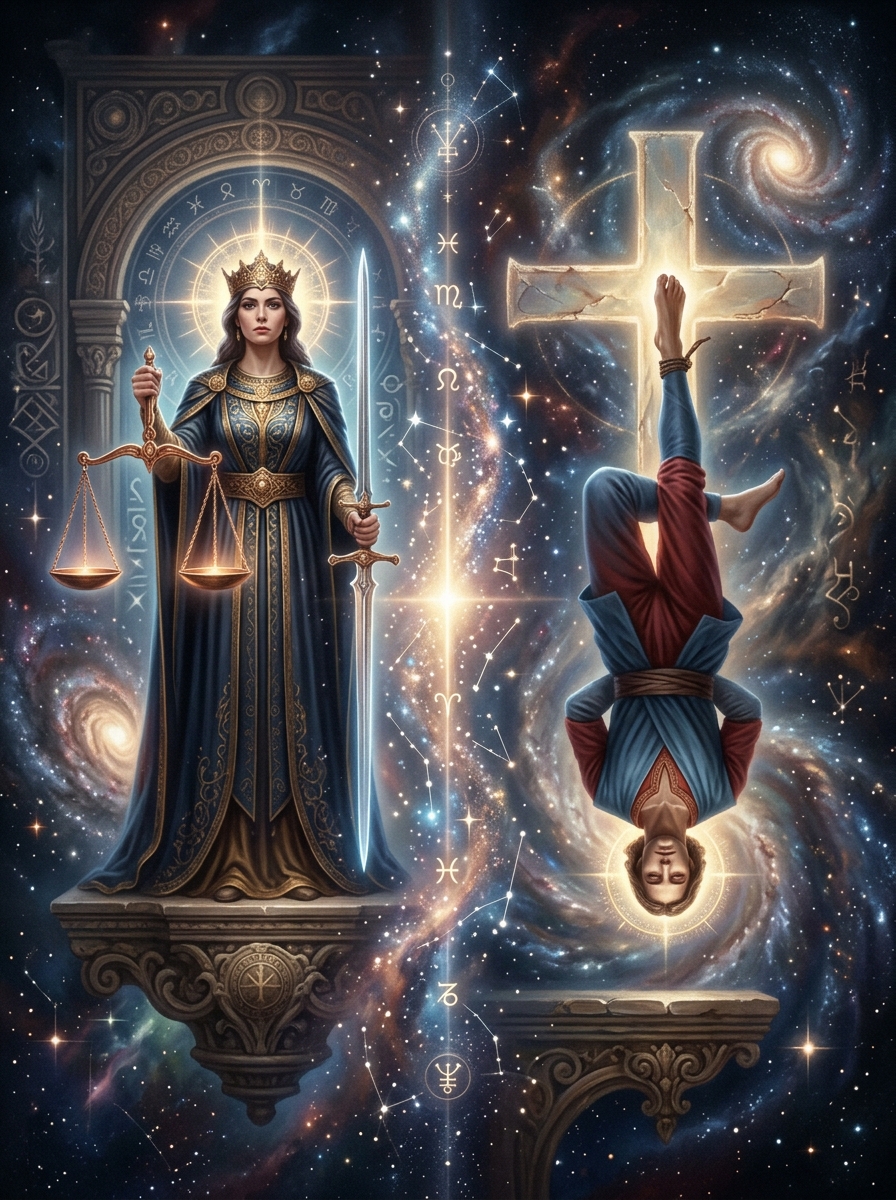
The Core Dynamic: A Verdict That Requires a Reorientation
Justice does not deliver her sentence quickly. She weighs, measures, and balances — and The Hanged Man insists that the only scale capable of holding the truth is one that has been inverted. Together they create a situation where the question is not what is right but how you are positioned to see it. If you approach this pairing expecting a straightforward yes‑or‑no, you will misread it. The cards are not blocking action; they are demanding that you change the angle from which you act.
The Justice archetype — numbered VIII in the Marseille tradition, XI in the Rider‑Waite‑Smith — represents cosmic balance, consequence, and the fact that every choice writes a receipt. The Hanged Man, number XII, suspends momentum so a deeper order can surface. In combination, they describe a liminal courtroom where judgment is postponed not from doubt but from the recognition that the facts are clean and the timing is wrong — or the timing clean and the definition of “right” incomplete. For a deeper understanding of each card in isolation, consult The Justice Tarot Card and The Hanged Man Tarot Card.
This is a sophisticated ethical paradox. Justice asks for proportionality; The Hanged Man asks for surrender. The reader must hold both: the knowledge that reality is structured and the humility to let that structure reveal itself on its own schedule. The result is not passivity but a chosen pause — the kind of stillness that allows a new axis to emerge.
Why This Combination Forms Under Moral Pressure
Psychologically, this pairing appears when the psyche can no longer sustain a comfortable lie. Justice forces a reckoning with the ledger of a relationship, career, or identity. But the reckoning cannot happen while you remain in the same position that produced the imbalance. The Hanged Man is the mechanism that forces a reorientation: you must hang upside down long enough to see the patterns that were invisible from your usual standpoint.
In Jungian terms, the combination signals a regression of will — a necessary withdrawal from the persona’s demands so that the Self can reorganize around a truer axis. The ego wants a verdict now; the Self knows that a verdict extracted too early is merely another evasion. This is why the pair often appears when a person is under moral pressure — a decision about ending a marriage, reporting misconduct, leaving a vocation that pays well but corrupts. The pressure itself is part of the lesson. Justice says the situation is real; The Hanged Man says you are not yet ready to meet it cleanly. The pause is not punishment but preparation.
This dynamic echoes the relationship between Justice and Judgment — both cards require a reckoning — but here the tempo is slower and the orientation more radical. Judgment calls a soul upward; Justice and The Hanged Man call a soul sideways, into a perspective that may feel like defeat before it feels like freedom. For a related treatment of cosmic verdicts, see Justice and Judgment Tarot Card Combination.
The Shadow of the Pause: When Surrender Becomes Avoidance
Every archetype carries a shadow, and this pair’s shadow is insidious. Justice can be twisted into self‑righteousness — “I am waiting for clarity because I am the only one with integrity.” The Hanged Man can collapse into passive martyrdom — “I must suffer because suffering is holy.” Together, they can produce a person who uses the language of moral discernment to avoid the discomfort of action. The pause that was meant to clarify becomes a permanent waiting room.
The key distinction is consent. The Hanged Man in his highest expression chooses suspension; he knows why he hangs and for how long. The shadow version is trapped, telling himself he cannot move until conditions are perfect. Justice then becomes the rationalization: “If I act now, I will disrupt the balance.” But Justice does not freeze — it calibrates. If the pause has no end and no purpose, it is not surrender; it is fear dressed as ethics.
This shadow often shows up in relationships where one partner sacrifices endlessly while the other takes, and both call it “devotion.” In career situations, it appears when someone refuses to enforce a fair contract because they “don’t want to rock the boat.” The cards warn: do not confuse patience with passivity. True suspension is a dynamic state of alert waiting, not a torpor. The Hanged Man and Death Tarot: From Sacred Suspension to Necessary Transformation explores how this pause can lead to genuine release, but only if the ego stops clinging to its preferred story.
Living the Dynamic: Applications in Love, Work, and Identity
Once the core dynamic is understood — Justice demands truth, The Hanged Man demands a flipped perspective — the applications become concrete without needing separate sections that re‑explain the cards.
In love, the combination usually appears when a relationship has become asymmetrical. One person has been adjusting; the other has been accommodated. Justice says the ledger must be balanced. The Hanged Man says you may need to stop negotiating from your current position — stop trying to make the old dynamic fair, and instead step into a wholly different arrangement, even if it means temporary distance. For single people, the pair asks: “Are your standards a shield or a scale?” Honesty about your own patterns — the willingness to be seen as you actually are, not as you wish to be — is the required reorientation. The Heart-Shaped Love Tarot Spread can help locate where the imbalance actually lives.
In career and money, the cards rarely promise a promotion. They more often appear when a contract is being negotiated, a reputation is at stake, or a job has become ethically untenable. Justice checks the fairness of salary, credit, workload. The Hanged Man says you must stop over‑identifying with productivity to see whether the structure itself is sound. A delayed decision may be exactly what the situation needs — someone is weighing consequences, or you need to let a hidden variable surface before you sign. If you are considering two paths that differ less in appearance than in integrity, the Decision Tarot Spread can reveal which one can survive full exposure to the truth.
In identity, this pairing often arrives when a person has built a self‑image around being the “good one,” the “patient one,” or the “victim.” Justice strips away the inflated narrative. The Hanged Man offers a safe space to let that identity unravel without shame. The work is to allow the unraveling, trusting that what emerges will be more aligned. This is the territory of the Hanged Man and Temperance: Surrender, Alchemy, and the Art of Becoming, where suspension becomes the crucible for a new compound.
The Spiritual Invitation: From Certainty to Earned Discernment
Justice and The Hanged Man together are a rite of passage. You enter with a question, a conflict, a pressure to decide. You leave not with an answer, but with a new capacity to hold the question. That capacity is earned by the willingness to remain still while the old self’s certainties dissolve. The combination does not reward heroism; it rewards alignment. It does not beautify suffering; it clarifies purpose.
If the reading feels heavy, that is because the cards are honest. They are not promising relief. They are promising that if you meet the pause with integrity — letting Justice name what is fair and The Hanged Man show you a vantage point you would never have chosen — the next movement will not need to be corrected. You will act from a place that has already accounted for the consequences. That is the verdict: not “when,” but “how cleanly.” The clean action, when it comes, will be worth the wait.
Related
- The Hermit and the Hanged Man: The Quiet Intelligence of Surrender
- The Hierophant and The Hanged Man Tarot Combination: Sacred Law Under Suspension
- The Hanged Man and The Devil: Suspended Will, Shadow Appetite, and the Price of Awakening
- Justice and Temperance Tarot Combination: Truth Tempered into Wisdom
- Justice and the Moon: When Truth Enters the Fog
Comments
Loading comments…