Dream About the Moon: Meaning, Symbols, and Psychological Reading
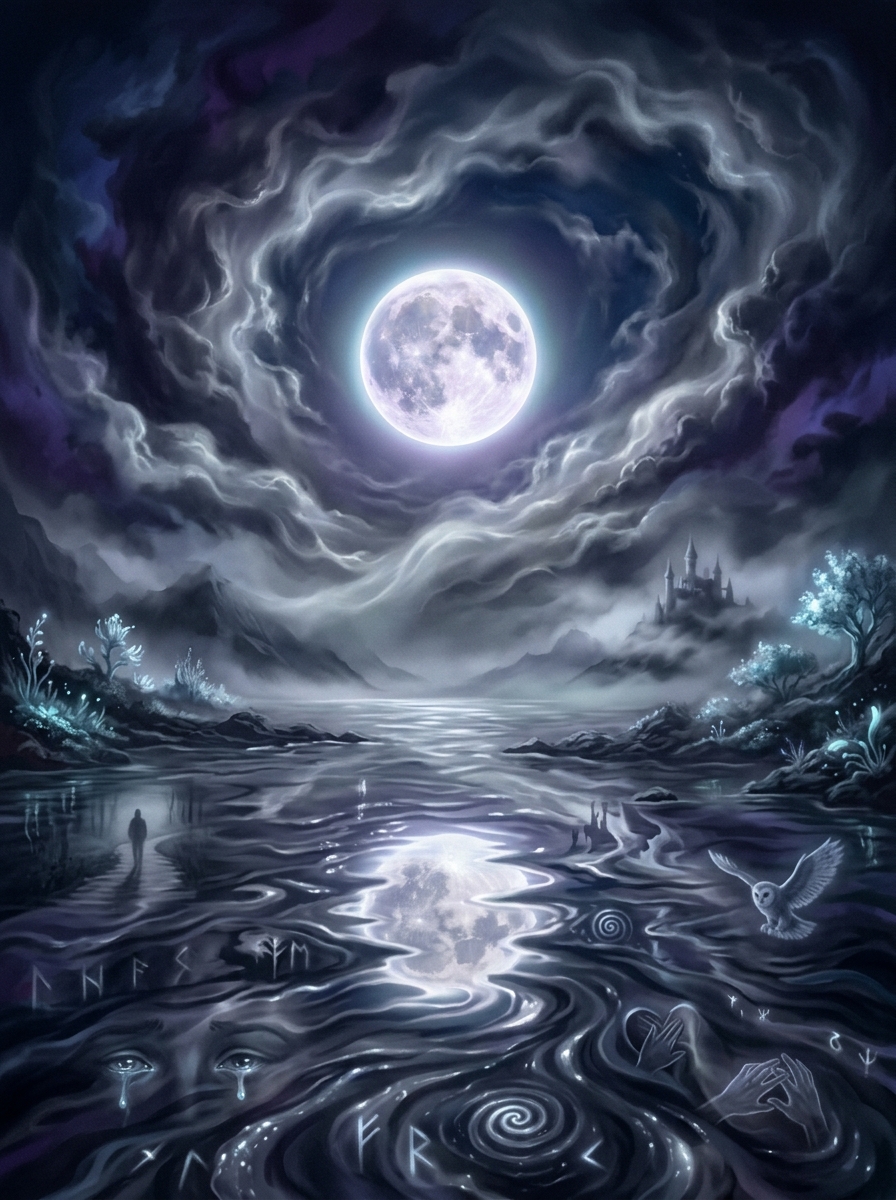
The Moon as the Psyche’s Reflective Surface
A dream about the Moon is never a straight line. It does not illuminate the way the Sun does; it reflects, bends, and complicates. Where the Sun in dream symbolism clarifies conscious intention, the Moon reveals what moves beneath certainty—feeling that has been lit indirectly by memory, attachment, or a truth you are not yet ready to face head-on. This is the core dynamic: the Moon in a dream is psychic life seen by its own glow, not by daylight reason.
Because the Moon receives its light rather than generating it, what appears in a moon dream is always refracted. A bright moon can mean emotional clarity—a feeling you’ve finally named. A veiled or clouded moon often signals feelings that are present but still unarticulated, held in the body rather than in language. The dream does not hand you an explanation; it hands you an atmosphere. That atmosphere is the real message. If you want to check whether the dream’s mood matched an actual lunar phase, the current moon phase can serve as a grounding reference, but the emotional logic of the dream remains the final authority.
The Moon also appears because the psyche needs a container for intensity. When life is in transition—a breakup, pregnancy, relocation, burnout, grief, or identity shift—the mind reaches for an image that can hold water without shattering. That image is the Moon. It registers emotional weather, not a weather report.
Reading the Lunar Condition
The meaning of the dream changes entirely with the moon’s condition. Phase, brightness, color, and movement are not decorations; they are the dream’s syntax. Each carries a distinct psychological charge.
Phase: Full, New, Crescent, Eclipse
A Full Moon dream intensifies what is already underway. It marks exposure, culmination, or a realization that can no longer be postponed. Psychologically, it is loud: desire, conflict, creativity, or grief at a peak. If the dream felt flooded with light or emotion, the Full Moon symbolism is directly relevant.
A new moon is the opposite: quiet, gestating. The Moon may be invisible, barely present, or implied by darkness. This points to germination, secrecy, or an emotional territory still pre-verbal. The feeling is not absence but potential waiting for articulation.
A crescent or waxing moon suggests development—a feeling trying to take shape, hope threading into awareness. A waning moon signals release, depletion, or the psyche beginning to let go of an old pattern. An eclipse changes the whole atmosphere: the Moon is there but interrupted, which often indicates psychic blockage, taboo feeling, or a life event that temporarily overshadows your ordinary emotional orientation.
Brightness, Color, and Motion
How the Moon looked matters more than its phase alone. A silver or white moon emphasizes purity of feeling, intuition, or a cool, lucid intelligence of the body. A red or blood-colored moon carries urgency, instinct, erotic force, or danger. A golden moon is rare and almost solar, suggesting a moment when feeling and confidence align. A dark moon may point to suppressed material, depression, or fertile unconsciousness not yet surfaced.
Movement changes the emotional tempo. A rising moon implies you are entering awareness of a feeling you hadn’t owned. A sinking moon suggests a response or attachment nearing completion. A moon that moves too fast can signal emotional instability or anxiety about time. A moon that follows you indicates a psychic issue that will not be evaded—a relationship pattern, memory, or unresolved attachment insisting on recognition.
Psychological Roots: Attachment, the Mother, and Bodily Intelligence
At the psychological level, the Moon represents the part of the psyche that organizes attachment: how you soothe yourself, what makes you feel safe, what you reach for when depleted. In Jungian terms, moon imagery belongs to the unconscious, the maternal imago, and the reflective aspect of the soul. That does not mean every moon dream is “about your mother” in a literal sense. Rather, the dream may be addressing your earliest templates for belonging, nourishment, privacy, and emotional rhythm.
The Moon also speaks to the body’s intelligence. Many people dream of it when they are not tracking their own exhaustion, hormonal shifts, or emotional overexposure. The dream translates bodily information into symbol. A moon dream can be a corrective: saying you are too dry, too exposed, too public, or too disconnected from your own tides. This is why lunar dreams often arrive after periods of overwork or hyper-rationality—the psyche demands you return to a receptive state.
When the dream has a tender, protective quality, the Moon may point toward internal caregiving. When it feels eerie or immense, it is showing the power of the unconscious itself—not dangerous by default, but larger than the personality. Moon dreams expose the limits of pure rational control. They remind you that not all truths arrive through explanation; some arrive as atmosphere. For a parallel in natal astrology, the way the Moon governs emotional environment and belonging is explored in Moon in the 11th House and Moon in the 5th House, though these are natal charts, not dreams—they share the same psychological grammar.
Dream Variations: The Moon in Scene
A moon dream becomes precise when you notice what surrounds it. The Moon over water differs from the Moon behind clouds; the Moon in your hands differs from the Moon over a city. These scenes are the dream’s syntax.
Over Water, in the Hands, with Figures
When the Moon reflects on water, the dream often centers on emotion mirroring emotion. This can mean romantic idealization, intuitive accuracy, or the uneasy recognition that your feelings are being shaped by another person’s presence. Water doubles the Moon, so the dream may be about reflection, projection, and emotional depth that cannot be measured at the surface.
A Moon in your hands dramatizes contact with something ordinarily untouchable. You may be wishing to possess inspiration, regulate feeling, or hold onto a fleeting state. If the Moon is broken or falling apart, the dream shows a disruption in emotional coherence—an old fantasy shattering to make room for a more honest relationship with reality.
When a person appears under the Moon, their role matters. A mother under the moon can point to inherited emotional patterns, caretaking, or unmet dependence needs. A lover under the moon introduces longing, secrecy, or the projection of safety onto desire. A stranger under the moon often represents the unknown receptive side of your own psyche—not necessarily gendered, but psychologically unfamiliar. An animal under moonlight signals instinct in its purest form, stripped of social explanation.
If the dream felt especially shadowed, anxious, or deceptive, the combination of The Devil and The Moon in tarot can help distinguish between productive unease and binding fear. And for dreams that carry a sense of hidden knowledge, the High Priestess and The Moon pairing illuminates the tension between inner knowing and obscurity—the moon does not always reveal; sometimes it orients you toward the unseen.
A Grounded Way to Read the Dream
The best moon dream reading holds two truths at once: symbolic openness and personal context. The Moon is not a universal code that means the same thing in every dream. It is a field symbol—it gathers meaning from your life, your mood, your relationship history, and the larger emotional weather around you. A moon dream after a conflict may register grief or reconciliation. The same image during a creative opening may signal inspiration and receptivity. Context decides the emphasis.
For a disciplined reading, ask three questions:
- What was the moon doing? Describe its phase, brightness, color, movement.
- How did you feel in its presence? Afraid? Soothed? Awed? Indifferent?
- What in waking life currently behaves in a similar way? A relationship, a project, a mood, a pattern?
This method keeps the symbol alive without turning it into superstition. It also avoids reducing the dream to plain psychology and missing its imaginal force. The moon in dreams is precisely where psyche becomes landscape. If you want to understand how Aurora Arcana approaches this kind of symbolic reading across tarot and astrology, the editorial frame is laid out in About Aurora Arcana.
A moon dream is rarely trivial. It is one of the psyche’s most refined images for emotional truth under changing light. The dream does not always explain. It orients. And orientation, in the realm of feeling, is often enough.
Related
- Dream About Being Naked: Exposure, Shame, and the Self Without Armor
- Moonstone Meaning and Healing Properties: The Lunar Stone of Inner Tides
- Manifesting at the New Moon: A Precise Rite of Beginning
- Dream About the Ocean: What the Water Is Trying to Tell You
- The Lunar Calendar: Tracking Cosmic Cycles, Evolutionary Astrology, and Psychological Integration
Comments
Loading comments…