Moon in the 5th House: The Drama of the Soul, Creative Alchemy, and the Inner Child
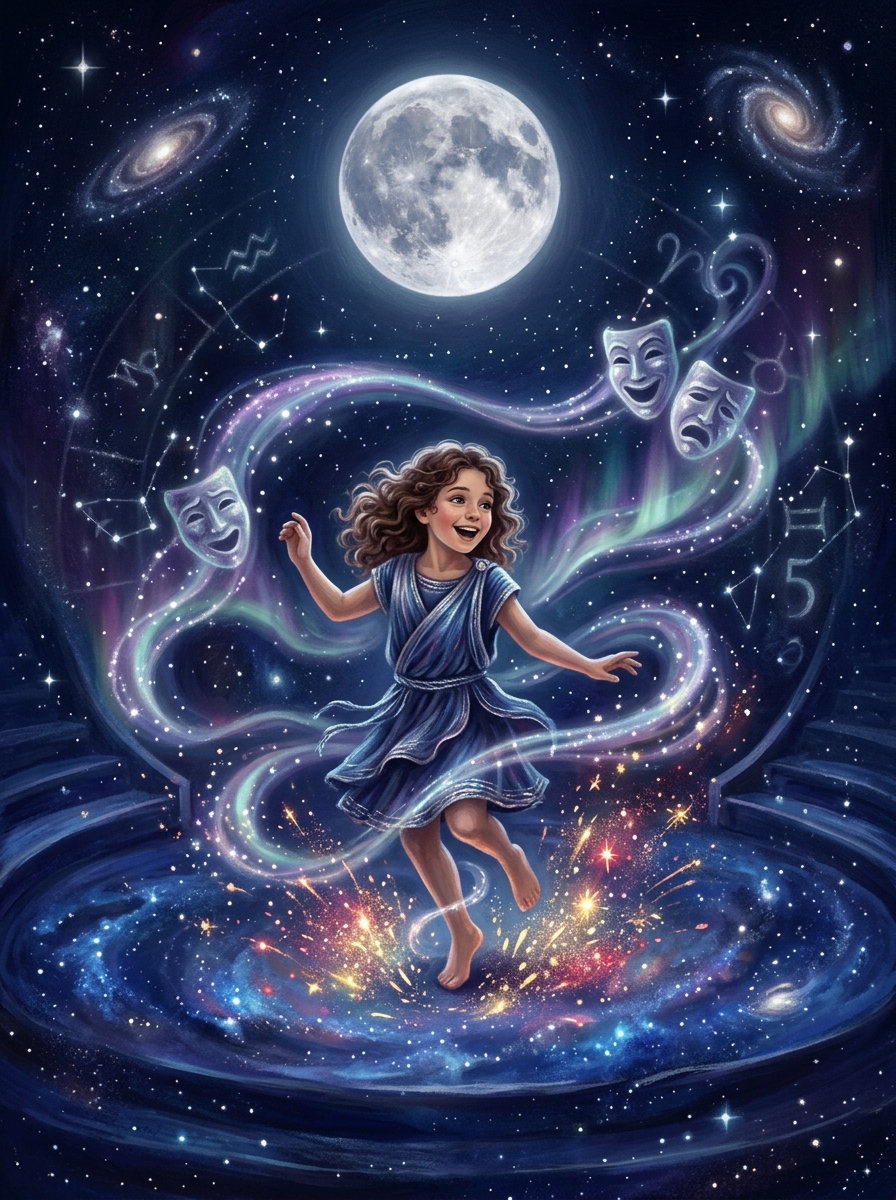
The Archetype of the 5th House Moon: Emotional Expression Seeking a Stage
In the traditional architecture of the natal chart, the Moon represents our deepest emotional needs, our instinctual habits, and the subterranean waters of our subjective experience. It is the vessel of our vulnerabilities, seeking sanctuary, safety, and quiet containment. Conversely, the Fifth House—associated with the zodiacal sign of Leo and the life-giving warmth of the Sun—is a solar arena. It is the sphere of self-expression, performance, play, romance, and creative output. When the lunar archetype is deposited into this solar domain, a complex psychological dynamic emerges. The Moon in the Fifth House represents an instinctual drive to make the private self public. Here, the unconscious mind does not wish to hide in the dark; it demands a stage, a spotlight, and a medium through which it can project its inner theater onto the external world.
For individuals with this placement, emotional safety is not found in quiet isolation or domestic retreat. Instead, security is directly linked to their capacity to express their feelings outwardly, dynamically, and creatively. Liz Greene, a seminal figure in psychological astrology, often notes that the placement of the Moon indicates where we are most prone to regression, yet also where we search for the mother. In the Fifth House, this search for nurturing occurs through the medium of creative self-projection. These individuals feel most safe when they are seen, heard, and validated for their unique presence. They possess an innate theatricality, a conversational rhythm that naturally shifts from quiet vulnerability to dramatic storytelling. They experience life as a sequence of scenes in which they are both the primary protagonist and the highly sensitive audience.
The Solar Domain vs. Lunar Needs
When the Moon resides in the Fifth House, the traditional boundary between the inner world and the outer world becomes highly porous. The Sun’s house asks us to shine, to stand out, and to celebrate our individuality. The Moon, however, operates on the principle of fluctuation, cycles, and receptive sensitivity. This creates a fascinating tension: the individual's sense of safety is tied to an arena of risk. To create, to love, and to perform are inherently risky actions that expose one to criticism and rejection. Consequently, the Fifth House Moon person is hyper-sensitive to how their self-expression is received.
If they feel ignored or dismissed, it does not merely bruise their ego; it threatens their emotional survival. They may retreat into defensive posturing or manifest sudden shifts in mood, swinging from exuberant self-confidence to deep insecurity. The task here is to learn that the stage of the Fifth House does not require a flawless performance, but an authentic one. By grounding their solar desires in genuine lunar vulnerability, they can learn to share their inner world without demanding that the audience stand and applaud every movement.
Furthermore, this placement suggests that the mother figure in early childhood may have been experienced as someone who was either highly creative, dramatic, or someone who only offered nurturing when the child performed or stood out. This childhood conditioning often reinforces the belief that one must be exceptional or visually expressive to deserve love. As adults, they must work to deconstruct this conditioning, recognizing that their emotional worth is inherent and does not depend on their ability to entertain others. The journey of the Fifth House Moon is one of moving from external performance to internal presence, finding safety not in the applause of the crowd, but in the quiet acceptance of their own hearts. They must realize that the stage is not a cage, and the audience is not their judge, but merely a mirror of the shared human experience.
Creative Expression as a Necessity for Emotional Regulation
For those with the Moon in the Fifth House, creative expression is far more than a recreational hobby or a pleasant pastime. It is a vital, non-negotiable mechanism for emotional regulation. In psychological terms, these individuals use creative media to externalize and process psychic material that would otherwise overwhelm their conscious minds. Without a creative outlet, the subterranean waters of the lunar subconscious can stagnate, leading to unexplained anxiety, somatic complaints, or sudden outbursts of emotional volatility.
When a Fifth House Moon individual picks up a paintbrush, sits at a piano, writes a poem, or steps onto a theater stage, they are engaging in an act of active imagination. They are translating raw, pre-verbal emotional states into symbolic forms. Carl Jung emphasized that the psyche speaks in symbols, and the Fifth House is the symbolic laboratory of the natal chart. The act of creation allows these individuals to look at their grief, their joy, their longing, and their rage from a safe therapeutic distance. The poem is not just a poem; it is their sadness given form, structure, and beauty.
The Mirror of Art: Externalizing the Unconscious
This process of externalization is crucial for maintaining psychological equilibrium. If they cannot create, they feel choked, cut off from the source of their vitality. The artistic medium acts as an emotional mirror, showing them who they are in moments of confusion. When they paint a chaotic storm, they are recognizing the chaotic storm within their own chest. This realization brings relief. It is a form of self-nurturing that bypasses the rational mind, allowing the nervous system to settle.
Furthermore, this placement suggests that their creative style will be highly instinctual and moody. They do not create out of intellectual curiosity or sterile technical ambition; they create because they feel a sudden, compelling surge of inspiration that must be released. Their art is characteristically intimate, exposing their soft underbelly to the world. To support their mental health, they must treat their creative space as a temple, protecting it from the pressures of commercialization or external criticism. The goal of their art is not perfection, but emotional release and self-revelation.
When we look at the chart through an evolutionary lens, the Fifth House Moon must learn to treat creativity as a daily spiritual practice. It is their way of digesting the world. If they absorb the stresses of modern life without filtering them through a creative medium, their emotional body becomes toxic. They might find themselves reacting to minor domestic issues with disproportionate anger or sadness, simply because the pressure within their creative boiler room has reached a dangerous level. By dedicating time each day to some form of creative play—whether it is sketching, journaling, playing an instrument, or cooking an inventive meal—they provide a healthy release valve for their feelings. This creative hygiene is just as important for their well-being as physical exercise or proper nutrition. They must also learn to accept that not all of their creative output needs to be shared with the public; sometimes, the most healing art is the art that is created for an audience of one.
The Landscape of Romance: Passionate Love and Emotional Chemistry
In the realm of romance, the Fifth House Moon experiences love as a grand, mythic adventure. The Fifth House governs the initial stages of courtship, flirtation, and the intoxicating chemistry of romantic attraction. With the Moon positioned here, the individual’s emotional security is deeply entwined with the drama of romance. They do not merely want a companion; they desire a muse, a co-star, and a mirror that reflects their own capacity for passion.
These individuals fall in love with intensity, casting their partners in elaborate psychological dramas. They possess an active fantasy life, often projecting their unconscious needs for nurturing, validation, and excitement onto the object of their affection. This can create a highly romanticized, cinematic approach to dating, where every gesture is magnified, every text message scrutinized for subtext, and every minor conflict experienced as a devastating tragedy.
The Thrill of the Chase: Chemistry and Fantasy
For the Fifth House Moon, the emotional chemistry must be palpable. They feed on the electricity of anticipation, the poetry of longing, and the visual aesthetics of courtship. However, this intense focus on romantic excitement can lead to a cycle of relationship volatility. Because the Moon represents cycles and phases, their romantic feelings can wax and wane with dramatic frequency. When the initial luster of a new relationship begins to fade into the quiet routine of daily life (which belongs to the Sixth House), they may feel a sudden drop in emotional temperature.
To counteract this, they might unconsciously stir up drama or seek out new romantic conquests to reignite the emotional high. Evolutionary astrologer Steven Forrest reminds us that the Moon’s true need is for intimacy and safety. For this placement to find lasting happiness in love, they must learn to distinguish between the superficial excitement of romantic drama and the quiet, sustaining warmth of genuine emotional connection. They must realize that a partner is a real human being with their own vulnerabilities, not a character written to satisfy their subconscious emotional scripts.
Moreover, the Fifth House Moon individual must learn to navigate their vulnerability in relationships. Because they feel so deeply and express themselves so vividly, they are highly susceptible to feeling exposed and rejected if their partner does not match their emotional intensity. They may respond to this perceived rejection by pulling back completely, hiding behind a mask of indifference or seeking attention elsewhere. True relationship maturity for this placement involves learning to stay present in the quiet, non-dramatic moments of partnership. It means recognizing that a quiet evening at home, devoid of grand gestures or intense emotional discussions, can be just as nurturing and validating as a passionate night out. By grounding their romantic expectations in reality, they can build relationships that are both creatively inspiring and emotionally stable. They must allow their partners the space to be human, accepting that no one person can act as their eternal muse.
Parent-Child Dynamics: Nurturing, Legacy, and Avoiding Emotional Enmeshment
The Fifth House is classically associated with children, representing both our physical offspring and our relationship to our lineage. When the Moon occupies this house, the maternal and nurturing instincts are directed fully toward children. These individuals often feel a profound, soul-level bond with their offspring, viewing parenting as their ultimate creative masterpiece and their most significant emotional legacy. They are deeply involved, intuitive, and protective parents, possessing an innate ability to understand the emotional needs of their children.
However, the shadow side of this placement in parent-child dynamics is the significant risk of emotional enmeshment. Because the Moon represents our emotional security, parents with this placement can easily project their own unfulfilled creative desires, emotional needs, and psychological vulnerabilities onto their children. The child becomes the source of the parent’s emotional safety, creating a subtle but heavy burden for the child to bear.
The Projective Identification Trap in Parenting
This dynamic often manifests as a parent who lives vicariously through their child’s achievements, social popularity, or artistic talents. The parent’s mood becomes entirely dependent on the child’s emotional state or external success. If the child is unhappy, the parent feels personally rejected or considers themselves an absolute failure. If the child excels, the parent feels validated and secure.
To cultivate healthy parent-child relationships, the Fifth House Moon individual must practice conscious detachment. They must realize that their children are separate souls with their own unique charts, paths, and destinies. Nurturing a child means providing a safe harbor, not a stage where the parent directs every movement. By developing their own creative lives and finding validation outside the parental role, they free their children to grow independently, without the burden of having to emotionally rescue or validate their parents.
In addition to physical children, this house also represents the individual's own lineage and ancestral inheritance. The Fifth House Moon is often tasked with healing generational patterns of emotional expression. They may carry the unexpressed artistic dreams or emotional wounds of their parents and ancestors. By consciously engaging in creative work and emotional healing, they can break these cycles, ensuring that their own children do not inherit the same psychological burdens. The goal is to provide a nurturing environment where the child feels loved for who they are, not for how well they perform or how closely they align with the parent's emotional expectations. This requires the parent to maintain clear boundaries, cultivating a sense of self-worth that is independent of their parenting role. They must learn that the greatest gift they can give their children is the freedom to be ordinary, to fail, and to find their own definition of happiness.
Reclaiming the Inner Child: The Healing Power of Unstructured Play
At its psychological core, the Fifth House is the repository of the inner child—that part of our psyche that remains spontaneous, curious, creative, and fully alive to the present moment. The Moon in the Fifth House indicates that the individual’s emotional well-being is directly tied to their relationship with this inner child. If they have suppressed their playfulness due to childhood conditioning, societal expectations, or adult responsibilities, their emotional health will suffer significantly.
Healing for this placement almost always involves reclaiming the capacity for unstructured play. This is not play with a goal, such as competitive sports or games with rigid rules, but play for the pure joy of the experience. It is the act of building sandcastles, playing with clay, dressing up, making silly noises, or dancing alone in a room without worrying about how it looks. It is an act of pure presence, free from the judgment of the rational mind.
To heal the inner child, the Fifth House Moon must actively court spontaneity. They need to create space in their lives where they are allowed to make mistakes, to be messy, and to explore without a deadline or a metric of success. This playful engagement acts as a soothing balm for their nervous system, releasing tension and rewiring old patterns of anxiety. When they allow themselves to play, they access a deep reservoir of joy and vitality that nourishes all other areas of their life, from their career to their relationships.
In many cases, the Fifth House Moon individual grew up too fast, taking on adult emotional responsibilities before they were ready. They may have had to act as the emotional caretaker for a parent, or they may have felt that they were only valued when they were productive and successful. Reclaiming the inner child is therefore a deeply therapeutic process of reparenting. It involves listening to the fears, desires, and creative urges of their younger self and validating those feelings without judgment. By scheduling regular "playdates" with themselves, they can rebuild a sense of inner safety and trust, allowing their natural creativity and joy to flow freely once again. They must learn that their worth is not dependent on what they produce, but simply on their capacity to experience the wonder of being alive.
Professional Paths: Vocations in the Arts, Child Education, and Expressive Therapies
The placement of the Moon in the Fifth House provides strong clues regarding professional satisfaction and vocational alignment. While the Midheaven (MC) and the Tenth House traditionally govern career status, the Moon indicates what we need to feel emotionally satisfied and personally fulfilled in our daily work. For these individuals, a dry, sterile, or highly bureaucratic work environment is akin to emotional starvation. They need professions that allow them to express their feelings, utilize their creative imagination, and connect with others on a human level.
Key professional paths that align beautifully with this placement include:
- The Creative Arts: Writing, acting, painting, musical performance, and directing. These fields offer a direct outlet for the Fifth House Moon’s need to externalize their inner world and share it with an audience.
- Childhood Education and Development: Working as teachers, counselors, pediatricians, or childcare specialists. Their natural empathy and intuitive understanding of children make them exceptional advocates for youth.
- Expressive Arts Therapies: Art therapy, drama therapy, music therapy, and play therapy. These fields combine their psychological sensitivity with their belief in the healing power of creative expression.
- Entertainment and Events: Planning celebrations, producing theater, or managing cultural events that bring joy, play, and emotional connection to communities.
In any career they choose, they must feel that their unique personality is valued. They do not do well as anonymous cogs in a corporate machine. They need visibility, creative autonomy, and the opportunity to bring warmth, humor, and emotional depth to their professional environment.
Furthermore, they often excel in roles that require them to inspire others or to facilitate creative expression in groups. Because they understand the vulnerability required to create, they can be incredibly supportive mentors, coaches, or directors. They know how to create a safe space where others can take creative risks, and they take great joy in witnessing the creative awakening of their students or clients. To avoid burnout, however, they must ensure they keep a clear boundary between their professional work and their personal creative practice. They need to reserve some of their creative energy for themselves, rather than giving it all away to their projects or clients. Professional success for this placement is measured not by corporate ladder-climbing, but by the degree of emotional authenticity and creative satisfaction they can bring to their work.
The Shadow Side: Drama, Emotional Narcissism, and the Need for Applause
Every astrological placement contains a shadow, a set of unconscious defense mechanisms that emerge when we feel insecure, unloved, or threatened. For the Moon in the Fifth House, the shadow is characterized by a tendency toward emotional drama, attention-seeking behaviors, and a deep-seated dependence on external applause. Because their sense of safety is tied to how they are perceived, they can easily slide into emotional narcissism, viewing every situation through the narrow lens of how it affects them.
When insecure, the Fifth House Moon can manifest as:
Navigating the Spotlight: Shadow vs. Sublimation
- Manufacturing Drama: If they are not receiving positive attention, they may unconsciously create crises, conflicts, or exaggerated tragedies to force others to focus on them. Negative attention is preferred over being ignored.
- Emotional Hypersensitivity: Taking every minor comment, delay, or perceived lack of enthusiasm as a personal rejection, leading to dramatic retreats or defensive outbursts.
- Performative Vulnerability: Sharing their feelings not to heal or connect, but to elicit sympathy, praise, or validation from an audience. The vulnerability becomes a curated performance.
- Over-identification with Roles: Becoming so attached to their role as the tragic hero, the artistic genius, or the perfect parent that they lose touch with their authentic, simple self.
To overcome these shadow tendencies, the individual must develop self-awareness. They must learn to recognize when they are performing their feelings rather than experiencing them. By cultivating a strong witness consciousness, they can observe their urge for drama without acting on it, choosing instead to channel those intense emotions into creative work rather than interpersonal conflict.
It is also important for the Fifth House Moon to realize that their need for applause is often a cover for a deeper fear of insignificance. They may worry that if they are not special, creative, or entertaining, they will be invisible and unloved. Healing this shadow involves learning to value the quiet, unremarkable parts of themselves. They must understand that they do not need to be on stage to be worthy of connection. By developing a rich inner life that is not shared with anyone, they can build a solid foundation of self-worth that does not depend on the shifting opinions of others. They must learn to appreciate the beauty of anonymity, finding security in the fact that they are loved simply for their existence.
Alchemical Integration: Cultivating Inner Validation and Balancing the 5th/11th House Axis
The ultimate spiritual and psychological goal for the Moon in the Fifth House is the alchemy of inner validation. They must learn to build an internal stage where they are their own primary witness, appreciator, and caregiver. When they can look at their own creations, their own feelings, and their own life and say, "This is beautiful, and it is enough," they free themselves from the painful cycle of seeking constant external validation.
This integration requires balancing the polar axis of the Fifth and Eleventh Houses. The Fifth House is personal, creative, and self-focused; the Eleventh House is collective, humanitarian, and group-focused. If the Fifth House Moon is too focused on their own drama, they lose touch with the larger community. They can become isolated in their own ego-expression.
By integrating the Eleventh House, they learn to put their creative gifts at the service of the collective. Their art, their play, and their passion are no longer just about validating their own ego; they become tools to inspire, heal, and connect with the wider world. They transition from the actor begging for applause to the storyteller who heals the village. This shift brings a profound sense of peace and emotional security, anchoring their lunar waters in the fertile soil of collective contribution.
Furthermore, this integration allows them to develop a healthier relationship with groups and friendships (which are ruled by the Eleventh House). Instead of always needing to be the center of attention in social settings, they can learn to be supportive members of the group, listening to others and celebrating collective achievements. They realize that their individuality is not threatened by participating in a group; rather, it is enriched. They learn to appreciate the diversity of perspectives around them, finding joy in collaboration rather than competition. This balance between the personal self-expression of the Fifth House and the collective vision of the Eleventh House leads to a mature, stable, and deeply fulfilling emotional life. By serving a larger cause, the Fifth House Moon discovers that their emotions, when channeled through the service of humanity, become a source of profound healing and inspiration.
Frequently Asked Questions
What does it mean to have the Moon in the 5th House?
Having the Moon in the 5th House means your emotional well-being, subconscious habits, and sense of safety are deeply connected to creative self-expression, romance, play, and your relationship with children. You feel most secure when you can actively share your inner world with others. Unlike those who find peace in privacy, you require a dynamic channel of self-projection to process your psychological landscape and feel emotionally balanced.
Does this placement make me prone to drama?
Yes, the shadow side of a 5th House Moon is a tendency to manufacture emotional drama or exaggerate situations to gain attention and validation. When you feel insecure or ignored, you may use dramatic outbursts as a defense mechanism to ensure you are seen. Healing this shadow involves learning to observe these urges without acting them out, and instead routing your intensity into creative projects or self-reflection.
How does the 5th House Moon affect my romantic relationships?
You likely experience romance with intense passion and a need for deep emotional chemistry. You enjoy the excitement of courtship and may romanticize your partners. However, you must be careful not to create unnecessary drama when the initial excitement fades into daily routine. Real intimacy requires accepting the quiet, ordinary moments of connection alongside the grand romantic sweeps.
What kinds of careers are best for this placement?
Careers in the creative arts (acting, writing, music), childhood education, child psychology, and expressive therapies (like art or drama therapy) are highly fulfilling. You need a profession where your creativity, empathy, and unique personality can shine. Avoid clinical, cold, or highly bureaucratic environments that do not offer a creative outlet.
How can I balance my need for external validation?
You can balance this by working with the opposite house—the 11th House. Focus on how your creative talents can serve your community or a larger cause rather than just boosting your ego. Additionally, practice mindfulness to observe your need for applause and learn to nurture your own inner child directly. Building a solid foundation of self-validation is the ultimate goal.
What is the relationship between the 5th House Moon and the inner child?
The 5th House Moon makes your relationship with your inner child a critical component of your mental health. If you suppress your need for play, creativity, and spontaneity, you will likely experience emotional stagnation or anxiety. Healing involves engaging in unstructured, pressure-free play and reparenting your inner child by validating their feelings directly.
Can this placement indicate a career in public speaking or performing?
Absolutely. The combination of the emotional sensitivity of the Moon and the performance-driven arena of the 5th House naturally lends itself to careers that require public visibility. Many public speakers, actors, musicians, and workshop facilitators have this placement, as they are naturally adept at reading the emotional field of an audience and responding with authentic vulnerability.
Related
- Sun in the Fifth House: The Radiant Self in Its Natural Kingdom
- The Moon in the Seventh House: The Relational Mirror of the Soul
- Moon in the 8th House: The Alchemy of Emotional Depth and Rebirth
- The Moon in the Fourth House: The Inner Sanctuary and Ancestral Roots
- Moon in the 11th House: The Chosen Family and the Soul's Hunger for Belonging
Comments
Loading comments…