Dream About a Car Crash: What Your Psyche Is Trying to Say
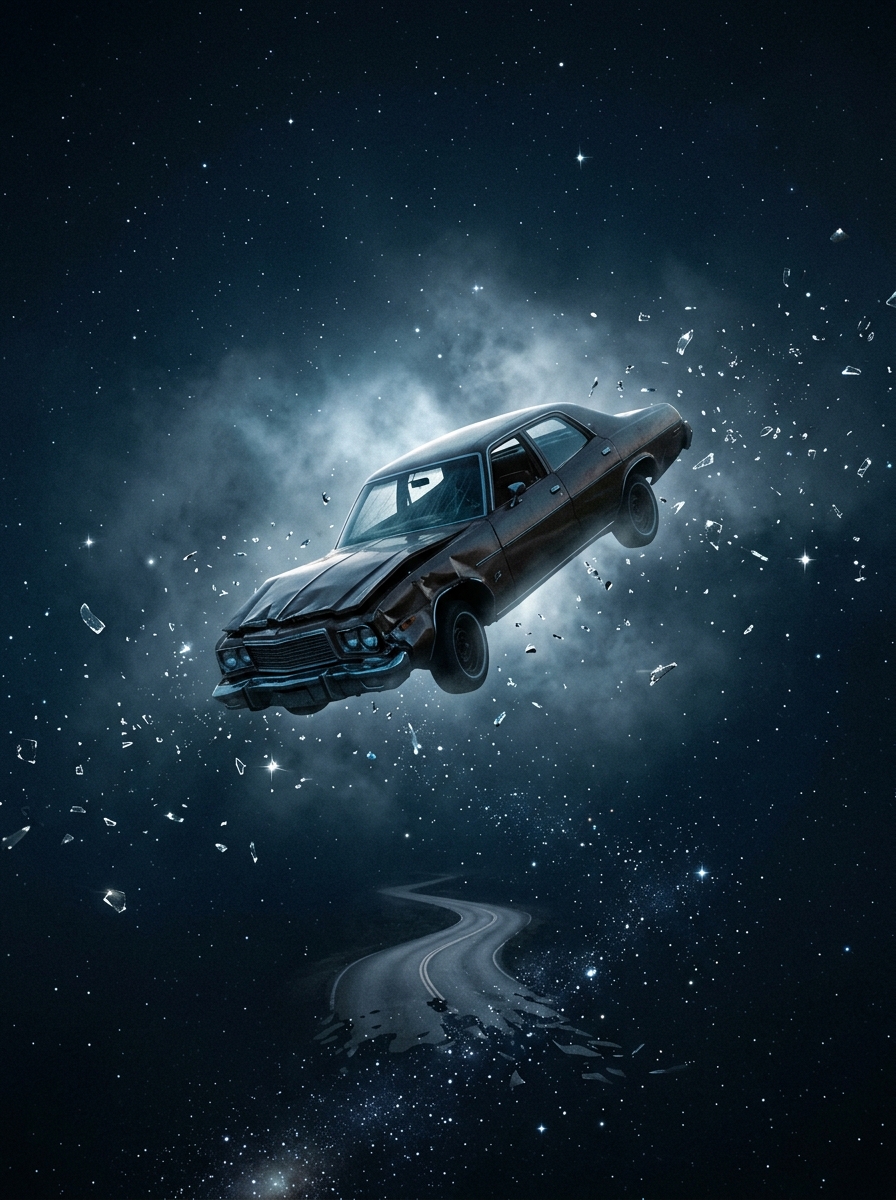
A dream about a car crash dramatizes a moment when the psyche’s forward motion meets a wall that consciousness has been trying to ignore. The car is the ego’s vehicle: the direction you have chosen, the speed you are keeping, the assumption that you are in control. The crash is the interruption that insistence could no longer avoid. This is not a prediction of pavement and metal—it is a symbolic compression of a waking-life collision between will and reality, intention and consequence, or two conflicting impulses inside the same driver.
The wreck as interruption
The core dynamic is simple: something is moving that should not be moving, or is moving in a way that the deeper self refuses to sustain. A car crash in dreams always involves a failure of guidance, whether through loss of steering, brake failure, another vehicle’s intrusion, or the driver’s own inattention. The symbolic weight falls on the moment contact is made—when the assumption of smooth travel proves false. In waking terms, this frequently arrives during periods of overcommitment—too many obligations, too fast a pace, too little room to adjust course. But it can also appear when an old trajectory no longer fits but the dreamer has not yet allowed themselves to stop.
The specific form sharpens the meaning. A single-car crash leans inward, pointing to self-sabotage, fatigue, or a solo journey that has outrun the dreamer’s capacity. A crash involving another vehicle introduces relational dynamics: conflict, entanglement, or misaligned timing with someone else’s direction. If the dreamer is a passenger, the issue likely concerns trust, dependency, or unease about being carried along by another’s decisions. If the dreamer is a bystander watching the wreck from outside, emotional distance may be at work—observing a collapse in one’s own life without yet feeling its impact.
The emotional tone of the crash also colors the reading. A high-speed impact points to overextension: ambition without rest, logic without feeling, speed without reflection. A low-speed fender-bender suggests friction, a small mistake the psyche refuses to gloss over. Either way, the dream compresses a pattern the dreamer has been living into one image the nervous system cannot ignore.
Why the psyche stages the impact
From a psychological standpoint, especially a Jungian one, the unconscious does not send car crashes for the thrill of destruction. It uses the symbol because it can hold multiple truths at once: the vehicle as personal agency, the road as life path, the collision as a breakdown of a one-sided attitude. A dream about a car crash often surfaces when the waking personality is forcing a particular direction—staying in a job that drains, pushing a relationship past its natural end, maintaining a self-image that no longer matches the facts. The psyche stages the impact to introduce proportion. If you are living in hyper-control, the crash offers surrender. If you are drifting, the crash introduces consequence.
The inner split is crucial. One part of the dreamer wants to accelerate; another part slams the brakes. The crash is the visible outcome of that internal tug-of-war. The dream does not ask which part is right—it simply shows that the contradiction cannot continue. For readers interested in how this kind of symbolic logic operates across different systems, the framework of tarot and astrology we use at Aurora Arcana treats dream images the same way: as meaning-making languages rather than predictive code. The same tension between will and friction appears in cards like The Chariot (controlled motion) and The Tower (sudden rupture). The crash is what happens when direction outruns integration.
Recurrent crash dreams are especially significant. A single nightmare can be a pressure valve; repetition means the underlying issue has not been metabolized. The psyche repeats what consciousness has failed to hear. This is the difference between a passing image and a persistent lesson—one appears, the other insists. When a dream returns, the question shifts from “What does this mean?” to “What am I refusing to stop doing?”
Survival, injury, and the aftermath
How the dream ends matters as much as how it begins. If you wake at the moment of impact, the unconscious is emphasizing anticipation—the fear of what is about to break, not the aftermath. If you remain in the wreck, the dream asks you to dwell in the result long enough to understand what has been broken. The condition of the dreamer after the crash offers a clear maturation-versus-shadow split.
Survival is surprisingly hopeful. It does not erase the warning, but it suggests resilience and the capacity to learn from a near-miss without being destroyed by it. The dream may be highlighting a problem before it becomes irreversible. Injuries, on the other hand, often point to emotional costs already incurred. The psyche is saying, “You have already been hurt by this pattern—you just haven’t let yourself feel it.” A crash with no injuries can dramatize fear without confirming catastrophe, which offers a chance to adjust before real damage compounds.
The shadow response to a crash dream is to treat it as a morbid omen and do nothing different—to read it as a random scare rather than intelligence. That avoidance reinforces the same split the dream was trying to reveal. The mature response is pattern recognition: asking what in waking life feels brittle, forced, or overdirected. Where are you accelerating despite warning signs? Where are you a passenger in your own existence? The dream is not asking you to stop driving altogether; it is asking you to check the alignment.
The crash in the context of a life
A single consolidated example shows how the same dynamic plays out in different domains. In work, a crash dream often arrives during a period of unsustainable pace—multiple deadlines, too many responsibilities, a role that demands a persona you cannot sustain. The car is your career trajectory; the crash is the body or the psyche saying “enough” before a breakdown forces the issue. In relationships, the crash can reflect a mismatch of speeds—one partner wants commitment, the other wants space; or a collision of expectations that have not been spoken aloud. The other car in the dream is rarely an enemy; it is a symbol of another will intersecting yours.
In decision-making, the crash may appear when you are postponing a choice—staying at a job you already know is wrong, remaining in a city that no longer fits. The crash is the consequence of inaction pretending to be destiny. The psyche dramatizes the outcome of not choosing so that you feel the weight of delay. In all these cases, the interpretation does not require a literal fear of driving; it requires looking at where momentum is substituting for alignment.
Sometimes the crash arrives after a deliberate change—a breakup, a resignation, a hard truth finally spoken. In that context, the wreck may not be warning but release. The old vehicle of identity—the one that drove toward a wall—has been abandoned. What looks like destruction is the end of a false trajectory. The dream asks a different question: “What part of you was driving toward a wall, and why did it take a dream to stop you?”
Reading the dream as intelligence
The most useful response to a dream about a car crash is not superstition or panic. It is inquiry. Ask where in waking life you are forcing motion because stopping would require an uncomfortable truth. Ask whether you are ignoring signs of strain—in health, in a relationship, in a financial plan, in a role you outgrew months ago. The dream is rarely trying to be flashy for its own sake; it is dramatizing a problem in a form your nervous system cannot deflect.
If the dream recurs, treat the repetition as data. The psyche is insisting because the waking mind keeps dismissing the message. You do not need to treat every dream as prophecy, but you should treat a pattern as intelligence. A dream that ends in survival may be offering you the chance to learn without the wreckage. A dream that ends in injury may be asking you to tend to wounds already taken. And a dream that ends in fire or water—crash into ocean, crash into flame—deepens the symbolism into dissolution or purification, themes that resonate with tarot’s Death card and the astrological transits of Pluto. The specific image matters, but the essential work is the same: stop treating the crash as a spectacle and start treating it as a signal.
A final note: not every car crash dream is ominous. Some arrive after a person has finally told the truth, after quitting a draining job, after leaving a relationship that had become a holding pattern. In those cases, the wreck may not be a warning at all—it may be the sound of an old identity breaking apart so a new one can begin. The psyche does not always ask “How do I avoid catastrophe?” Sometimes it asks, “What part of me needed to stop so violently that only a dream could make it real?”
Related
- Dream About an Airplane Crash: What the Fall Means
- Dream About Driving Off a Cliff: When Control Ends at the Edge
- Dream About Falling: When the Psyche Loses Its Handhold
- Dream About an Elevator: Rising, Falling, and the Inner Architecture of Change
- Dream About an Earthquake: When the Ground in You Starts Moving
Comments
Loading comments…