Dream About a Frog: Meaning, Psychology, and Symbolic Variations
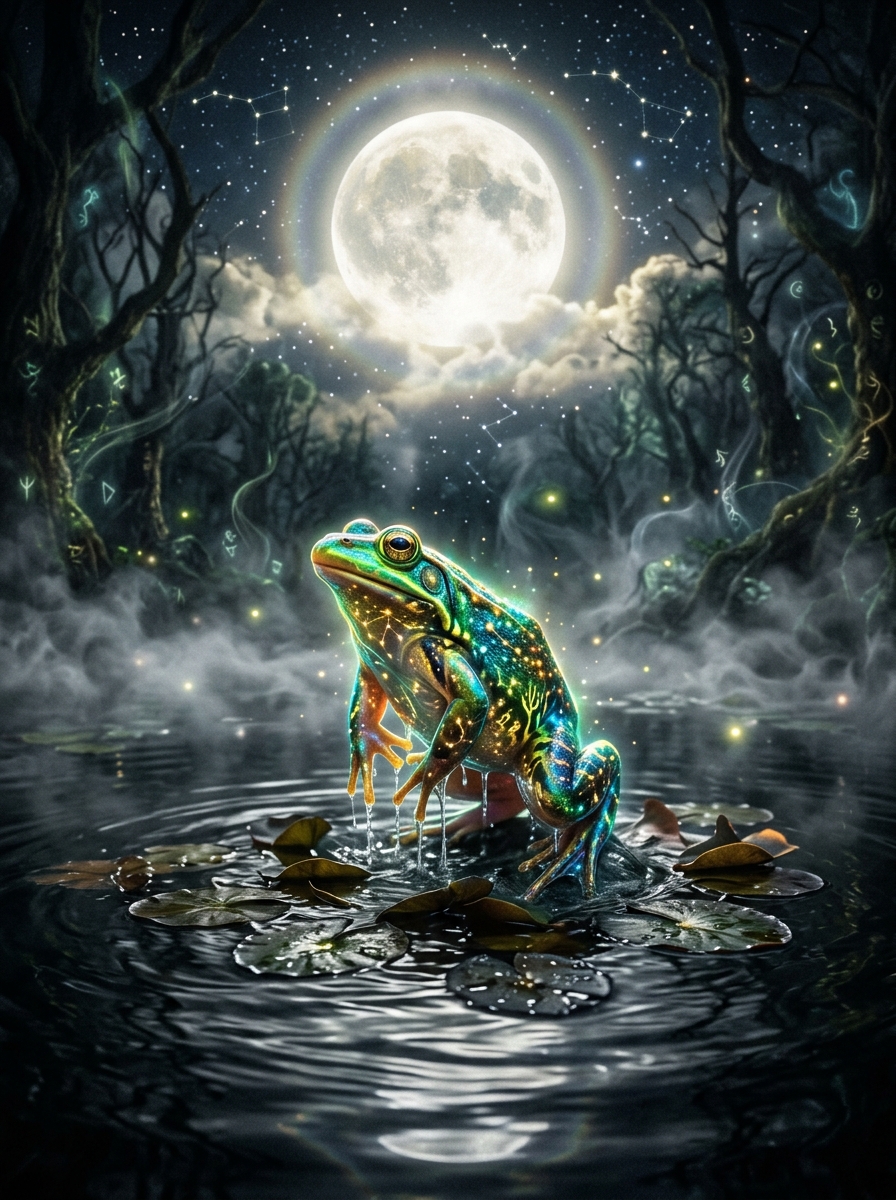
A dream about a frog rarely announces a single fixed fate. It announces a condition: adaptation is under way. The frog is a creature of thresholds—between water and land, larva and adult, silence and sound. When it enters sleep, it often mirrors a life moment where identity, feeling, or health is in flux. The image can feel earthy, slippery, comic, repellent, sacred, or all of those at once. That instability is the clue. The frog does not answer "what will happen." It shows you that something is already changing, and that change has not yet dried its wings.
The central thesis: transformation that is still wet
The core dynamic of a frog dream is metamorphosis under pressure, not luck or grossness, though either can surface. The frog is an amphibian, and that biology carries psychological weight: it lives by crossing environments. In dream language, the psyche is negotiating a crossing too—leaving behind an old emotional adaptation, entering a less familiar one, or learning to survive in mixed conditions where certainty is unavailable.
A frog is a developmental creature. Its life begins in water and becomes something else without ever fully abandoning its aquatic origin. Dreams borrow this biology to describe how the mind changes. You may be outgrowing an identity that once protected you but now feels juvenile, or discovering that a long-suppressed instinct is finally ready to surface in adult form. If the dream felt oddly tender, that can be the point: not every transformation is dramatic. Some are incremental, patient, and almost amphibian in their humility.
In Jungian terms, the frog can carry the energy of the shadowed instinct—what lives beneath polished social behavior and wants to rejoin consciousness. That does not make it monstrous. It makes it alive. For a broader framework on how we interpret dream symbols—not as fortune-telling but as meaning-making rooted in pattern, image, and psyche—see our Aurora Arcana about page.
The psychology of an amphibian instinct
Why does the subconscious reach for a frog rather than a bird or a fish? Because the frog belongs to the uncanny middle ground: familiar enough to belong to the natural world, strange enough to trigger aversion, ancient enough to feel mythic. Dreams love creatures that do not stay in one category. The frog's doubleness makes it a perfect carrier for emotions that are themselves ambiguous—grief that feels like irritation, vulnerability that slips into sexuality, a body-level knowing that hasn't yet become language.
Emotional metabolism and the inner marsh
A dream about a frog is often less about external events than about emotional metabolism. It points to feelings that have been sitting in a damp inner basement: unprocessed grief, irritation, vulnerability, sexuality, intuition. The frog doesn't "mean" one emotion; it signals the presence of something adaptive, amphibious, and not fully spoken. The psyche may be asking you to tolerate a rawer ecological truth about yourself—the emotional compost that, once acknowledged, becomes fertile.
Repulsion as accurate intelligence
A dream's disgust factor is never trivial. If the frog caused revulsion, fear, or a need to wash your hands, the psyche is dramatizing a boundary issue. Something in waking life may feel contaminating, invasive, or too close to the skin. The frog becomes a carrier of that charge. Sometimes the thing you reject most strongly is not actually dangerous; it is merely unfamiliar to your nervous system. Other times the repulsion is accurate, and the dream is showing you that your instinct already knows what your conscious mind is rationalizing away. The frog is a creature of instinct, not ideology. Its presence may reveal where your body disagrees with your story.
Healing, not glossy
People sometimes assume a frog equals healing because frogs are associated with cleansing waters. That can be true, but the deeper message is usually more specific: healing through contact with what has been avoided. If the frog jumped away from you, the dream may describe a healing opportunity not ready to be seized by force. If you held the frog, kissed it, or let it sit in your hand, the dream can indicate an increased capacity to stay with discomfort without immediately rejecting it. This is not sentimental. It is a sign of psychological maturity.
Where the frog appears — context as grammar
The same frog means something different depending on where it appears and what it does. The context is not decoration; it is the sentence in which the symbol speaks.
Frog in water, mud, or a pond
A frog in water usually intensifies emotional meaning. Still water suggests feelings deeper than they look; muddy water suggests ambiguity, old pain, or unclarified attachment. If the frog is thriving there, the dream may be affirming your ability to remain functional inside emotional complexity. If it is trapped, struggling, or dying, the dream may be showing an emotional environment that no longer supports healthy adaptation. A pond can signify a contained psychic world—a private emotional ecology. A marsh points to liminal territory where categories blur and old habits break down. These settings often arrive when the sleeper is moving through uncertainty rather than crisis.
Frog in the house, on the bed, or in your mouth
When a frog enters domestic space, the symbol becomes more intimate. In the house, it indicates that an instinctive or emotional issue has moved into everyday life and can no longer be kept outdoors in the psyche's wild regions. On the bed, the dream can involve vulnerability, intimacy, fertility, or rest disturbed by a living uncertainty. In the mouth, the image is especially striking: speech, swallowing, and truth are in play. You may have words you cannot say, or a truth you have "swallowed" that wants to become articulate. A frog in the mouth can also suggest a magical obstruction—something alive but unspoken lodged in the throat. Dream imagery often chooses bodily locations with precision; the body is not a container here, it is the map.
Frog jumping, croaking, or multiplying
A jumping frog tends to imply change that is abrupt, mobile, and not fully under conscious control. A croaking frog emphasizes voice—a message that is repetitive, primitive, or impossible to ignore. A swarm or cluster of frogs can indicate abundance, but not necessarily pleasant abundance. Sometimes the psyche is presenting too many small concerns at once—every overlooked feeling now making noise. If the frogs were green and lively, the dream carries a stronger note of renewal. If they were dead or desiccated, the image can suggest blocked adaptation: an instinct neglected until it lost vitality.
The mature expression and its shadow
A frog dream can show you how this amphibian energy operates when integrated—and what it looks like when it goes distorted.
Fertility, creativity, and the anxiety of abundance
Because frogs are associated with reproductive abundance and seasonal rain, a dream about a frog can touch fertility in the widest sense: conception, creativity, receptivity, and the willingness to generate new life. That does not have to mean pregnancy. It may mean an idea, a project, or a relationship phase that wants to be born. At the same time, fertility imagery can bring anxiety. A frog dream may expose fear of unwanted change, intrusive dependence, or bodily unpredictability. If the dream felt "too fertile" or overwhelming, the psyche may be registering an overflow: too much feeling, too many possibilities, too much life moving at once. Symbols of abundance can be unsettling when the container feels thin.
Boundary issues and shadow avoidance
When the frog appears as something to be escaped or killed, the shadow side emerges: resistance to change, refusal to wade into emotional murk, or a tendency to intellectualize rather than feel. The dream is not condemning you; it is showing you where your survival strategy has become a cage. The mature response is not to force yourself to love frogs but to ask what boundary the frog is crossing. Is it a boundary that needs to be reinforced—or one that needs to soften?
The trickster note
Sometimes a frog dream arrives with comic energy. The frog jumps awkwardly, inflates its throat absurdly, or appears in an incongruous place like a bathtub. That humor is not a distraction; it is the psyche's way of loosening a serious transition with a trickster's wink. The frog's indirection can teach you not to take the transformation too solemnly. Change that is still wet does not need a ceremony; it needs patience and a sense of the ridiculous.
Reading the frog in your own life
The most useful interpretation is specific, situational, and unsentimental. Ask not "what do frogs mean?" but "what is my psyche doing by choosing a frog now?" That question usually yields a sharper answer than any universal list.
Look for the emotional tone first
If the frog felt sacred, curious, or oddly comforting, the dream may be aligning you with a slower, more instinctual intelligence. If it felt dirty or invasive, the dream may be highlighting what you are resisting in yourself or someone else. If it was comic, the image may be softening a serious transition with a bit of trickster energy. The same symbol can carry grace, disgust, or instruction; tone tells you which register is active. A good reading honors texture, not slogans.
Ask what is changing form
If you are unsure what the frog refers to, track the boundary it inhabits. Are you between jobs, between lovers, between beliefs, between grief phases, between versions of your body? The frog often appears when a previous way of life is no longer adequate, but the next one has not yet stabilized. It is the psyche's way of saying: you can survive the in-between.
If the dream was vivid or recurring, the symbol may be asking for practical attention: more rest, clearer boundaries, less emotional leakage, or a willingness to confront something you have been classifying as minor. In dream language, "minor" often means "unexamined." The frog's persistence is a message that adaptation is under way. Something in the psyche is learning to live between worlds, and the frog is the shape that truth has taken for the night.
For a deeper dive into the interpretive principles we use—across tarot, astrology, and dreamwork—our Aurora Arcana about page outlines the lens of meaning-making rooted in pattern, image, and psyche, not prediction.
Related
- Dream About a Butterfly: Change, Delicacy, and the Soul in Motion
- Dream About River: Flow, Crossing, and the Emotional Current Beneath
- Dream About Turtle Meaning: Slow Wisdom, Protection, and Emotional Timing
- Dream About an Insect: Meaning, Psychology, and Symbolic Variations
- Dream About Snakes: What the Serpent Means in Sleep
Comments
Loading comments…