Dream About Birds: What Wings, Calls, and Flocks Reveal
The Threshold of Flight
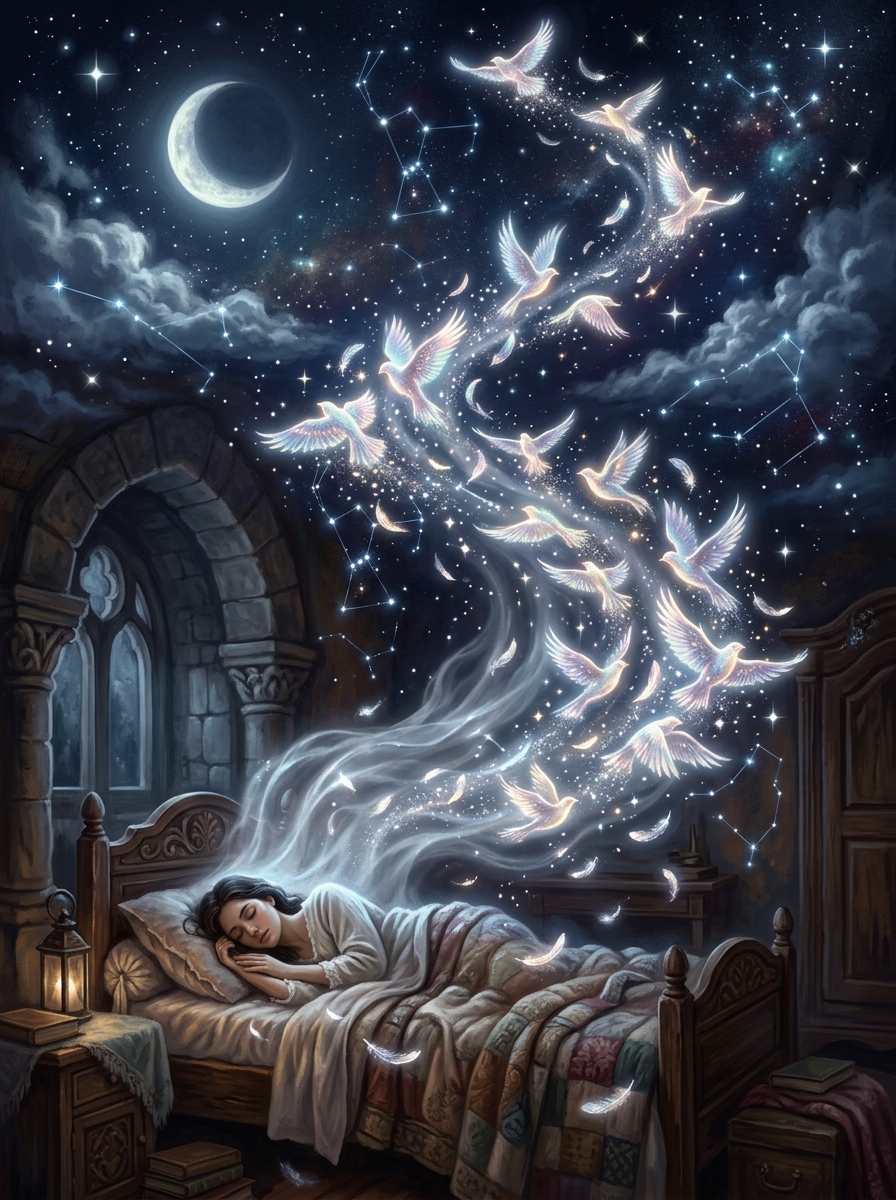
A dream about birds announces a change in mental altitude. Birds move between earth and sky, instinct and perspective, body and spirit. When they appear in sleep, something in you is reorganizing its relationship to height: ambition, insight, escape, or the longing for air. The core dynamic is not simply freedom—it is direction. A bird may represent a thought that will not land, a feeling that wants release, or a message arriving too quickly for ordinary language.
In astrological terms, bird dreams often echo Mercury themes: communication, perception, timing, and nervous energy. But they also touch the mythic territory of the sky, where vision expands and the ego loses its ground. The first question is never “What does a bird mean?” but “What kind of motion is the dream trying to teach?” A flying bird usually emphasizes possibility and perspective; a bird trapped in a room reveals a thought or desire that cannot find expression. The same species can be liberation in one dream and avoidance in another. Our approach to dream symbolism begins with context rather than one-size-fits-all definitions—and the context of a bird dream is always the dreamer’s current emotional climate.
The Grammar of the Dream
The most useful interpretations are specific. A crow is not a dove, and a hawk is not a sparrow. The psyche does not choose avian imagery randomly; it reaches for a creature whose habits fit the problem at hand. That is why dream journals that include species, color, and motion become far more revealing than vague summaries.
Behavior as Narrative
Start with what the bird does. A bird that is frantic signals an overexposed inner life. A serene bird models a calmer mode of mind. A bird that pecks or attacks moves from inspiration into urgency or psychic alarm. A bird that lands near you suggests the message has become personal—contact has been made. A bird flying into a window is a potent image: insight has collided with a boundary. If the dream turns on a bird’s call—chirping, shrieking, singing—the message may be less about image than interruption. Such dreams often arise during periods of mental overstimulation or when an intuition is trying to break through denial.
Species sharpen the emotional temperature. Crows and ravens appear when the dream is dealing with what is hidden, intelligent, or unavoidable: grief, sharp perception, the capacity to see what others miss. A hawk or falcon brings precision—a call to discernment or a warning that instinct has hardened into control. Doves carry peace, reconciliation, or the psyche’s need to remember softness after strain. Swallows suggest return, seasonal change, the intuition that life is moving again. Sparrows speak of ordinary resilience: small strength, communal dignity. A swan belongs to a more refined register—grace, erotic poise, hidden force. If a swan seems calm but imposing, the unconscious may be indicating a dignity stronger than it looks.
Color and Setting as Atmosphere
Once species is clear, the next layer is the dream’s grammar of color and setting. A white bird can suggest purity, release, or new beginning—but white can also indicate emptiness or spiritual abstraction. Black points toward the shadow, grief, protection, or knowledge not yet integrated. Red brings passion, alarm, rage. Blue suggests calm, communication, a mind seeking spaciousness.
Number changes the scale. One bird feels personal and focused. A pair can symbolize relationship, polarity, or a choice between two paths. A flock suggests collective forces: family patterns, social pressure, contagious emotion. A single bird in a wide sky is a signal; dozens moving as one body is weather.
Where the bird appears matters as much as how it moves. A bird in a house makes the unconscious feel intimate and domestic—a thought or feeling that has entered private life and can no longer be ignored. A bird in a cage speaks to restraint, captivity, a gift confined by circumstance. If you open the cage, the symbolism shifts toward release; if you cannot, the dream describes an unresolved constraint rather than a solution. A bird at a window marks a border between inner and outer life. In each case, the dream asks where the psyche is located: in flight, in transit, or at the threshold.
The Psyche’s Air Element
Birds are creatures of the air, and in dream language air is the element of thought. That is why bird dreams so often reflect your relationship to perspective: whether you are trapped in detail or ready to see the larger pattern. What you call freedom may actually be avoidance. What you call inspiration may be dissociation.
Between Freedom and Escape
The common interpretation of bird dreams as “freedom” is true but incomplete. Underneath that surface may be longing, grief, ambition, or the need for a different mental climate. If the dream feels airy, dazzling, or far away, the psyche may be lifting off from difficult material rather than integrating it. Not every bird dream is a blessing. Sometimes the bird is an escape route. Sometimes it is a conscience. Sometimes it is the soul’s refusal to remain at ground level with what has become stale.
In a Jungian frame, birds can symbolize spirit or inspiration—what rises above instinct without denying it. They are intermediaries between shadow and insight, body and meaning. A bird dream may appear when consciousness is growing enough to hold a wider truth but not yet steady enough to settle it. The bird becomes a living image of transition. That transitional quality is why bird dreams often occur during change, loss, courtship, creative emergence, or spiritual questioning. The dream is not merely describing your life; it is showing how your psyche is trying to adapt to it.
The Dreamer’s Role
Pay attention to what the bird does to you. Do you follow it, fear it, feed it, trap it, rescue it, or simply watch it? Your role often tells you more than the bird itself. To follow a bird is to be guided by instinct or intuition. To cage one is to contain a force that wants release—or to mistake control for safety. To rescue a bird may reveal a desire to save something fragile in yourself. To watch from below can imply humility, awe, or distance. If the dream contains multiple birds, ask whether the scene feels orderly or chaotic: a synchronized flock aligns with a collective pattern; a scattered flock indicates fragmentation of attention or competing pulls.
For a deeper exploration of how symbolic systems honor lived experience, see About Aurora Arcana, where we treat symbols as living images that gather personal history rather than fixed slogans.
The Waking Application
Bird dreams do not float in some abstract spiritual realm—they arrive because your life has reached a point that demands a shift in altitude. Here is how that dynamic expresses itself in concrete areas.
In love and relationships, a bird might signal a desire for more openness or a fear of being too close. A pair of birds often reflects a partnership in transition: either taking flight together or circling separate territories. A trapped bird can point to an unspoken wish for release—from an old pattern, a stagnant bond, or a self-image that no longer fits.
In work and creativity, the dream often asks whether you are using your mental energy productively or scattering it. A soaring hawk may be a call to focus; a flock of sparrows might remind you that small, consistent efforts build resilience. A bird pecking at you could be an intuition about a deadline or a neglected task.
In grief and loss, bird dreams can be poignant visits. A solitary bird against a wide sky may embody the absence you feel. A bird that lands near you and stays might be the psyche’s way of saying you are not entirely alone. These dreams do not need mystical interpretations to be meaningful; they are the mind’s way of metabolizing what has gone.
In spiritual or creative emergence, a bird may be the first sign that something in you is ready to take shape. Eggs and nests in dreams point to incubation—potential not yet hatched, a process that shouldn’t be forced. Chicks represent fragile beginnings, responsibilities, the tenderness of an unfinished plan. The dream says: protect the process. Do not rush the incubation. Timing is often the difference between genuine emergence and premature collapse.
Reading Your Dream with Precision
The clearest interpretation comes from friction: what in the dream feels beautiful but uneasy, free but incomplete, sacred but urgent. If the bird is a source of comfort, the dream may be nourishing your sense of possibility. If the bird is alarming, the dream may be exposing a boundary violation, a rising thought, or a truth you have tried to keep airborne instead of embodied.
Do not ask “What does this bird mean in a book?” Ask “What does this bird mean to me—today, in the middle of this life?” The dream speaks in images; your task is to listen for the emotional fact beneath the image. A bird dream is never only about wings. It is about what in you seeks altitude, what in you fears it, and what in you has already sensed the way forward. Trusting that sense—even before you can name it—is the dream’s real gift.
Related
- Dream About a Butterfly: Change, Delicacy, and the Soul in Motion
- Dream About Flying: Freedom, Fear, and the Mind in Motion
- Dream About an Insect: Meaning, Psychology, and Symbolic Variations
- Dream About Fish: What the Water Is Trying to Tell You
- Dream About Spiders: What the Web Is Trying to Tell You
Comments
Loading comments…