Dream About a Rainbow: Promise, Repair, and the Color of Aftermath
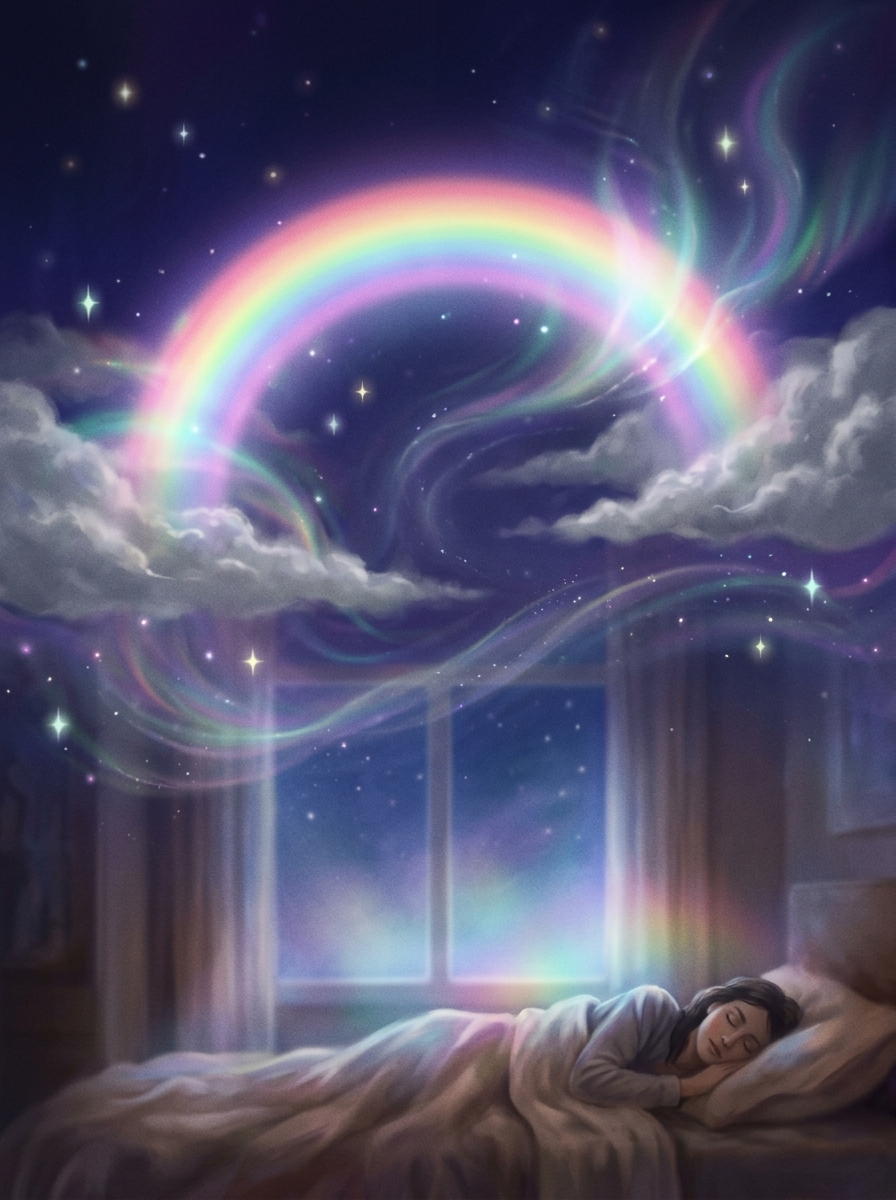
A rainbow in a dream marks the passage from fracture toward coherence. It is not the image of effortless happiness but the psyche’s way of picturing reconciliation between what had been split: grief and relief, loss and new possibility, the part of you that wants to hold on and the part already reaching forward. The meaning sharpens when you ask what came before it, whether you stood beneath it or merely observed it, and how the arc made you feel. This symbol depends on disturbance—rain must fall for a rainbow to appear—so it always carries residue of the storm. Read well, it tells you something about the aftermath you are living through now.
The rainbow as bridge, not as guarantee
A dream rainbow is rarely about childish optimism. In symbolic terms, it appears after rain because it requires a condition of broken light. That matters. The image suggests that something difficult has already happened, or is still happening, and that the mind is seeking a usable meaning inside that turbulence. If you have been grieving, arguing, recovering, or waiting for news, the dream may be registering that the emotional storm is not the whole story. This is why the symbol often carries a subtle lift without becoming frivolous. It does not promise that everything will be fine; it shows that the psyche can imagine a bridge between incompatible states.
In Jungian thought, the rainbow behaves like an integrative symbol: many colors, one arc. It gathers difference without erasing it. That makes it especially relevant when your life feels internally divided—duty versus desire, grief versus gratitude, the self that wants to move on versus the self still intact enough to remember. The dream does not solve the division. It presents the possibility of a shape that holds both sides. That shape is itself a change.
When the rainbow appears vivid, unusually close, or impossibly large, your unconscious is emphasizing the importance of this transitional moment. Exaggeration in dreams is not decoration; it is emphasis. A colossal arc intensifies the feeling that a turning point is near or that a promised resolution has become psychologically unavoidable. This is consistent with how the mind treats threshold symbols—they signal that you have reached a point where meaning is about to reorganize. For a broader look at how dream images map to inner life, Aurora Arcana’s approach to dream interpretation is built around context first, symbol second, certainty last.
Hope with a shadow in it
The rainbow is often read as hope, but dream hope is not the same as cheerful reassurance. In a mature dream, hope may arrive with a trace of sadness: the recognition that a loss had to happen for a new pattern to become visible. That is why rainbow dreams can feel moving rather than merely pleasant. They often arise when the unconscious is trying to restore proportion after overwhelm. The image says: the weather changed, and you survived the weather. The emotional tone is crucial—if the dream left you peaceful, you may be nearing internal settlement; if it felt startling, you may be encountering an unexpected burst of meaning after numbness; if it seemed unreal or too bright, the psyche may be compensating for heaviness by producing an image of wholeness more complete than your conscious mood can yet support.
Psychological roots: integration and aftermath
Psychologically, a dream rainbow reflects the mind’s effort to integrate experiences that were previously separate. The individual colors matter because they imply diversity held in relation. You may be moving toward reconciliation with a memory, a person, or a part of yourself that you had exiled. When the rainbow appears after a frightening dream, it can function as psychic relief—almost like a seal placed over disturbance. When it appears with tears, it signals emotional processing: you are not simply “getting over it,” you are metabolizing it.
If the rainbow is tied to a specific person, place, or memory, the dream may be pointing to reconciliation—not necessarily with the person involved, but with the feeling the person left inside you. The rainbow becomes an image of rejoining. This is not about forgiveness in a sentimental sense; it is about the psyche’s capacity to hold a wound and a blessing in the same frame. That capacity is what integration looks like in practice.
The dream may also be dramatizing movement toward an ideal that is real in effect even if it cannot be grasped literally. If you crossed under the rainbow, walked toward it, or tried to reach it, the dream is showing psychological orientation. You may be moving toward healing, creative synthesis, or a more truthful life structure. The rainbow is then less a reward than a direction. Chasing the rainbow does not always mean folly; it can mean devotion to possibility. But if the chase felt endless, the dream may be advising you to stop equating fulfillment with arrival and to notice the conditions already changing around you.
When the rainbow feels ominous
Not every rainbow dream is benign. If it looked dark, broken, reversed, or unnaturally static, the symbol can suggest forced cheerfulness or a promise that feels unearned. In psychological terms, the mind may be questioning a story of “everything happens for a reason” when you are not yet ready to accept it. A rainbow that appears too early—before the rain has truly passed—can imply premature closure, the pressure to interpret pain too quickly, or an external expectation that you move on before you have metabolized what occurred. In such cases, the dream is not delivering hope; it is showing you a hope that is not yet yours. That is still useful information: it tells you where the psyche is resisting a false resolution.
Variations that change the reading
The details of the dream often matter more than the headline image. A double rainbow tends to intensify the sense of revelation or surplus—the psyche is saying that one layer of meaning is not enough, and a second has arrived to deepen the first. This often appears during pivotal transitions, especially after a long period of strain, when relief is not merely relief but evidence that life contains more than one path forward. A full rainbow spanning the sky emphasizes completion, containment, and visible order. It gives the feeling that a process has reached a coherent shape.
A rainbow after a storm is one of the clearest symbolic forms—it confirms that the dream is about aftermath: recovery, perspective, or the beauty that becomes legible only once the worst has passed. If the rainbow appeared over water, the emotional field is stronger still, because water in dreams tracks feeling. A rainbow reflected on a lake can indicate inner resonance—not just outer beauty, but an emotional response to beauty that is now visible to you. If the rainbow appeared indoors, through a window, or in an impossible place, the unconscious may be locating hope in a sealed or private part of the self, not in public life. That is a sign that the healing is still interior and not yet acted upon.
Color emphasis also matters. Because a rainbow is made of color, the dream carries an unusually rich emotional spectrum. If one hue pulled your attention—bright red may underline urgency or vitality, blue may soften the image toward serenity or truth, yellow may add mental clarity or optimism, violet may tilt it toward intuition or spiritual significance—the key is not to decode each color mechanically but to notice which tone dominated. Dreams know how to stage emphasis. The color that draws your eye reveals the feeling the psyche most wants you to recognize.
The body of the dream
How you felt in the dream matters more than any external dictionary. If you felt calm, the rainbow may be a consoling symbol of alignment. If you felt urgent or ecstatic, it may signal a breakthrough of meaning that has not yet been spoken aloud. If you were chasing the rainbow, the dream can expose the psychology of pursuit: longing for a destination that is partly real and partly symbolic. A rainbow that appears with children, family, or play usually brings the symbol closer to innocence, continuity, and trust. But if the childlike feeling seemed almost out of place, the image may be compensating for adult fatigue—the mind restores color when life has become too monochrome. That is not escapism; it is repair.
Spiritual and symbolic traditions
Spiritually, the rainbow has long been associated with covenant, passage, and message. In the Hebrew Bible, it appears after the flood as a sign of peace between heaven and earth—which is one reason the symbol carries such a strong sense of reassurance in Western imagination. In other traditions, rainbow imagery can suggest a bridge between worlds, a path of blessing, or a sign that invisible forces are in dialogue with visible life. The dream does not have to be “religious” to use that logic. The psyche likes symbols that can hold both the earthly and the numinous.
That said, a spiritual reading should never flatten the dream into generic positivity. The power of a rainbow lies in its origin: light broken and refracted, not light left untouched. Symbolically, it says that unity can emerge through division. For someone emerging from conflict, illness, or emotional exhaustion, the dream may feel like grace precisely because it does not deny the storm. It places the storm inside a larger order. If you are drawn to the esoteric side of meaning, Aurora Arcana’s approach to dream interpretation balances symbolism with grounded interpretation rather than letting one eclipse the other.
Color as meaning, not decoration
Because a rainbow is made of color, the dream often carries an unusually rich emotional spectrum. Bright reds may underline vitality or urgency; blues can soften the image toward serenity or truth; yellows may add mental clarity or optimism; violets may tilt it toward intuition or spiritual significance. The key is not to decode each color mechanically, but to notice which tone dominated your attention. Dreams know how to stage emphasis. If one color kept pulling your eye, it may reveal the feeling the psyche most wants you to recognize.
How to read your rainbow dream in context
The most accurate reading of a dream about a rainbow comes from pairing the symbol with your current life weather. Ask what has recently broken open, what has begun to settle, and what part of you is looking for continuity. A rainbow dream after conflict can mean reconciliation, but it can also mean the mind is trying to restore dignity after humiliation. A rainbow after heartbreak may mark real healing, yet it may also show the gap between what was lost and what is still possible. In both cases, the image is about relation: the crossing of one state into another without pretending the first never existed.
Also note whether the rainbow was seen, shared, or hidden. A solitary rainbow can feel private, almost intimate, as if the dream were confiding a hope you have not announced. A rainbow witnessed with others may point to collective relief—a family, team, or relationship entering a better phase. If the rainbow disappeared too quickly, that can suggest fragility: a real promise, but one that must be noticed while it lasts. Dream symbols are not always permanent messages; sometimes they are timed glances.
The strongest recurring pattern is this: the rainbow appears when the psyche wants you to understand that contrast can be meaningful rather than merely painful. It is a symbol of reconciliation without erasure. If your waking life feels split, the dream may be showing you not a final answer, but the shape of an answer forming. That is often how genuine change begins—not with certainty, but with color returning to the sky after the rain. For a deeper look at how symbolic imagery interacts with astrological and tarot frameworks, explore the pages on Aurora Arcana’s core interpretive method.
Related
- Dream About a Butterfly: Change, Delicacy, and the Soul in Motion
- Dream About River: Flow, Crossing, and the Emotional Current Beneath
- Dream About Your Ex: What It Means When the Past Shows Up in Sleep
- Dream About the Sun: What It Means, Psychologically and Symbolically
- Dream About Stars: Guidance, Longing, and the Shape of Fate
Comments
Loading comments…