The Pisces Horoscope: Navigating the Ocean of the Collective Unconscious
Pisces and the Temporal Rhythm: Navigating Kairos and Emotional Currents
Pisces does not operate on the linear, mechanistic tick-tock of standard modern clocks. For the twelfth and final sign of the zodiac, time is not a march of uniform seconds, minutes, and hours, but a swirling pool of tides, undercurrents, and deep oceanic swells. To truly understand the Pisces horoscope is to step out of Chronos—the rigid, quantitative time of spreadsheets, calendars, schedules, and deadlines—and step fully into Kairos, the qualitative, sacred time of the right moment, the season of the soul, and the eternal, fluid now. Steven Forrest often speaks of the water signs as needing to feel their way through time rather than measuring it with intellectual precision. Nowhere is this more true than in the mutable, oceanic waters of the Fish. When a Piscean attempts to force themselves into a strict linear grid, they experience a kind of spiritual decompression sickness, a deep disruption of their inner alignment that leaves them feeling fragmented, alienated, and thoroughly exhausted by the demands of modern life. The modern world is built on the mechanics of Chronos, demanding constant, unyielding output regardless of the internal season, which is why the highly sensitive Pisces often feels like an alien in a landscape designed for machines.
The Difference Between Chronos and Kairos in Water Signs
To live productively and healthily as a Pisces, one must learn the difficult art of reading emotional currents as temporal indicators rather than personal failures. If the tide is pulling out, it is not a sign of failure, depression, or laziness; it is a clear, somatic signal from the universe to rest, dream, withdraw, and incubate. Trying to push a major project forward when the inner tide is low is like trying to sail a massive ship over dry sand; the effort is monumental, the friction is destructive to the psyche, and the ship remains stubbornly stationary. Conversely, when the tide rushes in, bringing with it a sudden flood of creative inspiration, emotional clarity, or spiritual insight, the Piscean must be ready to drop everything and ride the wave, even if it happens at three in the morning. This requires a level of trust and flow that can feel deeply uncomfortable in a society obsessed with constant, linear productivity. Yet, it is the only way to tap into the true genius of the sign.
Navigating these currents involves recognizing that your feelings are not static facts but passing weather systems in a vast ocean. When a transit activates the Piscean sensitivity, it triggers a somatic response that can feel completely overwhelming. The key is to develop the capacity to witness these waves without drowning in them. By tracking the lunar cycle and the daily movement of the planets through the houses, the Pisces individual can begin to see the patterns in their emotional tides. They learn that the deep sadness that occasionally washes over them is not a permanent state of being, but a passing current clearing space for new creative growth. In this way, horoscopy becomes not a tool for fortune-telling, but a map for navigating the vast, unseen oceans of the psyche. By aligning with Kairos, the Pisces transforms time from a prison of deadlines into a canvas of infinite, synchronized possibilities. They realize that they are not late; they are simply operating on a different, more ancient rhythm that honors the natural breathing of the cosmos.
Additionally, this relationship with time shapes how the Piscean processes history and memory. For Pisces, the past is not a distant country but a living presence that coexists with the present moment. They carry the memories of their childhood, their ancestors, and indeed the entire human species, as a physical sensation in their bodies. This makes them highly nostalgic but also prone to getting stuck in historical loops. By understanding the cyclical nature of planetary transits, they can learn to release the past, recognizing that every emotional state is part of a larger, recurring cosmic cycle.
The Mythopoetic Archetype: The Dual Fishes and the Golden Cord
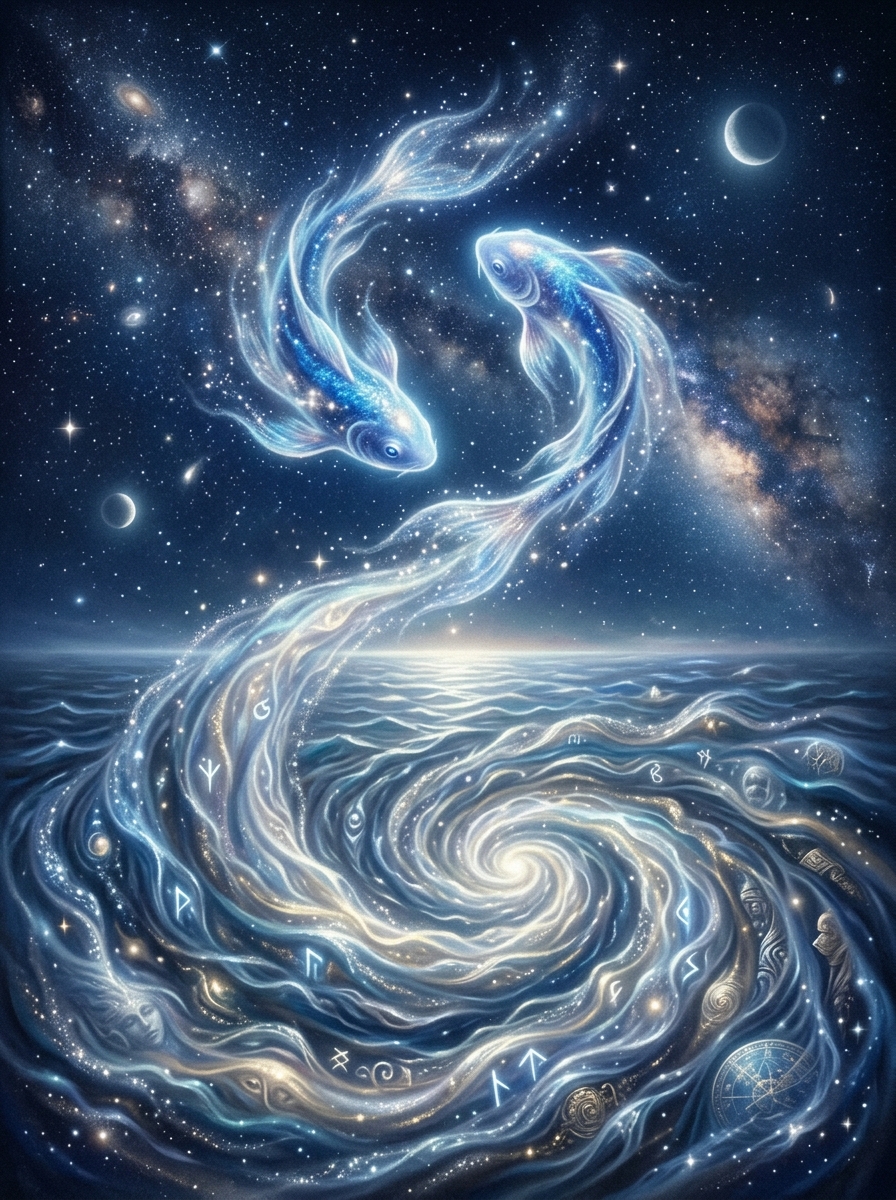
The symbol of Pisces is two fishes swimming in opposite directions, bound together by a golden cord or ribbon. This image, rich with mythological and psychological significance, captured the imagination of astrologers like Liz Greene, who saw in it the core psychological conflict of the sign. In Greek mythology, these are the fishes that carried Aphrodite and her son Eros to safety when they were fleeing the monstrous Typhon, the personification of chaos and destruction. To ensure they would not be separated in the dark, turbulent waters of the Euphrates, they tied a cord between them. This mythopoetic origin speaks to the fundamental human dilemma of the Pisces archetype: the search for safety through connection, and the terror of being torn apart by the chaotic, dissolving forces of existence.
The Celestial Binding of the Soul's Journey
One fish swims upward toward the heavens, representing the urge for spiritual transcendence, the longing to dissolve the ego and return to the primary unity of the cosmos. This is the urge that drives the mystic, the artist, and the dreamer to seek beauty and union with something larger than themselves. The other fish swims downward into the murky depths of the material world, representing the necessity of incarnation, the grounding of the divine spark in physical form, the messy work of human relationships, and the confrontation with the shadow. The golden cord that binds them is the human heart, the conscious ego that must hold these two opposing forces in tension. If the cord breaks, disaster follows. The upward-swimming fish, left to itself, becomes lost in spiritual escapism, delusion, psychosis, and a refusal to participate in the messy realities of human life. The downward-swimming fish, cut off from its celestial twin, drowns in the heavy, suffocating waters of materialism, addiction, and despair.
The work of the Pisces horoscope is to strengthen this cord, ensuring that the spiritual insights gained in the heights are brought down to enrich the earthly life, and that the struggles of physical existence are illuminated by the light of the divine. This dual nature explains the profound contradictions often observed in those born under this sign. They can be saintly in their selflessness and yet surprisingly slippery; deeply wise and yet easily led astray. They inhabit the threshold between worlds, where the boundaries of the self are fluid. The mythopoetic task is not to choose one fish over the other, but to honor both. It is the realization that the sacred and the profane are not separate domains, but two sides of the same golden ribbon. By embracing this paradox, the Pisces individual becomes a bridge between the visible and invisible worlds, manifesting the archetypal beauty of the cosmos in the everyday details of life. To sever the cord is to become either a phantom or a beast; to keep it bound is to achieve the true alchemy of human incarnation.
Furthermore, this internal tension is what drives the Pisces search for relationships. Because they feel divided within themselves, they often look for an external partner to act as the grounding cord. However, true security can only be found by developing the inner strength to hold both fishes in balance. When the Pisces learns to love both their human limitations and their divine potential, the golden cord becomes unbreakable, allowing them to swim freely in any direction without losing their connection to the center.
The Tension of Rulers: Jupiter's Search for Meaning vs. Neptune's Mysticism
The internal landscape of Pisces is shaped by the complex, ongoing relationship between its two planetary rulers: Jupiter, the ancient ruler, and Neptune, the modern sovereign. In classical astrology, Jupiter ruled both Sagittarius and Pisces, representing the expansion of consciousness and the search for truth. In Sagittarius, Jupiter seeks meaning through external exploration—philosophy, travel, and dogma. In Pisces, Jupiter turns inward, seeking truth through the expansion of the inner horizon, the cultivation of compassion, and the direct experience of the sacred. The ancient rulers were assigned based on visible light, and Jupiter represents the expansive, warm light of wisdom that seeks to bring the disparate elements of life into a meaningful, ethical whole.
Reconciling the Ancient and Modern Sovereigns
With the discovery of Neptune in 1846, astrologers assigned this distant, blue planet to Pisces, recognizing its affinity with the oceanic depths, dreams, illusions, and the dissolution of boundaries. This dual rulership creates a productive tension. Jupiter provides the structure, the ethical framework, and the philosophical drive that prevents the Piscean from dissolving entirely into the Neptunian fog. It demands that the spiritual experiences of the sign be translated into a coherent worldview, a set of moral values, or a life of practical service. Neptune, on the other hand, resists all structures, offering a radical mysticism that transcends Jupiterian theology. It whispers that all boundaries are illusions, that all systems of thought are limited, and that the ultimate truth is found in silent, total surrender to the infinite.
When these two forces are out of balance, the Pisces horoscope reflects this discord. An over-reliance on Jupiter can lead to spiritual pride, moralism, and a dogmatic insistence on one's own righteousness, turning the mystic into a preacher. An over-reliance on Neptune can lead to confusion, victimhood, codependency, and a complete loss of grounding, turning the mystic into a victim of circumstance. The mature Piscean must integrate both: the Jovian search for meaning and the Neptunian acceptance of mystery. They must have the courage to build a philosophical framework while remaining open to the silent, dissolving touch of the infinite. This integration allows them to stand firmly in their beliefs while remaining profoundly compassionate toward the struggles of others, walking the path of the spiritual seeker with both wisdom and grace. They become capable of navigating the vast, boundaryless ocean of Neptune while carrying the lighthouse lamp of Jupiter to guide their way.
To achieve this balance, it is helpful for Pisces to engage in spiritual practices that combine structure and surrender. Yoga, meditation, and structured ritual can provide the Jupiterian container, while silent contemplation, creative writing, and immersion in nature allow the Neptunian waters to flow. By consciously honoring both rulers, the Pisces individual avoids the twin traps of dogmatism and delusion, finding a middle path of practical mysticism.
Analytical Psychology: The Twelfth House and the Transpersonal Unconscious
In the natural wheel of the zodiac, Pisces is associated with the twelfth house, the sector of the chart that Arthur Edward Waite and later psychological astrologers associated with self-undoing, hidden enemies, and spiritual liberation. From a Jungian perspective, the twelfth house is the reservoir of the collective unconscious—the vast, transpersonal field of archetypes, myths, and ancestral memories that lie beneath the personal ego. To have planets in the twelfth house, or to navigate a strong twelfth-house transit, is to be invited to descend into this subterranean chamber, where the rules of the day-lit ego no longer apply and the boundaries between self and other dissolve.
C.G. Jung and the Oceanic Depths of the Mind
Carl Jung’s work on the active imagination and the integration of the shadow is essential for understanding this house. The twelfth house contains everything the ego has rejected, repressed, or failed to recognize in itself. For the Pisces individual, whose boundaries are naturally porous, this house is not a sealed vault but a leaky pipe. The contents of the collective unconscious constantly seep into their daily awareness, manifesting as vivid dreams, sudden mood swings, creative bursts, and unaccountable anxieties. This is why the twelfth house is traditionally associated with isolation; the individual must periodically withdraw from the noise of the world to sort through the psychic material they have absorbed.
Navigating this space requires a high degree of psychological sophistication. If one enters the twelfth house without a strong ego-container, they risk being overwhelmed by the archetypal forces of the collective unconscious—a state Jung described as inflation or psychosis. The Pisces horoscope emphasizes the need to develop tools for active imagination, journaling, dream analysis, and creative expression to give form to these formless energies. By translating the images of the unconscious into art, poetry, or ritual, the individual transforms what could be a source of psychological torment into a wellspring of creative genius. The twelfth house then ceases to be a place of imprisonment and becomes a sanctuary of transformation, where the individual dialogues with the deep, collective currents of humanity and emerges reborn.
Furthermore, the twelfth house represents the ultimate repository of our spiritual karma. It is the place where we must face the consequences of our past actions, not as punishment, but as an opportunity for integration and healing. For Pisces, this means confronting the hidden habits of self-sabotage and sacrifice that have held them back. By bringing the light of consciousness into the dark corners of the twelfth house, they can free themselves from these patterns and step into their true power as spiritual beings.
Porosity and Somatic Sensitivity: Suggestibility and the Human Tuning Fork
To be born under the sign of Pisces is to be a human tuning fork. Because the energy of Neptune dissolves boundaries, Pisceans possess an extraordinary degree of sensory and emotional porosity. They do not merely observe the emotions of others; they absorb them somaticly, feeling them directly in their own flesh and nervous system. Walk into a room where an argument has just occurred, and a Pisces will feel a physical contraction in their stomach. Sit next to someone who is grieving, and the Pisces will find tears welling up in their own eyes, often without knowing why. This sensitivity is a beautiful gift, the source of their profound empathy, but it is also a significant psychological liability if left unmanaged.
Without conscious boundary management, this porosity leads to chronic suggestibility. The Pisces individual can easily lose their own center, adopting the opinions, desires, and emotional states of the people around them. They become psychic chameleons, changing color to match their environment, which eventually leaves them feeling hollowed out, empty, and resentful. This somatic vulnerability is often the root cause of the physical fatigue and mysterious illnesses that plague the sign. The body, acting as a filter for the psychic debris of the environment, simply shuts down when it can no longer process the overload, seeking retreat through illness when the conscious mind refuses to set boundaries.
To ground this sensitivity, the Pisces must learn to distinguish between their own emotional material and the energy they have picked up from others. A simple but effective somatic practice is to regularly ask: "Is this energy mine?" Paying attention to the physical sensations in the body can provide clues; self-generated emotions usually have a clear narrative connection to one's life, whereas absorbed energy feels like a sudden, foreign intrusion. Developing a daily cleansing ritual—whether through saltwater baths, visualization, or time spent in nature—is not a luxury for Pisces; it is a basic requirement for psychic hygiene and mental sanity. By protecting their energy field, they can offer true compassion without losing their identity in the process.
Moreover, this sensitivity extends to the physical environment. Pisces are highly sensitive to foods, medications, chemical pollutants, and noise. They require clean, quiet spaces to rest and recover. Learning to create a physical sanctuary at home is essential for their well-being. By filling their home with soothing colors, soft lighting, and natural elements, they can create a healing buffer against the harshness of the outside world, allowing their nervous system to recalibrate and return to a state of balance.
The Virgo Polarity: Integrating Discernment and Grounding the Descendant
In the system of polarities that structures the zodiac, Pisces sits directly opposite Virgo. While Pisces represents the vast, undifferentiated ocean of the cosmos, Virgo represents the meticulous, analytical ordering of the material world. Every Pisces sun or rising individual has Virgo on their descendant, the angle of the chart that represents the "other"—the qualities we project onto partners and must learn to integrate within ourselves to achieve psychological wholeness. This axis is the bridge between the infinite and the specific, the divine vision and the daily chore.
The Sacred Craft of the Axis
For the Pisces, Virgo is the medicine they most need but often resist. The Piscean finds comfort in the vague, the poetic, and the infinite; they can view Virgo’s focus on detail, schedules, lists, and physical health as cold, dry, and limiting. Yet, without the grounding influence of Virgo, Pisces remains a dreamer who never manifests their dreams. The Virgo descendant calls the Pisces to bring order to their chaotic inner world. It insists that spirituality must be lived in the body, through daily routines, healthy habits, and practical service. It is the transition from vague compassion to concrete help.
Integrating this polarity means recognizing that analysis and intuition are not enemies, but partners. The discernment of Virgo allows the Pisces to filter the psychic noise they absorb, giving them the power to say "no" to energies that do not serve them. It provides the craft and discipline necessary to shape their creative inspirations into tangible forms. When the Pisces-Virgo axis is operating harmoniously, the individual possesses both the vision of the mystic and the skill of the artisan. They can touch the heavens with their minds while keeping their feet firmly planted on the earth, rendering the divine visible in the beauty of the mundane. In this synthesis, the daily routine becomes a ritual, and the smallest act of service becomes an expression of cosmic love.
This integration also transforms how the Pisces approaches work and health. Instead of viewing the physical body as a limitation, they begin to see it as a sacred instrument. They learn to care for their health through nutrition, exercise, and regular rest, recognizing that a healthy body is essential for holding their high level of spiritual energy. In their work, they apply Virgo's precision to their creative projects, ensuring that their artistic visions are executed with technical skill and professional discipline.
Periodical Horoscopic Cycles: Daily, Weekly, and Monthly Astrological Guides
Understanding the Pisces horoscope requires an appreciation of how different planetary cycles trigger different layers of the Piscean psyche. The daily horoscope is primarily ruled by the Moon, which changes signs every two and a half days, shifting the emotional landscape. For Pisces, these shifts are felt acutely. A Moon in a fire sign might bring a temporary burst of creative passion, while a Moon in an earth sign provides a welcome period of emotional stability. By tracking these rapid transits, the individual can plan their activities to align with the cosmic weather, choosing when to speak, when to create, and when to retreat.
Practical Strategies for Tuning Into Daily and Weekly Transits
On a weekly level, the fast-moving inner planets—Mercury, Venus, and Mars—provide the rhythm. A weekly horoscope might focus on how Mercury’s transit through the third house affects the Piscean’s ability to communicate their intuitive insights, or how Venus in the tenth house opens up opportunities for creative collaboration in their career. These cycles are long enough to allow for intentional action but short enough to require adaptability. The key is to use the weekly forecasts as a guide for navigating interpersonal dynamics, ensuring that one's porous boundaries are maintained even during intense planetary aspects.
Monthly cycles are dominated by the solar cycle and the major lunations—the New Moon and Full Moon. The monthly horoscope offers a broader perspective, highlighting the seasonal themes of the personal year. When the Sun enters the twelfth house, it is a time for retreat, reflection, and spiritual clearing. When the Sun enters the first house, it is a time for rebirth and personal expression. By understanding these larger cycles, the Pisces individual can avoid the anxiety of feeling like they are constantly starting and stopping, realizing instead that they are participating in a grand, archetypal dance of contraction and expansion. They learn to treat life not as a series of random events, but as a structured, musical composition.
Additionally, paying attention to the retrogrades of their ruling planets, Jupiter and Neptune, is crucial. During these periods, the energy turns inward, inviting the Pisces to review their beliefs and dismantle any illusions they have been holding onto. These are times for deep soul-searching, when the external world slows down to allow the inner landscape to be fully explored and healed.
The Great 2026 Shift: Neptune’s Transition from Pisces to Aries and the Spiritual Warrior
The year 2026 marks one of the most significant astrological events of the decade: the transition of Neptune, the ruler of Pisces, out of its home sign and into the cardinal fire of Aries. Neptune has been in Pisces since 2011, a long transit that amplified the collective hunger for spirituality, mysticism, and artistic expression, but also brought a tidal wave of misinformation, conspiracy theories, and escapism. For Pisces individuals, this period has been one of intense psychic exposure, testing the limits of their sensitivity and forcing them to confront the depths of their own illusions.
The Fire of Aries and the Death of the Illusion
As Neptune edges into Aries in 2026, the energy shifts dramatically. Aries is the sign of the warrior, the pioneer, and the individual ego. The watery, boundaries-dissolving influence of Neptune meets the raw, active fire of the Ram. This transition represents the birth of the "spiritual warrior"—a call for the Pisces individual to take the spiritual wisdom, empathy, and creative vision they have cultivated over the last fifteen years and put it into action. It is no longer enough to sit in quiet contemplation or hide in the safety of artistic isolation; the cosmic weather demands that this sensitivity be weaponized for healing and justice in the world.
This shift will not be comfortable. The transition from the comfortable, familiar waters of Pisces to the burning heat of Aries can feel abrasive to a sign that detests conflict. It demands a level of assertiveness and self-definition that Pisces often struggles to access. Yet, it is a necessary evolution. The Neptunian fire of Aries will burn away the self-pity, the victimhood, and the passive-aggressive tendencies that can plague the sign, leaving behind a refined, courageous spirit. By embracing this heat, the Pisces individual learns to stand up for their dreams, defend the vulnerable, and lead with a fierce, active compassion. They step out of the role of the passive dreamer and into the armor of the conscious creator.
Furthermore, this shift will demand a new kind of leadership from Pisces. In the Aries era, the spiritual warrior does not lead through force or dominance, but through the power of vulnerability, empathy, and truth. The Pisces must have the courage to speak their truth, even when it is unpopular, and to stand up for those who have been marginalized by society. By combining the courage of Aries with the compassion of Pisces, they can become a powerful force for healing in a world that is deeply divided.
Frequently Asked Questions
How can a Pisces protect their energy in crowded environments?
Because of your extreme somatic porosity, crowds can be incredibly draining. To protect your energy, practice active visualization before entering busy spaces: imagine yourself surrounded by a crystalline boundary that allows love to flow out but prevents external emotional debris from entering. Additionally, wearing protective stones like black tourmaline or labradorite can act as a physical anchor for your energetic boundaries.
What is the difference between a Pisces Sun and a Pisces Moon?
A Pisces Sun represents your core identity, life path, and the heroic journey of your ego toward spiritual integration. A Pisces Moon represents your private, emotional landscape, your subconscious reactions, and how you somaticly process safety and comfort. While a Pisces Sun seeks to actively express mysticism, a Pisces Moon feels the tides of the universe privately, requiring deep solitude to recharge.
How does the Virgo descendant affect Pisces relationships?
Your Virgo descendant means you are naturally drawn to partners who are organized, practical, analytical, and grounded. While this can sometimes create tension—as you may feel their focus on detail is cold or critical—these partners serve as a mirror for the discernment and physical structure you need to integrate. A healthy relationship allows you to learn from their grounding while they learn from your vast emotional depth.
Comments
Loading comments…