The Gemini Horoscope: An Esoteric Guide to Duality, Mental Agility, and Spiritual Synthesis
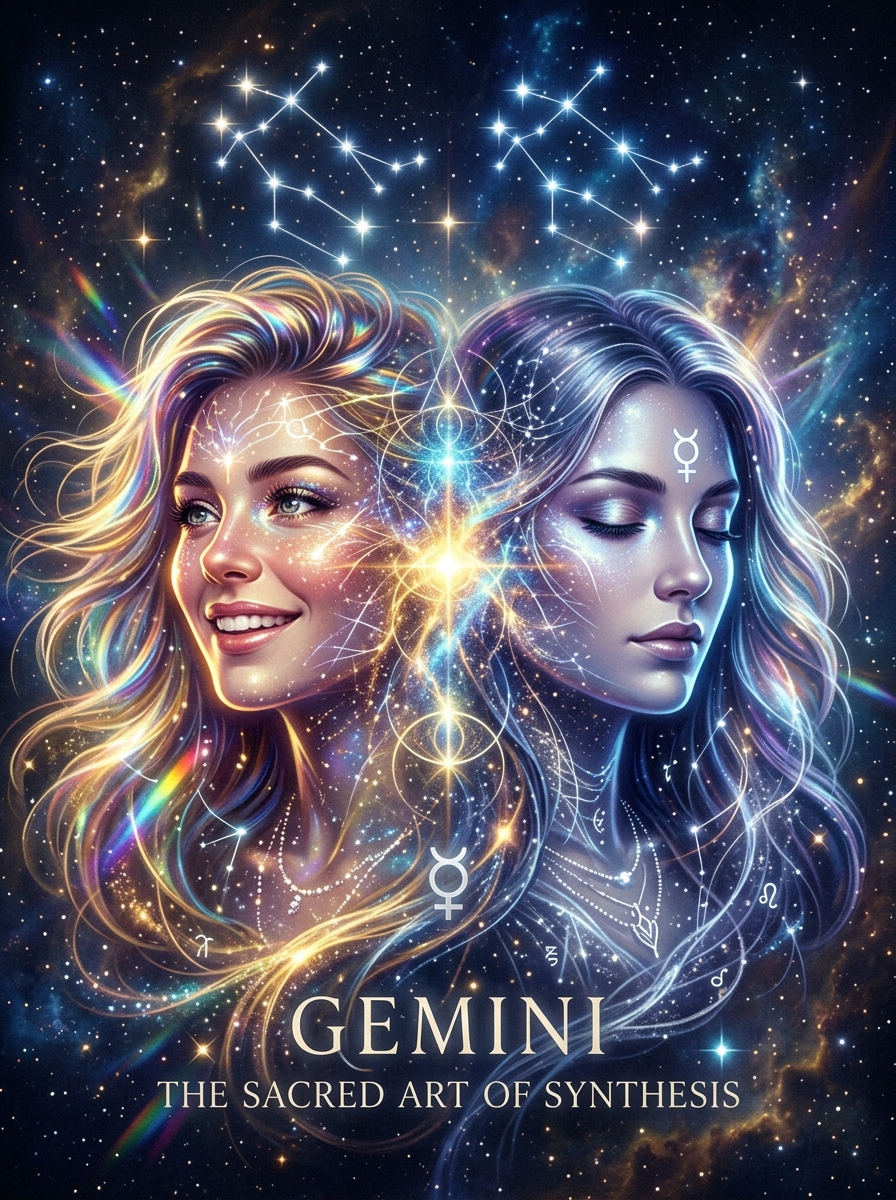
The Twins and the Clock: Understanding Gemini's Mythopoetic Duality and Kairos
To truly comprehend the Gemini archetype is to step into a hall of mirrors where nothing is static and everything is in a state of perpetual translation. In the Western esoteric tradition, Gemini is symbolized by the Twins—most famously represented by the myth of Castor and Pollux. One brother is mortal, bound to the earth and the inevitable decay of chronological time; the other is divine, sharing the timeless nectar of Mount Olympus. According to the classical myth, they were born from Leda, fathered respectively by a mortal king and by Zeus in the form of a swan. When Castor dies in battle, Pollux is so grief-stricken that he begs Zeus to share his immortality. Zeus allows them to share the gift, meaning they must spend their days alternating between the dark, silent underworld of Hades and the luminous, gold-lit heights of Olympus.
Carl Jung pointed to this myth as a profound psychological representation of the dual nature of the human psyche: the ego, bound by daily routines, logic, and physical limitations, and the Self, representing the infinite, transpersonal spark of consciousness. For the Gemini individual, reading a horoscope is not just about forecasting tomorrow's meetings; it is a ritual of checking in on this delicate dialogue between the mortal and the divine self. The mortal Twin, Castor, represents our daily personality—the part of us that handles budgets, runs errands, and seeks social approval. The divine Twin, Pollux, represents our immortal spark, the transpersonal consciousness that seeks higher patterns, ultimate meaning, and a connection to the source of all things. When we check our transits, we are looking for the places where these two twins meet and converse.
This duality shapes how Gemini experiences time. While the modern world operates on Chronos—the linear, quantitative ticking of the clock that demands productivity and sequential logic—Gemini thrives in the realm of Kairos. Kairos is qualitative time, the opportune moment, the sudden flash of inspiration where the past and future dissolve into a perfect present. When you track a Gemini horoscope, you are looking for these Kairos moments. You are looking for the exact alignment of planets that allows the nervous system to shift from the frantic noise of data gathering to the quiet resonance of genuine insight. It is the art of knowing when to speak and when to listen, when to cross the threshold into the underworld of introspection and when to ascend to the marketplace of ideas.
Castor and Pollux: The Human and the Divine
In the astrology of Steven Forrest, the Gemini archetype is defined by its insatiable curiosity and the need to perceive the world without the filtering lens of preconceived dogmas. The tension between Castor and Pollux is the tension between what is immediate, physical, and fleeting, and what is eternal and archetypal. In the daily horoscope, this manifests as a constant swing between hyper-rational analysis and sudden, mystical epiphanies. The mortal Twin, associated with Castor, processes sensory inputs and intellectual data with speed and precision, organizing the chaos of life into legible patterns. The divine Twin, Pollux, sees through these constructs, seeking the ultimate truth of oneness. In the ancient world, sailors saw the Twins as St. Elmo's fire on the masts of ships during storms—a physical manifestation of light emerging from darkness.
For the Gemini individual, this light is a reminder that the intellect is a bridge, not a destination. When Geminis ignore the divine Twin, they fall into dry intellectualism, collecting facts like empty shells on a beach. When they ignore the mortal Twin, they lose their connection to reality, drifting into ungrounded fantasies. Cultivating both aspects allows for a balanced, vibrant mind. Understanding this tension helps the practitioner of astrology view the daily transits as opportunities for integrating these two halves of the self, ensuring that the day's tasks are illuminated by a sense of higher purpose.
Aleister Crowley, in his analysis of the zodiac, associated Gemini with the Lovers card in the Tarot (Atu VI). He viewed this card not merely as a symbol of human romance, but as a depiction of alchemical union and the reconciliation of opposites. The figures in the card represent the active and passive, the intellectual and the emotional, the mortal and the divine. Crowley emphasized that the sword held by the figure above the couple represents the intellect's power to analyze and divide, which must ultimately be used to cut away illusions and reveal the underlying unity of all things. For Gemini, this Tarot connection provides a rich framework for understanding their path: the analytical mind must be used as a tool of discrimination, preparing the soul for the ultimate alchemical marriage of the mortal ego and the divine Self.
Chronos and Kairos: The Art of Qualitative Time
To live by Kairos is to reject the tyranny of the clock and instead synchronize one's actions with the cosmic cycles. In the Western esoteric tradition, time is not merely a quantitative measure but a qualitative flow. Arthur Edward Waite, in his writings on esoteric symbols, often hinted at this distinction, suggesting that true spiritual work requires alignment with the natural rhythms of the universe. For the Gemini, this means learning to read the cosmic weather. A transit of Mercury through a compatible sign is not just a good day for writing; it is a Kairos moment, a window of opportunity where thoughts flow effortlessly and connections are made with ease.
By paying attention to these qualitative shifts, Gemini can learn when to push forward and when to withdraw. Instead of trying to maintain a constant level of high-intensity output, which inevitably leads to burnout and fragmentation, they can learn to ride the waves of cosmic energy, utilizing the periods of mental expansion for creative work and the periods of contraction for grounding and integration. This shift from Chronos to Kairos is the key to unlocking Gemini's true potential, transforming a chaotic life into a harmonious dance with the cosmos. It allows Gemini to perceive the sacred geometry of time, where every moment has a distinct color, tone, and purpose.
The Cosmic Processors: Mercury Transits, Retrogrades, and the Higher Octave of Uranus
Gemini's mental landscape is ruled by Mercury, the swift-footed messenger of the gods, the psychopomp who alone can travel between the heavens, the earth, and the depths of the underworld. Mercury dictates the speed of the cognitive processor. When Mercury transits through air signs, Gemini's intellectual batteries are fully charged; when it dips into water signs, the mind becomes atmospheric, intuitive, and deeply subjective.
The Trickster's Pause: Mercury Retrograde
Perhaps no astrological cycle is as misunderstood in popular culture as the Mercury retrograde. In the tradition of Liz Greene, the retrograde phase is not a mechanical malfunction of the cosmos, but a psychological necessity. It is the Trickster archetype demanding a pause. During these three-week periods, which occur three to four times a year, the outward-directed energy of Mercury is forced inward. For Gemini, who normally processes information by throwing it outward through speech and writing, the retrograde demands a systematic review of the mental files. The usual shortcuts fail; emails go astray, and conversations are misconstrued.
This is the cosmos insisting that Gemini stop collecting new data and instead digest what has already been consumed. It is a time for rewriting, rethinking, and remembering. Rather than resisting the disruptions, the practitioner of esoteric astrology uses the retrograde to dive into the unconscious, resolving outstanding mental loops and listening to the dreams that are usually ignored in the rush of daily life. The Trickster, far from being a malevolent force, is a guide that shows us where our structures are too rigid and where we have become disconnected from our deeper truth. By embracing the retrograde as a time of inner sorting, Gemini can emerge with a clearer mind and a renewed sense of purpose. It is during these periods that we are reminded of the pre-shadow and post-shadow phases, where the mind gradually enters and exits the labyrinth of the subconscious, integrating the lessons of the transit.
Uranus in Gemini: The Electric Collective Shift
At a generational and collective level, the transit of Uranus through Gemini represents an epochal shift in communication, technology, and collective cognitive pathways. Uranus is the higher octave of Mercury—where Mercury represents the analytical mind, Uranus represents the divine spark of revelation, the lightning bolt of absolute knowing. When Uranus enters Gemini, it electrifies the sign's natural agility, bringing revolutionary changes to how humanity connects, processes, and disseminates information.
On an individual level, Uranus transits to Gemini placements can feel like a sudden surge in an electrical outlet. It brings brilliant, erratic breakthroughs, but also runs the risk of frying the nervous system. During these transits, Gemini must prioritize somatic grounding, ensuring that the body can safely channel the high-voltage energy of Uranian insights without collapsing into anxiety or cognitive fragmentation. Crowley, in his writings on esoteric initiation, often spoke of the need for a strong physical vessel to contain the electric currents of higher consciousness. For the Gemini during a Uranus transit, this means establishing a daily practice of grounding, whether through physical exercise, spending time in nature, or somatic meditation, to ensure that the mental brilliance of Uranus can be integrated and expressed in a constructive manner. Without this grounding, the high-frequency vibrations of Uranus can lead to severe insomnia, physical restlessness, and mental exhaustion.
Mercury through the Four Elements: The Mind's Changing Colors
To fully master the cognitive processor, Gemini must understand how Mercury's transit through the four elements alters their mental capacity. It is worth noting that Mercury rules two signs: Gemini (an air sign) and Virgo (an earth sign). In Gemini, Mercury's energy is lateral, associative, and communicative, branching out like a network of rivers. In Virgo, it is vertical, analytical, and nesting, categorizing data into practical systems. When Mercury transits the elements, its expression shifts:
- Mercury in Air (Gemini, Libra, Aquarius): The mind operates at lightning speed, drawing connections between abstract theories and creating elaborate mental models. While this is a peak phase for writing and debate, it carries the risk of intellectual isolation and nervous tension.
- Mercury in Water (Cancer, Scorpio, Pisces): The logical faculties yield to a more atmospheric, emotional way of processing. Thoughts are filtered through feelings and psychic impressions. It is a time for poetry, creative storytelling, and listening to the unspoken dynamics of relationships.
- Mercury in Earth (Taurus, Virgo, Capricorn): The mind becomes practical, methodical, and pragmatic. Gemini is forced to slow down and verify facts, draft concrete project plans, and apply ideas to physical reality.
- Mercury in Fire (Aries, Leo, Sagittarius): The intellect is ignited by passion and creativity. Thoughts are expressed with confidence and enthusiasm, though care must be taken to avoid dogmatism, intellectual arrogance, and verbal impatience.
Daily and Weekly Currents: Grounding Fast-Moving Astro-Energetics
To live consciously as a Gemini means learning how to organize a life that is naturally prone to scattering. Because the Moon changes signs every two and a half days, and Mercury moves rapidly through the zodiac, the daily horoscope provides a map of fast-moving emotional and cognitive currents.
Daily Lunar Rhythms and Cognitive Grounding
A daily horoscope is best utilized not as a predictive fortune, but as a meteorological report for the psyche. When the Moon passes through Gemini or another air sign, the emotional tone is light, curious, and communicative. This is the perfect time for brainstorming, initiating conversations, and gathering resources. However, when the Moon enters a grounding earth sign like Capricorn or Virgo, the Gemini mind may feel restricted or weighed down. Rather than fighting this emotional gravity, this transit should be used to organize files, pay bills, and turn abstract ideas into concrete outlines.
When the Moon transits a water sign (Cancer, Scorpio, Pisces), the intellect must yield to the heart; it is a time to feel, not to rationalize. Fire transits, on the other hand, spark immediate action and enthusiasm, indicating moments to push projects forward. By tracking these rapid lunar cycles, Gemini can learn to align their daily activities with their emotional landscape. Instead of forcing themselves to be social when the Moon is in Scorpio, or trying to do detailed accounting when the Moon is in Gemini, they can structure their tasks to match the cosmic currents, reducing friction and maximizing efficiency. Furthermore, when the Moon transits the angular houses (first, fourth, seventh, and tenth houses), Gemini's fundamental stability is tested, requiring specific routines to stay centered.
Venus and Mars: Structuring the Weekly Cycle
On a weekly level, the astrological focus shifts to the personal planets, Venus and Mars. Venus represents our relational aesthetic and what we value, while Mars represents our drive, libido, and assertiveness. By tracking these planets, a Gemini can structure their week:
- Venus in Fire or Air: Ideal for social engagements, networking, and public presentations. Geminis should schedule collaborative meetings, creative brainstorming sessions, and social gatherings during these periods, as their natural charm is amplified.
- Venus in Earth or Water: Better suited for intimate conversations, artistic creation, or replenishing energy reserves in solitude. This is a time to invest in close friendships, write poetry, or read a deeply engaging book rather than attending noisy events.
- Mars transits: These indicate where energy is flowing. A Mars transit through the Third House of communication suggests a powerful week for writing, debating, and pitching ideas, though it requires caution to avoid verbal conflict. If Mars is in a fire sign, the drive is direct and expressive; if in an earth sign, it is slow and methodical, requiring Gemini to apply concrete discipline to their projects.
By aligning their weekly plans with the transits of Venus and Mars, Geminis can ensure that their creative and physical energies are utilized effectively. They can avoid the common pitfall of starting projects when energy is low, or scheduling important social interactions during periods of emotional withdrawal. This conscious scheduling transforms astrology from a passive prediction tool into an active framework for personal empowerment.
Navigating the Solar Year: Peaks, Retrogrades, and the Sagittarius Axis
The solar year offers a reliable rhythm for Gemini's personal evolution. Every year, around May 20th, the Sun enters Gemini, marking the solar return and a period of peak vitality. This is a time of initiation, where the individual's core identity is illuminated, and new intellectual cycles are born. Conversely, six months later, around November 21st, the Sun enters Sagittarius, the polar opposite sign of Gemini. This represents the solar opposition, a time when Gemini's energetic reserves may feel depleted, and the external world demands accountability.
The Solar Return and the Sagittarius Polarity
In the Western esoteric tradition, opposition is not an conflict to be avoided, but a polarity to be synthesized. Arthur Edward Waite, in his discussions of Tarot symbols, often highlighted the balance of opposites as the key to spiritual transformation. The Gemini-Sagittarius axis is the axis of information and wisdom:
- Gemini represents the local view, the collection of facts, the immediate environment, and the mechanics of language.
- Sagittarius represents the global view, the search for meaning, philosophy, long-distance travel, and belief systems.
Without Sagittarius, Gemini becomes a collector of useless trivia, drowning in a sea of disconnected data points, unable to see the forest for the trees. Without Gemini, Sagittarius becomes a dogmatist, proclaiming absolute truths without understanding the practical details or the local nuances. Navigating the monthly cycle requires Gemini to consciously balance these two poles. During the Gemini solar season, collect the pieces of the puzzle; during the Sagittarius solar season, step back to see the whole picture.
This polarity also plays a role in relationship horoscopes, where partners from opposite signs teach Gemini how to transform raw data into a cohesive worldview. By integrating the Sagittarian qualities of belief, vision, and broad synthesis, Gemini can elevate their intellect from simple cleverness to genuine wisdom. They can learn to ask not just "how" things work, but "why" they matter, finding a deeper sense of meaning in their daily observations and studies. This alignment of the axes creates a psychological anchor, preventing the Gemini mind from drifting into the void of meaningless data collection.
The Archetypal Trap: The Puer Aeternus and the Cultivation of Focus
One of the most significant psychological challenges for the Gemini personality is the confrontation with the Puer Aeternus—the archetype of the eternal youth who refuses to grow up, commit, or face the limitations of the material world. In the writings of Marie-Louise von Franz and Liz Greene, the Puer is characterized by a brilliant but fragile intellect, a dread of boundaries, and a tendency to keep all options open indefinitely.
The Puer Aeternus and Alchemical Containment
For Gemini, this archetype manifests as a chronic fear of missing out, leading to extreme cognitive dispersion. The individual starts ten books at once, registers for five different courses, and maintains superficial connections with dozens of people, but struggles to master a single discipline or commit to a deep relationship. The mind becomes a restless butterfly, fluttering from flower to flower, tasting everything but digesting nothing. The Puer lives in a state of potentiality, preferring the fantasy of what could be to the reality of what is. This resistance to commitment is often disguised as a love of freedom, but it is ultimately a fear of limitation and death. Marie-Louise von Franz noted that the Puer often suffers from a "provisional life," a feeling that the real life has not yet begun, and that whatever one is doing is temporary.
In interpersonal relationships, the Puer archetype manifests as a persistent dread of intimacy. Intimacy requires showing one's true, vulnerable self and accepting the messy, unglamorous aspects of a partner. For the Gemini influenced by the Puer, this feels like an intellectual cage. They prefer the clean, exciting world of intellectual debate, witty banter, and initial attraction. When a relationship demands depth, vulnerability, and compromise, the Puer often flees, declaring that they are "bored" or that the partner is "restricting their freedom." To heal this pattern, Gemini must realize that deep commitment is not a limitation of freedom, but the very foundation upon which a meaningful life is built.
To overcome this dispersion, Gemini must learn the esoteric value of containment. Just as Alchemical processes require a sealed vessel (vas hermeticum) for transformation to occur, the Gemini mind requires boundaries to turn raw intelligence into wisdom. Grounding practices, such as daily writing rituals, somatic breathwork, and conscious media fasts, are essential tools for containing the mental wind. By choosing to limit options, Gemini does not lose their freedom; rather, they gain the power to manifest their ideas in the physical world. This containment is not a prison; it is the laboratory where the alchemist refines lead into gold. When a Gemini commits to one book, one project, or one path, the energy that was previously scattered is focused like a laser beam, cutting through confusion to reveal true insight.
Generational Anchors: Saturnian Structure and Plutonian Shadow-Work
While Mercury rules the day-to-day operations of Gemini, the outer planets—Saturn and Pluto—provide the profound structural and psychological adjustments required for true spiritual maturity.
Saturn's Reality Check and Plutonian Shadow-Work
Saturn acts as the cosmic reality check. When Saturn transits key areas of a Gemini's chart, it introduces boundaries, delays, and structural demands. While this can feel incredibly frustrating to an air sign that values mobility, Saturnian transits are essential for building lasting structures. It is the transit that forces the writer to sit down and finish the draft, or the speaker to verify their sources. Saturn teaches Gemini that true intellectual authority is built through discipline, patience, and the willing acceptance of limits. Saturnian transits demand that Gemini grow up, take responsibility for their words, and submit their ideas to the test of reality. It is the transit that transforms the witty commentator into a true scholar whose words have weight and durability.
Pluto, on the other hand, demands shadow-work. Pluto is the lord of the underworld, representing everything that is hidden, repressed, or taboo. When Pluto aspects Gemini placements, the lighthearted, intellectual defense mechanisms of Gemini are stripped away. Gemini's tendency to intellectualize emotions—to talk about feelings rather than actually feeling them—is challenged. Pluto forces a descent into the raw, emotional truth of the psyche, demanding that Gemini confront their own capacity for manipulation, superficiality, and verbal evasion.
Through this plutonian crucible, Gemini's communicative power is transformed, shifting from mere cleverness to deep, psychological resonance and therapeutic truth. The Gemini must face the realization that clever words cannot heal a broken heart, and that true power comes from vulnerability and depth rather than mental agility. This integration of Saturn's structure and Pluto's shadow-work is what allows the Gemini to mature from a restless collector of facts into a profound communicator of deep truth. They learn that the ultimate magic of language lies not in its ability to distract or amuse, but in its capacity to heal, transform, and connect the human soul to the divine.
Gemini Horoscope FAQ
How does Mercury retrograde specifically affect Gemini compared to other signs?
Because Mercury is Gemini's ruling planet, its retrograde phases are felt more acutely in their daily lives and nervous systems. While other signs might experience minor external inconveniences, Geminis often experience a deep internal rewiring. Their mental processing speed slows down, and their usual verbal defense mechanisms become less effective. It is a highly sensitive period that demands psychological rest, reflection, and a shift from intellectual analysis to intuitive processing. Geminis should use this period to review past work, reconnect with old friends, and meditate rather than launching new communication projects. It is a time for internal restructuring rather than external expansion.
What is the significance of the Gemini-Sagittarius polarity in daily practice?
The Gemini-Sagittarius polarity represents the axis of information and wisdom. In daily practice, a Gemini must balance their natural tendency to collect isolated facts (Gemini) with the quest for a broader, cohesive philosophy (Sagittarius). Without this balance, Gemini risks falling into cognitive fragmentation, collecting trivia without any sense of meaning. By incorporating Sagittarius's philosophical lens, Gemini can synthesize their observations into a meaningful worldview, allowing their daily intellectual pursuits to serve a higher spiritual purpose. This polarity is a call to align the rational mind with the intuitive quest for truth.
How can a Gemini manage the high-voltage energy of a Uranus transit?
A Uranus transit to Gemini placements can bring brilliant intellectual breakthroughs, but it also runs the risk of overloading the nervous system, leading to anxiety, insomnia, and mental exhaustion. To manage this high-voltage energy, Geminis must prioritize somatic grounding. This includes physical exercise, spending time in nature, practicing breathwork, and implementing a strict digital detox. Grounding the energy in the physical body allows the nervous system to process Uranus's lightning bolts of inspiration safely. Geminis must build a resilient somatic container to hold this electric energy.
How does the Puer Aeternus archetype manifest in a Gemini's professional life?
In a professional context, the Puer Aeternus manifests as a pattern of starting many projects with great enthusiasm but failing to complete them. The Gemini may constantly jump from job to job, fearing that commitment will limit their freedom. To overcome this, the Gemini must embrace the concept of the vas hermeticum, or alchemical containment. By choosing a single focus and committing to it, they transform restless energy into concrete professional achievements. They must learn that true freedom is found through self-discipline and mastery rather than constant avoidance of limits.
What role does Saturn play in transforming Gemini's communication style?
Saturn acts as the cosmic editor for Gemini. While Gemini's natural style is quick, witty, and sometimes superficial, Saturnian transits demand discipline, verification, and depth. Saturn forces Gemini to slow down, write with greater precision, and accept the limits of time and form. Although this process can feel restrictive, it is ultimately what allows Gemini to build lasting intellectual authority and turn fleeting thoughts into enduring works. Saturn teaches that words are sacred and should be chosen with care and responsibility.
How does a Gemini incorporate shadow-work during Pluto transits?
During Pluto transits, a Gemini must confront the shadow side of their intellect, which includes the tendency to intellectualize emotions, manipulate others through words, or use gossip and superficial conversation as a defense mechanism against intimacy. Shadow-work for Gemini involves practicing radical emotional honesty, learning to sit with uncomfortable feelings without trying to explain them away, and using language to express deep, authentic vulnerability rather than clever facades. This process allows them to access the healing power of the psychopomp, transforming their communication style.
Comments
Loading comments…