Yod Astrology: The Dynamics of the Finger of God
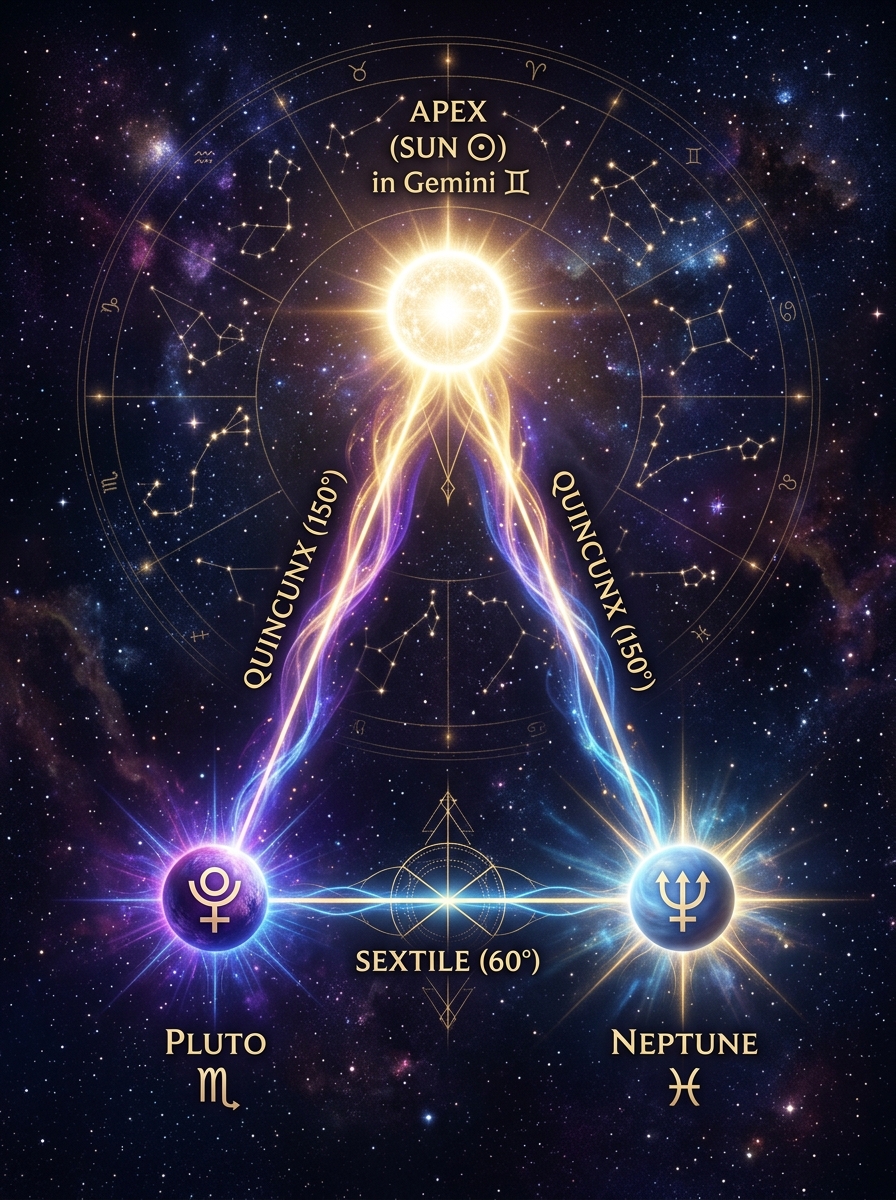
Introduction to the Yod: The Geometric Finger of Destiny
The study of astrology is fundamentally a study of geometry, light, and resonance. While individual planetary placements and singular aspects speak to specific facets of the psyche, aspect patterns reveal the overarching architecture of our evolutionary journey. Among these patterns, few evoke as much mystique, fascination, and occasional trepidation as the Yod. Popularly referred to in modern astrological circles as the "Finger of God" or the "Finger of Fate," the Yod is a rare, complex, and highly sensitive configuration that demands deep attention. It is a configuration that does not permit mediocrity or complacency; instead, it acts as a cosmic tuning fork, vibrating with a constant, pressing call toward spiritual alignment, psychological integration, and life-altering adjustments.
Visually, when mapped onto a natal chart wheel, the Yod forms a distinct, elongated isosceles triangle that resembles a celestial arrow or a pointing finger. This shape is created by the precise configuration of three planets. At the base of this triangle are two planets in a cooperative sextile aspect, separated by approximately 60 degrees. Both of these base planets project inward, forming a pair of challenging quincunx aspects (each approximately 150 degrees) toward a third planet, which sits at the apex. This apex planet acts as the focal point, bearing the concentrated energy of the entire configuration. The resulting geometry is an uneven, asymmetrical distribution of cosmic forces that creates a unique psychological tension within the native's experience.
The Anatomy of a Celestial Arrow
Historically, the recognition of the Yod as a distinct and powerful aspect pattern gained prominence in the early to mid-20th century, largely championed by pioneering astrologers such as Dane Rudhyar and Marc Edmund Jones. In Hebrew, the word Yod (י) is the tenth letter of the alphabet, representing the creative hand, the starting point of divine manifestation, and the spark of spirit. In the context of natal astrology, the naming is highly appropriate. The Yod operates as an indicator of an unavoidable calling or a specialized destiny. It is a pattern that suggests the individual has arrived at this lifetime with a highly specific, predetermined evolutionary task that cannot be ignored without experiencing significant internal friction.
To comprehend the Yod, one must look closely at its structural components. The sextile base provides a reservoir of talent, harmony, and cooperative capability. These two planets communicate easily, finding common ground and offering the individual a set of natural abilities or resources. However, because they are oriented toward the apex planet through the sharp, discordant angle of the quincunx, this harmonious base cannot simply rest in its comfort zone. The apex planet stands as a foreign entity, demanding that the talents of the base be synthesized and put to work in service of a higher, often inscrutable purpose.
Rather than a simple flow of energy, the Yod acts like a psychological lens, focusing light through a prism to a single, intense point. The native often spends the first half of their life feeling the pressure of this point without fully understanding where it originates. It is only through repeated crises, profound self-reflection, and radical shifts in consciousness that the true nature of the Yod begins to reveal itself, transforming from an erratic source of anxiety into a refined instrument of destiny. The pointing finger does not merely indicate a direction; it commands the native to stand upright, take ownership of their contradictions, and direct their life force toward a singular, transformative goal.
Mechanics of the Aspect Pattern: The Apex and the Sextile Base
To fully decode the behavior of a Yod, we must isolate its mechanical components and examine how they interact. The configuration is a study in structural polarity: it couples the supportive, open-ended potential of a sextile with the grating, disjointed adjustments required by two quincunxes. It is this specific combination that prevents the native from remaining static. The energy must move, but the path it takes is rarely straightforward.
The sextile base represents the psychological foundation of the Yod. Composed of two planets located 60 degrees apart, this aspect is traditionally associated with opportunity, ease of communication, and latent talent. Because they belong to compatible elements (either Fire and Air, or Earth and Water), these two planets share a common language. They represent areas of life where the native possesses natural gifts, intellectual curiosities, or emotional resources. For example, a sextile between Mercury in Gemini and Venus in Leo offers a fluid capability for creative expression, charismatic communication, and social charm. This base is comfortable, functioning as a cooperative alliance within the psyche.
However, the apex planet, situated 150 degrees away from both base planets, disrupts this harmony. The apex is the "receiver" of the configuration, the target toward which the cooperative energy of the base is directed. But because the relationship between the base and the apex is defined by the quincunx, this reception is far from smooth. The apex planet represents a part of the self that feels fundamentally alienated from the talents of the base. It is the focal point of the pressure, the crucible in which the individual is forced to forge something entirely new.
Element and Modality Incompatibility in the Quincunx
To understand why the quincunx aspect (also known as the inconjunction) creates such immense psychological tension, we must look at the building blocks of astrology: elements and modalities. Major aspects (conjunctions, sextiles, squares, trines, and oppositions) connect signs that share some structural relationship. Trines connect signs of the same element; squares connect signs of the same modality; oppositions connect signs of the same polarity.
The quincunx, however, connects signs that share absolutely nothing in common. They are of different polarities (masculine/feminine), different elements (Fire, Earth, Air, Water), and different modalities (Cardinal, Fixed, Mutable). For instance, if the apex planet is in Scorpio (Fixed Water) and the base planets are in Aries (Cardinal Fire) and Gemini (Mutable Air), the Scorpio apex has no common ground with either Aries or Gemini. Water does not understand the fiery impulsiveness of Aries, nor does it relate to the detached, intellectual curiosity of Gemini. Scorpio demands depth, psychological intimacy, and emotional truth, while Aries wants action and Gemini wants variety.
This absolute lack of common ground creates a state of perpetual misalignment. The planets involved cannot see each other; they operate in different dimensions, speaking entirely different languages. The native experiences this as a constant need to adjust, shift, and recalibrate. It is the feeling of trying to run a complex software program on an incompatible operating system. The energy cannot be integrated easily, leading to a sense of fragmentation, as if different parts of the personality are operating in silos, occasionally colliding in confusing ways. The apex planet, standing alone at the tip of the Yod, bears the brunt of this confusion, often feeling isolated, misunderstood, or hyper-sensitive to external stimuli.
The interaction within the Yod is therefore one of unequal partnership. The sextile base planets try to offer their gifts, but their methods are rejected or misconstrued by the apex. Conversely, the apex demands that its deep needs be met, but the base planets do not know how to satisfy those demands without undergoing a complete transformation of their own natures. This creates a psychological feedback loop where the individual feels driven to express the apex planet, but is repeatedly forced back to the base to refine, adapt, and adjust their tools before attempting to express the apex again.
The Evolutionary Calling: Karmic Themes and Psychological Individuation
In the realm of evolutionary astrology, as articulated by thinkers like Steven Forrest and Dane Rudhyar, the Yod is rarely viewed as a random configuration. Instead, it is understood as a profound karmic signature, a blueprint of a soul that has committed to a rapid, intense period of development. The Yod represents a turning point in the soul’s evolutionary narrative—a lifetime designed around a specific crisis of consciousness that forces the integration of disparate psychological parts.
From a Jungian perspective, the Yod is an engine of individuation. Carl Jung described individuation as the process by which an individual becomes their true, whole self, integrating both the conscious ego and the unconscious elements of the psyche. The apex planet of a Yod often represents a significant portion of the shadow self. Because its energy is so difficult to access via the comfortable pathways of the base, the native frequently projects the qualities of the apex planet onto the outer world. They may perceive the apex themes as external threats, societal pressures, or recurring patterns of victimization.
For example, an individual with Saturn as the apex of a Yod may initially experience Saturnian energy—structure, authority, limitation, and responsibility—as an oppressive external force. They may encounter domineering bosses, restrictive institutional systems, or sudden blockages that seem to thwart their personal freedom. In psychological terms, this is the shadow projected outward. The individual is being forced to confront their own inner authority, their own need to build structure and accept responsibility. The crisis continues to repeat, often with increasing intensity, until the native ceases projecting and begins the painful, necessary work of integrating Saturnian authority into their own psyche.
The Compulsive Nature of the Apex Integration
The drive toward integration within a Yod is characterized by a distinct sense of compulsion. The native feels drawn toward situations, careers, or relationships that force them to grapple with the apex planet. It is as if an unseen hand—hence the "Finger of God" moniker—is constantly nudging, pushing, or pulling the individual toward a specific destiny. This is not destiny in a fatalistic, pre-determined sense where choice is eliminated; rather, it is an evolutionary gravity. The soul has set up a structural necessity for growth, and the ego must eventually yield to this deeper requirement.
Liz Greene, in her extensive work on psychological astrology and the outer planets, emphasizes that the Yod requires a willingness to sit with discomfort. Because the quincunxes prevent easy resolution, the individual cannot rely on simple compromises. They must undergo a series of psychological deaths and rebirths. The old way of operating, represented by the unintegrated base and apex, must be dismantled. The native must learn to hold the tension of opposites—allow Aries to be bold and Gemini to be curious, while simultaneously honoring the deep, transformative demands of the Scorpio apex.
This evolutionary process is not a smooth, linear progression. It is characterized by sudden jumps, periods of intense incubation, and sudden realizations. The native may feel as though they are wandering in a desert, trying to solve a puzzle with missing pieces, until a sudden transit or event brings the entire pattern into focus. The evolutionary calling of the Yod is ultimately about alchemy: taking the base metals of the sextile and, through the intense pressure of the apex inconjunctions, transmuting them into the gold of a fully realized, integrated self.
The Methodological Debate: Classical Inconjunction vs. Modern Psychological Astrology
Within the astrological community, the Yod has been the subject of significant methodological debate, illustrating the philosophical divide between traditional, Hellenistic approaches and modern, psychological or evolutionary systems. To navigate this debate effectively, one must understand how the perception of the quincunx has evolved over the centuries, and why strict mathematical guidelines are crucial when identifying this pattern in a birth chart.
In classical astrology, particularly the Hellenistic and Medieval traditions, the quincunx was not considered an aspect at all. The traditional aspect system, formalised by Ptolemy, was based on the signs that could "behold" one another. Signs that shared a relationship of sextile, square, trine, or opposition were seen as connected, while signs separated by 150 degrees (or 30 degrees) were considered inconjunct or in aversion. Aversion meant that the planets in those signs could not see each other; they were blind to one another’s presence and could not cooperate. In traditional practice, this blindness was often associated with illness, sudden disruptions, or a lack of support, as the planets were unable to form a coherent relationship.
Modern psychological astrology, beginning in the early 20th century, reframed these "minor" aspects. Astrologers like Marc Edmund Jones and Dane Rudhyar recognized that the very lack of visibility in the quincunx created a unique, internal, psychological friction that was highly relevant to modern human development. Instead of viewing aversion as a purely negative or disruptive phenomenon, they saw it as a catalyst for internal adjustment. In a world where psychological growth and self-actualization are prioritized, the constant, subtle irritation of the quincunx became recognized as a powerful tool for driving consciousness forward. Johannes Kepler's introduction of minor harmonic aspects in the 17th century laid the groundwork for this shift, but it was the modern psychological movement that fully elevated the Yod to its current status as a major interpretive configuration.
Setting the Boundaries: Orb Tolerances and Mathematical Precision
Because the Yod relies on the delicate balance of two quincunxes and a sextile, mathematical precision is paramount. In modern astrology, it is easy to fall into the trap of using overly wide orbs, which can lead to the false identification of Yods. When orbs are too generous, the distinct geometric tension of the pattern is diluted, and the resulting interpretation loses its psychological accuracy.
Most professional astrologers who specialize in aspect patterns advocate for strict orb guidelines:
| Aspect | Exact Angle | Recommended Orb | Maximum Permitted Orb |
|---|---|---|---|
| Sextile (Base) | 60° | 2° to 3° | 4° (Only with Luminary involvement) |
| Quincunx (Apex) | 150° | 2° to 2.5° | 3° (Strict maximum limit) |
If the orbs exceed these limits, the configuration should not be classified as a true Yod. For example, if a planet at 10° Aries is sextile a planet at 15° Gemini (a 5° orb), and both are inconjunct a planet at 12° Scorpio (forming quincunxes of 2° and 3° respectively), the structural integrity of the Yod is highly compromised. The farther the aspects drift from exactness, the less the individual will experience the focused, compulsive pressure of the pointing finger. Instead, they will experience independent, occasional periods of adjustment related to the individual planets, rather than a singular, cohesive evolutionary calling.
Furthermore, there is ongoing debate regarding which astrological points can form a Yod. While some modern software programs automatically draw Yods involving the Ascendant, Midheaven, Chiron, or the Lunar Nodes, classical and strict modern astrologers agree that a true Yod must involve three active planetary bodies. Calculated points like the Ascendant or Midheaven do not emit energy; they receive it. While they can act as sensitive trigger points, they do not possess the psychological agency required to function as the base or the apex of a major evolutionary configuration. Without three true planets, the dynamic tension of mutual adjustment is absent, and the pattern behaves more like a personal vulnerability than a driven evolutionary calling.
Activating the Finger of Fate: Transits, Progressions, and the Release Point
A natal Yod can remain dormant for significant periods, manifesting only as a vague, undercurrent of restlessness or a persistent feeling of being "unready" for some unspecified task. The pattern requires activation. Just as a musical instrument must be struck to produce a sound, the Yod must be touched by transits and progressions to release its latent potential and initiate its major evolutionary chapters.
The primary triggers for a Yod are the transits of the slower-moving outer planets (Saturn, Uranus, Neptune, and Pluto) or major progressed aspects involving the Sun, Moon, or personal planets. When a transiting planet makes a conjunction, opposition, or square to the apex planet of the Yod, the psychological pressure reaches a critical threshold. The native is forced to confront the accumulated tension of the inconjunctions. These periods are marked by significant life choices, external crises that demand immediate adaptation, and internal breakthroughs that reorient the individual’s path.
Particularly critical is the concept of the Reaction Point or Release Point. This is the mathematical degree directly opposite the apex planet, sitting at the midpoint of the sextile base. If the apex planet is at 15° Scorpio, the release point is at 15° Taurus. Visually, the release point forms the empty space opposite the tip of the arrow, creating a temporary opposition configuration when occupied.
The Release Point: Navigating the Opposition Space
The release point serves as a vital psychological exit valve. Because the apex planet is under constant, dual pressure from the base, the energy can build up to unhealthy levels, manifesting as physical stress, anxiety, or compulsive behaviors. The release point provides the grounding mechanism that the Yod naturally lacks. It represents the quality and the area of life where the native can find balance and project the integrated energy of the configuration.
When a transiting planet passes through this release point, it temporarily completes a pattern known as a Boomerang. The transiting planet acts as a bridge, pulling the energy away from the hyper-focused apex and forcing the native to look at the opposite perspective. For instance, if the apex is in the 8th house of deep psychological transformation, joint resources, and intimacy, the release point will fall in the 2nd house of personal values, self-worth, and material security.
During a transit to the release point, the individual is encouraged to step back from the intense, obsessive focus of the 8th house and ground themselves in the simple, tangible realities of the 2nd house. They are reminded of their own value, independent of others' resources or psychological dramas. This shift in perspective often provides the clarity needed to resolve the long-standing tension of the Yod, allowing the native to return to the apex with a renewed sense of stability and purpose. Without utilizing the release point, the native risk burning out under the constant, unrelenting heat of the apex's demands.
In addition to transits, progressions serve as long-term internal cycles. When the progressed Sun, Moon, or Ascendant ruler reaches the exact degree of the apex planet, the native enters a phase of profound self-realization. These progressions act like slow-burning fuses, triggering internal adjustments that manifest as external changes over several years. During these times, the individual is often called to make choices that seem radical or irrational to others, but are felt as deeply necessary steps along their evolutionary path.
Living with a Yod: Integration, Self-Actualization, and Daily Practice
For those who carry a Yod in their natal chart, the journey toward self-actualization is not a straight line, but a spiral. It involves cycles of tension, adjustment, release, and eventual integration. Living with this pattern requires a high degree of self-awareness, patience, and a willingness to engage in deep psychological work.
The first step in working with a Yod is recognizing the cyclical nature of its expression. The native must understand that the feelings of misalignment or sudden crises are not indicators of failure or bad luck. Instead, they are evolutionary indicators, signaling that a shift in perspective is required. When a crisis occurs, rather than asking "Why is this happening to me?", the individual is encouraged to ask, "What adjustment is this situation demanding of my apex planet? How can I use the talents of my base planets to support this change?"
Practically, this involves working consciously with the planets involved, paying close attention to whether the apex is a personal or an outer planet:
- When the Apex is an Inner Planet (Sun, Moon, Mercury, Venus, Mars): The tension is deeply personal and felt daily. It affects the core ego, emotional safety, communication, relational patterns, or drive. The native must focus on conscious self-awareness, ensuring that they do not project their own personal needs onto their environment. They must do the heavy lifting of adjusting their personal habits to accommodate the complex requirements of the Yod.
- When the Apex is an Outer Planet (Jupiter, Saturn, Uranus, Neptune, Pluto): The pressure is collective, generational, and spiritual. The native feels caught in historical currents or larger evolutionary waves. Here, the work is about aligning the personal self with a higher power or cosmic principle. It requires letting go of the ego's desire to control the outcome and becoming a clean channel for the archetype represented by the outer planet.
- Audit the Base: Identify the two planets in sextile. What are their strengths? How can you deliberately cultivate their talents? If they are Mercury and Venus, make time for creative expression, writing, and deliberate social engagement. Ensure this foundation is healthy and active.
- Deconstruct the Apex: Examine the apex planet without judgment. What does it represent? If it is Mars, are you repressing your anger, or are you expressing it constructively? If it is Neptune, are you escaping reality, or are you channeling your imagination into art or spirituality?
- Locate the Release Point: Find the sign and house opposite your apex planet. Cultivate the qualities of this sign as a daily practice. If the release point is in Virgo, practice organization, physical self-care, and practical service to others. This acts as a stabilizer for the entire psyche.
Ultimately, the Yod is a gift of specialization. It is not a configuration for a simple, uncomplicated life, but for a life of profound meaning and impact. By holding the tension of the quincunxes and actively working to integrate the discordant energies, the native transforms the "Finger of God" from a source of fate-driven anxiety into a conscious instrument of destiny. They become capable of offering the world a unique perspective, bridging gaps that others cannot see, and embodying the true potential of evolutionary growth.
Frequently Asked Questions About Yod Astrology
Can a Yod include points like the Ascendant, Midheaven, or Lunar Nodes?
In strict astrological methodology, a true Yod must be composed of three planets. Calculated points such as the Ascendant, Midheaven, or Lunar Nodes do not possess the psychological agency or energy-emitting capacity of planetary bodies. While these points are highly sensitive and can act as trigger spots when they occupy the apex or release point of a Yod, they cannot form the foundational structure of the pattern itself. If you have a configuration where the Ascendant is the apex and two planets form the sextile base, it is highly sensitive, but it is technically classified as a "Yod-like configuration" rather than a true Yod, as the Ascendant cannot actively project energy back to the base.
What happens if I have multiple Yods in my natal chart?
Having multiple Yods in a single natal chart is extremely rare and indicates a highly complex, specialized incarnation. When multiple Yods exist, they often share planets, creating an interconnected web of tension and adjustment. This configuration suggests that the individual's life will be characterized by intense evolutionary pressure, with multiple areas of life requiring constant recalibration. The key to navigating multiple Yods is to locate the common denominators—the planets that participate in more than one pattern. Working to integrate these shared planets will have a cascading, positive effect on the entire chart, helping to resolve multiple areas of tension simultaneously.
Is a Yod inherently negative or representative of bad karma?
No. In modern evolutionary and psychological astrology, no aspect pattern is viewed as inherently negative or indicative of "bad" karma. The Yod is challenging because it requires constant adjustments and sits outside the ease of traditional major aspects. However, this challenge is designed to spur growth, not to punish. The concept of "karma" in this context is best understood as evolutionary momentum. The soul has chosen a path of rapid development, and the Yod provides the necessary structural tension to make that development possible. It is a signature of potential mastery and deep spiritual calling, not of misfortune.
How can I tell the difference between a Yod and a Golden Yod?
While a standard Yod is composed of a sextile (60°) base and two quincunxes (150°) pointing to an apex, a Golden Yod is a different, though structurally similar, configuration based on the quintile harmonic series. A Golden Yod consists of a quintile (72°) base and two biquintiles (144°) pointing to an apex planet. While both patterns form a similar triangular shape on the chart wheel, they operate differently. The standard Yod is associated with crisis, adjustment, and evolutionary pressure, whereas the Golden Yod is associated with latent creative talents, unique gifts, and a natural, self-actualizing genius that flows more easily once recognized.
How do I find the midpoint of the sextile base and why does it matter?
To find the midpoint of the sextile base, calculate the exact mathematical degree that sits halfway between the two base planets. For example, if Planet A is at 10° Aries and Planet B is at 10° Gemini, the midpoint sits at 10° Taurus. The degree directly opposite this midpoint—in this case, 10° Scorpio—is where the apex planet must sit to form a perfect Yod. The midpoint of the base is significant because it represents the point of maximum integration between the cooperative energies of the base. It is the anchor point of the sextile, and any transits to this degree will simultaneously activate both base planets, providing a powerful opportunity to strengthen the foundation of your Yod.
Comments
Loading comments…