The Grand Cross: Mastering the Sacred Geometry of Astrological Tension
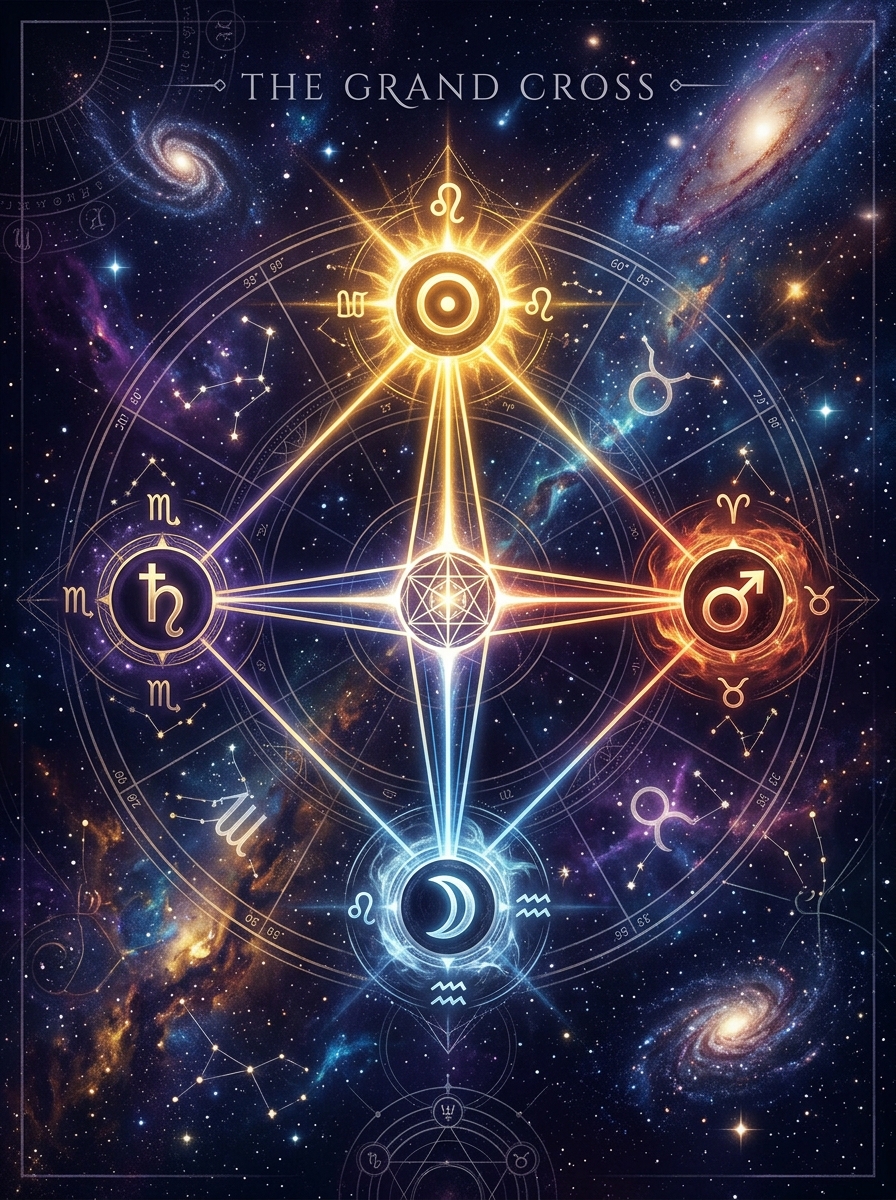
The Sacred Geometry of Celestial Tension: Understanding the Grand Cross
To look at a birth chart containing a Grand Cross is to gaze directly into a cosmic blueprint of high-voltage wiring. In the lexicon of psychological and esoteric astrology, few configurations command as much respect, or evoke as much apprehension, as this symmetrical web of planetary tension. The Grand Cross is not merely an aspect; it is a complete structural architecture of the psyche, a four-pointed mandala of conflicting urges that demands integration. Geometrically, it is formed when four or more planets occupy points of equal division along the 360-degree zodiacal wheel, creating a perfect square. This shape is composed of two oppositions (180 degrees apart) intersecting each other at right angles, which in turn generates four mutual squares (90 degrees apart). It is a closed system of maximum friction, where every planet involved is locked in a perpetual state of dynamic checkmate.
The Mechanics of the Cross: Two Oppositions and Four Squares
To understand the energetic current of the Grand Cross, we must first break down its component parts. An opposition is an aspect of relationship and polarization. It represents a tug-of-war between two opposing signs, where the conscious mind tends to identify with one end of the axis while projecting the other onto the outer world. In a Grand Cross, we have two such axes of polarization operating simultaneously, intersecting each other. For example, if one axis runs from Aries to Libra, representing the struggle between self-assertion and relational harmony, the second axis might run from Cancer to Capricorn, representing the tension between domestic emotional security and public, professional ambition. The squares, on the other hand, represent blockages, turning points, and crises of action. They are the friction points that prevent the oppositions from finding an easy compromise. When the Aries-Libra axis tries to resolve its polarity, the Cancer-Capricorn axis exerts a pull of its own, forcing the individual to account for emotional roots and structural duties. The result is a four-way pull where no single planet can express itself without immediately triggering the resistance of the other three. It is an intricate web of checks and balances that keeps the psyche in a state of constant alertness.
The Visual and Energetic Mandala: Drawing a Perfect Square
From a visual standpoint, the Grand Cross is one of the most striking patterns in a birth chart, appearing as a perfect square with an internal cross connecting the opposite corners. Historically, the square has always been the symbol of the material world, representing the four elements, the four directions, and the physical container of reality. In Western esoteric traditions, the cross represents the descent of spirit into matter—the horizontal axis representing the horizon of human experience and relationship, and the vertical axis representing the meridian of spiritual aspiration and earthly manifestation. The Grand Cross is the literal embodiment of this intersection. Unlike the flow of trines and sextiles, which represent the smooth, unconscious distribution of energy, the Grand Cross is a high-pressure system. It represents a soul that has signed up for a crash course in structural integrity. As Liz Greene has noted, the square forces consciousness to crystallize through struggle; without the resistance of the square, the ego remains soft, and the soul's potential remains dormant. The Grand Cross represents the absolute concentration of this developmental friction, compelling the native to build an exceptionally strong psychic container to withstand the pressure.
Steven Forrest notes that while trines represent gifts we take for granted, squares represent the muscles we must build in every dimension. The oppositions act as mirrors, reflecting the projection of our disowned qualities, while the squares act as roadblocks, demanding course corrections. This feedback loop means the individual cannot afford to live unconsciously. If they ignore one planet, the environment will present them with a crisis. For instance, if the Sun is involved, identity is bound up in this struggle; if the Moon, emotional equilibrium is recalibrated. This intense tension led early astrologers to label the configuration malefic. They saw only external crises and pressure, failing to realize that this friction is the very mechanism through which the unrefined personality is transmutated into the gold of the integrated self. The Grand Cross is not a prison; it is a laboratory of consciousness designed to produce spiritual resilience.
The Grand Cross vs. The T-Square: Why the Lack of an Escape Point Creates an Alchemical Crucible
To appreciate the Grand Cross, we must contrast it with the T-Square. The T-Square consists of two planets in opposition, both making a square to a third planet (the apex), leaving one quadrant empty. The T-Square is dynamic and action-oriented because it has a built-in relief valve. The energy of the opposition flows toward the apex planet, and the empty space opposite the apex serves as an escape point where tension can be projected. An individual with an apex in the Tenth House might dump their internal tension into career ambition to escape personal conflicts. The empty Fourth House represents the developmental task they avoid, using their career as an outlet.
The Apex Escape of the T-Square: A Temporary Relief Valve
This relief valve makes the T-Square highly productive. Many high-achievers possess T-Squares because this frustration drives them to take action. However, this escape route can function as an avoidant mechanism, allowing the individual to flee deeper polarities. The T-Square allows for lopsided development, where one area is hyper-emphasized. It is an unstable structure that keeps tipping, forcing the person to run back and forth between the apex and the empty house. While this creates a dynamic life, it does not guarantee integration, as the individual constantly seeks external avenues to discharge their internal current.
The Grand Cross as a Closed Loop: Continuous Friction and Self-Containment
In contrast, the Grand Cross is a closed loop. There is no empty space to project tension, and no single apex planet to act as a spokesperson. All four quadrants are occupied, and all four planets are of equal strength, pulling against one another. If the native focuses entirely on career, the domestic sphere demands attention; if they focus on relationships, identity and health undergo a crisis. There is no escape point, no back door, and no place to hide. This lack of a relief valve makes the Grand Cross feel claustrophobic in early life. The individual feels squeezed from all sides, locked in gridlock where every move triggers an equal and opposite reaction.
However, this lack of an escape route makes the Grand Cross a supreme alchemical crucible. In Western esoteric philosophy, alchemy is the art of spiritual transformation, symbolized by heating base metals in a sealed vessel until they dissolve and reform in a higher state of purity. The Grand Cross is that sealed vessel. Because tension cannot be discharged into external distractions, it is forced inward. The energy circulates within the boundaries of the cross, heating the psyche, breaking down rigid ego-structures, and forcing the individual to seek self-awareness. As Aleister Crowley wrote, the purification of the spirit requires intense, controlled heat within a closed container. The Grand Cross native is forced to endure this heat, not as a punishment, but as a phase of spiritual refinement. This friction grinds away superficial layers of the personality, forcing the individual to discover a center of gravity independent of external circumstances.
Psychological Integration and the Path of Individuation: Jungian Mandalas and Balancing the Four Functions of Consciousness
The psychological journey of the Grand Cross is best understood through Jung's concepts of the mandala and the four functions of consciousness. Jung observed that in moments of intense transformation, his patients spontaneously drew circular patterns divided into four sections—mandalas. He realized that the mandala is an archetype of wholeness, representing the Self striving for integration amidst chaos. The four points of the mandala correspond to the four directions, the four seasons, and the four functions of human consciousness: Thinking, Feeling, Sensation, and Intuition.
The Grand Cross as a Jungian Mandala of the Self
In the birth chart, the Grand Cross is a literal cosmological mandala. It represents the blueprint of the Self, divided into four distinct planetary centers of intelligence. Each planet represents a different drive that must be given equal voice. The Grand Cross native cannot be satisfied with partial development. A person with a harmonious chart can often get by by developing only one or two functions—for instance, becoming highly intellectual (Thinking) while letting their emotional life (Feeling) remain primitive. The Grand Cross native does not have this luxury. If they overdevelop intellect, repressed feelings will erupt through the other leg of the cross. The configuration demands that all four corners of the square be integrated.
Balancing the Four Functions: Sensation, Intuition, Thinking, and Feeling
To achieve integration, the individual must balance Jung's four functions, which map onto the astrological quadrants. The horizontal axis of the cross corresponds to the relational functions (Thinking and Feeling), while the vertical axis corresponds to the orienting functions (Sensation and Intuition). Sensation anchors the individual in the physical world, dealing with concrete facts, somatic reality, and sensory experience. Intuition opens the door to the unconscious, perceiving possibilities, symbols, and future potentials. Thinking provides the analytical structure, categorizing and conceptualizing the world objectively. Feeling provides the evaluative framework, determining value, meaning, and personal significance.
In a Grand Cross, these four functions are in conflict. Sensation (Saturn or a Taurus planet) demands physical realism, while Intuition (Jupiter or a Sagittarius planet) demands expansion. Meanwhile, Thinking (Mercury or Gemini) argues for logic, while Feeling (Venus or Cancer) pleads for emotional connection. Individuation is the journey of moving from the outer edge of the cross—where we are buffeted by the opposing winds of these functions—to the absolute center. At the center, the four functions are not eliminated; they are held in dynamic suspension. The ego ceases to identify with any single function and stands at the intersection, witnessing the interplay of all four. This center point is what Jung called the Self. The Grand Cross is a direct highway to individuation. Its conflicts prevent the native from remaining stuck in a one-sided ego state, forcing them to integrate the shadow and find centered wholeness.
Liz Greene notes that the planets in a Grand Cross often represent facets of the family shadow or ancestral patterns passed down to the individual. Each planet represents a voice in the family system that was ignored or repressed. In the native's life, these voices are loud and in conflict. Integration requires the native to act as an archetypal mediator, listening to each voice without letting any single one take over. When the individual learns to sit with the discomfort of these conflicting inner voices, a third thing—what Jung called the transcendent function—begins to emerge. This is a new level of consciousness arising from the tension of opposites, a creative synthesis that allows the individual to live with complexity. The Grand Cross, which once felt like a crucifixion, is revealed to be a crown of psychological maturity.
The Three Expressions: Cardinal, Fixed, and Mutable Grand Cross Dynamics in the Birth Chart
The way a Grand Cross operates depends heavily on its modality. Modalities—Cardinal, Fixed, and Mutable—describe the ways energy moves in the universe. A Grand Cross aligns within a single modality, meaning all four planets are in signs of that same modality. This concentrates the characteristic behavior of that modality, creating distinct psychological types and life challenges.
The Cardinal Grand Cross: The Crisis of Action and Initiative
The Cardinal Grand Cross is composed of planets in Aries, Cancer, Libra, and Capricorn. Cardinal energy is initiatory and dynamic, representing beginnings and leadership. Structured as a Grand Cross, this energy creates a life characterized by action, ambition, and repeated crises of direction. The native is driven to build and initiate, but is pulled in four different directions. The Aries planet demands personal freedom. The Libra planet demands relationship harmony. The Cancer planet demands emotional safety and family focus. The Capricorn planet demands professional success and disciplined authority.
This creates a dilemma: how to pursue personal goals without destroying relationships, and how to achieve career success without neglecting the home. The native often feels like a charioteer trying to control four wild horses running in opposite directions. In early life, this manifests as sudden starts and stops. They may throw themselves into career, only for a relational crisis to drag them back, or focus on domestic life until a desire for personal achievement disrupts their peace. Integration lies in realizing that action does not have to be reactive. By centering themselves, they can use the initiatory power of this configuration to manage complex, multi-faceted projects without burning out.
The Fixed Grand Cross: The Battle of Willpower and Resistance to Change
The Fixed Grand Cross comprises planets in Taurus, Leo, Scorpio, and Aquarius. Fixed energy is stabilizing and resistant to change, representing willpower and endurance. Configured as a Grand Cross, it presents struggles with inertia, gridlock, and deep-seated blockages. The Taurus planet clings to physical comfort and material predictability. The Scorpio planet demands psychological depth and death-and-rebirth transformation. The Leo planet seeks creative expression and ego recognition. The Aquarius planet demands objective detachment and intellectual freedom.
This creates an internal stalemate. The individual has an capacity for focus, but can become locked in a battle of wills. They may cling to an outdated situation out of fear, even as Scorpio demands they burn it to the ground. They may want to shine as a creator, yet feel paralyzed by the Aquarian demand to serve the collective. Because fixed signs are connected to security, the native experiences tension as somatic pressure. They can be stubborn, refusing to budge even when a situation is toxic. The key to integration is learning to surrender, realizing that true strength is not rigid resistance, but the ability to flow. Once integrated, the Fixed Grand Cross becomes a reservoir of creative power, determination, and stamina.
The Mutable Grand Cross: The Dissolution of Boundaries and Overwhelm of Adaptability
The Mutable Grand Cross is composed of planets in Gemini, Virgo, Sagittarius, and Pisces. Mutable energy is flexible and fluid, representing learning and dissolution. Arranged in a Grand Cross, this energy manifests as mental overwhelm, distraction, and a lack of boundaries. Gemini wants to gather information and communicate. Sagittarius seeks philosophical meaning and travel. Virgo demands practical utility and organization. Pisces longs for spiritual transcendence and the dissolution of boundaries.
The native is sensitive and intellectually brilliant, but constantly flooded with ideas and emotional currents. They struggle to find a stable center because they see all sides of every issue. In early life, this can lead to aimlessness, indecision, and fragmentation. They may become intellectual nomads, moving from one philosophy to another, or get lost in details to avoid cosmic sorrow. Unlike the Fixed Cross, the Mutable Cross changes too quickly, dispersing its energy. To integrate this pattern, the native must cultivate grounding and boundaries, learning to say 'no' to distractions. When grounded, the Mutable Grand Cross becomes a source of wisdom, intelligence, and empathy, enabling them to bridge different worlds.
The Evolutionary Legacy of the Grand Cross: Rewriting the Narrative of Karmic Burden
In classical astrological texts, the Grand Cross was often treated as a dark omen—a sign of a difficult, cursed life filled with unavoidable suffering and tragedy. Traditional delineations focused heavily on the outer events: broken relationships, professional ruin, physical illnesses, and sudden losses. However, modern psychological and evolutionary astrology has completely rewritten this narrative. Astrologers like Steven Forrest and Liz Greene have helped us understand that a birth chart is not a static sentence of fate, but a map of the soul's evolutionary intentions. From this perspective, a Grand Cross is not a cosmic punishment, but a sign of a highly advanced soul that has chosen an accelerated path of development.
The concept of karma, when stripped of its moralistic associations of reward and punishment, simply means action and the energetic momentum of past experiences. A Grand Cross indicates that the soul has reached a critical evolutionary junction. In previous lifetimes, or in the ancestral lineage, different parts of the psyche were developed in isolation. In this lifetime, all these separate threads are brought together into a single, high-tension field so they can be integrated. The friction of the Grand Cross is the friction of the soul waking up. It is as if the universe has turned up the volume on the native's internal conflicts so they can no longer ignore them. The suffering associated with the configuration is not meaningless; it is the labor pain of a new level of consciousness trying to be born.
Furthermore, the Grand Cross provides an extraordinary amount of creative and spiritual drive. The individuals who make the most significant contributions to human culture, science, and art are rarely those with smooth, easy charts. Easy charts often lead to complacency; when there is no internal tension, there is no motivation to create, build, or question the status quo. The Grand Cross native, driven by a constant search for balance, is compelled to act. Their life becomes an ongoing laboratory where they must test new ways of living, thinking, and being. The tension of the cross is the very fuel that powers their achievements. When we study the charts of historical figures who transformed their fields, we repeatedly find Grand Crosses and T-squares. These individuals did not succeed in spite of their charts, but because of them. They learned to harness the raw power of their planetary conflicts and channel it into constructive, evolutionary work.
To rewrite the narrative of the Grand Cross is to recognize it as a supreme gift. It is an invitation to step out of the reactive cycle of egoic drama and step into the role of the conscious creator. The native is not a victim of their planetary alignments, but an active participant in a cosmic dance of integration. The cross is a crucible, yes, but it is also a launchpad. By embracing the challenges of the configuration with curiosity and courage, the individual can transform their life from a series of exhausting crises into a masterpiece of spiritual evolution and self-mastery.
Esoteric astrology suggests that the ego must be crucified on the cross of matter before the spiritual self can be fully realized. This does not mean physical self-harm or ascetic denial; rather, it refers to the dismantling of the rigid, defensive ego-structures that keep us separate from our deeper nature. The four planets of the Grand Cross act as four pillars of a temple. If one pillar is too weak, the roof collapses. The individual is forced to strengthen all four pillars, which means developing psychological maturity, emotional literacy, intellectual clarity, and physical presence. This is a monumental task, and it is why the first half of life for a Grand Cross native is often so challenging. They are building the infrastructure of a temple that can hold an immense amount of spiritual light. Once the foundation is secure, the energy that once caused crisis begins to flow as a steady, luminous current of wisdom. The karmic burden is revealed to be a sacred contract, a pre-natal agreement to serve as a grounding wire for cosmic evolution.
Embracing the Center: Practical Ways to Navigate Life with a Grand Cross and Channel its Creative Energy
Living with a Grand Cross requires a shift in perspective: from identifying with the warring planets at the outer edges of the wheel to finding the still point at the center of the cross. If you imagine the Grand Cross as a wheel with four spokes, the outer rim is constantly spinning, creating a dizzying blur of movement and conflict. If you stand on the rim, you will be thrown off balance by the centrifugal force. But if you move to the hub—the exact center where the spokes meet—you will find a place of absolute stillness and leverage. This is the psychological and spiritual task of the Grand Cross native: to live from the center.
How does one find and maintain this center in daily life? First, it requires the cultivation of the observer self or the witnessing consciousness. When a crisis erupts—such as a conflict between your professional duties and your emotional needs—the natural tendency is to panic and react from one of the planets, taking a side in the dispute. The observer self, however, does not take sides. It steps back and says: "I am experiencing a pull toward action, and I am also experiencing a pull toward rest. I contain both of these urges, but I am not defined by either of them." This simple act of disidentification immediately reduces the emotional charge and creates space for a conscious response. It allows you to hold the tension of the opposites without being torn apart by them.
Second, somatic grounding is essential, especially for those with Cardinal and Fixed Grand Crosses. Because the configuration generates high levels of nervous tension, the body can easily become locked in a state of chronic stress or fight-or-flight arousal. Practices that anchor the awareness in the physical body—such as yoga, breathwork, somatic experiencing, or walking in nature—help to discharge excess energy and calm the nervous system. When the body is grounded, the mind is less likely to spin out into anxiety or paralysis. It is particularly important to pay attention to the signs and houses of the cross; for example, if earth signs are involved, physical touch, gardening, or clean eating can be highly therapeutic, while air signs might require journaling, breath retention, or vocal expression to release pressure.
Third, creative translation is a powerful tool for integration. The tension of the Grand Cross is raw, unmanifested energy waiting for form. If it is not given a creative outlet, it will express itself destructively as external conflict or physical illness. By channeling this energy into art, writing, business, or spiritual practice, you give the planets a neutral ground where they can cooperate. For example, writing a novel allows your Mercury to analyze, your Neptune to dream, your Pluto to dig into the shadow, and your Saturn to structure the plot. The creative project becomes a mini-mandala, a container that holds the complexity of your psyche.
Finally, we must remember that the goal of the Grand Cross is not to resolve the tension permanently. In the physical universe, tension is necessary for structure and movement. A violin string cannot produce music if it is loose; it must be stretched tight between two points. The same is true of the human soul. The tension of your Grand Cross is the very thing that makes your life beautiful, dynamic, and evolutionary. You do not need to fix your cross; you need to learn how to play it like a fine instrument. By embracing the center, you transform the cross from a symbol of suffering into a key that unlocks the deepest mysteries of your own nature.
Frequently Asked Questions
Is a Grand Cross rare in a birth chart?
Yes, the Grand Cross is one of the rarest aspect patterns in astrology. It requires four planets to be positioned at specific, narrow-orb angles (90 and 180 degrees) relative to one another, aligning in signs of the same modality. Because it demands such precise geometric alignment, many charts have partial patterns—such as a T-square or a single opposition—but very few contain a complete, closed Grand Cross. Having this pattern in your chart indicates a highly specialized, intense life path focused on integration and rapid psychological growth.
What is the difference between a Grand Cross and a Grand Trine?
While the Grand Cross is a four-pointed pattern of high tension, squares, and oppositions, the Grand Trine is a three-pointed pattern of ease, flow, and trines (120-degree angles) aligning in the same element (fire, earth, air, or water). The Grand Trine represents natural talents, flow, and areas where life comes easily to the native, but it can sometimes lead to stagnation or complacency because there is no friction to drive action. The Grand Cross, conversely, is all friction and crisis, driving constant action, self-examination, and psychological growth. Ideally, a chart with a Grand Cross also contains a trine or sextile to help ease and channel the immense tension of the cross.
Does having a Grand Cross mean I am destined for a difficult life?
Absolutely not. While a Grand Cross guarantees that you will experience significant internal tension and repeated turning points or crises, it does not mean your life will be unhappy or unsuccessful. The difficulty of the Grand Cross is front-loaded; the first half of life is often spent learning how to manage the intense, competing energies. Once you develop self-awareness, grounding practices, and a strong psychological foundation, the Grand Cross becomes an engine of extraordinary productivity, wisdom, and creative power. Many of history’s most successful, resilient, and influential figures possessed this configuration.
How do transits affect a Grand Cross in my birth chart?
When a transiting planet aspects one point of your Grand Cross, it automatically triggers the other three points because they are all geometrically linked. This means that transits to a Grand Cross are experienced as major, multi-dimensional life shifts. For example, if transiting Saturn conjoins one of the planets in your cross, it will simultaneously square two of the planets and oppose the fourth. This can feel like a sudden storm where every area of your life—relationships, career, home, and identity—demands attention at once. While intense, these periods are powerful evolutionary catalysts that force you to clear out old patterns and establish a new, stronger level of integration.
Can a Grand Cross involve houses instead of planets?
An astrological Grand Cross must involve actual planets, the Ascendant, or the Midheaven to have a functional, dynamic impact on the psyche. The planets represent the active psychological drives, while the houses represent the fields of experience where those drives manifest. A configuration consisting of empty house cusps does not form a Grand Cross. However, the houses that the planets of your Grand Cross occupy will tell you exactly where the tension will play out in your life—such as the relationship axis (First/Seventh houses) or the security axis (Fourth/Tenth houses).
Comments
Loading comments…