The Void of Course Moon: A Guide to the Cosmic Pause
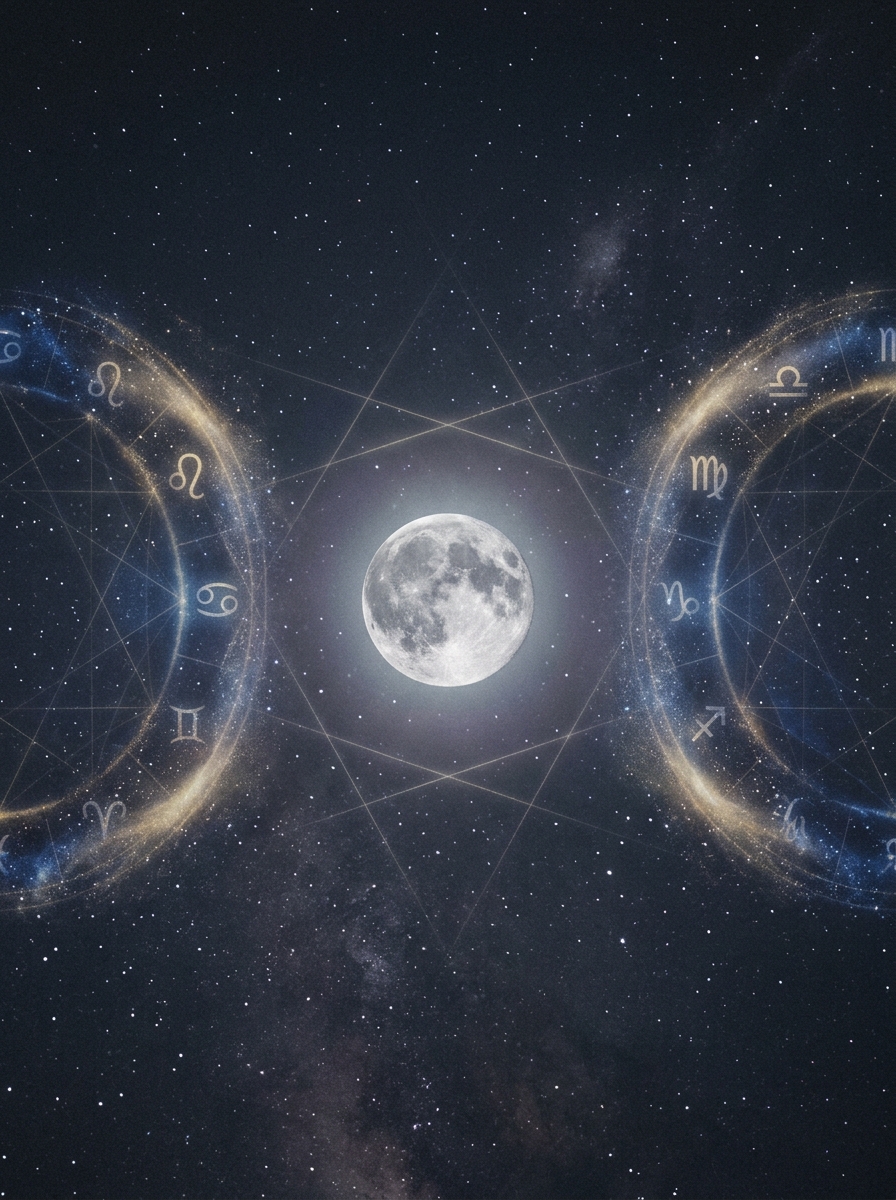
Understanding the Astrological Mechanics of the Void of Course Moon
The celestial dance of the cosmos operates on a rhythm of tension and release, aspect and integration. At the heart of this dance is the Moon, the fastest-moving body in our astrological sky, acting as the primary celestial mediator between the distant planetary archetypes and our immediate, earthly experience. Because of its swift motion, the Moon constantly forms geometric relationships, or aspects, with the other planets as it traverses the zodiac. However, there comes a point in every sign transit where this conversation falls silent. This period of quietude is known as the Void of Course (VoC) Moon.
To understand the mechanics of a Void of Course Moon, one must visualize the zodiac as a series of twelve rooms, each representing a sign. As the Moon travels through a room, it interacts with the inhabitants (the other planets) by forming major Ptolemaic aspects: the conjunction (0°), sextile (60°), square (90°), trine (120°), and opposition (180°). These aspects represent channels of energy exchange, triggering events, emotional shifts, and changes in momentum. The conjunction fuses energies together, the sextile opens doors of opportunity, the square introduces necessary friction, the trine allows resources to flow smoothly, and the opposition brings polarization and external awareness. The moment the Moon makes its final major aspect to any planet before leaving its current sign, its active communication cycle for that sign concludes. From that exact moment until the Moon crosses the cusp into the next zodiac sign, it is considered "Void of Course."
During this phase, the Moon is essentially floating in a corridor between rooms. It has said goodbye to the occupants of the room it is leaving but has not yet entered the next room to greet its new hosts. Symbolically, this represents a liminal space, a creative vacuum, or a "functional void." The cosmic current is suspended; the emotional and psychological tide that usually pulls us forward is temporarily slack. For centuries, astrologers have observed that when the Moon is in this state of transition, the energy required to project outcomes into the external world is missing. It is a period where the cosmic gears disengage, allowing the machinery of the universe to idle. The lack of planetary connection means that actions taken now lack the necessary structural support to anchor them into reality.
Traditional vs. Modern Astronomical Definitions of Lunar Aspects
The definition of what constitutes a Void of Course Moon has evolved with the development of the craft. Traditional astrology, rooted in the Hellenistic, Medieval, and Renaissance eras, calculated the void period based strictly on the Ptolemaic aspects formed with the seven visible classical planets: the Sun, Mercury, Venus, Mars, Jupiter, and Saturn. In this classical framework, outer planets like Uranus, Neptune, and Pluto did not exist, and therefore their aspects were not factored into the calculation of the Moon's void status. Traditionalists believe that only these visible spheres, which represent the concrete, physical structures of our everyday reality, can properly anchor the Moon's energy.
Modern astrologers, however, are divided on this methodology. Some argue that because Uranus, Neptune, and Pluto represent deep archetypal forces that shape our collective and individual psyches, their aspects must be included. If the Moon makes a trine to Pluto at 29 degrees of a sign, modernists would argue the Moon is not void, whereas traditionalists would claim the void began hours earlier after the Moon's last aspect to a classical planet. For the purpose of practical integration, many contemporary practitioners find that sticking to the classical seven planets provides the most reliable energetic reflection of the "functional void" in daily life, as these planetary bodies govern the visible, tangible structures of our everyday reality. When we ignore the outer planets for void calculations, we align with the visible, traditional tempo of human events.
The Historical Roots and the Traditional Rule of "Nothing Important"
The concept of the Void of Course Moon is not a modern psychological invention but a time-tested technique with deep roots in horary and electional astrology. Horary astrology—the art of answering specific questions based on the chart cast for the exact moment the question is asked—places immense weight on the condition of the Moon. In horary, the Moon represents the path of action, the flow of events, and the ultimate development of the query. If the Moon is void of course when a question is posed, it traditionally signals that the matter will not proceed, the situation will dissolve, or the querent will change their mind.
Historically, this gave rise to the Latin aphorism nihil inceptum procedet, meaning "nothing initiated will proceed." Astrologers like William Lilly, writing in his seventeenth-century masterwork Christian Astrology, noted that when the Moon is void, it is difficult for any business to go forward smoothly. The energy is akin to sowing seeds in unplowed, dry soil; the potential is there, but the environmental receptivity is completely absent. The traditional rule became clear: during a VoC Moon, avoid initiating any action that requires a successful external outcome. If you attempt to build a house, establish a partnership, or begin a journey, the foundational energy is missing, causing the endeavor to collapse under its own weight or drift off course.
This rule is based on the idea that the beginning of any project or event contains its entire lifecycle. If you start something when the Moon is disconnected from the other planets, the project itself remains disconnected from the structures of the world. It exists in an astrological vacuum. While this sounds ominous to the uninitiated, traditional astrologers did not view this as a curse, but rather as a natural law of timing. Just as a farmer does not plant crops during a frost, an astrologer does not launch a campaign when the cosmic currents are sleeping. It is a time when the universe withdraws its active participation, forcing us to rely on internal resources.
Horary Astrology and the Cosmic Null Zone
In horary charts, the Void of Course Moon is often referred to as a "null zone." When a client asks, "Will I get the job?" or "Will this real estate deal close?" and the Moon is void, the chart is frequently considered unresolvable in the affirmative. It suggests that the energy of the situation has already peaked and spent itself. The momentum has flatlined. The question itself may be moot, or the circumstances surrounding the query will change so radically that the initial question becomes irrelevant.
However, this null zone has a secondary, highly useful meaning in horary: "You have nothing to fear from the matter." If a client asks a question out of intense anxiety, such as "Will I be sued?" or "Is this rumor going to ruin my reputation?", a void Moon indicates that the threat is empty. The fears will lead to nothing, the opposing party will lose interest, or the situation will fade away without consequence. In this sense, the cosmic null zone acts as a protective shield, absorbing tension and preventing negative outcomes from solidifying. It teaches us that sometimes, the best outcome is no outcome at all.
What to Avoid: Navigating the Hazards of the Liminal Period
When the Moon is void of course, the external world operates with a strange kind of inertia. Decisions made during this time are often based on incomplete information, unrealistic expectations, or fleeting emotional states that shift the moment the Moon enters the next sign. Because the energetic foundation is unstable, certain activities are highly susceptible to complications, delays, or outright failure. Knowing what to postpone during these hours is key to working in harmony with the cosmos.
First and foremost on the list of avoidable actions is the signing of contracts and legal agreements. When you sign a contract under a VoC Moon, you are binding yourself to a set of terms in an astrological vacuum. Frequently, hidden clauses will emerge later, or the parties involved will experience a change of heart. The deal may require constant renegotiation, or it may simply fall apart entirely, leaving both sides frustrated. If you must sign a document during a void period, review it with extreme care, knowing that the terms are likely to change. The signatures applied during these hours often feel legally or energetically non-binding as the project progresses.
Similarly, launching new products, business ventures, or marketing campaigns during a void Moon is akin to shouting into a void. The reception is likely to be quiet, if not completely non-existent. The target audience may fail to notice the launch, or the product itself may suffer from unforeseen technical glitches. Key business proposals, job interviews, and high-stakes negotiations also suffer under this transit. The decision-makers may be distracted, indecisive, or unable to commit, leading to endless delays and stalemates. If you present a proposal during a void Moon, expect it to be shelved or ignored.
Major purchases should also be postponed. Whether it is a car, a house, a computer, or an expensive piece of jewelry, items bought during a VoC Moon often turn out to be sources of regret. You might find that the item has a hidden defect, that it goes on sale immediately after you buy it, or that you simply do not use it as much as you anticipated. It is a period of temporary illusions, where our desires are temporarily unanchored from practical reality. The shiny object that catches your eye during a void Moon will lose its luster the moment the Moon moves into the next sign.
Finally, booking critical travel plans or starting major journeys during a void Moon can lead to logistical headaches. While routine commuting is generally unaffected, booking flights, hotels, or rental cars during these periods often results in booking errors, missed connections, lost luggage, or unexpected delays. The itinerary you set during a VoC Moon is rarely the one you actually follow. If you must travel, verify your reservations multiple times and prepare yourself for unexpected detours.
Material Purchases and the Psychology of Remorse
The phenomenon of buyer's remorse under a Void of Course Moon has a clear psychological and astrological link. Because the Moon represents our emotional needs and our sense of security, its transit through a sign dictates what makes us feel safe and comfortable. When the Moon goes void, our connection to these needs is temporarily scrambled. We may buy an item because we feel a sudden, urgent desire to fill an emotional void, mistaking the transit's emptiness for a material need. We buy things to satisfy a hunger that cannot be sated by physical objects.
Once the Moon leaves the void and enters the next zodiac sign, our emotional landscape shifts dramatically. The leather jacket that seemed so essential when the Moon was void in Gemini suddenly looks impractical and loud when the Moon enters emotional, home-loving Cancer. The item no longer resonates with our updated energetic state, leading to immediate regret. Postponing non-essential purchases until the Moon enters its next sign allows the emotional dust to settle, ensuring that our financial decisions are aligned with our long-term goals.
Productive Uses: Capitalizing on the "Functional Void"
If the Void of Course Moon is a time when the external world slows down, it is conversely a period when the internal, spiritual world opens up. Far from being a waste of time, the void is a highly productive space if we align our activities with its introspective nature. By shifting our focus from action to integration, we can harness the unique power of the creative vacuum. It is a time to work on the self rather than on the world.
The most effective way to utilize a VoC Moon is to focus on routine, administrative tasks. These are actions that require no new decisions, no creative leaps, and no external buy-in. Filing paperwork, organizing your desk, cleaning your house, or responding to routine emails are perfect uses of this energy. Because these tasks are already in motion and require no initiation, they flow smoothly and help clear the decks for when the Moon enters its next sign and momentum returns. Cleaning your space during a void Moon can feel exceptionally therapeutic, as you are literally clearing out the old energy to make room for the new.
Exploratory discussions and brainstorming sessions are also highly favored, provided that no final decisions are made. When the pressure to produce a result is removed, the mind is free to wander into unconventional territories. You can pitch ideas, explore possibilities, and play "what-if" games without the burden of having to execute them immediately. Many writers and artists find that their most original ideas come during void periods, precisely because the critical, outcome-oriented part of the mind is asleep. The ideas generated now are raw and unfiltered, waiting to be shaped later.
On a deeper level, the Void of Course Moon is a sacred window for rest, reflection, and spiritual practice. It is an ideal time for meditation, yoga, journaling, and therapy. In a culture that demands constant productivity and relentless forward movement, the VoC Moon serves as a cosmic permission slip to do absolutely nothing. It is a time to sleep in, take a long bath, read a book for pleasure, or walk in nature without a destination. By honoring this pause, we replenish our nervous systems and prepare ourselves for the next cycle of activity.
Jungian Archetypes and the Value of the Creative Vacuum
From a Jungian perspective, the Void of Course Moon can be understood as a temporary return to the prima materia—the chaotic, formless state of the unconscious from which all consciousness emerges. Carl Jung wrote extensively about the necessity of the "creative void," a period of empty waiting that must precede any true psychological transformation. If we are constantly active, we block the natural flow of the unconscious mind. We must allow the soil of the psyche to lie fallow if we want it to remain fertile.
During the lunar void, the ego's control over our daily schedule is weakened, allowing archetypal images, dreams, and intuitive insights to rise to the surface. Astrologer Liz Greene has often noted that these periods of outer inactivity are vital for inner alchemy. By sitting with the emptiness of the void rather than trying to fill it with material distractions or forced productivity, we allow our psychological batteries to recharge. The void is not empty space; it is a pregnant silence, waiting for the right moment to speak. It is the womb of the mind, where ideas undergo gestation before birth.
How to Calculate, Identify, and Track Void of Course Periods
To make practical use of the Void of Course Moon, one must learn how to track it. Because the Moon's movement is highly variable, void periods do not occur at the same time every week, nor do they last for a set duration. Fortunately, modern technology and traditional resources make tracking this transit easier than ever.
The most traditional tool for tracking the Moon is the ephemeris—a book of tables that lists the daily positions of all the planets. To calculate the void period using an ephemeris, you look at the day's aspects and find the last major aspect the Moon makes before changing signs. For example, if the ephemeris shows that the Moon is in Taurus and its final aspect is a trine to Pluto at 14:30 UTC, and the Moon enters Gemini at 22:15 UTC, the Moon is void of course from 14:30 to 22:15 UTC. Any action initiated during this seven-and-a-half-hour window would fall under the rules of the void.
For those who do not wish to calculate these transits manually, there are numerous astrological calendars, websites, and mobile applications available. Many of these tools allow you to sync the VoC periods directly to your digital calendar, sending you notifications when the Moon goes void and when it enters a new sign. When choosing a tracking tool, look for one that allows you to toggle between traditional calculations (using only the seven classical planets) and modern calculations (including the outer planets) so you can experiment and see which alignment feels most accurate in your own life. By testing both methods, you can develop a personalized system that resonates with your daily workflow.
Ephemeris Reading and Modern Lunar Apps
While modern applications offer convenience, learning to read a physical ephemeris builds a deeper connection to the mechanics of the solar system. An ephemeris forces you to look at the geometry of the entire sky, seeing how the Moon's speed varies based on its distance from the Earth. It turns astrology from a screen-based alert into a living, breathing map of the solar system.
When tracking the void, you will notice that the planetary placements of the other transit bodies act as temporary blockades or open roads. If planets are clustered at the early degrees of their respective signs, the Moon will finish its aspects early in its transit, leading to a long void period. If there are planets situated at 28 or 29 degrees of any sign, the Moon will continue to make aspects until the very end of its transit, resulting in a very short void period. By observing these patterns in the ephemeris, you develop an intuitive feel for the cosmic tide, learning when the road is clear and when it is time to drop anchor.
Frequency, Variable Duration, and the Lunar Cycle
The Void of Course Moon is a frequent visitor in our lives, occurring approximately every two and a half days. Because the Moon takes about 28 days to complete its journey through all twelve signs of the zodiac, spending roughly two and a half days in each sign, we experience several void periods every single week. This high frequency makes it one of the most accessible and practical planetary cycles to work with on a regular basis.
However, while the frequency is predictable, the duration of the void is highly variable. A VoC Moon can last for a mere few minutes, or it can stretch out for nearly a full day. The duration is entirely dependent on the positions of the other planets in the zodiac. If the planets are spread out evenly, the Moon will form aspects throughout its entire transit. If they are clumped together, the Moon will aspect them all quickly and then spend the rest of its sign transit in silence.
If there is a planet located at the very end of a sign (for example, Mars at 29 degrees of Aries), the Moon will continue to make aspects to that planet until it is almost ready to leave its own sign. In this scenario, the void period might last for only fifteen minutes before the Moon crosses the boundary into the next sign. Conversely, if all the planets are situated at the beginning or middle of their signs, the Moon may form its last major aspect early in its transit (for example, at 10 degrees of a sign). Once that aspect is complete, the Moon must travel the remaining 20 degrees of the sign without making any further major aspects. Because the Moon moves at roughly 13 degrees per day, this can result in a void period that lasts for eighteen to twenty-four hours.
Understanding this variability is crucial for planning. A short void of fifteen minutes requires very little adjustment to your schedule—you can simply wait it out by taking a quick coffee break or tidying your desk. A twenty-four-hour void, however, requires a deliberate shift in strategy, prompting you to dedicate the entire day to routine work, editing, organizing, and self-care. It changes the day from an active, outbound push into a passive, inbound pull.
Orbital Mechanics and Sign Transitions
The variable length of the Void of Course Moon is a direct consequence of orbital mechanics. The Moon's path, known as its orbit, is elliptical rather than perfectly circular. This means that the Moon's speed changes as it moves closer to or further from the Earth (apogee and perigee). When the Moon is at its perigee (closest to Earth), it moves much faster, traversing the degrees of a sign quickly and shortening the duration of the void. When it is at its apogee (furthest from Earth), it moves slower, extending the void period.
Furthermore, the distribution of the planets across the zodiac wheel changes constantly. During seasons when planets are scattered evenly across the degrees, void periods tend to be short and frequent. During seasons when planets are concentrated in specific zones, leaving vast areas of the zodiac empty, we experience exceptionally long void periods. Recognizing these macro-patterns helps us understand the larger energetic seasons of our lives, showing us when the universe is prompting us to move quickly and when it is demanding that we slow down.
Modern Astrological Integration: Psychological Discernment vs. Superstition
In the modern era, the challenge of working with the Void of Course Moon lies in balancing classical wisdom with psychological discernment. It is easy to fall into a state of astrological paranoia, checking your calendar before making every minor decision or refusing to leave the house because the Moon is void. This obsessive behavior is not only counterproductive but goes against the true spirit of astrology, which is designed to empower, not paralyze.
Astrologers like Steven Forrest emphasize that astrological transits are not deterministic forces that dictate our fate, but rather archetypal weather patterns. Just as we do not cancel our lives when it rains, we should not cancel our lives when the Moon is void. Instead, we adjust our gear. If it is raining, we carry an umbrella. If the Moon is void, we adjust our expectations, double-check details, and approach our tasks with a spirit of flexibility and detachment. We must learn to navigate the void with grace rather than fear, using it as an opportunity to practice mindfulness.
If you find yourself in a situation where you must sign a lease, buy a ticket, or launch a project during a VoC Moon, do not panic. Recognize that while the classical rules suggest potential complications, those complications can often be mitigated through extra care and mindfulness. Use the void as a tool for slowing down. Take a deep breath, read the fine print twice, and remain open to the possibility that the situation may evolve in unexpected ways. By replacing fear with curiosity, you transform a potentially stressful transit into a powerful practice of mindfulness.
Ultimately, the Void of Course Moon is a gift from the cosmos—a built-in pause button in a world that rarely stops. It reminds us that productivity is not a linear path, and that rest is not a waste of time. By honoring the creative vacuum, we keep our creative wells full, ensuring that when the Moon finally enters its next sign and the green light flashes, we are ready to move forward with clarity, purpose, and strength. It is in the spaces between the notes that the music is made.
Frequently Asked Questions
What is the Void of Course Moon?
The Void of Course Moon is the period of time between the Moon making its last major aspect (conjunction, sextile, square, trine, or opposition) in its current zodiac sign and its entry into the next sign. It represents a temporary energetic pause or "functional void" in the astrological landscape. During this time, the cosmic currents are considered quiet, making it a period for integration rather than initiation.
Can I sleep or exercise during a Void of Course Moon?
Yes, absolutely. In fact, sleeping, resting, meditating, and gentle exercise like yoga are highly recommended during this transit. Because the external, goal-oriented energy is low, this is an ideal time to focus on physical recovery, relaxation, and turning your awareness inward. It is a period for replenishing your energy reserves rather than expending them.
What happens if I make a major purchase during this time?
Purchases made during a Void of Course Moon are frequently associated with buyer's remorse. You may find that the item is defective, that it does not fit your needs, that you find it cheaper elsewhere, or that you simply lose interest in it once the Moon enters its next sign. It is best to wait until the void ends before buying high-ticket items.
How often does the Void of Course Moon occur?
The Moon goes void of course approximately every two and a half days, as it transitions from one zodiac sign to the next. The duration of each void period can vary widely, lasting anywhere from a few minutes to nearly twenty-four hours, depending on the positions of the other planets in the zodiac at that time.
Does the Void of Course Moon affect medical procedures or surgeries?
Traditionally, astrologers advise against scheduling elective medical procedures or major surgeries during a Void of Course Moon, as the energy is unstable and outcomes can be unpredictable. However, for urgent or necessary medical situations, you should always follow the advice of your doctors immediately, rather than waiting for an astrological window.
How do modern astrologers view the Void of Course Moon differently than traditionalists?
Traditional astrologers calculate the void using only the seven visible classical planets and view it strictly as a time when external projects will fail to materialize. Modern astrologers often include the outer planets (Uranus, Neptune, Pluto) in their calculations and interpret the void through a psychological lens, viewing it as a valuable time for Jungian introspection, creative brainstorming, and deep rest.
Comments
Loading comments…