Saturn Retrograde: The Inner Audit of Soul and Structure
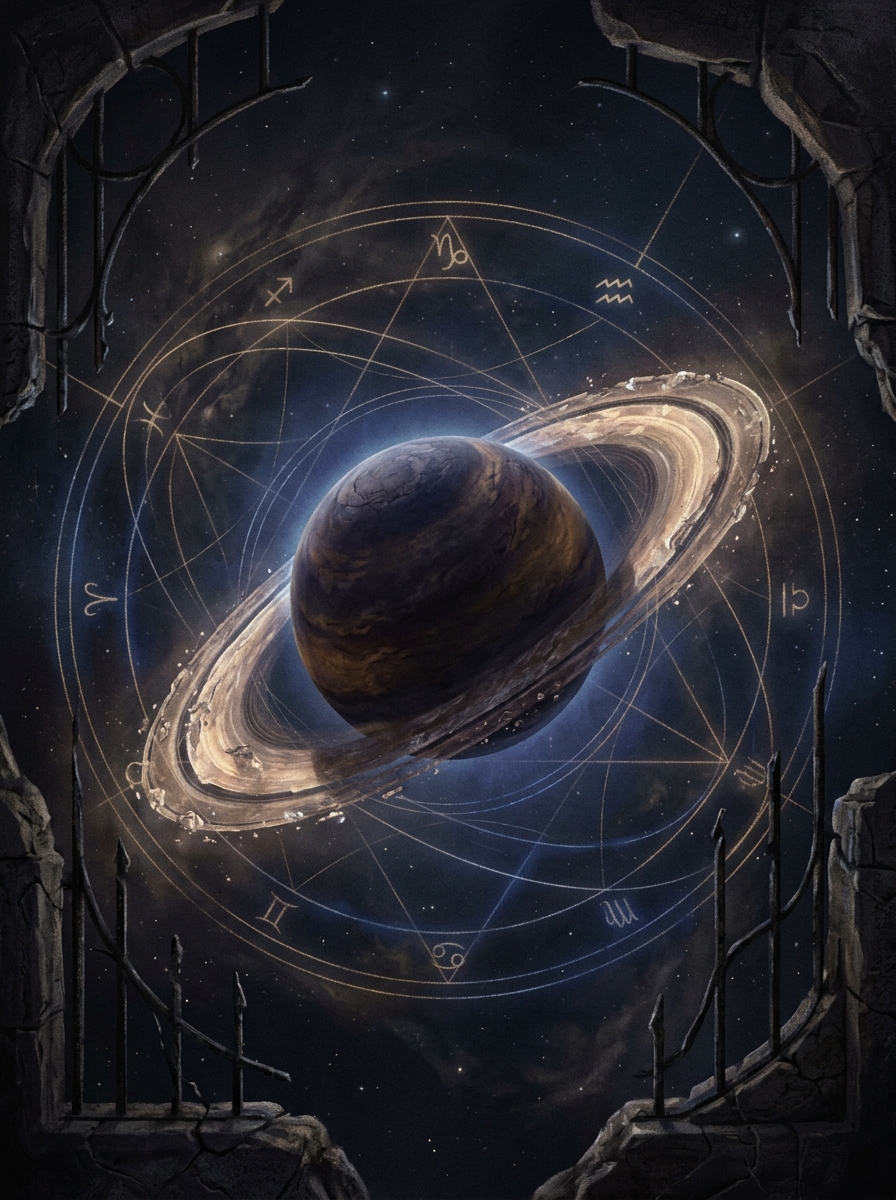
The Guardian of the Threshold: The Archetypal Gravity of Saturn
For millennia, Saturn stood as the outermost boundary of the visible solar system, the final sphere discernible by the naked eye. In the Western esoteric tradition, this physical reality mirrors a profound psychological truth: Saturn represents the limit of the conscious ego, the hard ring of bone and stone that defines what is tangible, measurable, and structured in our lives. As the planetary archetype of gravity, limits, and time, Saturn has long been feared as the "greater malefic," the cosmic taskmaster that enforces rules, demands obedience, and imposes limits. Yet, when we approach Saturn through the lens of psychological astrology, particularly the work of Liz Greene, a far more nuanced picture emerges. Saturn is not a punitive jailer, but rather the Guardian of the Threshold.
The Boundary of the Visible Eye
To understand the weight of Saturn, we must first look at its astronomical place in the heavens. Before the telescope pierced the dark to discover the transpersonal outer planets—Uranus, Neptune, and Pluto—Saturn marked the absolute edge of the human universe. It was the boundary line beyond which lay only the fixed stars and the infinite void. Psychologically, this boundary represents the ego's skin, the defensive shell we construct to navigate the physical world. Saturn provides the necessary container for identity. Without Saturn, our psyches would dissolve into the chaotic waters of Neptune or be shattered by the revolutionary lightning of Uranus. It is the gravity that keeps our feet on the ground and our minds anchored in consensus reality.
Yet, this protective container can easily become a prison. When we mistake the boundary of the ego for the absolute limits of existence, our structures calcify. We build rigid defense mechanisms, construct emotional armor, and cling to societal definitions of success. Saturn, as the Guardian of the Threshold, stands at this gate. It demands that we confront our fears, our limitations, and our mortality before we can cross into the transpersonal realms. It asks us to show our credentials—not in the form of superficial achievements, but in the currency of genuine self-knowledge and psychological maturity.
The Sentinel of Reality
In everyday life, the Saturnian archetype manifests as the structures we inhabit: our careers, our marriages, our social status, and our long-term goals. It is the concrete wall of reality that forces us to deal with things as they are, not as we wish them to be. When Saturn operates constructively, it grants us patience, self-discipline, resilience, and the capacity to endure hardship. It is the master craftsman who understands that anything of lasting value requires time, effort, and meticulous attention to detail.
However, when our relationship with Saturn is unconscious, we experience the Guardian as an external oppressor. We feel restricted by societal norms, trapped in unfulfilling jobs, or paralyzed by a chronic sense of inadequacy. We project the internal critic outward, viewing the world as a hostile place governed by cold, uncaring rules. To cross the threshold, we must stop resisting the limit and start understanding its purpose. The obstacle is not there to block us; it is there to test the structural integrity of our lives. It forces us to ask whether our structures are built on the shifting sands of external expectation or the solid rock of our own authentic truth.
The Astronomy of Retrogradation: Linear Chronos versus Opportunistic Kairos
From our perspective on Earth, planets occasionally appear to slow down, halt, and then move backward through the zodiac. This phenomenon, known as retrogradation, is an optical illusion born of our relative orbits. Because Earth travels faster on an inner track, we periodically overtake the slower outer planets. As we pass Saturn, the ringed giant seems to reverse its course across the backdrop of the stars, embarking on a journey that lasts approximately 140 days each year. While astronomical science explains this as a simple geometric consequence of heliocentric orbits, the psychological and astrological reality of this shift is profound. It marks a transition from the outward projection of discipline to an inward audit of the soul.
The Illusion of Backward Motion
When a planet is direct, its energy flows outward, seeking expression in the external world. Direct Saturn directs its focus toward building institutions, climbing career ladders, setting physical boundaries, and establishing order in the outer environment. It is busy constructing the scaffolding of our public lives. But when Saturn stations retrograde, the flow of energy reverses. The cosmic spotlight turns inward, illuminating the scaffolding itself and revealing the cracks, the dry rot, and the structural flaws we have ignored in our rush to build.
This retrograde movement is a natural pause in the cycle of creation. It is a period where we are asked to stop adding new stories to our architectural designs and instead inspect the foundation. If we attempt to force outward progress during a Saturn retrograde, we run headlong into delays, administrative bottlenecks, and unexpected obstacles. These are not signs of cosmic malice; they are the universe's way of enforcing a time-out. The retrograde demands that we look backward, review our past actions, and correct the mistakes we made when we were moving too quickly.
Chronos and the Demands of Linear Time
To fully comprehend this astrological shift, we must explore the dual nature of time as understood by the ancient Greeks: Chronos and Kairos. Chronos is linear, quantitative time—the ticking of the clock, the turning of the calendar pages, the relentless march toward the future. Saturn is the planetary ruler of Chronos (from which we derive words like "chronology" and "chronic"). In its Chronos aspect, Saturn demands efficiency, punctuality, and conformity to external schedules. It is the time that governs our workdays, our retirement accounts, and our biological aging.
Under the reign of direct Saturn, we are often slaves to Chronos. We measure our worth by how much we can produce in a given hour, how quickly we can climb a corporate ladder, or whether we are meeting milestones defined by society. Chronos is unforgiving; it waits for no one, and it punishes those who fall behind. In a culture obsessed with speed and productivity, the pressure of Chronos can become overwhelming, leading to burnout, anxiety, and a deep sense of alienation from our own natural rhythms.
Kairos: The Reclaimed Season of the Soul
When Saturn goes retrograde, the grip of Chronos relaxes, and we are invited to enter the realm of Kairos. Kairos is qualitative, opportunistic time—the right time, the season of the soul, the moment when circumstances align for meaningful action. Kairos cannot be measured by a clock or scheduled in a planner. It is the time of maturation, of incubation, of waiting for the fruit to ripen on the vine.
During Saturn Retrograde, we are forced to recognize that psychological and spiritual growth does not follow a linear path. We cannot schedule an epiphany, nor can we force ourselves to heal on a deadline. The delays we encounter during this transit are often invitations to step out of Chronos and into Kairos. A delay in a career project, for example, may seem like a setback in linear time, but in soul-time, it is the exact window needed to refine our skills, clarify our motives, or realize that we were chasing the wrong goal entirely. By embracing Kairos, we learn the art of active waiting, recognizing that the slow, silent work of the retrograde is just as vital as the visible progress of the direct phase.
The Jungian Psychology of Saturn: Shadow Work and the Father Complex
No psychological framework aligns more perfectly with the astrology of Saturn than the analytical psychology of Carl Jung. Jung’s concepts of the Shadow, the Father Complex, and the process of individuation provide a profound map for navigating the Saturnian landscape. In the natal chart, Saturn indicates where we feel most vulnerable, where we are most prone to self-doubt, and where we build our strongest defenses. It is the repository of our deepest fears, making it the primary gateway to the Jungian Shadow.
The Shadow Behind the Ringed Wall
The Shadow consists of those parts of ourselves that we reject, deny, or find unacceptable. Because the ego strives to maintain a positive self-image, it splits off these qualities—such as weakness, anger, ambition, or vulnerability—and consigns them to the unconscious. Saturn, as the planetary archetype of structure and defense, is the builder of the wall that keeps the Shadow hidden. It represents the rigid moral codes, the fears of social disapproval, and the internal prohibitions that keep us locked in a narrow definition of who we are.
+-------------------------------------------------------------+
|                     THE SATURNIAN ARCHETYPE                 |
+------------------------------+------------------------------+
|       DIRECT SATURN          |     RETROGRADE SATURN        |
|    (Externalized Energy)     |    (Internalized Energy)     |
+------------------------------+------------------------------+
| * Builds outer structures    | * Inspects inner foundations |
| * Seeks societal validation  | * Promotes self-sovereignty  |
| * Enforces external rules    | * Cultivates inner codes     |
| * Focuses on linear Chronos  | * Aligns with circular Kairos|
| * Projects the Judge outward | * Integrates the Shadow self |
+------------------------------+------------------------------+
When Saturn is retrograde, the wall becomes porous. The fears we have worked so hard to suppress begin to leak into our conscious awareness. We may experience this as a sudden wave of self-doubt, a feeling of emptiness, or a nagging suspicion that our achievements are hollow. Liz Greene notes that Saturn represents the "painful path of self-discovery," and this path inevitably leads through the Shadow. By facing the Saturnian shadow during the retrograde, we begin to see that our fears are not objective truths about our inadequacy, but rather the unintegrated fragments of our own power.
The Father Complex and the Projection of Authority
One of the most common ways we experience Saturn is through the Father Complex. In childhood, the father (or primary authority figure) is the child's first encounter with the external law. He represents the rules of society, the giver of reward and punishment, and the protector from the chaotic forces of nature. If this relationship is marked by coldness, excessive criticism, or absence, the child develops a wounded Father Complex. They internalize a harsh, punitive inner judge that monitors their every move.
In adulthood, this complex is projected onto the world. We look for the "father" in our employers, our government, our partners, and our spiritual guides. We constantly seek their approval, live in fear of their judgment, and blame them for our limitations. When Saturn stations retrograde, these projections begin to fail. The boss we relied on for validation ignores our efforts; the institution we trusted disappoints us; the rules we followed faithfully fail to bring us happiness.
This breakdown of projection is a painful but necessary step in the process of individuation. The withdrawal of the projection forces us to confront the archetype of the Father within ourselves. We are challenged to stop looking to the outer world for permission, validation, or structure. The retrograde asks us to dismantle the external judge and construct in its place an internal authority—a sovereign self that is responsible for its own limits, its own values, and its own destiny.
Saturn Retrograde in the Natal Chart: The Internalized Lawgiver
To be born with Saturn Retrograde is to carry a unique psychological blueprint. While a direct natal Saturn looks to the external world to understand rules, boundaries, and authority, the retrograde natal Saturn has these concepts turned inward from the very beginning of life. The individual is born with an internalized lawgiver, a highly active inner critic that can make the early life feel particularly heavy, but which ultimately offers the potential for profound self-mastery.
The Burden of the Internal Judge
For those with Saturn Retrograde in their birth chart, the primary struggle is rarely with external authority figures in the traditional sense; rather, it is with the relentless, unyielding judge that lives inside their own minds. These individuals are often incredibly hard on themselves. They carry an innate sense that they are not doing enough, being enough, or achieving enough, regardless of their actual external success. This can lead to a lifetime of overcompensation, where they work twice as hard as everyone else to prove a worth they do not internally feel.
Steven Forrest describes this placement as a "deeply personal, highly customized curriculum of self-definition." Because the standard of success is internalized, the individual cannot be comforted by external praise. A boss can tell them they did an excellent job, but if the project did not meet the rigorous standards of their internal judge, they will still feel like a failure. This constant self-auditing can manifest as perfectionism, chronic self-doubt, and a fear of taking risks. They are so terrified of making a mistake and facing their own self-condemnation that they may avoid putting themselves in positions where they could fail, leading to career stagnation or creative paralysis.
Forging Authentic Self-Discipline
The gift of natal Saturn Retrograde lies in the development of authentic self-discipline. A direct Saturn person may follow a rule simply because it is the law of the land or the expectation of their community. But for the retrograde individual, rules must make sense to their internal moral compass. They cannot easily conform to systems they do not respect, and they struggle to perform tasks that feel meaningless.
As these individuals mature, the path of healing involves transforming the punitive inner critic into a wise internal mentor. They must learn to separate their self-worth from their achievements and recognize that mistakes are a natural, necessary part of the learning process. When they learn to soften the harshness of their internal lawgiver, they unlock a rare capacity for self-regulation and focus. They become capable of working long hours in isolation, driven not by the fear of punishment or the desire for applause, but by a deep, quiet commitment to their own standards of excellence. They become truly self-motivated, building lives that are architecturally sound because every stone has been tested by their own hands.
Saturn Retrograde in Transit: Navigating Delays and Auditing Boundaries
Even if you do not have Saturn Retrograde in your natal chart, you will experience its energy for roughly four and a half months every year. When transiting Saturn goes retrograde, it acts as a cosmic brake pedal, slowing down the pace of our outer lives and demanding a rigorous audit of our goals, our commitments, and our psychological boundaries. This is not a time for launching major new enterprises; it is a time for consolidating, restructuring, and testing the integrity of what already exists.
       NATAL SATURN RETROGRADE             TRANSITING SATURN RETROGRADE
  +--------------------------------+  +--------------------------------+
  | * Lifetime internal critic     |  | * Temporary phase (140 days)   |
  | * Struggle with self-worth     |  | * Outer delays, project blocks  |
  | * Need for authentic standards |  | * Audit of current commitments |
  | * Self-motivated discipline    |  | * Re-evaluation of boundaries  |
  +--------------------------------+  +--------------------------------+
The Architecture of Delay
One of the most common complaints during a Saturn Retrograde transit is career stagnation. Projects that were moving forward smoothly suddenly hit administrative roadblocks, key decision-makers go silent, or resources dry up. In relationships, we may feel a sudden distance or a need to renegotiate the terms of our commitment. These experiences can produce intense frustration, especially for those accustomed to forcing their way through obstacles.
However, from an archetypal perspective, these delays are functional. They are designed to show us where our plans lack structural integrity. If a business venture collapses during Saturn Retrograde, it is often because the financial foundation was weak or the partners were not fully aligned. If a relationship hits a rocky patch, it is because long-festering boundary issues can no longer be ignored. The delay forces us to slow down and do the necessary maintenance work. It gives us the opportunity to ask: "Is this project truly worth my time and energy? Am I building this out of authentic desire, or out of a fear of missing out, societal pressure, or a need to please someone else?"
Fortifying the Internal Boundaries
Saturn is the planet of boundaries, the line that separates the self from the other. During its retrograde transit, our personal boundaries are put to the test. Many of us have a tendency to take on responsibilities that do not belong to us—whether out of guilt, a desire to control, or a fear of rejection. We say yes when we mean no, and we allow others to encroach on our time, our energy, and our emotional space.
Saturn Retrograde demands that we audit these leaks. It asks us to look closely at our commitments and identify where we are over-extended. This is a time to practice the clean, clear boundary of a simple "no." It is not about building defensive walls to shut the world out, but about establishing functional limits that protect our psychological integrity. By reclaiming our energy from obligations that are not ours to bear, we free up the resources needed to build our own dreams. The retrograde teaches us that true boundaries are not acts of hostility; they are acts of self-preservation and self-respect.
The Alchemy of Saturn: Reconstructing the Inner Foundations of Sovereignty
In the ancient science of alchemy, Saturn was associated with lead (plumbum), the heaviest, densest, and most dull of all metals. Lead was seen as the base material of the Great Work (Magnum Opus), the starting point from which the alchemist would extract the solar gold. The process of turning lead into gold was not a literal physical transmuting of metals, but a spiritual metaphor for the refinement of the human soul. To find the gold, one had to go deep into the heavy, dark, and restrictive matter of Saturn—a process that mirrors the work of Saturn Retrograde.
The Alchemy of Saturnian Lead
The alchemical process begins with the nigredo, or the blackening. This is a stage of decay, dissolution, and confrontation with the shadow. It feels heavy, depressing, and restrictive—much like a challenging Saturn transit or a difficult retrograde phase. During this time, the ego feels stripped of its power, forced to sit with its limitations, its failures, and its mortality.
Yet, the alchemical texts remind us that the seed of the gold is hidden within the lead. The very traits that make Saturn feel heavy—its density, its gravity, its resistance—are the qualities that make it stable, enduring, and strong. When we sit with our Saturnian pain, when we audit our fears and take responsibility for our lives, we begin the process of calcination. We burn away the dross of external expectations, leaving behind the pure, indestructible essence of who we are. The lead of our fear is transformed into the gold of wisdom, resilience, and self-possession.
Sovereign Authority: Becoming Your Own Architect
As the retrograde cycle draws to a close, Saturn stations direct, ready to resume its forward march through the heavens. But we do not return to the world as the same people who entered the retrograde cave. Having audited our foundations, confronted our shadow, and dismantled our projections of authority, we are ready to step into a new level of personal sovereignty.
                  +--------------------------------+
                  |      ALCHEMICAL TRANSFORMATION  |
                  |     OF THE SATURNIAN ARCHETYPE |
                  +---------------+----------------+
                                  |
                                  v
                  +--------------------------------+
                  |  STAGE 1: THE LEAD (Nigredo)   |
                  |  - Cold, heavy, restrictive    |
                  |  - Externalized fear & guilt   |
                  |  - Slavery to Chronos (Time)   |
                  +---------------+----------------+
                                  |
                                  v
                  +--------------------------------+
                  |  STAGE 2: THE FIRE (Audit)     |
                  |  - Dismantling projections     |
                  |  - Facing the Father Complex   |
                  |  - Reclaiming energy & limits  |
                  +---------------+----------------+
                                  |
                                  v
                  +--------------------------------+
                  |  STAGE 3: THE GOLD (Sovereignty)|
                  |  - Authentic self-discipline   |
                  |  - Mastery of internal timing  |
                  |  - The World: Self-Integration |
                  +--------------------------------+
In the tarot, Saturn is associated with the final card of the Major Arcana: The World. In Arthur Edward Waite’s design, a figure dances inside a wreath of laurel, surrounded by the four fixed signs of the zodiac. It is a card of completion, of integration, of limits realized and celebrated as the very boundary that allows beauty to exist. The dancer does not fight the wreath; she dances within it.
This is the ultimate lesson of Saturn Retrograde. True freedom does not come from the absence of limits, but from the mastery of them. By taking responsibility for our own boundaries, our own discipline, and our own healing, we stop being victims of a cold, demanding world. We become the sovereign architects of our own lives, building structures that can withstand any storm, grounded in the solid rock of our own authentic truth.
Frequently Asked Questions About Saturn Retrograde
What is the difference between a natal Saturn retrograde and a transiting Saturn retrograde?
A natal Saturn retrograde is a permanent feature of your astrological birth chart. It represents a lifelong psychological blueprint, indicating that the energy of Saturn—discipline, authority, limit, and judgment—was internalized from the moment of your birth. This placement manifests as a highly active inner critic, a deep struggle with self-worth, and a need to develop self-motivated, authentic standards of success rather than conforming to societal expectations.
In contrast, a transiting Saturn retrograde is a temporary, cyclical event that affects everyone for approximately 140 days each year. During this transit, the cosmic energy of Saturn slows down and turns inward for the entire collective, regardless of where Saturn is in your natal chart. The transit acts as a temporary period of structural review, bringing outer delays, career stagnation, and relationship checks that force you to audit your goals and fortify your boundaries. While the natal placement is a lifelong school of self-sovereignty, the transit is a seasonal check-up designed to test the integrity of your current path.
Why does Saturn Retrograde feel so heavy, and how can I ease the tension?
Saturn Retrograde feels heavy because it forces us to confront the density of reality and the weight of our unconscious shadows. When Saturn's energy turns inward, it withdraws the external distractions that normally keep us from looking at our fears. We are forced to sit with our insecurities, our feelings of inadequacy, and the areas of our lives where we have avoided taking responsibility. The weight we feel is the pressure of our own unintegrated shadow material demanding to be seen.
To ease this tension, you must stop resisting the retrograde's slowdown. If you attempt to push through delays with force, you will only experience frustration and burnout. Instead, practice the art of conscious surrender to the pause. Dedicate time to journaling, shadow work, and auditing your commitments. Somatic grounding practices—such as walking in nature, strength training, or working with clay—can help you process the heavy Earth energy of Saturn. Remember that the heaviness is not a punishment, but the natural gravity required to help you build solid foundations.
Does Saturn Retrograde cause career stagnation or job loss?
Saturn Retrograde does not inherently cause job loss, but it does expose the structural weaknesses in your professional life. If your career is built on a shaky foundation—such as a job you dislike but stay in for security, a business venture with misaligned partners, or a role where you consistently violate your own boundaries—the retrograde transit will bring these issues to a crisis point. This can manifest as project delays, administrative bottlenecks, or conflicts with authority figures that make your career feel stagnant.
Rather than viewing this stagnation as a disaster, treat it as a professional audit. Use this time to review your long-term goals and assess whether your current job aligns with your authentic values. If you experience a job loss during this transit, it is often a harsh but necessary clearing of the path, removing a structure that was ultimately serving as a prison so that you can build a career that is genuinely yours. Avoid launching new businesses or changing jobs impulsively during the retrograde; instead, use the time to plan, refine your resume, and clarify your professional boundaries.
How does Saturn Retrograde interact with my Saturn Return?
Your Saturn Return is a major astrological milestone that occurs when transiting Saturn returns to the exact zodiacal position it occupied at your birth, happening between the ages of 28–30, 57–60, and 88–90. If your Saturn Return occurs while transiting Saturn is retrograde, the intensity of this period of maturation is amplified. The outer challenges of the Return—such as major career shifts, structural relationship changes, or a reckoning with adulthood—will be accompanied by a deep, introspective psychological audit.
A retrograde Saturn Return demands that you do not just change your outer life, but that you fundamentally alter your internal relationship with authority and self-worth. You are being asked to grow up, but to do so on your own terms rather than society's. The delays and obstacles of the Return will feel more internal, forcing you to dismantle childhood programming and father complexes. If you have natal Saturn retrograde, a retrograde Saturn Return can actually feel like a familiar homecoming, providing you with the exact introspective tools you need to successfully navigate this rite of passage.
What crystals, tarot cards, or archetypes help navigate Saturn Retrograde?
To navigate the heavy, introspective energy of Saturn Retrograde, you can work with symbols and tools that align with the archetypal wisdom of Saturn. In the tarot, the primary cards associated with Saturn are The World (representing limits, integration, and completion) and The Hermit (representing introspection, solitude, and the light of inner wisdom). Contemplating these cards can help you understand the value of pulling back from the world to find your own light.
For crystal work, choose stones that are grounding, protective, and structural. Black tourmaline, obsidian, and black onyx help absorb excess anxiety and fortify your energetic boundaries. Hematite and smoky quartz provide grounding, helping you stay centered when faced with delays or frustrations. The primary archetype to work with is the Inner Sage or the Wise Architect. When you feel overwhelmed by the harsh judgment of the inner critic, consciously invoke the energy of the Wise Elder who knows that anything of lasting value takes time to build, and that your worth is not defined by the speed of your journey.
Related
- The Saturn Return: Astrological Rite of Passage to Authentic Adulthood
- Pluto Retrograde: The Inner Revolution You Cannot Outrun
- Planetary Retrograde: The Art of Moving Backward to Move Forward
- Saturn Transits: The Astrological Cycles of Maturity, Boundaries, and Realism
- Saturn in Scorpio: The Mastery of Shadow, Power, and Psychological Resilience
Comments
Loading comments…