Venus Trine Saturn: The Discipline of Grace
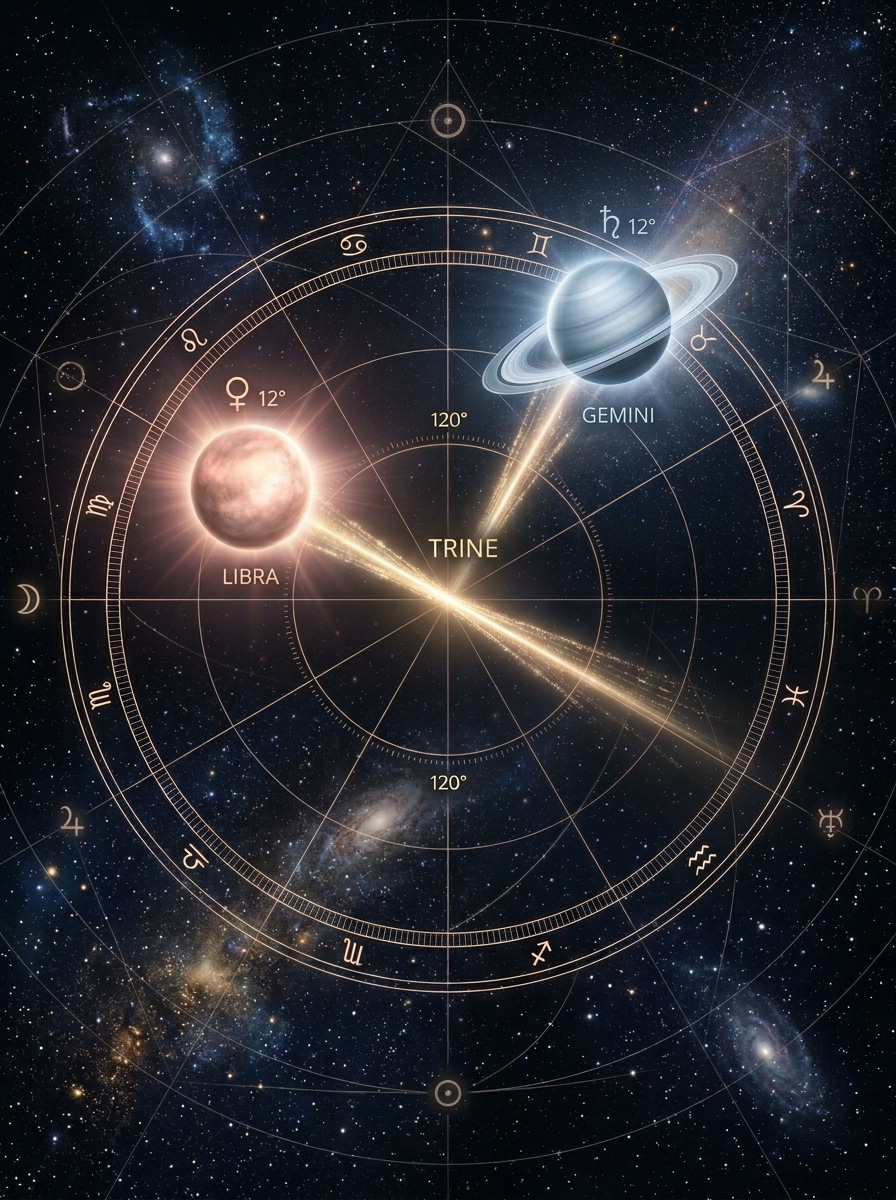
The Agreement Between Want and Weight
Venus trine Saturn is the aspect of love that does not need to raise its voice. Venus wants pleasure, beauty, attachment, and mutual regard; Saturn wants form, limits, and accountability. In a trine—astrology’s most effortless harmonic—the two drives do not cancel each other. They collaborate. The result is a psyche that already knows what many spend years learning: what is worth wanting must also be worth maintaining.
This is not the wild combustion of a square or the magnetic heat of a Venus-Mars contact. The trine gives ease, but ease here means the ability to build something beautiful that does not evaporate when life becomes inconvenient. The person with this aspect often experiences desire as a considered pull rather than a fire alarm. Attraction is selective, standards are quietly high, and commitment is not a crisis—it is the natural shape of affection that has agreed to honor the calendar, the budget, the difficult conversation.
The core psychological signature is simple: Venus learns patience from Saturn, and Saturn learns tenderness from Venus. That exchange creates grace with backbone. But a trine is not a pass; as the trine aspect itself cautions, the danger is that flow becomes inertia. For Venus trine Saturn, the risk is not chaos but overcontrol, not drama but an emotional austerity that mistakes restraint for virtue.
How the Psyche Learns to Love Slowly
Underneath the elegance of this aspect lies a serious architecture of self-worth. Venus symbolizes value; Saturn symbolizes earned reality. When they are in trine, the person develops a sense of worth through competence, reliability, and visible restraint. They do not feel entitled to pleasure or love; they feel that these must be cultivated and protected. This can produce admirable composure, but it also installs a private ledger: I can relax only after I have proven myself. I can receive only after I have contributed.
This inner accounting is not the harshness of a hard aspect—it is subtler, often socially rewarded. The person looks serene while carrying a quiet sense of obligation. Yet there is a deep gift here: object constancy. The loved one remains real even when absent, flawed, or temporarily disappointing. That is why this aspect supports fidelity, artistic discipline, and financial prudence. The psyche does not confuse intensity with value.
For a wider view of what Venus contributes to the equation, see Venus in astrology. For the Saturnine principle of disciplined structure, Saturn in Capricorn clarifies the architecture that this trine borrows. But the trine itself is not a sign placement—it is a relationship. The houses, not the signs, tell you where this relationship plays out: in money, partnership, creativity, reputation, or the private architecture of home.
The Mature Heart and the Shadow of Guardedness
The highest expression of Venus trine Saturn is trustworthiness that remains alive. A mature heart does not simply endure; it becomes more capable of warmth because it is no longer preoccupied with proving itself. The person learns that structure exists to protect value, not to imprison it. In relationships, this means showing up during stress, remembering anniversaries, and treating devotion as something with a usable shape. In work and money, it means stewardship rather than panic or fantasy.
But every trine has a shadow, and here the shadow is not chaos—it is overcontrol. Because the aspect makes competence look elegant, the person may not realize how much is being withheld. Vulnerability begins to feel sloppy, indulgence unsafe. The internal ledger can become a cage: I have done the work, so I deserve the result; if I am responsible, I should not have to ask twice. That attitude looks noble but breeds a covert loneliness.
Compare this, for contrast, with the emotional fluency of Moon-Venus synastry, which gives sweetness without the Saturnian edit. Venus trine Saturn needs occasions where beauty is received without being justified, affection expressed without being audited. Otherwise the trine becomes a lovely cage: orderly, dignified, and too small.
Where the Aspect Lives: Love, Work, and Aesthetic Discipline
In relationships, Venus trine Saturn values consistency over spectacle. These are the partners who show up during illness, handle the unglamorous Tuesday, and believe that devotion should have a practical shape. They may be slow to commit, but their commitment is not a performance—it is a promise kept. Attraction often gravitates to maturity, gravitas, or partners who embody Saturnian qualities: reserve, competence, patience, a certain scarred dignity.
In work and money, the aspect supports professional credibility and financial prudence. The person can turn talent into something usable, budget without feeling deprived, and earn trust through visible reliability. The poise resembles Venus in the 10th House—polished, respected, often trusted with roles that require tact.
Aesthetically, Venus trine Saturn manifests as an eye for clean lines, classical balance, durable quality over trendiness. The person may prefer well-made things to flashy ones, and often has a developed sense of proportion. Craft—whether ceramics, tailoring, music, or architecture—is where beauty becomes inseparable from discipline. Compare the structured creativity of Venus in the Fifth House; here the discipline is not external but woven into the pleasure itself.
The houses reveal the precise stage. A trine involving the 4th and 8th houses feels ancestral and intimate; one touching the 3rd and 11th expresses through communication and social networks; one involving the 12th makes devotion private, almost spiritual. The aspect itself is the style of the exchange; the houses tell you the room.
Keeping the Grace Alive
The corrective for Venus trine Saturn is not recklessness—it is permission. Permission to enjoy without earning it first. Permission to be held without having to hold the structure. Permission to love without auditing the cost.
This is where the Saturnian lesson becomes liberating. Saturn does not only say no; it says, This matters enough to maintain. Venus does not only say yes; it says, This is worth cherishing. Together they create a style of love, art, and labor that can survive repetition without losing meaning. For those who carry this aspect, the path forward is to keep one foot in devotion and one foot in reality—and to occasionally let the former lead. The trine becomes beautiful when it can hold both: the discipline and the delight, the promise and the tenderness.
A useful final lens is to see how this aspect differs from the ethereal surrender of Venus in the 12th House or the expansive sociability of a Venus-Jupiter contact. Venus trine Saturn is not about transcendence or abundance; it is about what lasts. And in the long life of a chart, that is often more valuable than brilliance.
Related
- Venus Sextile Saturn: Love That Can Hold Its Shape
- Venus Conjunct Saturn: Love Under Pressure, Love Made Real
- Venus Opposition Saturn: Love Under Pressure, Value Under Test
- Moon Trine Venus: The Gentle Intelligence of Feeling and Affection
- Venus Square Saturn: Love Under Pressure, Value Under Construction
Comments
Loading comments…