Venus Sextile Saturn: Love That Can Hold Its Shape
The Architecture of Durable Affection
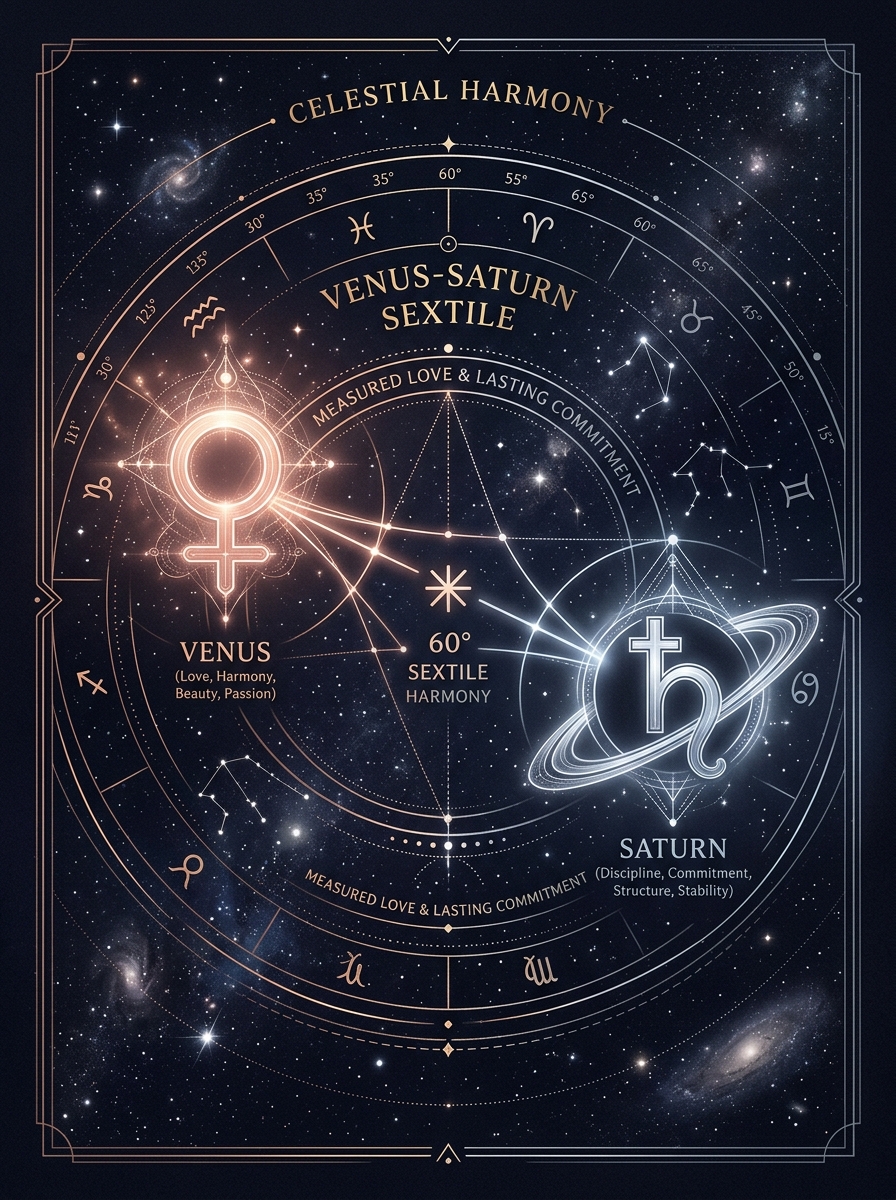
Venus sextile Saturn is the aspect of love that has learned how to stay. Venus wants to attract, soften, enjoy, and value; Saturn wants to define, test, protect, and endure. In sextile, those impulses cooperate without losing their separate intelligence. The result is not flamboyant charm but dependable grace — a person who knows how to make beauty last, how to commit without self-betrayal, and how to attach value to what can survive time.
The sextile is an aspect of usable talent, not passive gift. As described in the broader logic of the sextile aspect, it asks for conscious activation. With this pairing, the psyche learns that pleasure and limitation are not enemies. The heart can be courteous without being weak; desire can be selective without becoming sterile; love can include standards.
A temperament that trusts time
People with this aspect often mature early in one specific way: they understand that what matters is worth waiting for. Saturn gives Venus a sense of economy. Instead of scattering affection everywhere, the native invests carefully. They may not be the first to speak, but what they say is usually considered. They may not rush intimacy, but once they enter it, they tend to build around it.
This shows up as quiet self-possession, yet it can also hide under reserve. The heart may be warm, but it reveals itself through usefulness, reliability, and consistency rather than theatrical displays. In Jungian terms, the aspect domesticates a restless anima/animus projection: the person becomes less interested in fantasy and more interested in what can actually be lived.
The shadow version is equally specific. Because Saturn scrutinizes, the native may feel they must earn affection through performance, usefulness, or impeccable conduct. They may confuse self-respect with emotional bracing. When that happens, the softening power of Venus gets delayed, and the person becomes very good at being admirable while remaining privately underfed. The task is not to abandon standards; it is to let standards serve intimacy rather than replace it.
A useful comparison is the subtler dynamic of the semi-sextile, which describes adjacent energies that need patient integration. The sextile is more fluent than that, but Venus sextile Saturn still requires participation. It is a skilled aspect, not an automatic one.
The emotional logic of restraint
This aspect typically gives an emotional style that values containment over leakage. Feelings are not cold; they are curated. The person dislikes messy displays, but that is not emotional absence. They are deeply sensitive to the cost of sentiment: they know affection means something only when backed by action, and they are quietly disappointed by people who speak beautifully but fail structurally.
That makes them excellent at holding a relationship together through weather. They are often the one who remembers the mortgage, the doctor’s appointment, the anniversary, the ungrateful follow-through. Their love is not abstract; it is fiduciary.
The Roots of Emotional Economy
This aspect does not arise from a vacuum. Its signature — measured affection, distrust of ease, preference for earned connection — is forged early, often in a childhood where love was conditional on achievement or where resources were scarce. The native internalizes that approval must be proven, that vulnerability is risky. Saturn in sextile to Venus does not necessarily indicate deprivation, but it does shape a psyche that treats affection as something requiring structure.
The child becomes the curator
Children with this aspect often show unusual seriousness about relationships. They may be the friend who remembers every promise, the sibling who stabilizes chaos. They learn to manage others’ expectations before managing their own. This can produce a generous adult, but one who secretly fears being loved without a reason.
The pre-verbal integration that precedes full awareness is subtly different from the more explicit tension of a square. The sextile offers a smoother pathway: the person gravitates toward situations where duty and pleasure align. But it also means that when they encounter a partner or job that demands pure spontaneity, they feel unmoored. They may mistake freedom for irresponsibility.
The shadow of self-denial
The main friction is not overt conflict but over-control. Saturn can make Venus suspicious of ease. The native may unconsciously believe enjoyment is unserious, need is embarrassing, or beauty is suspect unless it serves a duty. In adulthood, this produces a restrained but chronically undernourished emotional life.
Sometimes the pattern appears as delayed blooming. The person may not date freely, may not trust their own attractiveness, or may habitually choose partners who require proving. They feel most lovable when useful, sober, or competent. If they are not careful, they build an identity around being the one who keeps it together while privately wishing someone would relieve them of the burden.
This is one of the clearest places where the aspect differs from the easy flow of more openly expressive Venusian signatures like Venus in Leo or Venus in Taurus. Those placements lean toward abundance or radiance; Venus sextile Saturn must learn that restraint is not the same thing as deserving less.
Maturation and the Shadow
A sextile is a talent, not a guarantee. The same instincts that create dignity can create deprivation. The work of this aspect is to let Saturn refine rather than inhibit Venus.
When maturation happens
In its mature expression, the aspect produces loyalty that is not naive. The native understands that commitment is made meaningful by boundaries. They are usually not interested in love that dissolves into chaos. Even when tender, they remain evaluative. That makes them excellent partners: not seduced by chemistry alone, they want coherence.
In relationships, this looks like patience, discernment, and the ability to weather inconvenience without dramatic collapse. The person expects a lot from themselves, but they often feel safest with people who have inner structure. This is why the aspect pairs naturally with the deeper commitment themes of Saturn in the 7th house or Saturn in Capricorn, though the sextile itself is gentler and more workable than those placements.
Aesthetic discipline and earned ease
The gifts of Venus sextile Saturn are best understood as forms of graceful containment. The native often has an instinct for proportion: they prefer classic lines, durable materials, understated elegance because they can feel the difference between what sparkles and what holds. Venus refines; Saturn edits. Together they produce a palate for quality, not novelty.
This is visible in creative work. The person may not produce in a fever, but their creations have craft. They can revise, wait, tolerate the dull middle stage where something is being made real. This makes the aspect especially useful in any vocation that depends on refinement over time: design, restoration, editing, architecture, curation, finance, law, relationship work, or any art that must survive contact with reality.
For house‑specific expression, compare placements like Venus in the 10th house or Venus in the 6th house. Those show where Venusian value is visible; the sextile shows how that value is sustained.
When the shadow takes over
The shadow appears when the inner critic becomes a relationship habit. If love must be earned, every connection becomes an audit. The person may become uncomfortable with neediness — in themselves and others. They might prefer affection that is polished, predictable, and low‑maintenance, which sounds mature until it becomes a way to avoid vulnerability.
The remedy is not sentimental indulgence. It is accurate valuation. Saturn asks, “What is worth preserving?” Venus asks, “What is worth loving?” The healthy answer is not that only the perfect are worthy; it is that the real, the flawed, and the time‑tested can be beautiful precisely because they are real.
Living the Aspect: Love, Work, and Self‑Worth
A natal aspect matters because it becomes behavior under pressure. Venus sextile Saturn shows its maturity where desire has consequences.
Love and commitment
In relationships, this aspect is often the signature of dependable attachment. The native does not fall for a fantasy and drift once reality arrives; they are more interested in the real person from the beginning. Slow to trust, but once trust is built, they are not casual with it. The relationship becomes a structure they maintain.
That said, they may need partners who can read restraint correctly. Because affection is understated, others can mistake it for distance. The native may not say “I love you” in a fireworks style, but they will show up. If the partner needs overt reassurance, this aspect benefits from conscious translation: saying the soft thing aloud instead of assuming the practical thing will be understood automatically.
Synastry reveals how this temperament lands with another person’s emotional field. For example, Moon‑Venus synastry often explains why one person experiences the other as naturally comforting, while a Venus‑Saturn native may express care through steadiness rather than pure warmth.
Work, money, and competence
This is one of the cleaner indicators of financial caution and the capacity to build slowly. The person may not get rich quickly, but they often do better with time than with speculation. They understand value as accumulated, maintained, protected. They are usually more comfortable budgeting than gambling.
Professionally, Venus sextile Saturn supports reputation. People trust the native’s judgment because it feels solid. Even in artistic fields, there is often a business instinct beneath the aesthetics. Talent without structure leaks away. The native is drawn to work where elegance and responsibility must coexist. If the chart emphasizes public life, Saturn in the 10th house can intensify the theme of visible competence; the sextile provides the inner architecture that makes it possible.
Self‑worth and aging
The deepest gift of this aspect is the possibility of self‑worth not dependent on applause. It improves with age because the native often becomes more comfortable in their own skin once they stop confusing youth with value. They discover that their most attractive quality is not ease but reliability — the ability to be beautiful without needing to be ornamental.
That is why this aspect often ripens late. It belongs to people who become more themselves by becoming more exact. Their lives may not be dramatic, but they are resilient, well‑made, and quietly luminous. They know that what endures has its own kind of glamour.
For the broader Venusian lens behind that value system, see Venus in Astrology. For the Saturnian counterpart, Saturn in Aquarius offers a study in principled structure, while Saturn in Gemini shows how discipline can refine expression rather than silence it.
Venus sextile Saturn is the aspect of love that can bear weight. It does not promise endless ease; it promises shape, proportion, and the possibility that affection can become architecture. In a chart, that matters because the things we can sustain are the things that become our lives.
Related
- Venus Conjunct Saturn: Love Under Pressure, Love Made Real
- Venus Opposition Saturn: Love Under Pressure, Value Under Test
- Venus Square Saturn: Love Under Pressure, Value Under Construction
- Venus Trine Saturn: The Discipline of Grace
- Sun Sextile Venus: Ease, Magnetism, and the Art of Being Well-Loved
Comments
Loading comments…