Venus Square Saturn: Love Under Pressure, Value Under Construction
The Core Dynamic: Desire Meets the Gatekeeper
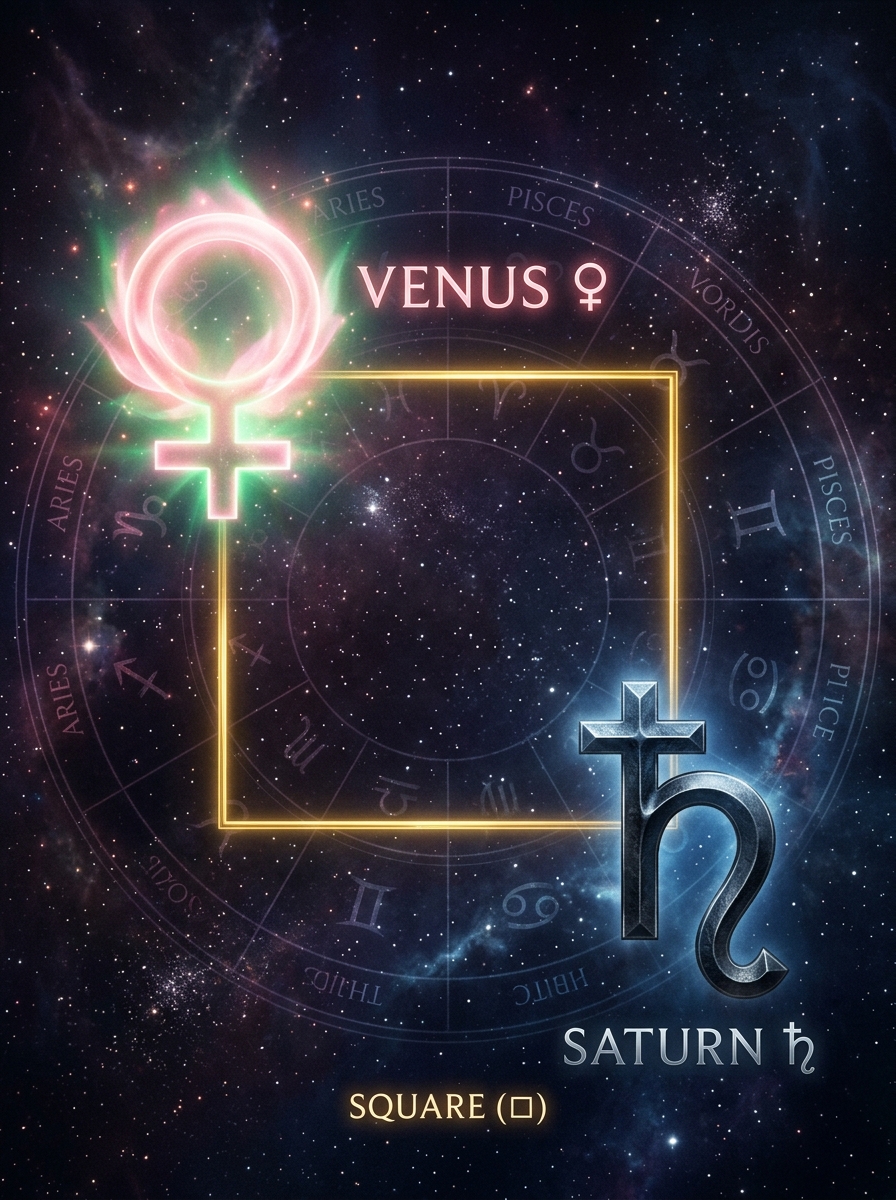
Venus square Saturn is not a placement of lovelessness; it is a placement of love under surveillance. The native’s capacities for affection, pleasure, self-worth, and attraction do not flow unobstructed — they hit a wall of restraint, a demand for proof, a delay, or an inner censor. The friction between Venus (receptivity, delight, relational ease) and Saturn (limits, responsibility, consequence) produces a psyche that instinctively suspects ease and confuses pleasure with risk. This is a square, so the tension is not resolved by compromise; it demands conscious integration. For the larger logic of how pressure becomes development, see the astrology of the square aspect.
The core insight is simply stated: the person learns early that love must be earned, that softness invites punishment, and that desire itself is a liability. That learning may be subtle — a parent who withheld warmth until a child performed, a culture that praised sacrifice over satisfaction, or a formative relationship that taught the harsh arithmetic of affection. The result is not coldness but a hypervigilant warmth: every gesture measured, every need weighed against an invisible ledger.
How It Forms: The Psychology of Conditional Worth
Saturn presses on Venus most acutely in the domain of self-worth. The native grows up with the implicit or explicit message that value is conditional — that to be loved, one must be exemplary; to enjoy, one must first earn. This is often internalized as a chronic audit of the self: “Am I attractive enough? Successful enough? Good enough?” The audit is so automatic that even pleasure becomes suspect. Spending money, receiving a compliment, relaxing into intimacy — each act triggers a quiet Saturnian interrogation.
Psychologically, this creates a split between longing and legitimacy. Desire remains, but it is forced into a deferred, permissible form. The person may develop a taste for what is difficult, distant, or dutiful — because such objects feel allowable. This pattern is especially sharp when Venus rules the second house of self-value; the Venus in the second house theme of worth tied to possessions or body image is amplified by Saturn’s austerity. The underlying fear is that wanting something freely is irresponsible, that the self must be managed like a budget.
This conditioning does not erase the need for connection. It forces the need underground, where it becomes a secret yearning that surfaces in dreams, in art, or in relationships that feel too heavy to sustain. The soul learns to translate love into duty, affection into obligation, pleasure into earned reward. That translation can produce impressive discipline, but it starves the heart unless the unconscious ledger is eventually examined.
Maturation and Shadow: From Guardedness to Earned Grace
Venus square Saturn matures when the native stops using boundaries as weapons against the self. The gift is not the abolition of Saturn — it is the transformation of Saturn from persecutor to protector. This happens through repeated encounters with limits that clarify rather than humiliate: a relationship that survives disappointment, a craft refined through failure, a love that proves itself over time. Each experience teaches that weight does not have to crush warmth, and that structure can hold tenderness rather than strangle it.
The Shadow: Defenses That Become Destiny
The undeveloped expression of this square is not sadness but structural self-denial. The person may unconsciously choose partners who are unavailable, overburdened, or emotionally distant — thus confirming the Saturnian premise that love must be hard. This projection is elegant and insidious: if the partner is a wall, the native can remain the one who longs from a safe distance, never risking the shame of being seen wanting. Other common shadow patterns include chronic self-deprivation (refusing pleasure out of principle), perfectionism that paralyzes creative expression, and a habit of rejecting affection before it can be taken away.
In extreme cases, the body becomes a site of discipline — criticized, hidden, or treated as a project rather than a home. Pleasure triggers guilt; rest feels like theft. For a related framework on how hard aspects generate growth through sustained tension, the T-square aspect pattern often contains this Venus-Saturn dynamic as one spoke of a broader crucible.
The Gift: Endurance and Earned Grace
The higher expression is a love that knows its own weight. This aspect builds formidable loyalty, refined taste, and the ability to cherish what has been tested. The native develops an almost old-soul realism: they are not easily deceived by charm, and they value reliability over fantasy. In art and design, this produces a sense of proportion and restraint — a spare elegance that respects form. The Venus in Capricorn archetype exemplifies the same principle of value refined by responsibility: beauty that grows more beautiful under pressure rather than less.
The key maturation step is consent: the native must learn to permit themselves small, conscious pleasures without requiring them to be earned. Not reckless indulgence, but a balanced consent to enough lightness. Saturn’s gatekeeping can then shift from denying desire to protecting it — setting boundaries that keep intimacy safe, not sterile.
Living the Square: Love, Work, and Timing
Once the dynamic is understood, its expressions across life domains become coherent applications, not separate puzzles. The native does not need a different rule for every area; they carry the same lens of measured value into each.
In Love
Affection is slow to trust. Early relationships often feature delay, distance, or age gaps — anything that makes closeness feel earned. The native may test partners for durability: “Will you still be here when I am difficult? When I fail?” The fear is not commitment but vulnerability. The most healing partnerships are those built on transparent agreements and mutual respect for limits. When the native stops treating their own softness as dangerous, the square can produce profound eros — the charged intimacy of two people who have survived their own guardedness. The Saturn in the 7th house archetype resonates here, though the square makes the lesson primarily internal.
In Work
Professions that demand both beauty and structure suit this placement: design, architecture, editing, finance, elder care, or any craft where form and function must cooperate. The native’s work often shows a signature of restraint — a building that looks solid but breathes, a piece of writing that says more by what it omits. They are exceptionally good at improving systems, not just decorating them. For a public-facing version of Venusian discipline, see Venus in the 10th house, though the square adds a sharper edge of earned legitimacy.
In Timing
This aspect is rarely in a hurry. Many natives bloom later than their peers — not because they are less capable, but because Saturn refuses shortcuts. Confidence comes after disappointment has clarified what matters. Style sharpens with age. Relationships become more beautiful once the pressure to force immediacy is released. The delay is not punishment; it is part of the architecture of Venus square Saturn. What emerges is a love that can hold weight — and that is Saturn’s stern blessing to Venus: not less love, but love that has been forged, tested, and chosen.
Comments
Loading comments…