Saturn in Gemini: Structure, Intellect, and the Path to Communicative Mastery
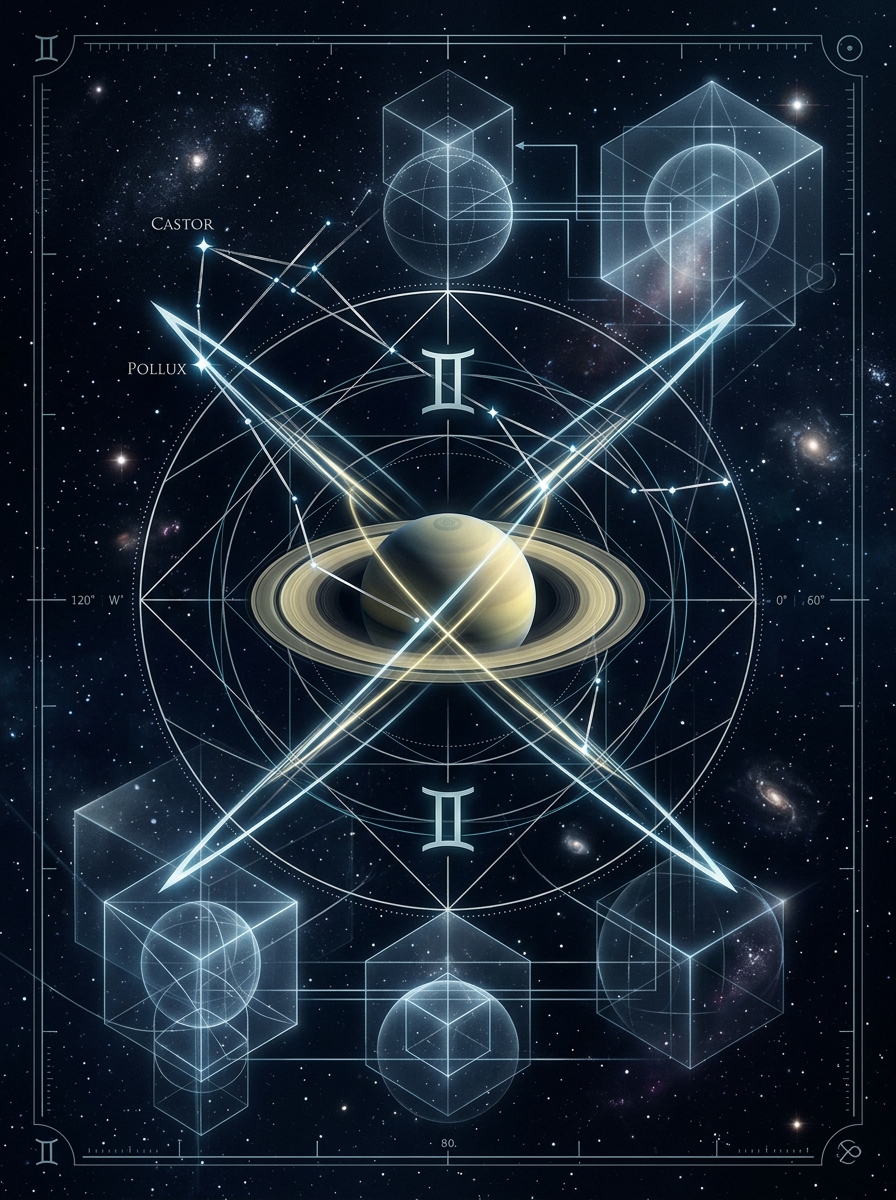
The Archetype of Saturn in Gemini: Blending Mercury's Airy Volatility with Saturn's Structure
To fully comprehend the astrological dynamics of Saturn in Gemini, one must first contemplate the profound cosmic collision between the winged trickster messenger and the stern, leaden architect of the zodiac. Gemini, ruled by the swift planet Mercury, represents the realm of mutable air—restless, inquisitive, associative, and endlessly seeking to connect disparate concepts. It is the archetype of the cosmic butterfly, tasting every flower of knowledge, driven by an insatiable curiosity that inherently resists boundaries, categorization, and finality. Gemini lives on the horizontal plane of information gathering, gathering data points, exchanging ideas, and revelling in the pure joy of mental agility and association.
When Saturn, the ancient lord of form, boundaries, contraction, and structural integrity, enters this volatile and breezy domain, the rules of the cognitive game are altered fundamentally. Saturn does not tolerate superficiality, nor does it allow for intellectual flightiness or easy shortcuts. It demands verticality, depth, discipline, and structural accountability. The light, airy curiosity of Gemini is suddenly forced into a crucible. Astrologer Liz Greene, in her seminal work Saturn: A New Look at an Old Devil, points out that Saturn's position in the natal chart represents the area where the individual feels most vulnerable and exposed, yet it is also the precise arena where they are compelled to build their most enduring structures through patient, conscious labor. In the sign of Gemini, this evolutionary challenge is located squarely within the mind.
This placement represents the alchemical fusion of the mercurial spirit within the cold, contracting Saturnian vessel. Without the influence of Saturn, Gemini’s mental energy can easily scatter into a million directions, resulting in nervous exhaustion, anxiety, and a collection of superficial, unconnected facts. Without Gemini’s fluid intellect, however, Saturn’s structures can turn rigid, dogmatic, authoritarian, and dry. Together, they require the individual to ground their intellectual pursuits, to move from mere gathering to synthesis. It is the process of crystallizing thought—of turning fleeting, ephemeral concepts into concrete structures of logic, language, literature, and functional form.
The Alchemical Vessel of the Mind
In the Western esoteric tradition, particularly within medieval alchemical philosophy, the mind is viewed as a vessel (vas hermeticum) that must hold highly volatile elements long enough for them to transform under intense heat. Mercury represents the volatile spirit (spiritus mercurialis), which is fluid, elusive, and naturally resistant to capture or confinement. Saturn represents the heavy, leaden container—the prima materia or the nigredo phase of decomposition and restructuring—which restricts, cools, and burns away the impurities of restlessness and superficiality.
For the individual born with Saturn in Gemini, the mind itself becomes this alchemical vessel. In early life, this configuration often feels like an oppressive weight. Thoughts do not flow with the easy, breezy rapidity that one might expect from a Gemini placement. Instead, they are subject to a heavy mental gravity. Every idea is tested, scrutinized, measured, and often rejected by the internal critic before it can even be expressed to the outer world. However, as maturity progresses, the Saturnian vessel stops being a prison and becomes a sacred laboratory. The volatility of the mercurial mind is stabilized, allowing for deep concentration, intellectual endurance, and the capacity to synthesize complex, disparate systems of thought into a unified, functional whole.
Mercury and Saturn: The Dance of Flight and Gravity
Steven Forrest, in his writings on evolutionary astrology, describes Saturn’s journey as a process of learning to accept limits in order to achieve true competence and mastery. When we look at the interaction between Mercury and Saturn, we see a dance between flight and gravity. Mercury wants to fly, to leap from branch to branch of the intellectual tree, collecting ideas without necessarily worrying about their long-term validity or cohesion. Saturn represents the pull of gravity, demanding that the roots of the intellectual tree be examined, tested, and structurally reinforced.
This tension creates a unique cognitive rhythm. The Saturn in Gemini individual may process information more slowly than their peers, not because they lack intelligence, but because they are sorting, cataloging, checking, and re-checking the structural integrity of every piece of data they receive. They are building a mental cathedral, brick by brick, whereas others might be content building temporary tents of opinion. This deliberate pace is a source of great strength, though it is often misjudged in a culture that values quickness and snappy soundbites over depth and meticulous accuracy.
Intellectual Maturity and the Weight of Words
As the individual matures, the relationship between Mercury and Saturn shifts from one of conflict to one of cooperation. The initial feelings of mental restriction and cognitive blockages give way to a structured discipline. The individual learns that words have weight, power, and real-world consequences. They begin to use language not as a plaything to pass the time or deflect emotion, but as a precise instrument of change, education, and organization.
This intellectual maturity manifests as a commitment to accuracy. The Saturn in Gemini person becomes a custodian of meaning, refusing to use words loosely or deceitfully. They understand that clarity of language is directly linked to clarity of consciousness. By embracing Saturnian discipline, they free their minds from the anxious chatter of unstructured thoughts, achieving a state of mental clarity that is both grounded and receptive to higher wisdom.
The Imposter Syndrome and Intellectual Autocritique: Facing Cognitive Insecurity
One of the most poignant and challenging manifestations of Saturn in Gemini is a profound, often hidden sense of cognitive vulnerability or intellectual inadequacy. Because Saturn represents the psychological domain where we feel tested, judged, and found wanting, those born with this placement frequently carry an unconscious, deep-seated fear that they are not smart enough, that their knowledge is fundamentally flawed, or that they will eventually be exposed as frauds. This is the classic, textbook signature of intellectual imposter syndrome.
In early childhood, this may have manifested as difficulties in school, speech impediments, reading struggles, learning differences, or simply feeling intellectually misunderstood or ignored by teachers, siblings, and peers. Even when the individual is exceptionally bright—as is often the case—they may harbor a stubborn belief that they do not possess "real" intelligence. This cognitive insecurity leads to an intense, persistent internal autocritique. The mind becomes its own harshest judge, analyzing every sentence spoken, written, or even thought for potential flaws, errors in logic, or signs of ignorance.
The Fear of Being Exposed
This internal critic is not merely a psychological nuisance; it is a defensive mechanism designed to prevent external humiliation. The logic of Saturn is preemptive and protective: "If I criticize myself first and find every flaw in my argument before anyone else does, I can never be caught off guard or exposed." Consequently, the individual may overprepare for meetings, research topics to the point of exhaustion, or remain completely silent during intellectual debates, even when they possess valuable insights that could resolve the issue at hand.
This fear of exposure can lead to a self-imposed isolation of the intellect. The individual may avoid writing, public speaking, or sharing their ideas, fearing that they will be judged as foolish or incompetent. The tragedy of this defense mechanism is that it hides the very gifts Saturn seeks to cultivate. The intellectual structure they build through their rigorous self-doubt is often far more robust and thoroughly researched than the superficial assertions of those who speak without thinking.
Overcoming the Inner Inquisitor
To heal this cognitive wound, the Saturn in Gemini individual must reframe their relationship with their inner critic. The goal is not to silence the critic completely—for Saturn's critical capacity is a vital tool for editing, refining, and ensuring accuracy—but rather to strip it of its emotional cruelty and paralyzing power. Carl Jung wrote extensively about the integration of the shadow, and for Saturn in Gemini, the shadow is the feared "stupid self" or the ignorant child.
By acknowledging this fear of intellectual inadequacy, the individual can begin to separate their core self-worth from their intellectual performance. They learn that making a mistake in logic, grammar, or fact is not a moral failing or a sign of worthlessness, but simply a normal, necessary part of the learning process. Over time, the inner inquisitor is transformed into an objective, compassionate editor—a helpful ally that ensures clarity and precision without paralyzing the creative or communicative impulse.
The Psychology of Astrological Insecurity
In psychological astrology, Saturn is seen as the shadow-maker. In Gemini, it casts a shadow over the functions of communication, learning, and logical deduction. The individual may look at others and assume they possess an ease of expression that is forever denied to them. They may envy the glib, the smooth-talkers, and the quick-witted.
However, this envy is merely the projection of their own undeveloped potential. The ease they see in others is often shallow, whereas the path Saturn demands of them is one of hard-won expertise. When the Saturn in Gemini individual realizes that their insecurity is actually the starting point for a lifelong quest for genuine knowledge, the nature of the placement changes. The insecurity becomes a driving force for meticulous scholarship, deep research, and the development of an authentic, authoritative voice.
The Myth of the Dioscuri: Bridging the Concrete Mind and Transcendental Logos through Silence
The astrological sign of Gemini is represented by the Twins, Castor and Pollux—the Dioscuri of Greek and Roman mythology. One twin, Castor, was mortal, born of a human father, representing the concrete, analytical, practical, and everyday mind that navigates the physical world, handles logistics, and categorizes sensory data. The other twin, Pollux, was immortal, fathered by Zeus, representing the divine intellect, the transcendental Logos, and the higher intuitive mind that perceives universal truths beyond language.
For those with Saturn in Gemini, the split between these two twins is deeply felt and represents a core spiritual and evolutionary lesson. The concrete mind (Castor) is often hyperactive, collecting facts, figures, and practical data to feel secure and in control. Yet, this endless collection of information can feel empty, disconnected from any higher meaning or spiritual truth. The transcendental Logos (Pollux) represents the deep, silent wisdom that transcends words. Saturn acts as the bridge between these two realms, using the discipline of silence and structured reflection to unite the mortal and immortal twins.
The Duality of the Twins: Castor and Pollux
In everyday life, the Saturn in Gemini individual may struggle to reconcile their need for practical, logical reasoning with their yearning for a deeper, more spiritual understanding of the universe. They may find themselves trapped in the details, unable to see the forest for the trees. Or conversely, they may escape into abstract theories and intellectual systems, using words as a shield to avoid feeling the raw reality of life.
The myth of the Dioscuri reminds us that Castor and Pollux shared their immortality; when one was in the underworld, the other was in the heavens, alternating days. This speaks to the necessity of rhythm, balance, and integration. The analytical mind must serve the higher truth, and the higher truth must be grounded in practical, everyday reality. Saturn enforces this balance by restricting the easy, superficial pathways of communication, forcing the individual to seek a deeper integration of both aspects of the mind.
The Sacred Art of Silence
Silence is the ultimate Saturnian tool for Gemini. In a world saturated with noise, chatter, and constant, rapid communication, the Saturn in Gemini individual is called to master the sacred art of silence. This is not the silence of repression, fear, or punishment, but the deliberate, constructive silence of listening, contemplation, and receptivity.
Through silence, the constant, anxious chatter of the mortal twin (Castor) is stilled, allowing the quiet, profound voice of the immortal twin (Pollux) to be heard. It is in the spaces between words, in the pauses of conversation, and in the quiet of a focused mind that true wisdom is crystallized. Liz Greene notes that when Saturn restricts speech, it is often to ensure that when the individual finally does speak, their words carry the weight of real authority, truth, and purpose.
The Logos in Western Esotericism
In the Western esoteric tradition, the concept of the Logos is central. It is the divine word, the ordering principle of the cosmos. Aleister Crowley, in his writings on the tarot and astrology, associated Mercury with the Magus, the channel of the Logos. When Saturn influences this channel, the responsibility of transmitting the Logos becomes immense.
The Saturn in Gemini individual must learn that they are not the authors of truth, but its translators. They must prepare their minds through discipline so that they can accurately transmit the higher laws of the cosmos. This requires them to move beyond personal opinions, gossip, and mental chatter, and instead align their intellect with the objective, universal truths of the Logos. This alignment is only possible when the mind has been quieted and structured by Saturnian discipline.
Career Manifestations: Excellence in Technical Writing, Editing, and Precise Communication
While Saturn in Gemini presents significant psychological challenges, it also bestows extraordinary gifts when these challenges are met with discipline, patience, and practice. In the professional sphere, this placement is a classic indicator of excellence in fields that require precision, structure, logical organization, and absolute clarity of thought.
Because they have spent years analyzing, doubting, and refining their own cognitive processes, Saturn in Gemini individuals often develop an unparalleled mastery of language. They make exceptional editors, technical writers, researchers, translators, curriculum designers, and educators. They possess the rare and valuable ability to take complex, chaotic, or highly abstract information and organize it into clear, accessible, and structured formats.
Navigating the Modern Information Economy
In our modern information economy, where data is abundant but clarity is scarce, the skills of the Saturn in Gemini individual are highly sought after. They are the ones who can look at a mountain of unorganized data and extract the essential narrative. They do not get lost in the noise; instead, they filter out the irrelevant information and build a logical framework that others can follow.
Their professional value lies in their reliability and rigor. They do not publish unverified information, nor do they rely on emotional rhetoric to make a point. They demand evidence, logical consistency, and precise terminology. In a professional setting, they are the ones who catch the errors in the contract, refine the messy draft into a polished manuscript, or design the logical workflow that keeps a team organized and efficient.
| Professional Area | Saturnian Strength | Gemini Application |
|---|---|---|
| Technical Writing & Editing | Structural integrity, precision, elimination of fluff | Translating complex data into clear manuals and guides |
| Research & Journalism | Fact-checking, rigor, objective analysis | Investigating stories, cataloging historical data |
| Education & Curriculum Design | Structured learning paths, patience, discipline | Breaking down complex subjects for students |
| Law & Contractual Analysis | Attention to detail, spotting logical loopholes | Drafting precise legal documents and arguments |
| Database Architecture | System design, categorization, logical relationships | Organizing large structures of digital information |
The Master of the Written Word
As writers, Saturn in Gemini individuals are rarely verbose or flowery. Instead, their style is characterized by economy, clarity, and precision. They believe that every word must earn its place on the page. This makes them exceptionally suited for technical writing, medical writing, and editing, where ambiguity can have serious real-world consequences.
In the realm of editing, they are unmatched. They can see the underlying structure of a piece of writing and identify where the logic breaks down or where the narrative wanders. They are not afraid to cut away the fluff, helping other writers find their true voice by stripping away the unnecessary noise. This process of editing is a perfect metaphor for the Saturnian work: finding the essential form by removing the superfluous.
Integrating Saturn in Gemini: Moving from Mental Anxiety to Communicative Mastery
The ultimate goal of the Saturnian journey is not merely to cope with our insecurities, but to transform them into our greatest strengths and sources of authority. For Saturn in Gemini, this means moving from a state of chronic mental anxiety, self-doubt, and fragmented communication to a place of intellectual authority, inner quietude, and communicative mastery.
This integration requires a conscious effort to change how one relates to the mind and the nervous system. The individual must learn to treat their thoughts not as absolute truths, but as hypotheses that can be tested, refined, or discarded. They must also learn to ground their nervous energy through physical practices, as the hyperactive mental state of Gemini can easily deplete the physical vitality of the Saturnian body, leading to burnout and chronic fatigue.
Calming the Storm
To calm the mental storm of Saturn in Gemini, one must address both the mind and the body. Because Gemini is an air sign, its energy tends to rise into the head, causing a disconnect from the physical body. Saturn, as an earth-like structuring force, demands that this energy be grounded.
Physical practices such as yoga, walking in nature, and somatic therapy are essential for grounding this nervous energy. When the body is grounded, the mind naturally follows, reducing the frequency of anxious, looping thoughts. Additionally, establishing a consistent daily routine provides a Saturnian container that helps to stabilize the mutable, unpredictable energy of Gemini.
The Shift to True Intellectual Authority
The transition from intellectual insecurity to authority is marked by a shift in motivation. In the early stages, the individual communicates to prove themselves, to hide their flaws, or to gain validation. This keeps them trapped in a cycle of anxiety and performance.
When integrated, the individual communicates to serve. They speak because they have researched a topic deeply, structured their thoughts carefully, and believe the information is of genuine value to others. This service-oriented approach removes the ego-driven fear of failure. They no longer worry about being judged; instead, they focus on being clear, helpful, and accurate. They have transformed the lead of mental anxiety into the gold of true wisdom.
Practical Steps for Integration
To facilitate this integration, several practical habits can be cultivated:
- Structured Writing Practices: Keeping a journal, writing essays, or engaging in technical writing helps to externalize and organize the chaotic flow of thoughts. Giving form to thoughts on paper reduces internal mental pressure.
- Mindfulness and Silence: Dedicating time each day to silence, meditation, or breathwork helps to calm the nervous system and quiet the hyperactive analytical mind.
- Intellectual Specialization: Rather than trying to know everything (a common Gemini trap), focusing deeply on a few specific subjects allows Saturn to build genuine expertise and authority.
- Active Listening: Shifting the focus from "what am I going to say next" to deep, receptive listening allows the individual to connect more authentically with others, bypassing the fear of performance.
- Vocal Expression: Engaging in activities that require controlled, structured use of the voice—such as public speaking classes, singing, or reading aloud—helps to overcome the fear of speaking and builds confidence.
The Saturn Return in Gemini: The Great Intellectual Initiation
The Saturn Return, occurring approximately every twenty-nine and a half years, is a major cosmic initiation. It is the time when Saturn returns to the exact position it occupied at the moment of our birth, demanding a rigorous accounting of our lives, our choices, and our alignment with our true path. For those with Saturn in Gemini, the Saturn Return is an intellectual and communicative initiation, forcing them to confront their cognitive habits, intellectual insecurities, and the way they relate to truth.
During this period, the structures of the mind are thoroughly tested. Any intellectual defenses, superficial belief systems, or habits of deceptive or scattered communication will be exposed and dismantled. The individual may experience situations that force them to speak up under pressure, defend their ideas, or conversely, remain silent and listen when they would rather speak.
The First Saturn Return (Ages 28-30)
The first Saturn Return is often felt as a period of crisis and restructuring. For Saturn in Gemini, this crisis is typically centered around career, education, and voice. The individual may realize that the intellectual path they have followed was chosen to please parents or conform to societal expectations, rather than reflecting their true interests.
They may feel a strong urge to go back to school, change careers, or finally write the book they have been putting off for years. The universe demands that they take their mind seriously. This return forces them to discard the superficial opinions of others and begin the hard work of building their own intellectual authority.
The Second Saturn Return (Ages 58-60)
The second Saturn Return is a time of consolidation and elderhood. For those with Saturn in Gemini, it is a period where they are called to step fully into the role of the teacher, mentor, or wise elder. The insecurities of youth have largely been integrated, and the individual now possesses a wealth of structured knowledge and experience.
During this return, they may focus on passing down their knowledge to the next generation, writing memoirs, or designing educational programs. The challenge here is to avoid intellectual rigidity, ensuring that while their knowledge is structured, their mind remains open to new ideas and perspectives.
Navigating the Initiation
To navigate the Saturn Return in Gemini successfully, one must practice radical honesty. This is not the time for mercurial evasions or clever excuses. The individual must look honestly at where they have allowed fear to silence them, and where they have used chatter to avoid deep reflection.
By facing these patterns with courage and discipline, the Saturn Return becomes a powerful catalyst for growth. The individual emerges from the initiation with a grounded, resilient mind, a clear sense of intellectual purpose, and a voice that is ready to speak with genuine authority.
Frequently Asked Questions
Does Saturn in Gemini make a person less intelligent?
Absolutely not. Saturn does not limit intelligence; it limits the ease, speed, and confidence of cognitive processing and communication in the early stages of life. While someone with Saturn in Gemini might have felt slow, struggled with traditional learning environments, or faced learning differences in their youth, this placement often produces a deep, highly structured, and rigorous intellect in adulthood. Their intelligence is built on solid, tested foundations, making it far more durable and reliable than superficial quickness. They do not merely memorize facts; they understand the structural relationships between them.
How does this placement affect personal relationships and communication?
Saturn in Gemini can make an individual cautious, reserved, or formal in their communication, especially with new acquaintances or in public settings. They may struggle with small talk, finding it superficial, exhausting, or anxiety-inducing. In relationships, they value intellectual honesty, clear agreements, and meaningful, structured conversations. They must guard against using intellectual analysis or excessive debate as a way to avoid emotional vulnerability, intimacy, and the non-verbal expressions of love.
What is the difference between Saturn in Gemini and Saturn in the 3rd House?
While they share many structural similarities, Saturn in Gemini is a sign placement, coloring the psychological style, cognitive processing, and overall archetype of the mind. Saturn in the 3rd House is a house placement, focusing the Saturnian lessons of structure, limitation, and responsibility specifically on the concrete environments of daily communication, siblings, local community, primary education, and short-distance travel. When both occur together, these themes are doubly emphasized, pointing to a life path deeply centered on mastering communication.
Can Saturn in Gemini lead to chronic anxiety or OCD?
The combination of Gemini's highly active nervous energy and Saturn's intense desire for control and perfection can manifest as cognitive anxiety, circular thinking, or a tendency to obsess over details. If the individual tries to control their external world by hyper-analyzing every variable, it can lead to OCD-like behaviors, analysis paralysis, or chronic worry. Integrating physical grounding techniques, mindfulness, and accepting that absolute control is an illusion are key to alleviating these symptoms and finding mental peace.
What are the best creative outlets for this placement?
Writing is the premier creative and therapeutic outlet for Saturn in Gemini. Whether it is journaling, writing poetry with strict structures (such as sonnets or villanelles), technical writing, or editing, the physical act of organizing thoughts on a page is highly grounding. Other excellent outlets include learning a new language, studying formal logic or philosophy, playing games that require strategic thinking (like chess), or teaching structured classes where they can share their hard-won expertise with others.
Comments
Loading comments…