Venus in Pisces: The Art of Exalted Devotion and Unconditional Love
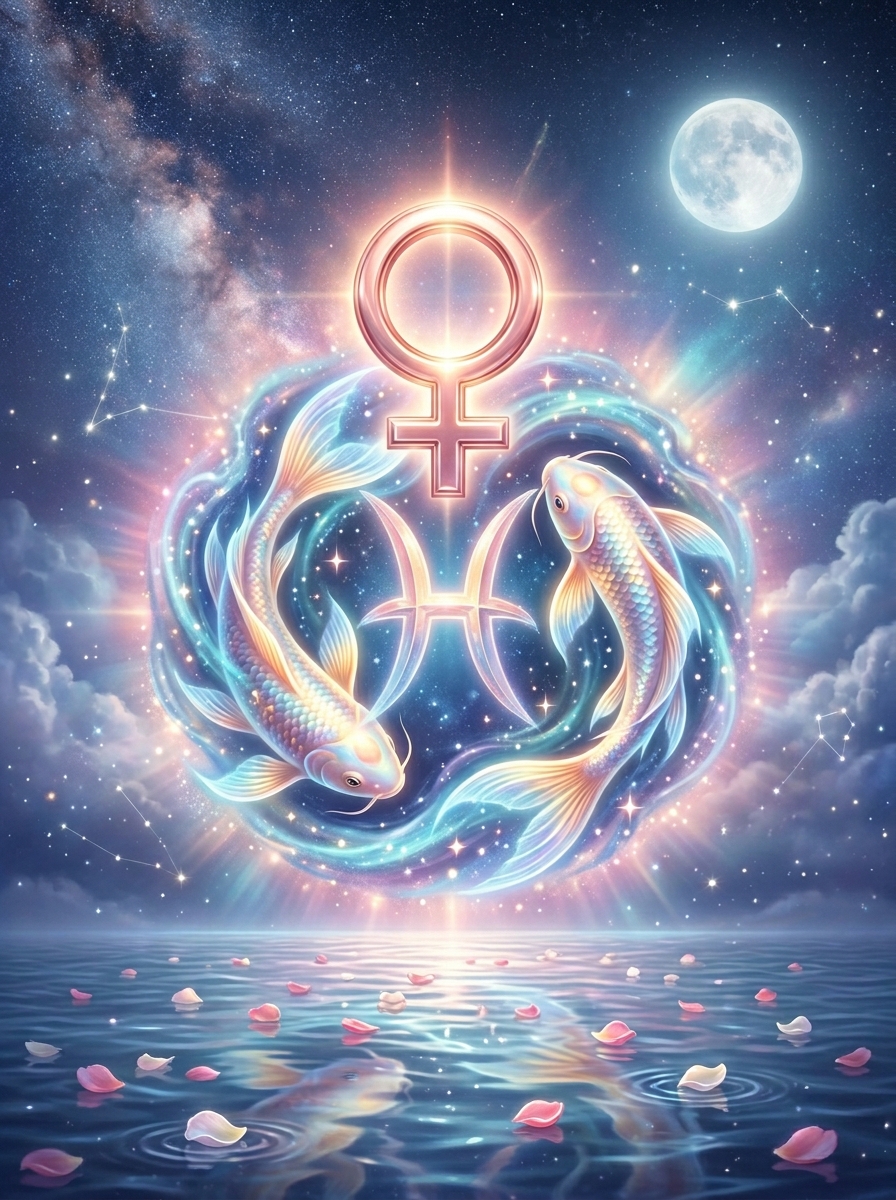
Venus in Pisces as the Exalted Archetype: The Oceanic Feeling
In the grand, complex architecture of psychological and esoteric astrology, the planetary placements in the natal chart are not merely arbitrary indicators of personality traits or simple behavioral habits. Instead, they represent dynamic, living expressions of archetypal energy operating across various levels of human consciousness. When we examine the placement of Venus in Pisces, we are analyzing the planet of love, relational values, personal aesthetics, and social harmony operating within the mutable water sign of its traditional and modern exaltation. In the classical system of planetary dignities, Venus finds her absolute zenith, her highest and most refined expression, in the deep, boundaryless waters of Pisces. To fully understand why the goddess of beauty and connection ascends to her peak in the sign of the Fish, we must explore the spiritual, mythological, and psychological mechanics of both the planet and the sign, looking past superficial romantic definitions and diving into the depths of esoteric philosophy.
The Traditional Exaltation of Venus
In traditional astrology, Venus is the planet of attraction, relational balance, and value. She represents the universal force that draws separate entities together, establishing harmony, pleasure, and mutual benefit. When placed in Taurus or Libra, her signs of domicile, Venus operates in a grounded, structural, or social manner. Taurus brings her down to the sensory, physical world of touch, comfort, and material stability, while Libra elevates her to the realm of social contracts, intellectual fairness, and transactional equilibrium.
However, it is in Pisces—a sign ruled traditionally by Jupiter and modernly by Neptune—that Venus reaches her exaltation. Here, the boundaries of the self, which Libra seeks to balance and Taurus seeks to secure, are completely dissolved. Pisces is the vast ocean of collective consciousness, the realm of the undifferentiated source where all things originate and to which all things must eventually return. By placing Venus in this watery matrix, her capacity for love is freed from the constraints of ego, transaction, and physical limitation. In Pisces, Venus is no longer concerned with whether a relationship is fair, equal, or secure; she is concerned only with the absolute realization of unity. This is the love that Carl Jung associated with the transcendent function—the capacity of the psyche to bridge opposing forces and experience a higher state of wholeness. Esoteric writer Liz Greene notes that Venus in Pisces represents the longing of the individual soul to return to the primal womb of existence, a longing that is projected onto the human beloved, transforming the partner into a symbol of the divine.
This yearning for spiritual fusion means that Venus in Pisces individuals often experience romantic encounters as sacred events. For them, love is not a contract, nor is it a game of mutual benefits. It is a form of mysticism. The beloved is no longer merely a human partner with flaws and temporal constraints; they become a portal to the divine. Under the influence of Neptune's tide, personal affection is elevated into spiritual adoration. The danger, of course, lies in the fact that no mortal partner can indefinitely carry the weight of a divine archetype. When the mundane realities of life interfere, the transition from sacred ecstasy to disillusioned grief can be swift and painful. Yet, at its best, this placement brings a rare capacity for grace, forgiveness, and absolute empathy to a world too often dominated by relational pragmatism.
The Concept of the "Oceanic Feeling"
To appreciate the psychological reality of Venus in Pisces, we must reference the concept of the "oceanic feeling," a term originally coined by the French writer Romain Rolland in a letter to Sigmund Freud in 1927, and later analyzed by Freud in Civilization and Its Discontents and integrated by Carl Jung into his studies of the collective unconscious. Rolland described it as a sensation of "eternity," a feeling of an indissoluble bond, of being one with the external world as a whole. For the individual with Venus in Pisces, this oceanic feeling is the very foundation of their relational psychology. They do not seek a simple partnership or a standard domestic arrangement; they seek a spiritual merger, a state of emotional fusion where the boundary between "self" and "other" ceases to exist.
This desire for absolute fusion is not merely a romantic whim; it is a profound metaphysical urge. When Venus in Pisces enters a relationship, they experience the connection as a sacred container. The partner is not merely a collection of human traits, virtues, and flaws; they are a holy portal. The Venus in Pisces individual projects their internal image of the divine—the anima or animus, in Jungian terms—directly onto the beloved. Through this projection, the mundane details of daily life are infused with a mystical glow. Every glance, every silence, and every shared moment is charged with symbolic significance, reminiscent of the evocative imagery found in the Rider-Waite-Smith Tarot, where the Suit of Cups represents the flow of divine grace through human emotion. In this state of exaltation, Venus in Pisces is capable of extraordinary selflessness, empathy, and forgiveness. They see the underlying divine spark within the partner, looking past their temporary human failures with a compassionate gaze that few other placements can emulate. Yet, this exaltation contains the seeds of its own tragedy, for the human container is fragile, and the ocean is vast and indifferent to the boundaries required for survival in the material world.
Romantic Expression and the Intuitive Flirting Style
The way Venus in Pisces expresses romance and initiates courtship is a complete departure from the assertive, direct styles associated with fire or air signs. Because they operate on a fluid, emotional frequency, their method of attraction is subtle, highly intuitive, and deeply energetic. They do not conquer, nor do they negotiate; instead, they invite, absorb, and dissolve.
Subtle Signals and Energetic Flirting
For Venus in Pisces, the art of flirting is an exercise in emotional osmosis. They do not rely on scripted pick-up lines, structured dates, or overt displays of confidence. Instead, they communicate through a silent, psychic language of micro-expressions, shared pauses, and energetic receptivity. When they are attracted to someone, they create an invisible field of absolute acceptance around that person. A Venus in Pisces individual will sit with you and listen to your deepest vulnerabilities with a gaze that is completely free of judgment, making you feel as though you are the only person in a crowded room.
This flirting style is receptive rather than active. They attract others by allowing themselves to be deeply affected by them. They reflect your emotions back to you like a still lake, creating an immediate, uncanny sense of intimacy and familiarity. It is a form of magnetic vulnerability; by showing their own soft, unguarded edges, they disarm the defenses of others. They are masters of the unspoken, operating in the subtle spaces of shared glances, gentle touches that linger just a moment too long, and a quiet presence that feels like a refuge from the harshness of the outside world. This highly intuitive approach allows them to read the emotional landscape of a room or a person instantly, adjusting their presentation to match the unexpressed desires and emotional deficits of the person they wish to attract. They do not need to speak their love; they radiate it, leaving the target of their affection wrapped in an atmosphere of warmth that is difficult to define but impossible to ignore.
Attracting the Vulnerable and Artistic Soul
Because of their natural resonance with suffering and beauty, Venus in Pisces individuals are magnetically drawn to—and attract—partners who are either highly creative, deeply sensitive, or visibly wounded. They are the patrons of the misunderstood artist, the silent poet, and the struggling soul. In their psychological framework, vulnerability is the only true currency of genuine connection. They are often bored by conventional displays of strength, wealth, or social status; instead, they are captivated by a person’s cracks, their unresolved grief, and their raw, unvarnished humanity.
This attraction is rooted in a deep-seated belief that love is a redemptive force. To Venus in Pisces, a partner who is perfect and put-together offers no space for the transformative power of devotion. They want to heal, to soothe, and to elevate. They see the latent potential in an artistic soul who is struggling to find their footing in a materialistic world, or they feel a profound, karmic obligation to hold space for someone carrying a heavy emotional burden. While this can lead to incredibly rich, soulful, and creative partnerships where both individuals inspire each other to reach new spiritual heights, it also sets a dangerous trap. By constantly seeking partners who need saving, Venus in Pisces risks turning their relationships into clinics, placing themselves in the role of the infinite healer while neglecting their own human limitations.
The Devotional Dimension of Venusian Love
To truly comprehend Venus in Pisces, one must examine the concept of devotion. In a modern culture that often views relationships through the lens of transactional psychology—focusing on mutual benefit, emotional return on investment, and personal growth metrics—Venus in Pisces stands as an archaic, radical anomaly. For this placement, love is not a contract; it is a devotional practice, a form of active mysticism.
Total Devotion and Sacred Unions
When Venus in Pisces commits to a partner, their devotion is total and absolute. They do not hold back reservations, nor do they maintain a calculated distance to protect themselves from potential heartbreak. They throw open the gates of their emotional sanctuary, inviting the partner to enter fully. This devotion is expressed through a constant, gentle flow of empathy, care, and absolute loyalty. They are the partners who will stand by you during your darkest hours, offering a steady, unshakeable love that does not depend on your performance, your mood, or your worldly success.
This level of devotion is reminiscent of the spiritual discipline of Bhakti yoga, where the devotee seeks union with the divine through intense, personal love and surrender. For Venus in Pisces, the relationship is a sacred site. They view the bond as something larger than the sum of its parts, an independent entity that must be tended to with reverence. They express their love through quiet, often invisible acts of sacrifice—staying awake to comfort a distressed partner, adapting their plans to accommodate the other's emotional needs, or offering forgiveness for transgressions that would end more transactional relationships. They believe, with a fierce, quiet conviction, that love is the ultimate reality, and that any sacrifice made in its service is inherently valuable. They do not keep a ledger of who did what; they give because the act of giving itself is the source of their joy and spiritual alignment.
The Search for the Divine in the Mundane
This devotional drive means that Venus in Pisces is constantly searching for the divine within the ordinary routines of life. They want to infuse the daily grind of domesticity with a sense of magic and sacredness. A simple dinner is transformed into a ritual of connection; a casual conversation is steered toward the mystical, the psychological, or the existential. They are deeply sensitive to the spiritual atmosphere of their home and their relationships, striving to maintain an environment of peace, beauty, and emotional safety.
However, this search for the divine in the human partner carries significant psychological risks. Human beings are, by definition, limited, flawed, and inconsistent. When the partner inevitably acts out, shows selfishness, or displays the mundane limitations of their humanity, Venus in Pisces experiences a profound, existential shock. They may feel as though the temple has been defiled, retreating into a quiet, sorrowful mourning. To sustain their devotion, they must learn to bridge the gap between the archetypal divine love they feel and the messy, imperfect reality of human connection, recognizing that true devotion lies in loving the flawed human being, not just the pristine archetype.
Ethereal Aesthetics and Non-Materialistic Values
The influence of Venus extends beyond romance into the realms of aesthetics, art, personal taste, and our relationship with the material world. For Venus in Pisces, these areas are characterized by a rejection of the hard, concrete realities of the physical plane in favor of the fluid, the atmospheric, and the imaginative.
Dreamlike Aesthetics: Colors, Textures, and Sanctuaries
In their visual preferences, Venus in Pisces individuals avoid the rigid, geometric structures of ultra-modern minimalism, as well as the heavy, ostentatious displays of wealth and status. Instead, they gravitate toward an aesthetic that is ethereal, soft-focus, and evocative of other realms. They want their visual environment to feel like a dream, a painting by the Impressionists, or a quiet, mist-covered shore.
Their style is characterized by:
- Flowing, Sensual Fabrics: They prefer garments made of silk, chiffon, soft knits, and vintage lace—materials that move with the wind and blur the physical silhouette.
- Aquatic and Muted Tones: They are drawn to seafoam green, ocean blue, soft lavenders, pearlescent whites, and iridescent textures that shift and change under different lighting.
- Atmospheric Interiors: Their living spaces are designed as sanctuaries from the noise of the world. They favor soft, indirect lighting, an abundance of candles, diffuse scents of sandalwood or jasmine, and art that depicts mythological themes, vast oceans, or abstract dreamscapes.
- Nostalgic and Antique Elements: They love objects that carry a history, items that feel as though they have washed up from a bygone era, bringing a sense of nostalgia and timelessness into their daily lives.
For Venus in Pisces, aesthetics are not about showing off or conforming to fashion trends. It is about creating an emotional frequency. They dress and decorate to induce a state of mind, using color, texture, and light to build a sanctuary where their sensitive nervous systems can rest and dream.
Wealth as Flow: The Non-Materialist Financial Stance
Just as their aesthetics transcend the physical, their relationship with money and material possessions is characterized by a high degree of idealism and detachment. Venus in Pisces does not view money as a tool for personal power, social dominance, or rigid security. Instead, they view it as a fluid, energetic resource—something that should flow, like water, to where it is needed most.
They possess an instinctual, non-materialistic attitude toward wealth. They are remarkably generous, often giving money to friends in need, donating to charitable causes, or funding artistic projects without expecting anything in return. In their minds, hoarding wealth is a form of spiritual stagnation; it blocks the natural flow of abundance. They trust, sometimes to a degree that looks like financial naivety to more grounded placements, that the universe will provide for them as long as they remain in the flow of giving and receiving.
While this attitude brings a beautiful, stress-free relationship to the material world, allowing them to remain uncorrupted by greed, it can also lead to practical difficulties. Without a grounding influence, Venus in Pisces can struggle with financial boundaries. They may allow others to take advantage of their generosity, fail to plan for their own future security, or avoid looking at their financial realities because the concrete details of budgets and bills feel too harsh and restrictive. They must learn that managing money is not a betrayal of their spiritual values, but a practical way to protect their sanctuary and sustain their capacity to help others.
Shadow Work: The Pitfalls of Idealization, Martyrdom, and Codependency
Every astrological exaltation carries a corresponding shadow of equal magnitude. For Venus in Pisces, the very traits that make them capable of sublime connection—boundless empathy, emotional fluidity, and spiritual idealism—are also the source of their deepest psychological wounds. Without conscious shadow work, this placement can lead to cycles of self-abandonment, disillusionment, and relational trauma.
The Savior-Martyr Trap and the Vulnerable Partner
The most common relational pattern for Venus in Pisces is the savior-martyr dynamic. Driven by their intense empathy and their attraction to vulnerability, they frequently enter relationships with individuals who are struggling with addiction, unresolved trauma, severe emotional instability, or a general inability to navigate the demands of adult life. Venus in Pisces projects onto these partners the archetype of the "noble, wounded soul," believing that their unconditional love, patience, and sacrifice can heal the partner's deep-seated wounds.
This belief is a form of spiritual hubris. In this dynamic:
- The Savior Phase: Venus in Pisces gladly takes on the emotional, practical, and sometimes financial burdens of the partner, believing that by doing so, they are performing a sacred act of devotion. They tolerate poor treatment, excuse irresponsible behavior, and ignore their own warning signs, convinced that their love will eventually break through the partner's defenses.
- The Transition to Martyrdom: As time passes and the partner fails to heal or take responsibility, the savior role transitions into that of the martyr. Venus in Pisces begins to suffer silently, carrying the weight of the relationship alone. They wear their suffering as a badge of spiritual honor, believing that the depth of their pain is proof of the depth of their love.
- The Codependent Loop: The relationship becomes locked in a codependent cycle. Venus in Pisces needs the partner’s vulnerability to feel valuable and spiritually aligned, while the partner relies on the lack of boundaries to avoid growing up. This loop erodes the self-esteem of both individuals, preventing genuine intimacy and replacing it with a mutual addiction to crisis and rescue.
To dismantle this trap, the Venus in Pisces individual must realize that healing cannot be forced upon another person. They must learn to recognize when their desire to help is actually an attempt to control the relationship's outcome or avoid looking at their own internal wounds.
Psychological Projection: Anima, Animus, and Fantasy
At the core of the Venus in Pisces shadow is the mechanism of psychological projection. As Carl Jung extensively documented, projection occurs when the ego refuses to integrate its own unconscious contents and instead sees them reflected in external objects or people. Venus in Pisces has a natural, deep connection to the divine, the mystical, and the transcendent. However, rather than developing their own spiritual life or creative expression, they often project these qualities onto their romantic partners.
They do not fall in love with the actual person standing in front of them; they fall in love with a fantasy, a romantic mirage of their own creation. They paint a beautiful, Neptunian portrait over the reality of the partner, ignoring any evidence that contradicts their vision. When the partner acts in a way that shatters this image, Venus in Pisces experiences a devastating sense of betrayal and disillusionment. Instead of accepting the reality, they may retreat further into fantasy, using daydreaming, escapism, or denial to avoid the painful truth that their partner is merely human.
To heal this pattern, Venus in Pisces must engage in rigorous shadow work. They must recognize that the beauty, peace, and spiritual depth they seek in their partners are actually qualities of their own soul. By reclaiming their projections, they can develop a rich internal life and allow their partners to be human, free from the impossible demand to act as a living god.
The Virgo-Pisces Axis: A Path to Integration and Boundaries
In astrology, no sign stands alone. Each sign is part of a polarity, an axis of opposing yet complementary energies that must be integrated to achieve psychological wholeness. For Venus in Pisces, the path to balance and healthy relationships lies in the integration of its polar opposite: Virgo.
Discernment: The Virgoan Anchor
Pisces is the sign of the infinite, the boundless, and the universal. Virgo is the sign of the finite, the detailed, and the practical. While Pisces seeks to dissolve boundaries and merge with the universe, Virgo seeks to analyze, categorize, and define. For Venus in Pisces, Virgo represents the necessary anchor that prevents their relational life from dissolving into a chaotic, boundaryless sea.
The primary lesson Virgo offers to Venus in Pisces is discernment. Pisces sees the divine spark in everyone and concludes that everyone is safe, trustworthy, and worthy of immediate emotional intimacy. Virgo, on the other hand, looks at the concrete evidence of a person's behavior, asking:
- "Is this person's behavior aligned with their words?"
- "Do they respect my emotional and physical space?"
- "Is this relationship sustainable on a day-to-day level, or is it supported only by intermittent moments of fantasy?"
Integrating Virgoan energy means learning to look at relationships with objectivity and critical thinking. It involves recognizing that while all souls may be spiritually equal, not all human personalities are safe to let into one's inner sanctuary. Discernment is not a rejection of love; it is the practical application of love to protect the self and ensure that one’s energy is invested in connections that are mutually supportive and healthy.
Constructing Sacred Boundaries
The ultimate synthesis of the Virgo-Pisces axis is the creation of what can be called "sacred boundaries." To Venus in Pisces, the word "boundary" often feels like a threat—a cold, isolating wall that cuts them off from the magic of connection. They fear that setting boundaries is a form of selfishness or a rejection of their devotional values.
Virgo teaches them that boundaries are actually the ultimate act of love and service. A boundary is not a wall to keep people out; it is a gate that determines who and what has access to your energy. Without boundaries, Venus in Pisces becomes overwhelmed by the emotional currents of the world, absorbing the stress, trauma, and demands of others until they are depleted, resentful, and unable to offer genuine support.
By setting clear boundaries, Venus in Pisces preserves their energetic integrity. They learn to say "no" to behaviors and relationships that drain their spirit, recognizing that by doing so, they are preserving their capacity to say a deep, meaningful "yes" to connections that are healthy and reciprocal. They transition from the role of the martyr, who gives out of depletion and resentment, to the integrated healer, who gives out of a genuine, grounded abundance. This integration allows their Neptunian ideals to find a practical, Virgoan expression in the physical world, turning their romantic dreams into stable, beautiful realities.
The Role of Venus in Pisces in Synastry and Compatibility
When analyzing astrological compatibility—the art of synastry—having Venus in Pisces creates a unique set of relational dynamics. Because this placement seeks a deep, soul-level union, their compatibility with other charts depends on how well the partner's planets can receive, ground, or reciprocate this intense watery energy.
Compatibility with Water and Earth Signs
Venus in Pisces finds immediate emotional resonance with the other water signs:
- Cancer: This is a deeply nurturing connection. Both placements value emotional safety and intimacy. Cancer provides the protective, domestic container that allows Venus in Pisces to express their vulnerability, while Pisces brings a sense of spiritual magic that elevates Cancer's daily routines.
- Scorpio: This is a connection of intense psychological depth and passion. Scorpio seeks absolute loyalty and emotional truth, which aligns perfectly with Pisces' desire for complete fusion. Together, they can build a private, highly intuitive world that feels impenetrable to outsiders.
- Taurus: As the opposite sign of Scorpio and a domicile of Venus, Taurus provides a beautiful, grounding presence for Venus in Pisces. Taurus helps bring the Piscean ideals down to earth, offering stability, sensory pleasure, and a reliable physical foundation that keeps Pisces from drifting away.
- Capricorn: The structure and ambition of Capricorn provide a solid, protective anchor for the fluid energy of Pisces. Capricorn values the loyalty and softness of Venus in Pisces, while Pisces helps soften the rigid edges of Capricorn, showing them the value of vulnerability.
Challenges with Air and Fire Signs
Conversely, relationships with fire and air signs can present significant challenges:
- Aries and Sagittarius: Fire signs express love through action, independence, and adventure. The boundaryless, sensitive nature of Venus in Pisces can feel overwhelming or clingy to fire signs, while Pisces may perceive fire's directness and independence as coldness or rejection.
- Gemini and Libra: Air signs operate in the mental, social, and communicative realms. They seek intellectual stimulation and social flexibility. The deep, emotional, and non-verbal fusion sought by Venus in Pisces can be difficult for air signs to comprehend, leading to a sense of disconnect where Pisces feels misunderstood and the air sign feels emotionally smothered.
Frequently Asked Questions
What does it mean to have Venus in Pisces in a natal chart?
Having Venus in Pisces in a natal chart means that your values, aesthetic tastes, relationship style, and capacity for love are expressed through the mutable water element of Pisces. You likely seek relationships that offer deep emotional and spiritual connection, valuing empathy, devotion, and mutual understanding over transactional security. You have a natural appreciation for ethereal beauty, art, and music, and you possess a highly compassionate, non-materialistic outlook on life.
Why is Venus considered "exalted" in Pisces?
Venus is considered exalted in Pisces because the sign's boundless, Neptunian nature provides the ideal environment for the planet's highest values. While Venus seeks connection and harmony, Pisces dissolves the ego boundaries that separate us, allowing love to expand from personal affection into unconditional, universal devotion. In Pisces, Venus is freed from the need for material guarantees or social contracts, expressing love in its purest, most spiritual form.
How does someone with Venus in Pisces behave when they are in love?
When in love, someone with Venus in Pisces displays total emotional devotion and a high degree of empathy. They are incredibly sensitive to their partner's emotional state, often sensing their needs before they are spoken. They show affection through quiet acts of selflessness, creative expression, and by establishing a peaceful, accepting sanctuary for their partner. They are deeply romantic, treating the relationship as a sacred bond and seeking a state of profound emotional and spiritual fusion.
What are the primary relationship challenges for this placement?
The primary challenges include a tendency to idealize partners, projection, falling into savior-martyr dynamics, and struggling to set healthy boundaries. Venus in Pisces individuals often fall in love with a person's potential or a romantic fantasy rather than the reality of who they are. This makes them vulnerable to codependent loops, tolerating unacceptable behavior, and experiencing severe disillusionment when the fantasy inevitably cracks under the pressure of daily life.
How can a Venus in Pisces individual establish healthy boundaries without losing their romance?
A Venus in Pisces individual can establish healthy boundaries by integrating the qualities of their opposite sign, Virgo. They must learn that boundaries are not barriers to love, but practical tools that protect their energy and allow romance to exist in a safe, sustainable container. They can practice discernment by observing a partner's concrete actions rather than their words or potential, and recognize that saying "no" to toxic behavior is a form of self-love that preserves their capacity for genuine devotion.
Related
- Venus in Virgo: Love as a Practical Craft
- Sun in Libra, Moon in Pisces: The Archetype of the Empathetic Artist
- Venus in Capricorn: The Architecture of Mature Love
- Saturn in Pisces: The Alchemical Vessel of the Soul
- Venus in Aquarius: The Psychological Astrology of Unconventional Love, Autonomy, and Philia
Comments
Loading comments…