Unakite Meaning & Healing Properties: Green Stone of Repaired Feeling
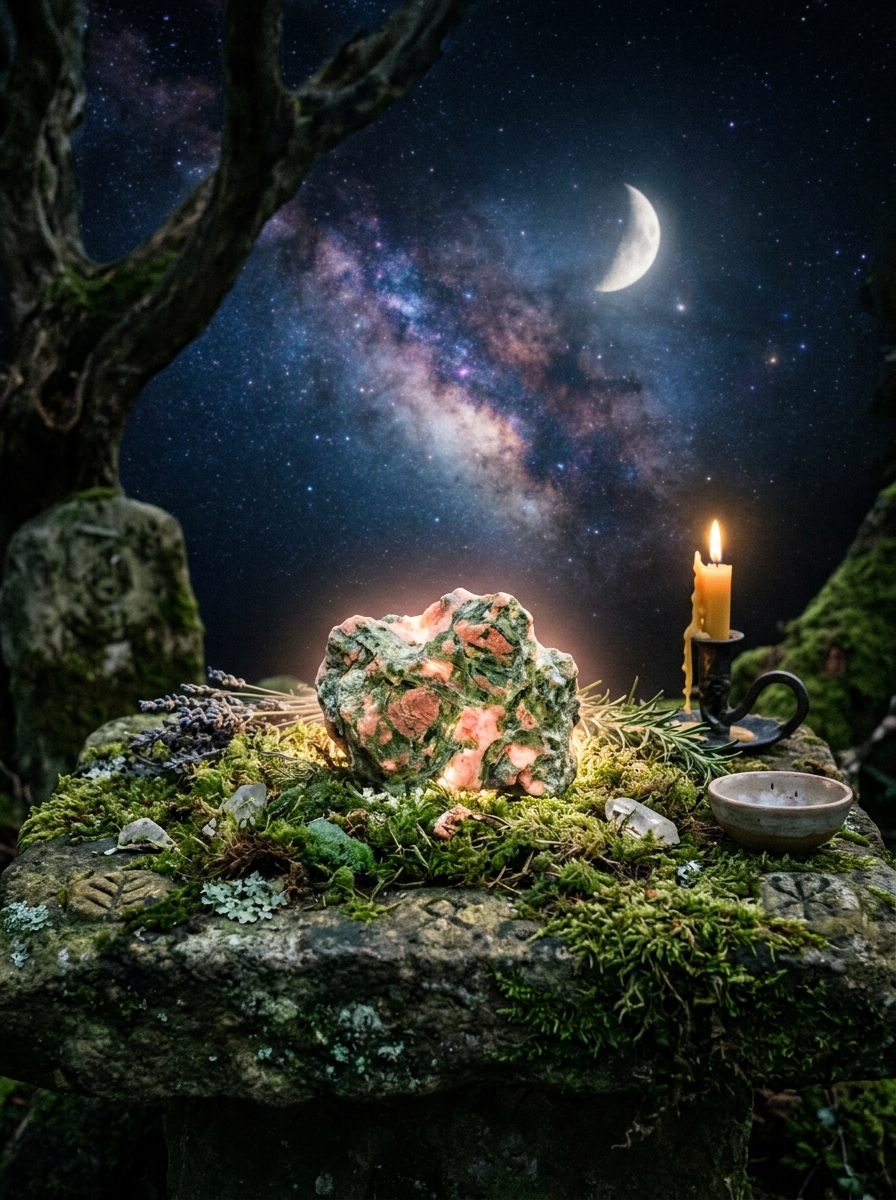
Unakite is a stone of integration: not bliss, not denial, but the difficult grace of letting feeling, memory, and intention occupy the same room. Its metaphysical meaning centers on emotional repair, heart-centered endurance, and the slow reassembly of what stress, grief, or self-protection has split apart. Green epidote and pink feldspar do not merely decorate one another; they model a psyche learning how to let tenderness and vitality coexist.
The Core Dynamic: Integration Without Erasure
Unakite is often called a heart stone, but that label softens its real work. Its gift is not uncomplicated comfort; it is emotional integration of the kind that reorganizes the self around its fractures rather than pretending they never happened. The stone tends to resonate with people recovering from overreaction, guardedness, resentment, or the numbness that follows too much feeling for too long.
In symbolic terms, the green-and-pink pattern matters. Green is the color of growth, recovery, and the heart chakra; pink softens green into receptivity, mercy, and relational trust. Unakite holds both tones in a single field, so its symbolism is less about choosing between strength and vulnerability than about discovering they are interdependent. That makes it a natural companion for contemplative work on the Sun sign, where identity can become rigid and needs to regain flexibility without dissolving the self.
This is not a stone of dramatic rupture. It works by accretion, making small acts of honesty feel survivable. It becomes relevant during long transitions: therapy, recovery, sobriety, breakup aftermath, caregiving burnout—any season in which the psyche must learn a new grammar for safety.
How Unakite Works on the Psyche: Regulation Through Gradual Unwinding
The healing reputation of unakite rests on its ability to help the heart tolerate complexity. Many stones associated with love emphasize attraction or emotional openness. Unakite is less interested in seduction than in repair. It asks: what if love begins where self-abandonment ends?
When people describe feeling “grounded” with unakite, they are usually sensing its earthy steadiness rather than any sudden energetic surge. The stone supports gradual unwinding: tightness around old memories, defensiveness in intimacy, a tendency to anticipate loss before it arrives. In that sense, its healing property is profoundly psychological. It can be used as a tactile reminder that the body does not need to remain in yesterday’s emergency.
Heart Chakra and Nervous System
Unakite is most commonly linked with the heart chakra, but not in the sentimental sense. It is heart work as regulation: the ability to stay present when feelings are layered, contradictory, or unfinished. The green component speaks to circulation, renewal, and relational balance; the pink component introduces compassion without indulgence. For people who live too long in the head, unakite can serve as a bridge downward into embodied feeling. For those who feel everything at once, it can serve as a stabilizer, making emotion legible instead of overwhelming.
This is one reason it fits so well with the symbolism of a sextile—not a crisis aspect but an opening, a usable line of flow between states that need to learn cooperation. If you are studying how planetary energies cooperate in a sextile aspect, unakite can anchor that work in the body rather than leaving it as abstraction.
Emotional Patterns and Repetition
Unakite is especially useful for reframing emotional repetition—replaying old roles in love, carrying inherited family moods, or mistaking familiarity for fate. The stone does not break such habits by force; it encourages a kinder form of self-observation. Its energy helps people who:
- apologize for having needs
- equate tenderness with weakness
- protect themselves by becoming unreadable
- keep trying to outwork pain instead of metabolizing it
These patterns live near the shadow of the heart: not lack of feeling, but feeling fenced off by fear. Unakite’s medicine is to make the fence visible, then negotiable.
Shadow and Mature Expression: From Guardedness to Relational Trust
The shadow side of unakite’s territory is not the stone itself—the stone is a tool—but the emotional architecture it helps reveal. Chronic self-criticism, the compulsion to perform competence, the habit of anticipating loss—these are the shadows that unakite’s green-pink steadiness can illuminate. In its mature expression, the stone supports a kind of relational trust that is not naive. It does not promise that people will stay or that wounds won’t reopen. It teaches that the heart can survive its own history.
Astrologically, unakite is commonly linked with Virgo and Scorpio. Virgo brings discernment, repair, and practical care; Scorpio adds depth, emotional honesty, and the courage to face what has been buried. Together they describe a stone uninterested in vague positivity. It wants truthful healing: patterns noticed and changed. If your chart contains a stellium, especially in an earth sign or house where intensity gets internalized and overmanaged, unakite can help prevent the self from becoming all function and no feeling. The stellium meaning page explores why some people need stones like this to restore emotional breathing room.
Because unakite is slow rather than flashy, it is a good match for people tired of spiritual intensity as performance. It favors coherence over catharsis. The mature expression of unakite work is not feeling better; it is being able to stay in the room with what is real.
Applications Across Life Arenas: Love, Work, Inner Work
Once the core dynamic is understood, it can be applied without re-explaining. In love, unakite helps the heart stop negotiating against itself—so that attachment is not confused with self-abandonment. In work, it steadies the nervous system during conflict or creative risk, especially when the astrological houses governing daily labor (6th) or public reputation (10th) are under stress. In inner work, it is a companion for meditation that does not demand visions; it simply asks that you sit with what is, for as long as it takes.
During periods of transition—moving, ending a chapter, reworking a family pattern—place unakite beside a written intention and return to it over several days. The stone responds to repetition. It is not about the dramatic declaration; it is about teaching the psyche a new pattern through contact. If that pattern involves growing beyond emotional habits that no longer serve your path, pairing unakite with a North Node intention practice can give direction to the repair.
Ritual Pairings and Cleansing
Unakite prefers clean, simple handling. Refresh it with moonlight, smoke, sound, or brief resting on a natural surface. Water is usually fine for polished pieces, but gentler methods are safer because the stone is a composite. In pairing work, unakite combines well with stones that clarify its heart-centered message. One useful pairing is with the Emperor and the Sun current—authority warmed by vitality, not hardened into control—as explored in The Emperor and The Sun Tarot Card Meaning.
Unakite’s magic is the magic of becoming internally consistent. It helps the heart stop negotiating against itself. That is its great contribution: not ecstasy, not escape, but the quieter miracle of being able to feel, remember, and choose from the same center. When used this way, the stone becomes less an accessory than a witness—a green-and-pink record of the fact that healing can be neither clean nor fast and still be real.
Related
- Amazonite Meaning & Healing Properties: The Stone of Clear Boundaries
- Rose Quartz Meaning: The Soft Power of the Heart Stone
- Peridot Meaning: The Green Fire of Renewal
- Agate Meaning & Healing Properties: Earth’s Quiet Architect
- Prehnite Meaning & Healing Properties: The Stone of Quiet Knowing
- Aventurine Meaning & Healing Properties: The Stone of Steady Luck
Comments
Loading comments…